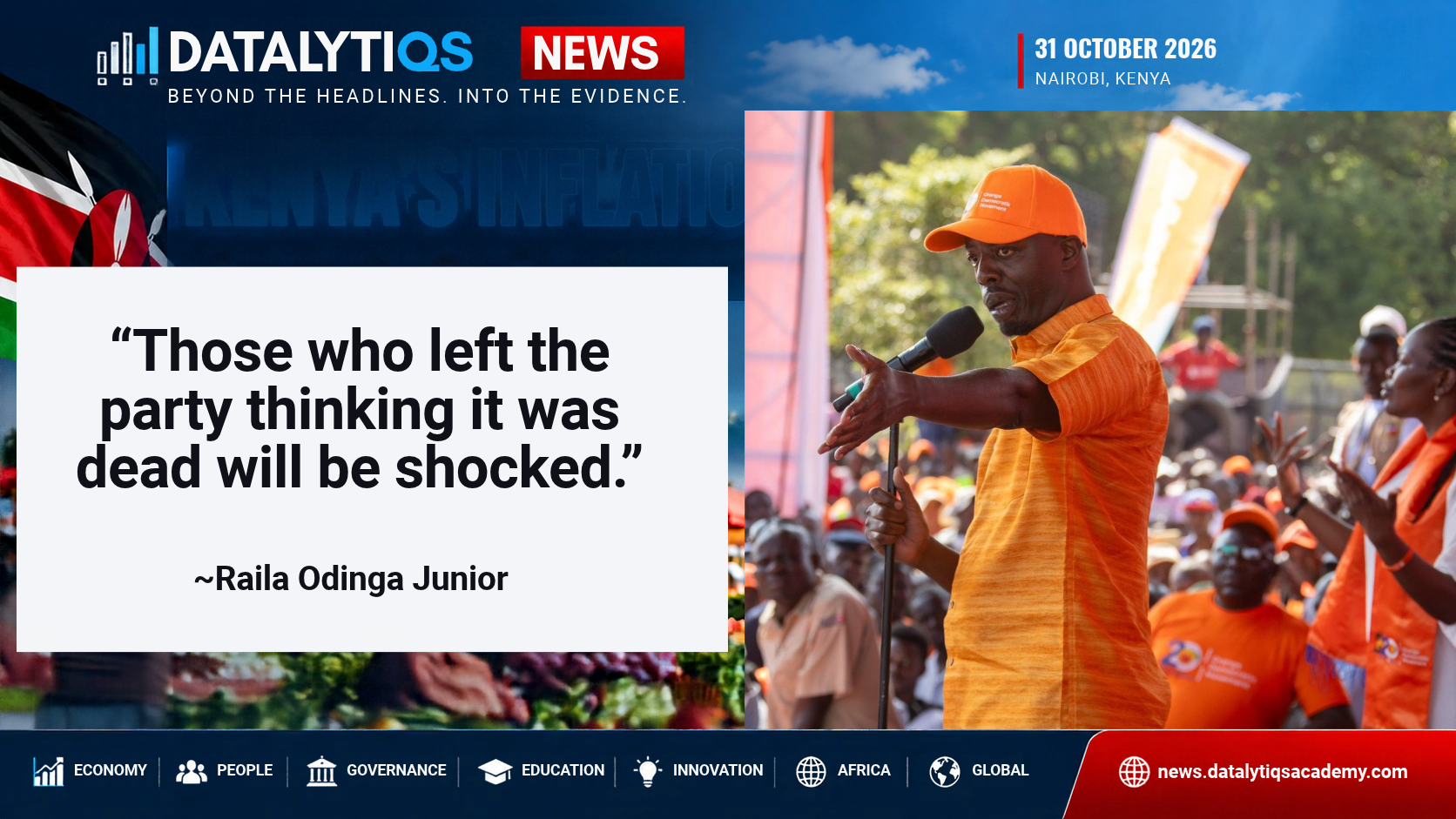
Raila Odinga Junior has defended his father’s political party against those questioning its future, declaring that ODM will continue competing for Nairobi’s elective seats. But his own ambition to represent Kibra raises questions about political inheritance, internal party democracy and the direction of ODM ahead of 2027.
NAIROBI, KENYA — 31 October 2026
Raila Odinga Junior has issued a warning to politicians who have abandoned the Orange Democratic Movement (ODM), insisting that the party founded by his late father, former Prime Minister Raila Odinga, remains politically active and intends to defend its electoral presence in Nairobi.
Speaking ahead of ODM’s October 31 Jacaranda Grounds rally, Junior dismissed suggestions that the party had lost its political relevance following Raila’s death.
“Nairobi was Baba’s bedroom, and those who left the party thinking it was dead will be shocked,” he declared.
He further maintained that ODM would continue contesting seats in the capital despite the departure of politicians who have chosen alternative political formations.
The remarks, reported by Daily Nation on October 30, came as ODM prepared to conclude its month-long Mwezi wa Baba commemorations.
They also followed Junior’s declaration that he intends to contest the Kibra parliamentary seat on an ODM ticket in the 2027 General Election.
His entry into elective politics introduces an important dimension to the party’s future: whether Raila Odinga’s political legacy will translate into a new generation of leadership through competitive party nominations and electoral contests.
Raila Junior Defends ODM’s Political Identity
Junior’s remarks form part of a series of public statements in which he has urged ODM members to remain within the party despite disagreements over its political direction.
During an October 18 engagement in Garissa, he argued that members should resolve disputes through internal dialogue rather than resigning.
He has also defended ODM’s national identity, describing it as a political organisation whose influence extends beyond individual communities.
Speaking in Turkana on October 23, Junior credited ODM with contributing to Kenya’s democratic development and the advancement of devolution.
These statements reflect his publicly declared commitment to preserving the organisation his father led for more than two decades.
However, his political position is not simply a call for institutional continuity.
Junior has also expressed support for President William Ruto’s re-election while maintaining that he will seek the Kibra parliamentary seat through ODM.
That position places him among politicians who support continued cooperation between ODM and the current administration.
It also distinguishes his approach from politicians who have questioned that cooperation and pursued alternative opposition platforms.
The Jacaranda Rally and Nairobi’s Political Contest
Junior’s latest remarks coincided with preparations for ODM’s Jacaranda Grounds rally on October 31.
The event marked the culmination of activities commemorating the first anniversary of Raila Odinga’s death.
ODM Nairobi chairman George Aladwa said the gathering was intended to strengthen party structures and communicate the organisation’s plans for 2027.
The rally attracted attention because Jacaranda Grounds had previously hosted a September gathering associated with the Linda Mwananchi initiative and politicians including Nairobi Senator Edwin Sifuna and Embakasi East MP Babu Owino.
Aladwa rejected suggestions that ODM’s event was designed to compete directly with that gathering.
Junior’s remarks nevertheless illustrate the wider disagreement over ODM’s political identity and the choices facing members who are dissatisfied with its current direction.
His reference to politicians who have left the party should be understood as a political criticism.
It does not establish that every politician associated with a competing movement has formally resigned from ODM.
Party membership and resignation are matters that require verification through official party records.
Why Kibra Matters to the Odinga Family
Junior’s declared parliamentary ambition gives his comments additional significance.
Kibra has a longstanding association with Raila Odinga’s political career.
Before constituency boundaries were revised, Raila represented the larger Lang’ata constituency from 1992 until 2013.
The constituency included areas that subsequently became part of the present-day Kibra constituency.
This historical connection explains why Junior’s decision to seek the Kibra seat has attracted attention.
He has publicly described the constituency as an important part of his father’s political history and has referred to his own involvement in political organisation within the area.
However, historical association does not establish an entitlement to elective office.
Kibra’s parliamentary representative must be determined through the applicable electoral process.
Similarly, ODM’s candidate must be selected in accordance with the party’s constitution, nomination rules and electoral law.
The distinction is central to evaluating Junior’s political ambitions.
His family background may explain public interest in his candidacy, but it cannot substitute for the legal and democratic requirements governing the constituency.
Junior Faces an Existing Political Field
The Kibra parliamentary contest is not beginning with a vacant political field.
Incumbent MP Peter Orero and former MP Imran Okoth have been identified in earlier reporting as political figures associated with the constituency’s emerging electoral competition.
Junior’s interest therefore introduces another potential aspirant into an already established political environment.
In August, Daily Nation reported on the developing contest involving Junior, Orero and Imran.
The report highlighted Junior’s engagement with community groups, elders and political organisers.
He has also spoken about education and bursary access as priorities he would pursue if elected.
These are relevant policy commitments that can be examined independently of his family background.
For example, an assessment of education support in Kibra could examine the constituency’s National Government Constituencies Development Fund allocations, bursary distribution procedures and documented education-related outcomes.
Such scrutiny would allow residents to compare aspirants’ proposals against identifiable public needs.
Raila Junior’s Meeting With Simba Arati
Junior’s political activities have extended beyond public rallies.
On October 27, he met ODM Deputy Party Leader and Kisii Governor Simba Arati alongside Nairobi party aspirants and grassroots representatives.
According to The Star, discussions focused on party unity, fair nominations and strengthening ODM’s organisational structures ahead of the 2027 elections.
The meeting is significant because it connects Junior’s individual parliamentary ambitions to wider questions about party administration.
Fair nominations require clear eligibility criteria, published procedures, impartial election officials and credible dispute-resolution mechanisms.
They also require consistency between the assurances given by party leaders and the processes ultimately implemented.
Junior’s participation in discussions about nomination fairness therefore creates a measurable institutional expectation.
The relevant question will be whether those principles are applied consistently when ODM begins selecting candidates.
The Political Legacy Question
Raila Odinga’s death has prompted debate about the future of ODM and the relationship between his family, the party and the broader political movement associated with his leadership.
In October, Daily Nation reported that commemorative activities organised by the Odinga family and ODM had developed along partly separate lines.
The reporting also highlighted differing political positions among family members.
Junior has reaffirmed his commitment to ODM and expressed support for continued cooperation with President Ruto.
His sister Winnie Odinga, who has declared interest in the Nairobi Senate seat, has appeared in political engagements associated with figures questioning the party’s present direction.
These differences illustrate an important distinction between family relationships and political institutions.
Members of the same family may hold different political positions.
Those positions do not automatically become binding decisions for a political party.
Likewise, a party’s constitutional leadership and nomination organs remain institutionally distinct from the relatives of its founder.
Raila’s historical influence is a matter of public record.
The future governance of ODM, however, must be assessed through its constitution, elected officials, internal procedures and decisions.
Does a Political Legacy Guarantee Electoral Support?
Junior’s warning that those who believed ODM was politically finished would be surprised is a statement of political confidence.
It is not an independently verified measurement of current electoral support.
ODM’s historical performance in Nairobi provides useful context, but past results cannot establish future outcomes.
Changes in political leadership, candidate selection, alliances and voter priorities can affect electoral behaviour.
Similarly, attendance at the Jacaranda rally demonstrates mobilisation around a particular event, not the voting intentions of Nairobi’s registered electorate.
Reliable assessment of current public support would require appropriately designed surveys, verified party membership data and other clearly defined indicators.
Even these measures have limitations and must be interpreted according to their dates, coverage and methodology.
The 2027 election results will ultimately establish the number of votes received by each candidate.
Until then, political claims about the strength or weakness of competing formations remain claims rather than electoral findings.
The Test of Internal Party Democracy
Junior’s declared ambition raises a practical question for ODM: how will the party select its Kibra parliamentary candidate?
The answer depends on the nomination framework formally adopted for the 2027 election.
Kenya’s legal framework requires political parties to conduct nominations in accordance with applicable legislation, regulations and their governing documents.
A credible process should establish candidate eligibility, the method of selection, membership requirements where relevant, nomination deadlines and dispute-resolution procedures.
These safeguards are especially important when an aspirant has a prominent political family background.
A fair process should neither confer an automatic advantage because of family association nor impose additional barriers on that basis.
All eligible aspirants should be assessed under the same published rules.
The party should also clarify how members can challenge alleged irregularities and obtain timely decisions.
Public confidence will depend on the transparency of the actual process.
Beyond the Odinga Name: What Does Kibra Need?
The political discussion surrounding Junior’s candidacy has focused heavily on his family background and ODM’s internal relationships.
However, Kibra residents also have substantive representation and service-delivery concerns.
These include education support, sanitation, housing conditions, employment opportunities, public safety and access to essential services.
Not every issue falls directly within the constitutional mandate of a Member of Parliament.
Some responsibilities belong to Nairobi City County, national government ministries or other public institutions.
An effective parliamentary candidate should therefore distinguish between legislative responsibilities, oversight functions, constituency-level development programmes and services delivered by other levels of government.
For education support, residents can examine the administration and outcomes of bursary programmes.
For housing and sanitation, they can assess the roles of county and national institutions and the relevant policy frameworks.
For employment and enterprise development, candidates can explain the legislative or oversight measures they propose rather than offering commitments outside their direct authority.
This approach would shift part of the electoral debate from political inheritance to measurable public representation.
DatalytIQs Political Intelligence Assessment
Junior’s remarks reveal several developments that warrant continued monitoring.
First, he is publicly aligning himself with ODM’s institutional continuity. His statements in Nairobi, Garissa and Turkana consistently emphasise remaining within the party and resolving disputes internally.
Second, his Kibra ambition creates a direct test of nomination fairness. The party’s eventual candidate-selection procedure will provide evidence of how its rules operate when prominent aspirants compete.
Third, his support for President Ruto is relevant to ODM’s wider political negotiations. However, Junior’s individual position should not be treated as a substitute for a formally approved party or coalition agreement.
Fourth, Raila Odinga’s political legacy remains a significant subject of public debate. Its meaning is being interpreted differently by family members, party officials and other political actors.
Finally, the needs of Kibra residents remain distinct from internal party disagreements. The constituency’s policy priorities should be evaluated through evidence about public services, institutional responsibilities and proposed legislative action.
These observations establish the relevant political and governance questions without determining the merits of any aspirant.
What Happens Next?
Several developments will provide clearer evidence of the direction of the Kibra contest.
ODM’s publication of its 2027 nomination timetable and rules will establish the procedures applicable to aspiring parliamentary candidates.
Formal declarations by Junior and other aspirants will clarify the composition of the contest.
The party’s treatment of nomination disputes will provide an opportunity to assess the transparency of its internal processes.
Junior’s policy proposals for Kibra can also be examined against the constituency’s development needs and the constitutional responsibilities of an MP.
At the wider party level, any formal decisions concerning cooperation with UDA should be assessed through documented agreements and resolutions rather than statements made at rallies.
Conclusion: ODM’s Future Cannot Be Settled by a Political Warning Alone
Raila Odinga Junior has delivered a clear message to politicians questioning ODM’s future: the party remains active, and he intends to help sustain its political presence.
His decision to seek the Kibra parliamentary seat adds a personal electoral dimension to that message.
Yet the issues extend beyond his ambitions.
ODM faces questions about internal democracy, political cooperation, organisational continuity and the relationship between its founder’s legacy and its present leadership.
For Kibra residents, the forthcoming contest also presents an opportunity to scrutinise competing proposals on education, public services and representation.
Junior’s warning may become a memorable statement in Nairobi’s political debate.
But the party’s institutional decisions and the choices made by voters will provide the evidence by which its future is assessed.
A political legacy can inspire a candidacy. It cannot replace a credible nomination process or the mandate of voters.
DatalytIQs News — Beyond the Headlines. Into the Evidence.
Sources and References
- Daily Nation — Mwezi wa Baba: Oburu expected to address ODM’s Jacaranda rally, 30 October 2026.
- The Star — Raila Junior, Simba Arati meet Nairobi ODM aspirants over party unity, 27 October 2026.
- The Star — Raila Junior warns ODM members against quitting party amid internal feuds, 18 October 2026.
- Daily Nation — Raila Junior’s Kibra bid rattles ODM MP Orero, Imran, 29 August 2026.
- Daily Nation — Odingas vs ODM: The silent battle over Raila’s legacy, 4 October 2026.
- People Daily — Sakaja, Raila Odinga Junior attend ODM’s mega rally at Jacaranda Grounds, 31 October 2026.