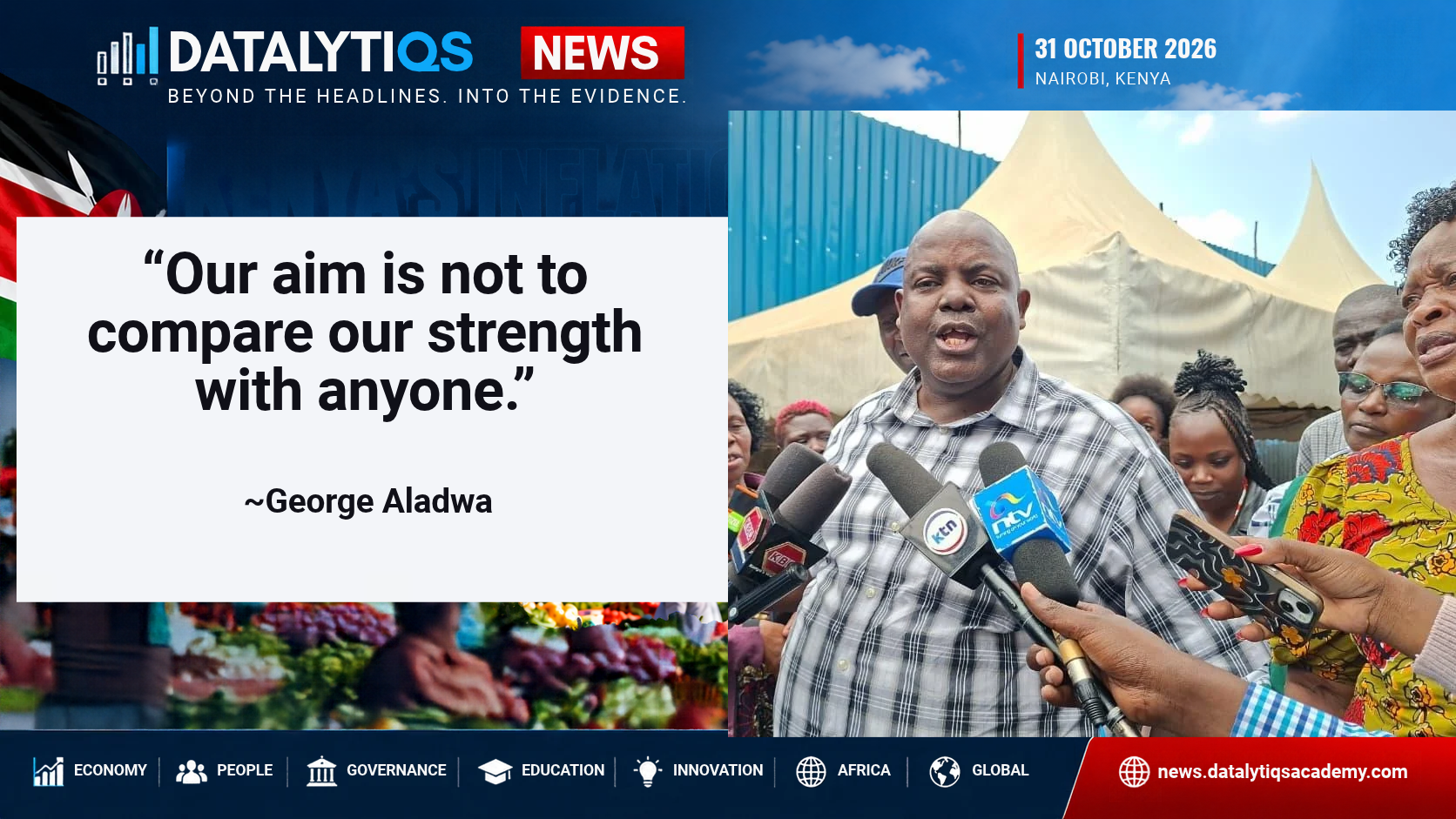
“Our aim is not to compare our strength with anyone,” says Makadara MP George Aladwa, insisting that ODM’s Jacaranda gathering is about honouring Raila Odinga, strengthening party structures and preparing for 2027. But the choice of venue has renewed scrutiny of the party’s relationship with Edwin Sifuna’s Linda Mwananchi initiative.
NAIROBI, KENYA — 31 October 2026
Nairobi ODM chairman and Makadara Member of Parliament George Aladwa has dismissed suggestions that the party’s Jacaranda Grounds rally was organised to demonstrate political superiority over Nairobi Senator Edwin Sifuna and the Linda Mwananchi initiative.
Speaking ahead of the October 31 gathering, Aladwa maintained that the Orange Democratic Movement was pursuing its own political programme, including strengthening grassroots structures and preparing for the 2027 General Election.
“Our aim is not to compare our strength with anyone,” Aladwa said, rejecting interpretations of the rally as a direct contest with Sifuna’s political associates.
His remarks come as ODM seeks to maintain its organisational presence in Nairobi following the death of its founding leader, Raila Odinga, while political disagreements over the party’s relationship with President William Ruto’s administration continue to attract national attention.
The Jacaranda gathering also marks the conclusion of Mwezi wa Baba, a month-long programme of commemorative activities honouring Raila’s political legacy.
Yet the rally’s location has become part of the political discussion.
Jacaranda Grounds previously hosted a Linda Mwananchi gathering on September 13, bringing together Sifuna, Embakasi East MP Babu Owino and other politicians associated with the initiative.
The decision by ODM to hold its own event at the same venue has prompted comparisons between the two political formations, despite Aladwa’s insistence that the party is not organising its activities around its rivals.
Aladwa: ODM Has Its Own Political Roadmap
In remarks reported by The Star on October 31, Aladwa said ODM intended to communicate directly with its supporters about the party’s political plans.
He explained that the party’s immediate objective was to consolidate its existing representation and organise for future electoral contests.
The Makadara legislator also described Nairobi as an established centre of ODM political activity.
His argument was that the party’s mobilisation programme should be understood within its broader institutional objectives rather than as a response to a single political movement.
This distinction is important.
Political parties routinely hold rallies to communicate policies, recruit supporters, strengthen constituency networks and prepare for elections.
A gathering may also serve symbolic purposes, particularly when commemorating an influential political figure.
However, the presence of competing political organisations within the same geographical area can create a perception of rivalry, even where organisers deny that competition is the primary purpose.
For ODM, the immediate challenge is to translate its public mobilisation into functioning party structures and a clearly communicated political programme.
Why Jacaranda Grounds Has Become Politically Significant
Jacaranda Grounds, located in Nairobi’s Embakasi East constituency, has become a prominent venue for political gatherings.
Its significance in the current debate arises partly from the September 13 Linda Mwananchi rally associated with Sifuna and Babu Owino.
The event drew public attention to the initiative’s political message and its association with politicians questioning aspects of ODM’s current direction.
ODM’s subsequent announcement that it would hold its October 31 rally at the same venue invited comparisons.
Some political commentators have interpreted the choice as an attempt to demonstrate that ODM retains a strong presence in Nairobi.
Party officials, however, have maintained that the event forms part of their own established programme.
Both observations can be reported without treating either interpretation as conclusively established.
The choice of venue creates a visible point of comparison, but it does not prove that the organisers selected it primarily to challenge Sifuna.
That would require evidence of their planning decisions or an explicit statement establishing such an objective.
Mwezi wa Baba: Commemoration Meets Electoral Preparation
ODM has presented the Jacaranda gathering as the culmination of activities commemorating the first anniversary of Raila Odinga’s death.
During October, party officials participated in events recognising his contribution to Kenya’s political history and the development of multiparty democracy.
The Nairobi rally was intended to bring together party leaders, delegates, elected representatives, aspirants and supporters.
At a press conference on October 30, Aladwa said preparations had been completed and that the party expected substantial attendance.
He also confirmed that the programme would provide an opportunity to discuss ODM’s political future.
The event therefore combines two identifiable objectives: commemorating Raila’s legacy and communicating the party’s plans ahead of 2027.
These objectives are not necessarily contradictory.
Political parties frequently use commemorative events to reinforce their organisational identity and articulate future priorities.
Nevertheless, the distinction between remembrance and electoral mobilisation is relevant when evaluating the messages delivered by party leaders.
The public-interest questions concern the policies, institutional decisions and commitments communicated during the gathering.
ODM’s Changing Political Environment
The Jacaranda rally takes place during a period of political realignment.
ODM’s cooperation with President William Ruto’s administration has generated differing positions among politicians associated with the party and its traditional opposition networks.
Some ODM leaders have supported continued cooperation and discussions concerning a possible formal political agreement with UDA.
Others have questioned the implications of that cooperation for ODM’s identity and its role in national politics.
Sifuna’s Linda Mwananchi initiative has emerged within this wider environment of disagreement and political reorganisation.
The movement’s public engagements with other opposition leaders have added another dimension to the political debate.
However, participation in joint rallies or political meetings does not, by itself, establish a binding coalition agreement.
Formal political arrangements require documented decisions through the relevant party institutions.
The same principle applies to ODM’s discussions with UDA.
Statements concerning possible future cooperation should be distinguished from agreements that have been formally negotiated, approved and published.
Nairobi’s Electoral History Provides Context, Not a Forecast
Nairobi has historically been important to ODM and the broader political coalitions associated with Raila Odinga.
In the 2022 presidential election, Raila received 767,395 votes in Nairobi County, compared with William Ruto’s 561,775 votes, according to figures cited in contemporary reporting.
The same reporting indicates that ODM secured eight of Nairobi’s 17 parliamentary seats, while other parties within the Azimio coalition also won constituencies.
These figures demonstrate the political significance of Nairobi in the previous electoral cycle.
They do not establish current party membership levels or predict how residents will vote in 2027.
The distinction is especially important because a presidential coalition’s vote total cannot automatically be attributed to one constituent political party.
Similarly, the electoral preferences of voters in 2022 cannot be assumed to remain unchanged five years later.
Changes in party leadership, candidate selection, coalition arrangements and local political issues may affect future electoral behaviour.
Any contemporary assessment of political support would require appropriately designed and dated evidence.
Can Rally Crowds Establish Political Strength?
The public debate surrounding Jacaranda has placed considerable attention on attendance.
Images of large gatherings can demonstrate that organisers mobilised participants and generated public interest.
They cannot, however, establish the proportion of registered voters supporting a political party.
Rally participants are self-selected rather than randomly sampled.
Attendance may be affected by publicity, transport, event timing, weather, the presence of prominent politicians and the availability of resources for mobilisation.
Some participants may attend gatherings organised by more than one political formation.
Others may support a party but be unable or unwilling to attend a rally.
Consequently, comparing photographs from the September Linda Mwananchi gathering and the October ODM event would not provide a statistically valid measure of electoral support.
Even a reliable count of participants would establish attendance at a particular event, not voting intentions across Nairobi County.
A more informative assessment would examine party membership, functioning constituency branches, candidate recruitment, nomination participation and representative public-opinion data.
Ultimately, official election results remain the authoritative measure of votes cast.
What Aladwa’s Statement Reveals About ODM’s Strategy
Aladwa’s rejection of a direct comparison with Sifuna is significant because it identifies the party’s stated organisational priorities.
Rather than describing Jacaranda as a contest between individual politicians, he has emphasised communication with supporters, retention of existing seats and expansion of ODM’s representation.
These objectives can be evaluated through subsequent actions.
For example, the party could demonstrate organisational development by publishing constituency-level leadership structures, membership procedures and plans for identifying candidates.
It could also provide a clear explanation of its policy priorities and the institutional process governing coalition negotiations.
Such information would make the party’s roadmap more measurable.
By contrast, statements about political strength remain difficult to evaluate when they are not accompanied by verifiable organisational evidence.
The same standards should apply to Linda Mwananchi and other political formations seeking public support.
Nomination Politics Could Become the More Consequential Contest
As the 2027 election approaches, party nominations will become an important test of internal organisation.
Nairobi contains 17 parliamentary constituencies, numerous county assembly wards and countywide elective positions.
Each presents distinct challenges involving candidate selection, membership eligibility and internal dispute resolution.
ODM leaders have indicated their intention to defend existing seats and contest additional positions.
Achieving those organisational objectives would require clear nomination rules, functioning party election bodies and credible procedures for handling disputes.
The Nairobi Senate contest has already attracted public declarations of interest from politicians including Lang’ata MP Phelix Odiwuor, popularly known as Jalang’o, and East African Legislative Assembly legislator Winnie Odinga.
Their potential participation illustrates why nomination arrangements matter.
Public expressions of interest do not determine who will receive a party ticket.
The relevant decisions must follow applicable law and the party’s duly adopted rules.
For ODM, transparent nominations would provide more substantive evidence of institutional organisation than comparisons between political rallies.
The Importance of Political Tolerance
The growing visibility of competing political formations also places attention on political tolerance.
In September, Aladwa publicly affirmed Linda Mwananchi’s right to organise a rally in Nairobi.
He said ODM had no intention of interfering with its activities and called for reciprocal respect.
The position is consistent with the constitutional protection of peaceful assembly and political participation.
Political competition can involve sharp disagreement over policies, leadership and coalition arrangements.
However, supporters of different parties should be able to organise and communicate their positions without intimidation or disruption.
Public authorities also have a responsibility to facilitate lawful gatherings impartially.
The fact that two political formations use the same venue on different dates does not create an exclusive political entitlement to that location.
Nairobi’s public spaces remain available for lawful civic and political activity, subject to applicable requirements.
DatalytIQs Political Intelligence Assessment
Aladwa’s statement presents an opportunity to distinguish political messaging from measurable organisational performance.
Four issues deserve particular attention.
First, the purpose of a rally should be established from organisers’ statements and documented activities. Although commentators may interpret Jacaranda as a political contest, ODM’s stated objectives include commemoration and grassroots mobilisation.
Second, crowd attendance is an incomplete indicator of political support. Event participation demonstrates mobilisation at a particular time and place, not representative voter preferences.
Third, party organisation can be measured more directly. Verified membership records, constituency branches, candidate-selection procedures and documented party resolutions provide stronger evidence of institutional development.
Fourth, coalition relationships require formal verification. Political meetings and public declarations should not be confused with completed agreements or legally established changes in party affiliation.
These considerations do not determine which political formation has greater support.
They establish a framework for examining the competing claims through evidence.
What Should Be Monitored After Jacaranda?
The most important follow-up concerns the substance of the rally.
Any official resolutions should be examined to determine whether ODM adopted new policies, organisational decisions or positions concerning the 2027 elections.
Statements by senior party leaders should be assessed against previously announced commitments.
Further reporting should establish whether the party publishes a constituency-level mobilisation plan, updates its nomination procedures or clarifies its position on cooperation with UDA.
The participation of elected representatives and aspirants may provide information about political relationships, but attendance alone should not be treated as proof of formal allegiance.
Similarly, any reported crowd figures should identify their source and methodology.
Without independently verified counting procedures, estimates should remain attributed rather than presented as established measurements.
Conclusion: Jacaranda Is a Political Stage, Not an Electoral Verdict
George Aladwa has rejected the suggestion that ODM organised its October 31 Jacaranda rally to compete directly with Edwin Sifuna’s Linda Mwananchi initiative.
His stated position is that ODM is pursuing its own programme of commemoration, grassroots consolidation and electoral preparation.
The choice of Jacaranda Grounds has nevertheless attracted comparisons because the venue hosted a Linda Mwananchi gathering in September.
Those comparisons may shape political commentary, but they do not establish the motives of organisers or the electoral preferences of Nairobi residents.
The more consequential developments will emerge through party decisions, coalition agreements, constituency organisation and nomination procedures.
A rally can demonstrate the ability to mobilise a crowd. It cannot, on its own, establish an electoral mandate.
For Nairobi voters, the more substantive questions concern what political organisations propose, how they select their candidates and whether they can be held accountable for their commitments.
DatalytIQs News — Beyond the Headlines. Into the Evidence.
Sources and References
- The Star — ODM seeks to prove political might in Nairobi with rally after Linda Mwananchi show, 31 October 2026.
- The Star — ODM to cap Raila commemorations with Jacaranda mega rally, 30 October 2026.
- People Daily — Sakaja, Raila Odinga Junior attend ODM’s Jacaranda rally, 31 October 2026.
- Daily Nation — ODM says it will not interfere with Linda Mwananchi rally, 11 September 2026.
- People Daily — ODM announces Jacaranda rally as Nairobi political debate intensifies, 17 October 2026.