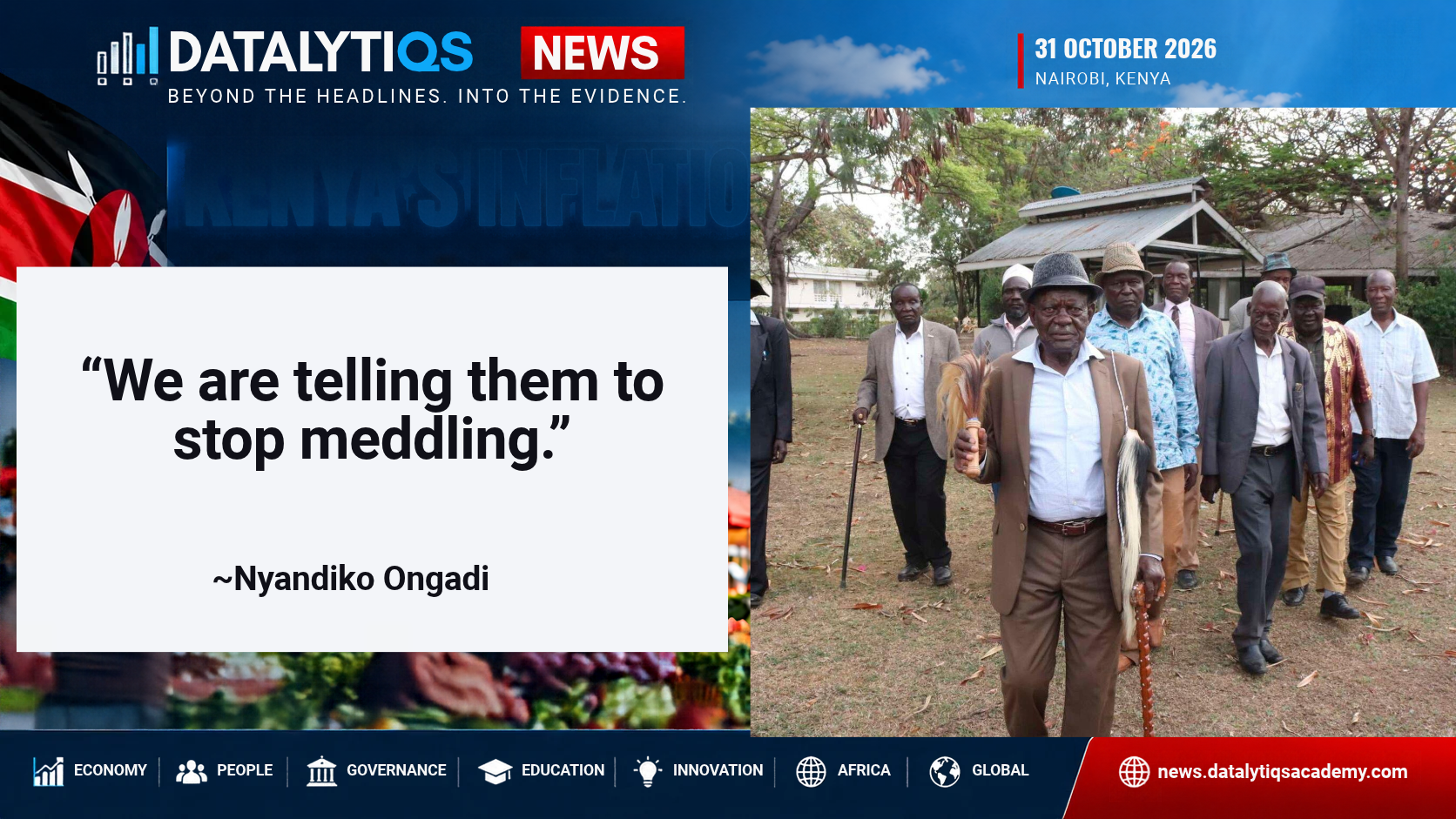
Nyandiko Ongadi has accused unnamed politicians from Nyanza of interfering with the Luo Council of Elders, warning that political influence is undermining efforts to reunite the cultural institution. But a decade-long dispute involving rival leader Odungi Randa raises deeper questions about legal recognition, succession, cultural authority and the council’s independence.
HOMA BAY, KENYA — 31 October 2026
A fresh confrontation between cultural leadership and political influence has emerged in Nyanza after Nyandiko Ongadi, one of two rival claimants to the leadership of the Luo Council of Elders, accused politicians of perpetuating divisions within the institution.
Speaking during a meeting at Alaw Rachuonyo Ground in Karachuonyo constituency, Homa Bay County, on October 26, Ongadi warned political leaders from Kisumu, Homa Bay, Siaya and Migori counties against interfering with the council’s internal affairs.
He alleged that some politicians had encouraged rival leadership arrangements and contributed to disagreements that have persisted for more than a decade.
The accusation was direct.
“We know political leaders in Kisumu, Homa Bay, Siaya and Migori counties who have continued to split elders in the council. But we are telling them to stop meddling with the council’s affairs before we expose them.”
Ongadi did not publicly identify the politicians he accused or present independently verifiable evidence establishing their involvement.
His allegations therefore remain unproven.
Nevertheless, the remarks have renewed attention on an unresolved leadership dispute involving Ongadi and Odungi Randa, both of whom claim the position of Ker, the traditional head of the Luo Council of Elders.
The controversy extends beyond a disagreement between two individuals. It raises questions about who possesses legitimate authority to lead the institution, how cultural leadership should be determined and whether political associations have compromised the council’s independence.
A Decade of Rival Leadership Claims
The current dispute traces its origins to the period following the death of former council leader Riaga Ogalo in August 2015.
Ongadi maintains that he was selected to succeed Ogalo and that his claim is supported by the council’s registration documents.
However, a separate leadership line had emerged around Willis Opiyo Otondi, who was installed as Ker in 2010.
Following Otondi’s death in February 2023, another succession process culminated in the selection of Odungi Randa during the Piny Luo Festival in Homa Bay in July 2023.
Randa was subsequently installed at Ofafa Memorial Hall in Kisumu in December 2023.
Ongadi’s faction disputed that process and continued to maintain that he was the lawful chairman.
The result has been two competing leadership structures, each asserting authority over an institution traditionally associated with cultural preservation, community unity and dispute mediation.
Both factions have attracted support from elders within the Luo community.
The persistence of parallel leadership claims has complicated efforts to establish a single recognised institutional voice.
Ongadi: The Council Cannot Have Two Chairmen
At the Karachuonyo meeting, Ongadi insisted that the council’s constitution provides a framework for selecting its leadership.
He argued that the existence of rival claimants was inconsistent with the institution’s governing arrangements.
Ongadi said he possesses the council’s official registration certificate and maintained that the documents support his position.
However, possession of registration documents is not, by itself, sufficient to conclusively determine every question concerning leadership succession.
A complete legal assessment would need to establish the identity of the registered organisation, its constitution, the officeholders recorded with the relevant registrar, the validity of subsequent elections and any applicable court orders.
These documents would also need to be examined together rather than selectively.
The central question is whether the procedures through which the rival claimants assumed office complied with the governing rules of the institution.
Until the relevant records and legal determinations are comprehensively examined, the competing claims should not be presented as conclusively resolved.
Randa’s Position: Leadership Must Reflect the Elders’ Decision
Odungi Randa has previously rejected Ongadi’s claim to exclusive leadership.
In an August 31 report by Daily Nation, Randa defended his selection in 2023, arguing that elders had considered regional representation and the history of leadership appointments.
He maintained that his election followed deliberations among elders and that the institution needed leadership reflecting broader geographical representation.
Randa also disputed Ongadi’s reliance on possession of the council’s documents.
He accused his rival of wrongfully holding those records, an allegation that likewise requires independent verification.
Importantly, Randa has expressed support for reconciliation discussions while maintaining that he is the legitimate Ker.
His position demonstrates why appeals for unity have not automatically produced agreement.
Both factions have expressed an interest in reconciliation, but neither has publicly relinquished its leadership claim.
Any durable settlement would therefore need to address the underlying questions of legitimacy, representation and institutional procedure.
The Political Interference Allegations
Ongadi’s latest accusations focus on what he describes as the involvement of political leaders in the council’s internal disputes.
He alleges that politicians have supported preferred elders and contributed to the establishment of rival leadership arrangements.
Other elders attending the Karachuonyo meeting expressed similar concerns.
Owuor Akede argued that cultural leadership should remain separate from partisan political competition.
John Maji warned that elders who become closely associated with political parties may compromise their ability to mediate disputes involving people with different political affiliations.
Their concerns raise a substantive governance issue.
Traditional elders may participate in civic affairs and engage with elected officials. Such engagement does not automatically amount to improper interference.
The accountability question is whether political actors have attempted to determine cultural leadership outcomes through influence, pressure or procedures inconsistent with the council’s constitution.
That distinction matters.
A politician attending a cultural ceremony is not necessarily interfering with the institution.
Similarly, an elder expressing a political opinion does not automatically establish institutional capture.
Evidence of improper interference would require examination of specific actions, decisions and their effects on the council’s internal processes.
Without that evidence, allegations against unnamed politicians should remain clearly attributed.
The Historical Relationship Between Politics and Luo Cultural Leadership
The relationship between Luo cultural institutions and political leadership has a long history.
Jaramogi Oginga Odinga served as the inaugural Ker of the Luo Council of Elders between 1952 and 1957 before pursuing a national political career.
The council has subsequently maintained connections with influential political and community figures.
Former Prime Minister Raila Odinga also participated in events involving the council.
In May 2023, The Star reported that Raila attended discussions concerning succession following Otondi’s death.
The same reporting recorded objections from elders associated with Ongadi, who questioned the involvement of politicians in the succession process.
In July 2023, Raila attended the cultural festival at which Randa was installed and publicly supported his leadership.
These documented historical engagements provide context for the current dispute.
They do not, on their own, establish that any politician unlawfully interfered with the council’s leadership.
The relevant distinction is between participation in cultural affairs and actions that violate the institution’s legally applicable governance procedures.
The Legal Dimension: Registration, Constitution and Court Proceedings
The dispute has also reached the courts.
A High Court judgment dated September 19, 2025, in litigation involving Ongadi and other petitioners addressed applications arising from the council’s leadership dispute and earlier court orders.
The proceedings concerned, among other matters, a July 4, 2023, status quo order and allegations that subsequent events involving Randa’s installation breached that order.
The existence of those proceedings is significant because the dispute cannot be assessed solely through public statements or possession of documents.
A proper legal examination requires the operative court orders, the full judgment, any subsequent appeals or rulings, and the council’s current registration records.
A temporary status quo order should not automatically be interpreted as a final determination of leadership legitimacy.
Similarly, the existence of a contempt application does not establish that contempt was proved.
The exact findings and current legal position must be established from the relevant court records.
The September 2025 judgment is an important documentary source, but it should not be presented as conclusive evidence of the council’s current leadership without examining its operative orders and any subsequent developments.
Can the Registrar of Societies Resolve the Dispute?
Ongadi’s reliance on the council’s registration certificate places particular attention on the Registrar of Societies.
Where an organisation is registered under the Societies Act, its official records may help establish its registered identity, constitution, officeholders and submitted changes.
However, the evidentiary value of a certificate depends on what it actually certifies.
A certificate establishing that an organisation is registered does not necessarily settle every later dispute concerning the validity of an election or succession.
For the Luo Council of Elders, the most useful records would include the current registered constitution, amendments, annual returns, notices of changes in officeholders and relevant correspondence concerning disputed appointments.
The legal status of each rival faction would also need clarification.
Do both claim to represent the same registered society?
Have either of the factions established separate legal entities?
Were leadership changes submitted to the registrar, and were they accepted or disputed?
What effect, if any, have court proceedings had on those records?
Answers to these questions would provide a firmer foundation for assessing the rival claims.
Why the Constitution Matters More Than Public Endorsements
A cultural organisation’s constitution establishes its internal governance arrangements.
It may specify the qualifications required for leadership, the method of selection, terms of office, voting rights and procedures for resolving disputes.
It may also provide rules concerning removal, succession and the convening of meetings.
For the Luo Council of Elders, these provisions are central to determining whether the processes that produced Ongadi’s and Randa’s competing claims were valid.
Public endorsement by prominent individuals cannot automatically replace constitutional procedures.
Neither can the size of a gathering conclusively determine legal authority.
A meeting attended by hundreds of elders may demonstrate substantial support for a particular position.
However, its constitutional significance depends on whether the participants were entitled to make the relevant decision, whether the meeting was properly convened and whether the prescribed procedures were followed.
The legitimacy of leadership therefore requires examination of both the applicable rules and the evidence that those rules were observed.
The September Reconciliation Effort
The latest disagreement follows earlier attempts to reconcile the rival factions.
On September 1, the Kenya News Agency reported that the groups had agreed to pursue a memorandum of understanding intended to end their longstanding rivalry.
Ongadi publicly appealed for unity, while Randa welcomed dialogue but maintained his leadership claim.
The development suggested a willingness to explore reconciliation.
However, agreement to discuss reconciliation is not the same as resolving the dispute.
A meaningful settlement would need to clarify the status of the competing leadership claims, establish mutually accepted procedures and determine how the institution would operate thereafter.
The October 26 meeting demonstrates that significant disagreements remain.
It does not, by itself, establish that all reconciliation efforts have failed.
The current status of any memorandum, negotiating committee or formal settlement requires further verification.
What Is at Stake for the Luo Community?
The Luo Council of Elders has historically been associated with the preservation of cultural practices, promotion of community cohesion and mediation of disputes.
Its credibility depends partly on public confidence that its leaders can act impartially.
Prolonged leadership disagreements can make it difficult for the institution to present consistent positions on cultural matters.
They may also create uncertainty about who is authorised to represent the council at public functions, enter agreements or speak on behalf of its members.
The consequences extend beyond ceremonial leadership.
Traditional institutions can provide forums for intergenerational dialogue, preservation of oral history, community mediation and engagement on cultural heritage.
Where rival groups claim the same authority, their ability to perform these functions may be affected.
However, the extent of any actual disruption should be established through evidence rather than assumed from the existence of leadership disputes.
DatalytIQs Political Intelligence Assessment
The current dispute presents four principal questions.
First, who holds legally recognised institutional authority? This requires verification of the council’s registered constitution, official records, valid leadership procedures and applicable court orders.
Second, what evidence supports the allegations of political interference? Public accusations should be tested against identifiable actions, records and responses from those accused.
Third, can reconciliation address the underlying legitimacy dispute? A durable agreement must clarify leadership, decision-making authority and the procedures governing future succession.
Fourth, how can the council preserve its independence while engaging with elected leaders? Cultural institutions may interact with political authorities, but clear governance arrangements can help distinguish legitimate cooperation from improper influence.
These questions should be examined without assuming that either faction’s claims have already been conclusively established.
What Should Happen Next?
The most immediate requirement is documentary transparency.
The council’s governing constitution and relevant registration records should be made available for examination through lawful procedures.
The rival factions should clarify the basis of their respective leadership claims and identify the decisions they consider legally valid.
Any outstanding court proceedings should be followed through their official records.
If reconciliation discussions continue, the parties should clarify whether they have agreed on a mediation framework, who represents each side and what procedures will govern any settlement.
Allegations of political interference should also be supported by specific evidence.
Where individuals are identified, they should have an opportunity to respond.
These steps would not automatically resolve every disagreement, but they would establish a more reliable basis for public understanding.
Conclusion: Cultural Authority Must Be Established Through Legitimate Procedures
Nyandiko Ongadi’s warning has renewed scrutiny of the Luo Council of Elders’ longstanding leadership dispute.
His accusation that politicians are interfering with the institution is serious, but the available reporting does not independently establish the wrongdoing alleged.
At the same time, the competing claims of Ongadi and Odungi Randa cannot be resolved simply by repeating their public positions.
The decisive evidence lies in the council’s governing documents, valid leadership procedures, official registration records and applicable court determinations.
Reconciliation remains a possible path, but it must address the institutional causes of disagreement rather than merely produce another public declaration of unity.
A council entrusted with preserving cultural authority must be able to demonstrate the legitimacy of its own leadership.
For the Luo Council of Elders, the question is not only who should occupy the office of Ker, but how that office can retain credibility, independence and the confidence of the community it seeks to serve.
DatalytIQs News — Beyond the Headlines. Into the Evidence.
Sources and References
- The Star — Luo elders accuse politicians of fuelling leadership wrangles, demand unity, 26 October 2026.
- The Standard — Politicians told to stop polarising the Luo Council of Elders, 27 October 2026.
- Daily Nation — Luo elders’ power struggle deepens, 31 August 2026.
- The Star — Luo Council of Elders enter into a truce, 1 September 2026.
- The Star — Wrangles loom over Luo Council of Elders succession, 30 May 2023.
- Kenya Law — Ongadi & 8 Others, High Court judgment dated 19 September 2025, concerning litigation over the Luo Council of Elders’ leadership and related court orders.