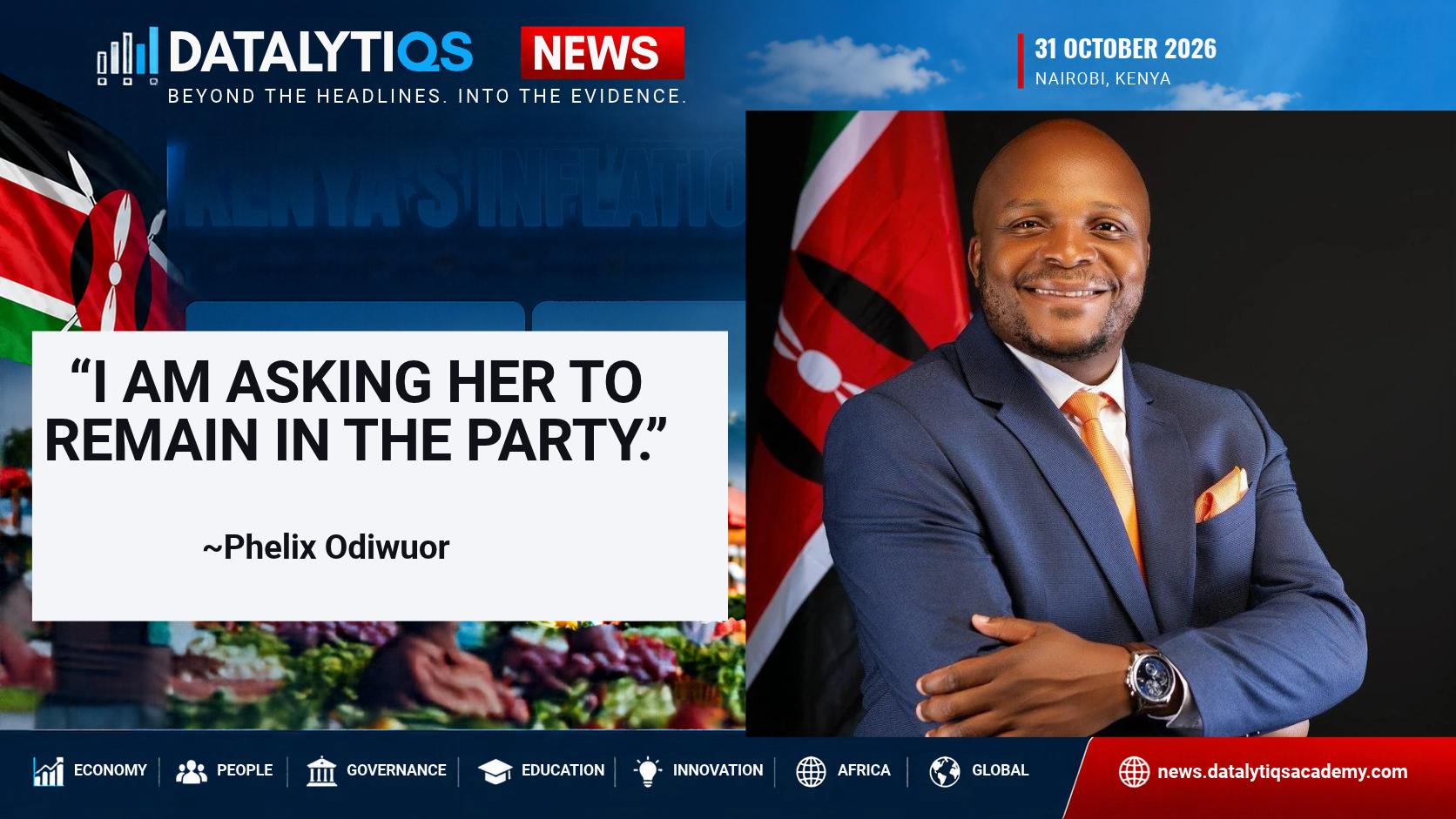
Lang’ata MP Phelix Odiwuor has urged Winnie Odinga to remain in ODM and contest the party’s Nairobi Senate nomination. But beyond their competing ambitions lies a larger question: can the party guarantee transparent nominations amid disagreements over its political direction ahead of 2027?
NAIROBI, KENYA — 31 October 2026
Lang’ata Member of Parliament Phelix Odiwuor, popularly known as Jalang’o, has challenged East African Legislative Assembly legislator Winnie Odinga to remain in the Orange Democratic Movement (ODM) and compete against him for the party’s Nairobi Senate nomination ahead of the 2027 General Election.
Speaking during an ODM delegates’ meeting at the Co-operative University of Kenya on October 25, Jalang’o urged Winnie not to abandon the party as competing political formations seek to consolidate their positions in Nairobi.
The remarks, reported by Daily Nation on October 26, followed Winnie’s announcement that she intends to contest the Nairobi senatorial seat.
Jalang’o’s invitation comes amid disagreements within ODM over its relationship with President William Ruto’s administration, the emerging Linda Mwananchi political initiative associated with Nairobi Senator Edwin Sifuna, and the future direction of the party following the death of its founding leader, Raila Odinga.
What initially appears to be a contest between two prominent political personalities is therefore developing into a wider examination of party loyalty, nomination credibility and internal democracy.
Jalang’o: Let Us Face Each Other in ODM
Addressing party delegates, Jalang’o acknowledged Winnie’s intention to contest the Nairobi Senate seat and invited her to participate in ODM’s internal nomination process.
He urged her to remain within the party rather than pursue her political ambitions through another formation.
His message was that the Senate ticket should be contested through ODM’s established nomination structures.
The remarks also reinforced his own intention to seek the seat.
Earlier, on October 16, Jalang’o welcomed Winnie’s entry into the contest, describing it as an important development in an increasingly competitive race.
He said her participation had not changed his political ambitions and committed to supporting whoever secures the ODM nomination if he does not emerge as the candidate.
That undertaking introduces an important test of political consistency: whether aspirants who publicly commit to accepting nomination outcomes will honour that position when the process concludes.
However, such commitments can only be meaningfully evaluated once the party publishes its nomination rules, conducts the selection process and resolves any disputes.
Winnie Odinga’s Nairobi Senate Ambition
Winnie publicly declared her intention to contest the Nairobi Senate seat during commemorations marking the first anniversary of her father Raila Odinga’s death at Migwena Grounds in Bondo, Siaya County, on October 15.
Her announcement attracted attention because she linked her political plans to the possibility of Edwin Sifuna seeking a different elective office.
She also emphasised her intention to pursue political leadership alongside young people.
However, her announcement did not conclusively establish the political party through which she would contest the election.
That distinction is central to Jalang’o’s challenge.
An intention to seek elective office is not equivalent to obtaining a political party nomination.
For Winnie to contest through ODM, she would need to meet the applicable membership, eligibility and nomination requirements.
Alternatively, she could pursue another legally available electoral route, subject to the relevant rules and deadlines.
As of the reporting reviewed, no final ODM nominee for the Nairobi Senate seat had been established.
The Odinga Family’s Different Political Positions
The contest has attracted further attention because members of Raila Odinga’s family have expressed different positions concerning Nairobi’s emerging political competition.
Raila Odinga Junior has publicly supported Jalang’o’s Senate ambition while acknowledging Winnie’s right to contest.
He has also urged her to pursue her political ambitions through ODM.
Winnie’s association with politicians involved in Linda Mwananchi has generated discussion about her future political affiliation.
However, appearing alongside politicians associated with a particular movement does not automatically establish formal party membership, resignation from another party or a binding electoral agreement.
Those matters require verification through party records and official declarations.
The differing positions within the Odinga family should not be confused with a formal institutional decision by ODM.
The party’s nominee must ultimately be determined through its legally recognised procedures.
Nairobi’s Senate Race Is Becoming Crowded
The contest extends beyond Jalang’o and Winnie.
According to reporting by The Star and Daily Nation, other individuals who have expressed interest in the Nairobi Senate seat include nominated Senator Crystal Asige, musician KRG The Don, lawyer Cecil Miller, former Makadara MP Reuben Ndolo and other political aspirants.
Their participation reflects the growing interest in the seat currently held by Edwin Sifuna.
However, the field of declared aspirants is not necessarily the same as the final list of candidates who will appear on the ballot in 2027.
Some aspirants may seek different party tickets, withdraw, enter coalition arrangements or fail to satisfy nomination requirements.
The final candidate list will depend on party nominations, applicable electoral rules and clearance by the Independent Electoral and Boundaries Commission.
The immediate contest is therefore as much about political organisation and party affiliation as it is about individual declarations.
ODM Leaders Promise Fair Nominations
Jalang’o’s remarks came during a delegates’ meeting at which ODM officials addressed concerns about internal party democracy.
Kisii Governor and ODM Deputy Party Leader Simba Arati assured delegates that the party intended to conduct fair nominations and that tickets would be issued after the prescribed process.
Makadara MP and Nairobi ODM chairman George Aladwa similarly warned against irregular candidate selection.
The statements are significant because contested nominations have historically been a source of disputes within Kenyan political parties.
A credible nomination process requires more than assurances from party officials.
It requires published rules, transparent eligibility criteria, a reliable membership register, consistent treatment of aspirants and an accessible mechanism for resolving complaints.
These safeguards become particularly important when influential politicians compete for the same ticket.
The party’s ability to demonstrate procedural fairness will be assessed through its actual nomination arrangements, not merely its public commitments.
What Do ODM’s Nomination Rules Require?
Kenyan political party nominations operate within a statutory and regulatory framework.
The Elections Act, Political Parties Act and Elections (Party Primaries and Party Lists) Regulations establish requirements concerning nomination procedures, candidate selection and dispute resolution.
The regulations provide that party primaries should be democratic, transparent, accountable, inclusive and peaceful.
They also recognise party members’ rights to access information relating to nomination rules, election boards, membership registers and party constitutions.
ODM’s published nomination rules provide for the involvement of party organs, including the National Elections Board, in organising candidate selection.
The rules also address candidate vetting and the procedures governing nominations for elective positions, including the Senate.
However, the precise procedures applicable to the 2027 Nairobi Senate nomination must be established from the current, duly certified rules and any lawful amendments.
An older version of the party’s rules should not automatically be treated as the definitive framework for the forthcoming contest.
The Membership Register Could Become a Central Issue
If ODM conducts a competitive nomination involving registered party members, the accuracy of its membership register will be fundamental.
The party will need to establish who qualifies to participate, the relevant membership cut-off dates and how eligibility will be verified.
A credible process must also address duplicate records, disputed registrations, changes in membership and access to the register under applicable legal safeguards.
These are not minor administrative questions.
A contested register can generate disagreements about who was entitled to vote and whether the nomination outcome reflects the choices of eligible participants.
For Nairobi, the challenge is especially important because the county contains numerous constituencies and wards with different organisational structures.
A transparent nomination exercise should therefore identify the eligible electorate and apply the same rules consistently across participating areas.
No verified evidence reviewed for this report establishes that ODM’s Nairobi Senate membership register is currently defective. The issue is an accountability requirement that should be examined before nominations.
Direct Ticket, Consensus or Competitive Primary?
Another important question concerns the method ODM will use to select its Senate candidate.
Kenyan electoral regulations allow political parties to establish different nomination methods, subject to their constitutions and applicable law.
These may include competitive primaries and non-competitive procedures, such as consensus or direct nominations, where permitted by the party’s duly adopted rules.
Consequently, Jalang’o’s invitation to Winnie to face him in party primaries is a political proposal rather than proof that ODM has already formally selected a particular nomination method.
The party must clarify whether the Nairobi Senate ticket will be determined through a vote, consensus arrangement or another legally permissible procedure.
That decision should be communicated before aspirants commit resources and before members are asked to participate.
Any departure from published rules would require careful legal scrutiny.
What Happens if an Aspirant Disputes the Result?
A credible nomination framework must provide a mechanism for handling complaints.
Disputes may arise over candidate eligibility, the membership register, voting procedures, counting, tallying or alleged irregularities.
Political parties are expected to maintain internal dispute-resolution mechanisms.
The Political Parties Disputes Tribunal also plays a statutory role in resolving disputes falling within its jurisdiction, subject to applicable procedural requirements.
For the Nairobi Senate contest, aspirants should know the complaint-filing procedures, deadlines, responsible bodies and available avenues for review.
A nomination process that produces a declared candidate without resolving legitimate procedural complaints risks undermining confidence among party members.
Conversely, transparent and timely dispute resolution can help establish confidence even where the outcome is closely contested.
The Broader Political Divide Within ODM
The proposed contest cannot be separated from ODM’s changing political environment.
Some party leaders support continued cooperation with President Ruto’s administration and have advocated formal arrangements concerning the 2027 elections.
Other political figures associated with ODM’s traditional opposition constituency have questioned that direction.
Linda Mwananchi’s emergence has added another organisational dimension to these disagreements.
Jalang’o has publicly identified himself as both an ODM member and a participant in the broad-based government arrangement.
Winnie’s political engagements have included figures associated with a different approach to opposition politics.
These differences help explain why their potential nomination contest has attracted attention beyond Nairobi.
Nevertheless, their political associations should not be used as substitutes for formal membership records or documented party decisions.
The critical institutional question is whether ODM can apply its nomination rules consistently to eligible aspirants despite their differing political relationships.
DatalytIQs Political Intelligence Assessment
The Jalang’o–Winnie exchange raises four substantive issues.
First, party loyalty and candidate eligibility are distinct questions. Political leaders may publicly appeal for loyalty, but eligibility for a party ticket must be determined through the party’s constitution, nomination rules and applicable electoral law.
Second, the nomination method must be established in advance. Aspirants and members should know whether the Senate candidate will be selected through a competitive primary, consensus or another permitted procedure.
Third, membership data are central to electoral integrity. Where registered members participate in candidate selection, the register must be accurate, accessible through lawful procedures and consistently applied.
Fourth, dispute resolution is an essential component of internal democracy. Aspirants should have a clear mechanism for challenging procedural irregularities without relying on informal political intervention.
The public statements made by Jalang’o, Winnie and other ODM leaders establish their declared political positions.
They do not establish the outcome of a future nomination or demonstrate that any aspirant has already secured the party ticket.
What DatalytIQs News Will Monitor
The next developments requiring scrutiny include ODM’s officially certified 2027 nomination rules, the announcement of the Nairobi Senate nomination method, candidate eligibility requirements and the timetable for aspirant applications.
Winnie’s formal decision concerning her party affiliation will also be relevant.
Further attention should be paid to the membership register, the composition and independence of the party’s election bodies, and the procedures for resolving nomination disputes.
Any coalition arrangements affecting Nairobi elective positions should be examined against formal party resolutions and published agreements.
These documents will provide stronger evidence of the emerging electoral process than public declarations alone.
Conclusion: The Senate Ticket Must Be Decided Through Transparent Rules
Jalang’o’s invitation to Winnie Odinga has brought the Nairobi Senate nomination debate into sharper focus.
The Lang’ata MP wants Winnie to remain in ODM and contest the party ticket through its internal structures.
Winnie has declared her intention to seek the Senate seat but has not, in the reporting reviewed, conclusively settled the question of the political vehicle she will use.
Meanwhile, ODM leaders have promised fair nominations as the party navigates disagreements over its political direction.
The central issue is therefore not simply whether Jalang’o and Winnie eventually compete against each other.
It is whether the party can provide a nomination process that eligible aspirants and members can scrutinise, understand and challenge through established procedures.
Political loyalty may be debated at rallies, but a credible party nomination must be determined through transparent rules, verifiable membership records and accountable institutions.
DatalytIQs News — Beyond the Headlines. Into the Evidence.
Sources and References
- Daily Nation — Keep off ODM, party tells Gachagua and opposition ahead of Nairobi mega rally, 26 October 2026.
- Daily Nation — Winnie Odinga’s many hurdles in Nairobi Senate bid, 22 October 2026.
- The Star — Jalang’o: Winnie Odinga’s entry makes Nairobi Senate race more competitive, 16 October 2026.
- Daily Nation — How Kenya’s party nominations work, 2 October 2026.
- Independent Electoral and Boundaries Commission — ODM Party Election and Nomination Rules (published document).
- Kenya Law — Elections Act.
- Kenya Law — Elections (Party Primaries and Party Lists) Regulations, 2017.