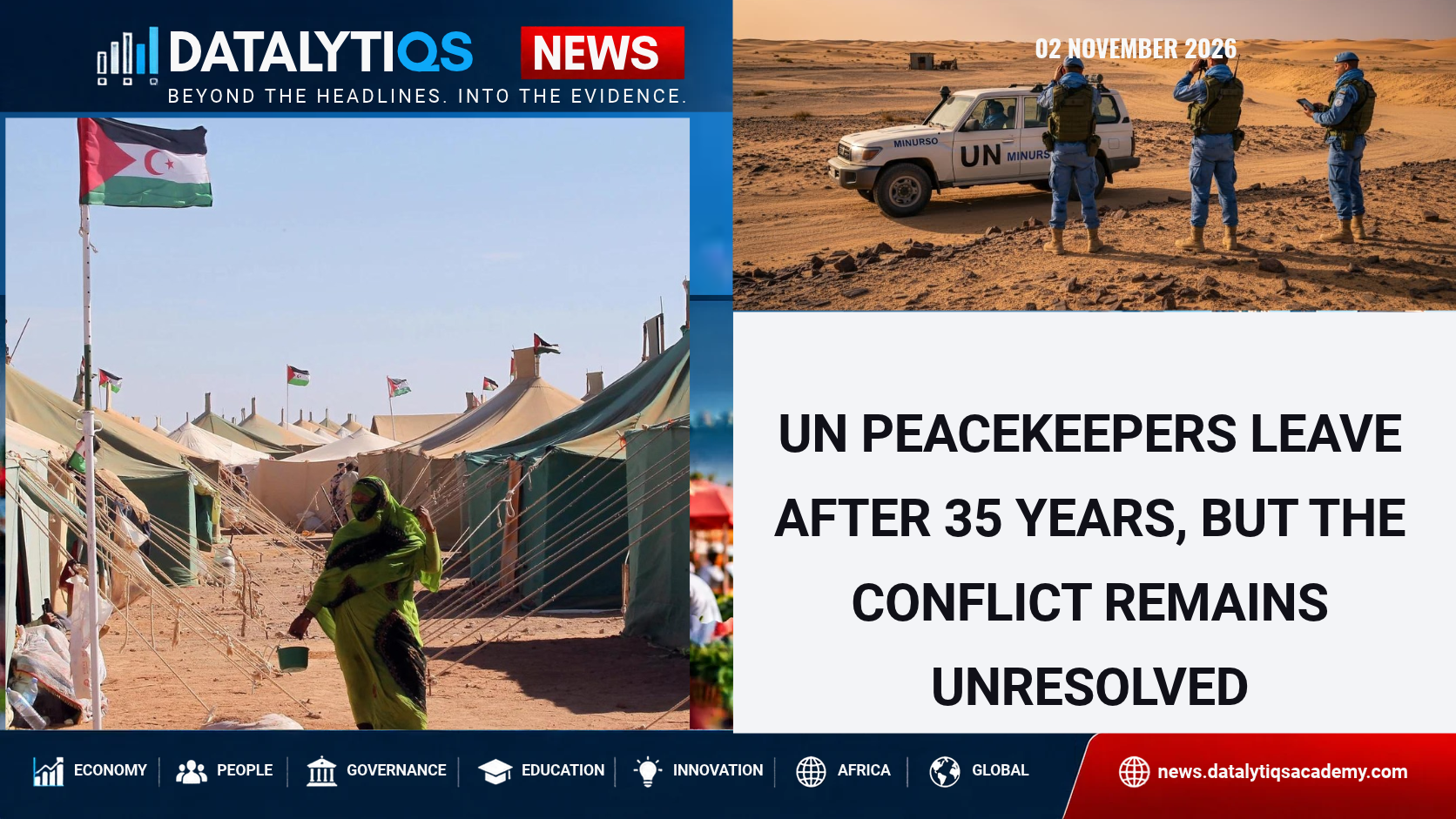
DATALYTIQS NEWS | AFRICAN AFFAIRS & GLOBAL DIPLOMACY | 2 NOVEMBER 2026
UNITED NATIONS / WESTERN SAHARA — The United Nations peacekeeping mission in Western Sahara is winding down after 35 years, following a diplomatic confrontation between the United States and Russia that prevented the Security Council from renewing its mandate. The departure ends a longstanding UN monitoring presence without resolving the territory’s disputed political status.
The United Nations Mission for the Referendum in Western Sahara, known as MINURSO, was established in 1991 to monitor a ceasefire and prepare a referendum through which the Sahrawi people would determine the territory’s future.
That referendum never took place.
On October 30, 2026, Russia vetoed a US-sponsored Security Council resolution proposing a revised mission and a political process centred on Morocco’s autonomy plan. A competing Russian resolution to extend MINURSO also failed.
The mandate expired on October 31, and the UN announced the mission’s wind-down from November 1. Morocco welcomed the outcome, while Algeria and the Polisario Front criticised it.
1. WHAT EXACTLY HAPPENED AT THE SECURITY COUNCIL?
Mission established
1991
Resolution 690
Years of operation
35
1991–2026
Referendums held
0
Original political objective unmet
Mandate expired
31 OCT
2026
The Security Council considered two competing approaches on October 30.
| Proposal | Main provisions | Outcome |
|---|---|---|
| United States draft | Extend and restructure the mission, remove its referendum-oriented identity and centre negotiations on Morocco’s autonomy proposal | Received 11 affirmative votes but was vetoed by Russia |
| Russian draft | Extend MINURSO’s existing mandate for another year | Failed to secure the required support |
The UN’s official meeting record reports that the Russian draft received three votes in favour, one against and 11 abstentions. Some initial media accounts gave a different affirmative-vote count; the UN meeting record is the authoritative reference for the formal tally.
The result was a failure to renew the mandate—not a Security Council decision resolving Western Sahara’s sovereignty.
2. WHY THE UNITED STATES AND RUSSIA DISAGREED
The US proposal would have reoriented the UN presence away from preparing a referendum and toward negotiations based on Morocco’s autonomy initiative.
Under Morocco’s proposal, Western Sahara would exercise a form of self-government while remaining under Moroccan sovereignty.
Washington’s argument was that the referendum framework had failed to produce a settlement over several decades and that a different negotiating basis was necessary.
Russia argued that the US approach prejudged the territory’s status and undermined the principle of self-determination.
The Polisario Front also opposed a process that effectively excluded independence as a possible outcome.
These are different positions on the framework for negotiation—not simply a dispute over the operational cost of peacekeeping.
3. HOW WESTERN SAHARA BECAME ONE OF AFRICA’S LONGEST-RUNNING DISPUTES
Western Sahara is a sparsely populated territory on Africa’s Atlantic coast, south of Morocco and west of Algeria and Mauritania.
Its modern dispute developed during decolonisation.
Spain withdrew from the territory in 1975. Morocco asserted sovereignty, while the Polisario Front pursued independence for the Sahrawi people.
Armed conflict continued until a UN-brokered ceasefire in 1991.
The United Nations then established MINURSO, with the expectation that a referendum would allow eligible voters to decide between independence and integration with Morocco.
Disagreements over who qualified to vote prevented that referendum from taking place.
THE KEY HISTORICAL MILESTONES
| Year | Development |
|---|---|
| 1975 | Spain withdraws; competing territorial claims intensify |
| 1976 | Polisario declares the Sahrawi Arab Democratic Republic |
| 1991 | UN-backed ceasefire and MINURSO established |
| 2007 | Morocco presents its autonomy proposal |
| 2020 | Polisario announces withdrawal from the ceasefire after renewed tensions |
| 2025 | Security Council renews MINURSO through October 2026 |
| 2026 | Competing US and Russian proposals fail; mandate expires |
The 2020 breakdown is particularly important: although MINURSO continued to exist, the political and military environment was no longer the same as under the original 1991 ceasefire arrangement.
4. WHAT MINURSO ACHIEVED—AND WHAT IT DID NOT
MINURSO had two central functions: supporting the ceasefire arrangements and preparing the planned referendum.
Its presence also provided a continuing UN mechanism for observing developments and reporting on security conditions.
The referendum objective remained unfulfilled.
That does not mean the mission performed no useful work. Monitoring, reporting and communication can help limit misunderstandings and support de-escalation even when the underlying political dispute remains unresolved.
However, the mission could not independently compel the parties to agree on voter eligibility or a final political settlement.
The distinction is between a peacekeeping operation’s ability to monitor a conflict and the political authority needed to resolve the conflict.
The Security Council’s failure to renew MINURSO now removes an established monitoring mechanism without replacing it with an agreed alternative.
5. MOROCCO’S POSITION: AUTONOMY UNDER MOROCCAN SOVEREIGNTY
Morocco administers most of Western Sahara and regards the territory as part of the kingdom.
Its 2007 autonomy initiative proposes regional self-government within Moroccan sovereignty rather than an independent state.
Moroccan authorities welcomed MINURSO’s non-renewal. Their position is that the longstanding referendum-centred process has failed and that negotiations should proceed on the basis of autonomy.
The Security Council’s 2025 resolution had already given increased prominence to Morocco’s autonomy proposal as a basis for negotiations.
Nevertheless, the expiration of MINURSO’s mandate does not itself constitute international legal recognition of Moroccan sovereignty over Western Sahara.
The distinction between administrative control, diplomatic support for an autonomy proposal and a final internationally agreed settlement remains essential.
6. ALGERIA AND THE POLISARIO FRONT: SELF-DETERMINATION REMAINS CENTRAL
The Polisario Front seeks independence for Western Sahara and represents the Sahrawi Arab Democratic Republic.
Algeria supports the Polisario and hosts Sahrawi refugees in camps near Tindouf.
Both criticised the Security Council outcome.
Algeria objected to what it characterised as the American draft’s preference for Morocco’s position. The Polisario maintained that the Sahrawi people’s right to self-determination should remain central to any political settlement.
Their objection is not simply that UN personnel are leaving. It is that the proposed replacement framework could narrow the range of political outcomes available for negotiation.
Morocco, by contrast, argues that autonomy provides a practical settlement framework after decades without a referendum.
These competing positions remain unresolved.
7. WHAT HAPPENS TO UN PERSONNEL AND EQUIPMENT?
The end of MINURSO’s mandate should not be confused with the instantaneous physical departure of every UN employee or asset.
According to AP, a smaller UN team will oversee the withdrawal of personnel and equipment, including the return of assets belonging to troop-contributing countries and the disposal of UN-owned equipment.
The UN Secretary-General has warned about the security implications and urged restraint.
The immediate operational challenge is the loss of an established international monitoring presence in an area where low-intensity hostilities have continued since the breakdown of the ceasefire in 2020.
A residual logistical withdrawal team is not equivalent to a replacement peacekeeping mission.
8. THE HUMANITARIAN DIMENSION: WHAT HAPPENS TO SAHRAWI CIVILIANS?
The diplomatic dispute is frequently framed around Morocco, Algeria, Russia and the United States.
Yet its consequences extend to Sahrawi civilians, including generations of refugees living in camps in southwestern Algeria.
The unresolved conflict raises continuing questions about displacement, access to humanitarian assistance, family separation, livelihoods and the protection of civilians.
Humanitarian organisations have warned that the disappearance of MINURSO’s monitoring and de-escalation functions could create additional security risks.
The mission’s closure does not automatically terminate humanitarian programmes administered by other UN agencies and aid organisations.
However, deteriorating security could complicate their operations.
A comprehensive diplomatic settlement would therefore need to address civilian protection and displacement alongside territorial status.
9. WHY THIS MATTERS FOR THE AFRICAN UNION
Western Sahara is not only a United Nations dispute. It also has a longstanding African institutional dimension.
The Sahrawi Arab Democratic Republic is a member of the African Union. Morocco rejoined the continental organisation in 2017.
Their simultaneous presence within the AU illustrates the complexity of the continent’s approach to territorial sovereignty, decolonisation and self-determination.
The AU’s predecessor, the Organisation of African Unity, was involved in the settlement proposals that informed MINURSO’s creation.
The current development raises several institutional questions:
- Can the African Union facilitate renewed dialogue without replacing the UN’s legal responsibilities?
- What role could African mediation play in preventing further hostilities?
- How should the continental organisation address competing positions held by its members?
- Could an African-supported monitoring arrangement complement future UN diplomatic efforts?
These are possible avenues for diplomacy, not announced AU decisions.
10. THE MOROCCO–ALGERIA DIMENSION
The dispute has contributed to longstanding tensions between Morocco and Algeria.
The two countries severed diplomatic relations in 2021, and Western Sahara remains a major source of disagreement.
The closure of MINURSO could further complicate relations because the two governments interpret the UN decision differently.
Morocco views the expiration as an opportunity to move beyond a referendum framework it considers unworkable.
Algeria views the failure to preserve the mission and its original purpose as a setback for self-determination.
The resulting diplomatic environment may affect regional cooperation, border security and economic integration.
11. THE ECONOMIC DIMENSION: PHOSPHATES, FISHERIES AND LEGAL CERTAINTY
Western Sahara contains valuable natural resources, including phosphate deposits and Atlantic fisheries.
Resource exploitation is politically sensitive because it intersects with questions of sovereignty, consent and the economic rights of the territory’s people.
The departure of MINURSO does not resolve those legal questions.
Companies, governments and investors involved in activities connected to the territory must continue to consider applicable international and domestic legal requirements.
The broader economic concern is that an unresolved territorial dispute can discourage investment, complicate trade relationships and limit regional integration.
The economic value of natural resources is therefore inseparable from the political and legal framework governing their use.
12. THREE POSSIBLE PATHWAYS AFTER MINURSO
| Scenario | What it would involve | Main consideration |
|---|---|---|
| Renewed political negotiations | UN, AU or other mediators facilitate talks | Parties must agree on a credible negotiating framework |
| Continued diplomatic deadlock | Competing sovereignty and self-determination positions remain | Security monitoring and civilian protection become more difficult |
| Escalation of hostilities | Further military incidents occur without an established UN monitoring mission | Increased risks to civilians and regional stability |
These are analytical possibilities, not forecasts.
The developments that deserve monitoring include any new Security Council initiative, UN withdrawal arrangements, verified military incidents, AU diplomatic engagement and humanitarian access.
13. THE CENTRAL GOVERNANCE LESSON: A MANDATE IS NOT A SETTLEMENT
The MINURSO experience demonstrates the limits of international peacekeeping when the parties cannot agree on the political outcome.
For 35 years, the United Nations maintained a mission originally intended to help implement a referendum.
The mission’s continued existence provided an institutional presence, but it did not resolve the dispute over eligibility, sovereignty or self-determination.
Its closure now creates a different problem: an unresolved conflict without the same monitoring infrastructure.
From an institutional-performance perspective, the relevant questions are not limited to whether the mission achieved its original objective.
They also concern what it prevented, what monitoring capacity will be lost, what replacement arrangements are available and how the UN can protect civilians during withdrawal.
A mission can fail to deliver a political settlement while still performing operational functions that matter.
CONCLUSION: THE UN MISSION IS ENDING, NOT THE WESTERN SAHARA DISPUTE
The failure of competing US and Russian resolutions has brought MINURSO’s 35-year mandate to an end.
Morocco sees an opportunity to advance negotiations based on autonomy under its sovereignty.
Algeria and the Polisario Front maintain that Sahrawi self-determination must remain central to any legitimate settlement.
The Security Council has not reconciled those positions.
The referendum promised in 1991 never occurred, and the absence of a renewed mandate leaves new questions about security monitoring, humanitarian protection and the future diplomatic process.
The UN has closed a peacekeeping chapter without closing the conflict itself. The next test is whether diplomacy can establish a credible process for addressing the dispute before the loss of monitoring capacity creates additional risks.
DATALYTIQS POLITICAL SATIRE
WESTERN SAHARA: 35 YEARS, NO REFERENDUM—AND NOW NO PEACEKEEPERS!
The UN established MINURSO in 1991 to monitor a ceasefire and help organise a referendum on Western Sahara’s future.
Thirty-five years later, the referendum has never happened, the territorial dispute remains unresolved, and the peacekeeping mission is winding down after the Security Council failed to renew it.
Morocco welcomes the outcome. Algeria and the Polisario Front object. Washington and Moscow disagree over the political framework.
The blue helmets are packing, but the dispute has not packed a single suitcase!
Apparently, international diplomacy can spend 35 years managing a file without resolving the case.
Closing the office does not settle the dispute. It merely leaves the unanswered questions outside the locked door.
VERIFIED SOURCES
ASSOCIATED PRESS — 1 NOVEMBER 2026
Mission closure, competing political positions, withdrawal arrangements and regional implications.UN peacekeeping mission in Western Sahara ends after 35 years
REUTERS — 1 NOVEMBER 2026
UN announcement, history of the mission and reactions from Morocco, Algeria and the Polisario Front.UN mission ends after Security Council fails to renew mandate
UNITED NATIONS — 30 OCTOBER 2026
Official Security Council meeting record and voting results.Security Council fails to adopt competing Western Sahara resolutions
SECURITY COUNCIL REPORT — 30 OCTOBER 2026
Analysis of the competing US and Russian proposals and the proposed changes to MINURSO.Western Sahara: Security Council vote on MINURSO
DATALYTIQS NEWS — BEYOND THE HEADLINES. INTO THE EVIDENCE.
Reporting cut-off: 2 November 2026. The mission’s mandate has expired and its wind-down is underway. This does not constitute a final settlement of Western Sahara’s territorial status or the immediate removal of every UN asset and staff member.