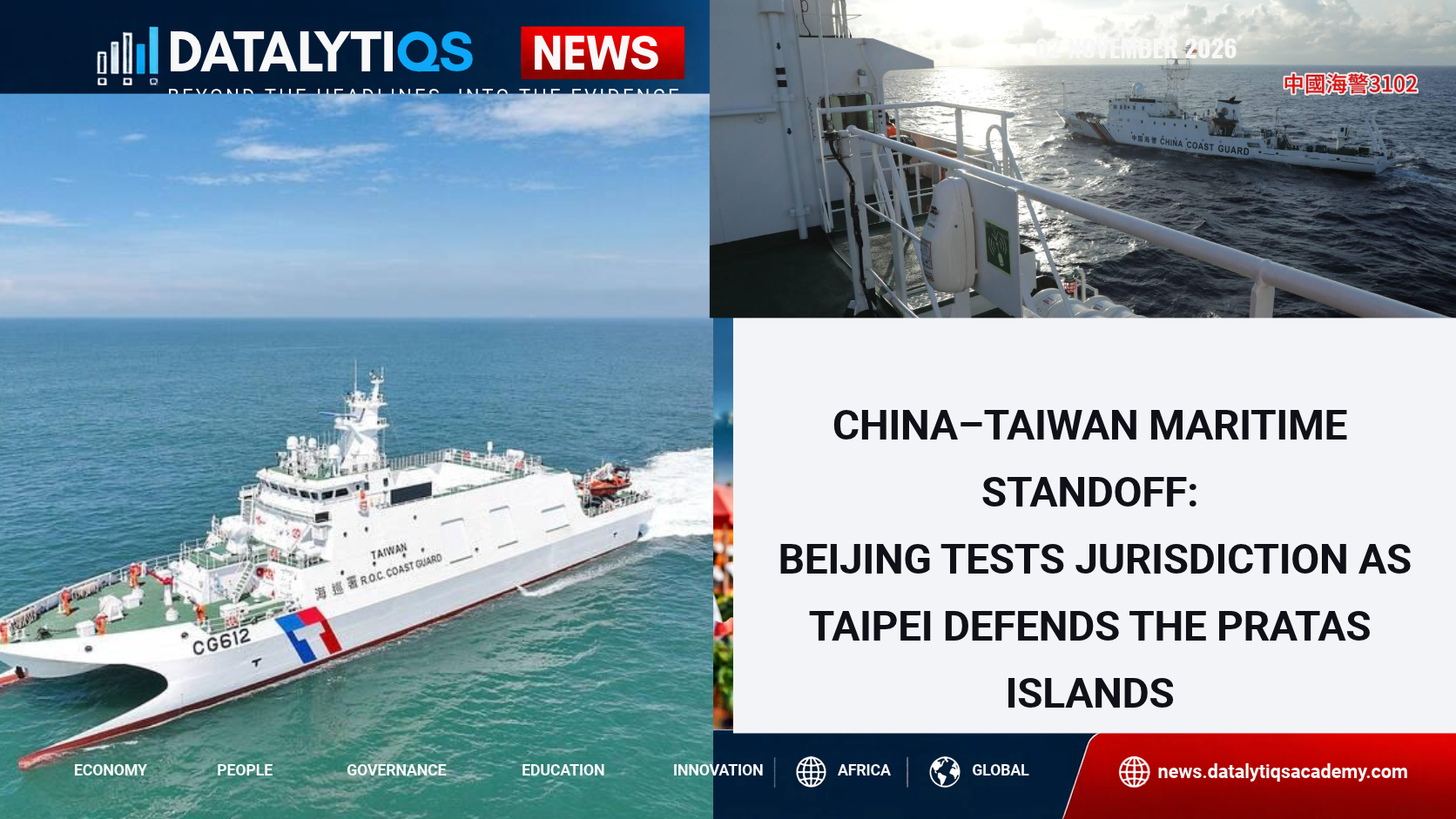
DATALYTIQS NEWS | GLOBAL GEOPOLITICS & MARITIME SECURITY | 2 NOVEMBER 2026
TAIPEI / BEIJING — A confrontation between Chinese and Taiwanese coastguard vessels near the Taiwan-administered Pratas Islands has renewed concerns about maritime security in the South China Sea, as Beijing expands patrols that Taipei considers attempts to impose Chinese jurisdiction over waters it controls.
The incident occurred on Saturday, October 31, when a Chinese coastguard vessel entered waters Taiwan designates as restricted around the Pratas Islands, also known as Dongsha.
Taiwan dispatched a coastguard vessel, challenged the Chinese ship and ordered it to leave. At their closest point, the vessels approached within approximately one nautical mile of each other.
Taiwan described the encounter as its 13th operation involving Chinese coastguard intrusions near the islands this year.
Beijing maintains that its vessels are conducting legitimate law-enforcement patrols in waters under Chinese jurisdiction.
The dispute is significant because it extends beyond an isolated confrontation. It involves competing claims of sovereignty, increasingly frequent coastguard deployments and concerns about whether maritime enforcement operations could contribute to a wider crisis around Taiwan.
1. WHAT HAPPENED ON OCTOBER 31?
Incident date
31 OCT
Saturday, 2026
Closest reported separation
1 nm
Approximately 1.85 kilometres
Reported expulsion operations
13
Near Pratas in 2026
Chinese vessels involved
16
Reported cumulative encounters
Figures attributed to Taiwan’s Coast Guard Administration and reported by AP on November 1. The operation and vessel counts should not be confused with the number of separate calendar days.
Taiwan’s coastguard said the Chinese vessel approached the Pratas Islands early Saturday, prompting an interception.
According to TaiwanPlus, the Chinese vessel had its Automatic Identification System (AIS) switched off as it approached the island. AIS is a maritime identification and tracking system used to communicate vessel information. The reported AIS status has not been independently established from publicly presented tracking records.
Taiwan’s authorities reported that the Chinese vessel subsequently departed following their intervention.
There were no confirmed reports in the reviewed accounts of shots fired, casualties or a collision during this particular encounter.
That does not eliminate the significance of the confrontation: close vessel manoeuvres, competing orders and incompatible jurisdictional claims create circumstances in which errors or misinterpretations can escalate rapidly.
2. WHY THE PRATAS ISLANDS MATTER
The Pratas Islands lie in the northern South China Sea, broadly between southern Taiwan and Hong Kong, more than 400 kilometres from Taiwan’s main island.
They are administered by Taiwan but claimed by the People’s Republic of China.
The islands are sparsely inhabited, without a permanent civilian population, and are strategically exposed because of their distance from Taiwan’s principal population and military centres. Internazionale
Their importance arises from three characteristics.
Geographical position: Pratas lies near maritime approaches connecting the northern South China Sea with the wider western Pacific.
Administrative control: Taiwan’s continued management of the islands is a practical expression of its authority over the territory.
Security vulnerability: The distance from Taiwan’s main island makes reinforcement, resupply and crisis response more complicated than for locations closer to Taiwan.
Security analysts have therefore examined the islands as a possible location where a limited confrontation could occur without initially involving the whole of Taiwan.
That is a scenario considered in security analysis, not evidence that Beijing has decided to seize the islands.
3. BEIJING’S POSITION: THESE ARE CHINESE WATERS
China regards Taiwan as part of its territory and rejects the Taiwanese government’s claim to separate sovereignty.
Beijing also claims the Pratas Islands and their surrounding waters.
On October 21, Chinese Taiwan Affairs Office spokesperson Zhang Han said Chinese coastguard patrols around the islands were legitimate law-enforcement activities intended to maintain navigation and operational order.
Beijing has described its maritime activities as the exercise of jurisdiction rather than an intrusion into another government’s waters.
China’s coastguard also announced a separate patrol east of Taiwan on October 31, saying its operations would continue to protect China’s territorial and maritime interests.
From Beijing’s stated perspective, the patrols reinforce a sovereignty claim it considers longstanding.
Taipei disputes that legal and political premise.
4. TAIPEI’S POSITION: CHINA IS ATTEMPTING TO NORMALISE JURISDICTION
Taiwan’s Coast Guard Administration argues that China’s patrols are designed to create the appearance of established administrative authority in waters that Taiwan controls.
Taipei regards the patrols as harassment and a challenge to maritime security.
In its November 1 statement, Taiwan rejected Chinese jurisdictional claims over waters east of its main island and said Chinese coastguard communications were being used to assert authority over shipping. Focus Taiwan
Taiwanese officials have described this pattern as an attempt to establish de facto jurisdiction through repeated operations.
The concern is that activities initially regarded as exceptional may become frequent enough to be treated as routine.
That would not automatically establish legal sovereignty, but it could change the operational environment for Taiwanese patrol vessels, civilian shipping and other maritime users.
5. THIS IS NOT AN ISOLATED INCIDENT
Earlier confrontations provide important context.
| Date | Reported development | Significance |
|---|---|---|
| June 5, 2026 | Chinese and Taiwanese coastguard vessels entered a tense standoff near Pratas | Demonstrated close-range maritime confrontation |
| June 27 | Taiwan reported another Chinese coastguard entry, with ships approaching within 0.4 nautical miles | Illustrated the potential for close-quarters incidents |
| October 2 | Taiwan reported using water cannon against a Chinese fishing vessel near Dongsha | Showed enforcement tensions involving civilian fishing activity |
| October 16 | Two Chinese coastguard vessels entered Taiwan-designated restricted waters | Taiwan reported its 11th expulsion operation of the year |
| October 21 | Beijing publicly defended its jurisdictional patrols | Confirmed the dispute over legal authority |
| October 31 | Latest confrontation near Pratas | Taiwan reported its 13th operation involving Chinese coastguard intrusions |
These developments are documented in Reuters reporting, Taiwan’s Coast Guard Administration releases and regional media.
The sequence supports a finding of recurring maritime confrontation. It does not, by itself, establish that a blockade or invasion is imminent.
6. THE LEGAL DISPUTE: SOVEREIGNTY, TERRITORIAL WATERS AND RESTRICTED ZONES
The legal argument requires distinguishing three different concepts.
| Concept | Meaning | Relevance to Pratas |
|---|---|---|
| Territorial sovereignty | Authority over land territory | China and Taiwan assert incompatible claims |
| Territorial sea | Maritime belt generally extending up to 12 nautical miles from lawful baselines | Sovereignty over land determines the corresponding maritime entitlement |
| Exclusive economic zone (EEZ) | Zone generally extending up to 200 nautical miles, subject to delimitation and other legal considerations | Coastal states have specified resource-related sovereign rights, not unlimited sovereignty over all activities |
Taiwan’s coastguard has described a restricted zone extending 24 nautical miles from the Pratas atoll’s baseline. That domestic enforcement designation should not be confused with the internationally recognised maximum breadth of a territorial sea. Focus Taiwan
Under the United Nations Convention on the Law of the Sea, maritime entitlements and navigational rights depend on the applicable maritime zone and legal circumstances.
Importantly, the convention does not itself determine which government holds sovereignty over the disputed islands.
Nor does every passage through disputed waters automatically constitute a violation of international law.
The legal assessment would depend on the precise location, conduct of the vessel, claimed jurisdiction and applicable rules.
The central problem is that China and Taiwan do not agree on the underlying authority from which their maritime claims arise.
7. WHY COASTGUARD VESSELS ARE BECOMING SO IMPORTANT
Military operations and coastguard patrols serve different immediate functions.
Naval warships primarily perform military and defence missions. Coastguard vessels commonly undertake maritime policing, fisheries enforcement, search and rescue, and protection of maritime interests.
But in disputed waters, those functions can overlap.
A coastguard vessel can assert jurisdiction by issuing warnings, inspecting fishing boats, directing ships to change course or maintaining a patrol presence.
Such operations may alter day-to-day control without requiring an overt military attack.
Security analysts often describe this as grey-zone activity: coercive or competitive conduct that remains below the threshold of conventional armed conflict.
The terminology is analytical. It does not establish the legality or motive of every individual patrol.
Taiwanese officials have argued that Beijing is combining coastguard operations with military and civilian maritime activity to increase pressure on Taiwan’s administration.
8. THE EASTERN TAIWAN PATROLS: A SEPARATE BUT RELATED DEVELOPMENT
One important distinction in the November 1 reporting is that the Pratas confrontation and the Chinese patrol east of Taiwan were separate operations.
Reuters reported that two Chinese coastguard vessels conducted operations off Taiwan’s eastern coast, prompting Taiwanese vessels to monitor their movements.
Taiwan’s coastguard said Chinese radio broadcasts asserted jurisdiction over shipping in an area where Taipei rejects Beijing’s authority. reuters.com
The east-coast activity is strategically significant because Taiwan’s eastern maritime approaches are relevant to commercial shipping and potential resupply routes during a crisis.
Taiwanese officials have expressed concern that sustained Chinese coastguard activity could contribute to preparations for a future maritime blockade.
That is a stated security concern, not independent proof that the October 31 patrol was itself a blockade rehearsal.
9. HOW A MARITIME BLOCKADE WOULD DIFFER FROM ORDINARY PATROLLING
A blockade involves attempts to prevent or substantially restrict maritime access to a territory or coastline.
Routine patrols, even disputed ones, do not necessarily amount to a blockade.
The distinction matters because different activities carry different legal and security consequences.
Possible escalation pathway — illustrative, not predictive
Recurring coastguard patrolsVessels assert jurisdiction and issue warnings
More intrusive maritime enforcementInterceptions, inspections or orders affecting commercial traffic
Sustained restrictions on maritime accessPotential disruption to shipping, supply routes and port operations
Wider military or diplomatic crisisPossible international responses and increased risks to civilians
These stages are not inevitable.
An incident could be resolved through communication, withdrawal or diplomatic intervention without progressing further.
The concern is that repeated confrontations increase opportunities for accidents, misunderstandings and incompatible enforcement orders.
10. THE INTERNATIONAL DIMENSION: WHY EUROPE AND THE UNITED STATES ARE WATCHING
The Taiwan Strait and surrounding maritime areas are important to global trade, international security and the movement of energy and manufactured goods.
The United States maintains substantial security and economic interests in the region, while European governments have increasingly expressed concern about changes to the status quo through coercion.
In June 2026, France, Germany and Britain jointly expressed alarm about Chinese maritime activity east of Taiwan and its implications for regional stability.
These concerns do not mean that foreign governments necessarily agree on every legal aspect of the Pratas dispute.
The broader international interest concerns freedom of navigation, peaceful dispute management and preventing military confrontation.
Any major interruption of maritime traffic could affect shipping insurance, freight rates, supply chains and financial markets.
11. WHY THE GLOBAL ECONOMY HAS A STAKE IN THIS DISPUTE
Taiwan occupies an important position in advanced semiconductor manufacturing, while the wider region contains major shipping routes connecting Asian production centres with international markets.
A maritime crisis could create several economic transmission channels.
Shipping and logistics: Restrictions or heightened security risks could cause vessel rerouting, delays and increased insurance premiums.
Semiconductors: Disruptions to production, electricity supply, personnel movements or shipping could affect electronics, telecommunications, automotive manufacturing and data-centre supply chains.
Financial markets: Heightened geopolitical uncertainty could influence exchange rates, investment decisions and the pricing of risk.
Energy security: Shipping disruption could affect the movement and cost of energy supplies in East Asia.
These are potential consequences of a more extensive crisis. The October 31 Pratas encounter has not been shown to have caused a significant disruption to global semiconductor production or international shipping.
12. IMPLICATIONS FOR KENYA AND AFRICA
Kenya’s exposure to a China–Taiwan maritime crisis would principally be through international trade and supply chains.
China is an important supplier of manufactured goods, machinery, electronics and industrial inputs to African markets.
Taiwan is important to global technology supply chains.
If maritime tensions developed into prolonged shipping disruption, Kenyan importers could face increased delivery times, freight charges or supply uncertainty.
Possible downstream effects include higher costs for electronics, information technology equipment, machinery and selected consumer products.
However, the scale of any impact would depend on the nature, location and duration of disruption.
For evidence-based monitoring, relevant indicators would include container freight indices, semiconductor lead times, shipping insurance premiums, Asian port congestion and the Kenya shilling’s exchange rate against major trading currencies.
No quantified Kenyan economic loss can responsibly be attributed to this specific coastguard incident on the evidence reviewed.
13. WHAT THE DATA ACTUALLY TELL US
Taiwan’s reported 13 operations near Pratas in 2026 demonstrate repeated maritime confrontations.
They do not automatically reveal the duration, severity or strategic purpose of every incident.
A more informative maritime-security dataset would distinguish between encounters, vessels, time spent inside restricted waters, closest approach, AIS activity, use of water cannon and any damage or injuries.
For example, Taiwan’s June 27 statement reported that vessels came within 0.4 nautical miles of each other, compared with approximately one nautical mile in the October 31 incident.
The shorter June separation is an observable measure of proximity, but it does not alone prove that the earlier incident was more dangerous. Speed, sea conditions, manoeuvres and communication would also matter.
A rigorous analysis would avoid treating every patrol as equivalent.
EVIDENCE STATUS
| Claim | Assessment |
|---|---|
| A Chinese coastguard vessel approached Pratas on October 31 | Supported by AP and Reuters reporting |
| Taiwan challenged the vessel and said it departed | Supported by Taiwan’s official account |
| Taiwan recorded 13 operations involving Chinese intrusions this year | Official Taiwanese figure reported by AP |
| The vessels came within approximately one nautical mile | Taiwanese coastguard account |
| China asserts jurisdiction over the waters | Confirmed Chinese government position |
| China has begun a formal blockade of Taiwan | Not established |
| The incident resulted in casualties or exchange of fire | Not reported in the reviewed accounts |
| The incident proves an invasion decision has been made | Not established |
14. WHAT SHOULD BE MONITORED NEXT?
The most informative developments would be changes in the frequency and duration of patrols, whether Chinese vessels begin inspecting or diverting commercial shipping, and whether coastguard operations are coordinated with major military exercises.
Other important indicators include official maritime notices, independently documented shipping disruptions, diplomatic communications and any incidents involving collisions or the use of force.
The objective of monitoring should be to distinguish changes in actual maritime behaviour from rhetorical escalation.
CONCLUSION: TWO GOVERNMENTS, ONE SEA, COMPETING CLAIMS OF AUTHORITY
The latest Pratas confrontation demonstrates how maritime policing has become an important dimension of the dispute between Beijing and Taipei.
China maintains that its patrols are lawful exercises of jurisdiction. Taiwan rejects those claims and regards the operations as attempts to normalise Chinese administrative control.
The October 31 incident ended without a reported armed clash, but it forms part of a recurring pattern of encounters around strategically exposed islands.
The wider concern is not that every coastguard patrol constitutes an act of war. It is that repeated confrontations under incompatible legal claims can increase the risk of miscalculation.
A maritime boundary dispute becomes especially difficult to manage when both sides issue lawful orders according to their own understanding of sovereignty—and neither accepts the other’s authority.
The immediate priority for regional stability is preventing close encounters from escalating while preserving safe commercial navigation and channels for crisis communication.
DATALYTIQS POLITICAL SATIRE
CHINA AND TAIWAN: TWO COASTGUARDS, ONE SEA—AND NO AGREEMENT ON WHO OWNS THE WHISTLE!
Taiwan says it has expelled another Chinese coastguard vessel near the Pratas Islands, recording its 13th such operation this year.
Beijing calls its patrols lawful enforcement. Taipei calls them harassment.
Same water. Two governments. Two versions of the law.
The worrying part is that the dispute is no longer confined to diplomatic statements. It is playing out between actual ships, sometimes less than two kilometres apart.
And while politicians argue over jurisdiction, the world’s shipping lanes and technology supply chains have every reason to watch closely.
When two coastguards both believe they are the traffic police, the greatest danger is that neither recognises the other’s stop sign!
SOURCES AND FURTHER READING
ASSOCIATED PRESS — 1 NOVEMBER 2026
Main report on the Pratas confrontation, the one-nautical-mile separation and Taiwan’s reported 13 operations.Taiwan accuses China of harassment after coastguard standoff
REUTERS — 1 NOVEMBER 2026
Separate Chinese coastguard patrols east of Taiwan and concerns about maritime access.Taiwan says China is harassing shipping with east-coast patrols
CENTRAL NEWS AGENCY / FOCUS TAIWAN — 1 NOVEMBER 2026
Taiwan Coast Guard Administration’s official response to Beijing’s claims of jurisdiction.Taiwan rejects China’s claimed maritime jurisdiction
TAIWAN COAST GUARD ADMINISTRATION — 27 JUNE 2026
Primary-source account of an earlier close encounter near Dongsha.Official coastguard incident statement
TAIPEI TIMES — 18 OCTOBER 2026
Earlier Pratas confrontation and the accumulation of reported maritime incidents.Chinese vessels enter restricted waters around Pratas
DATALYTIQS NEWS — BEYOND THE HEADLINES. INTO THE EVIDENCE.
Reporting cut-off: 2 November 2026. This report distinguishes observed and officially reported maritime activity, competing jurisdictional claims, and potential security scenarios. A blockade, invasion decision or major commercial disruption has not been independently established from the reported incident.