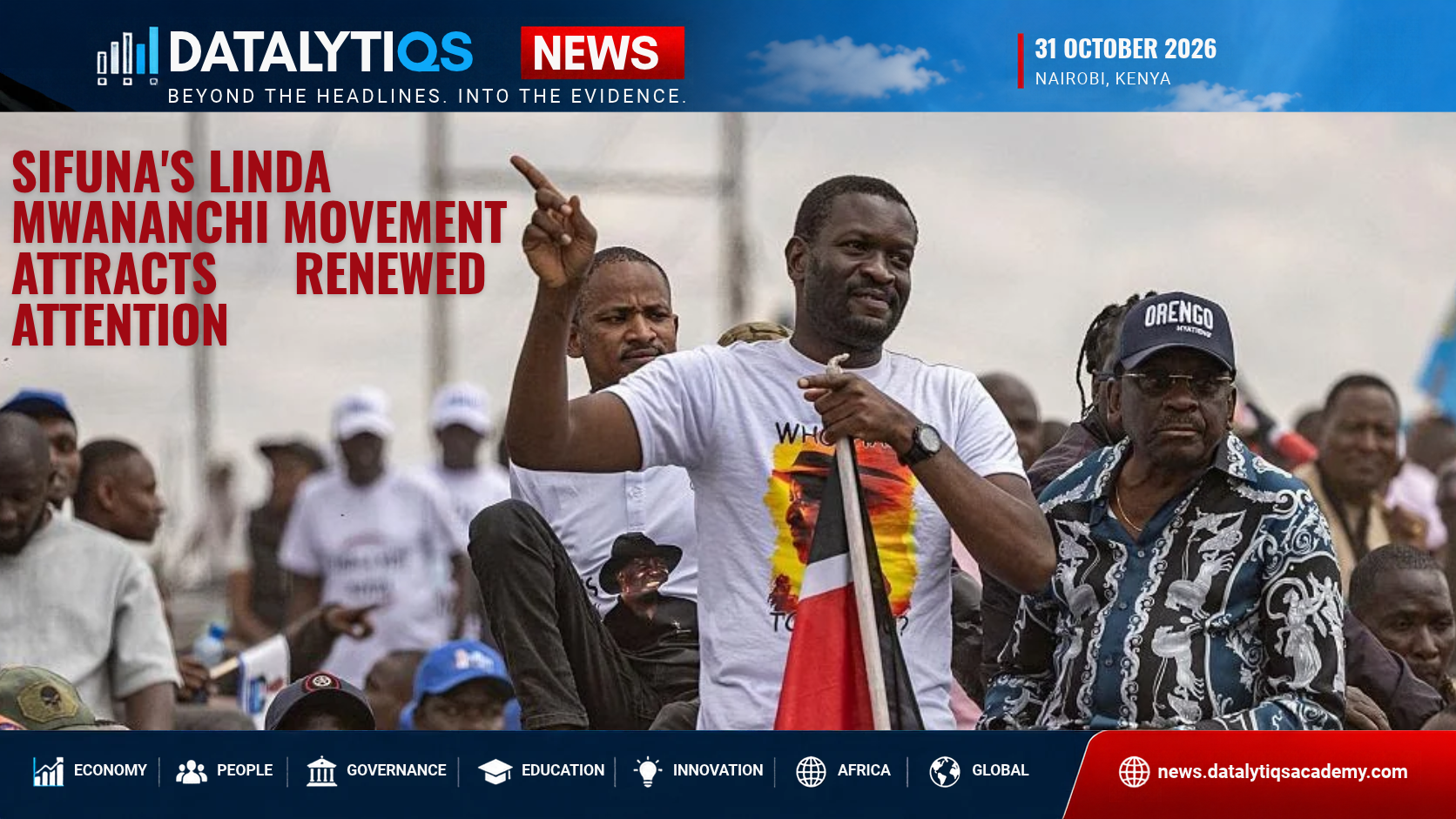
New party headquarters, a proposed national leadership structure and an ambitious economic agenda have elevated Edwin Sifuna’s political project. But disagreements over the opposition presidential ticket are already testing the emerging alliance.
Linda Mwananchi’s October 30 headquarters launch brought together several opposition leaders ahead of Kenya’s 2027 General Election.
NAIROBI, Kenya — Nairobi Senator Edwin Sifuna has placed his Linda Mwananchi Movement at the centre of renewed national political attention following the unveiling of its headquarters in Lavington, Nairobi, on Friday, October 30, 2026.
The event brought together former Deputy President Rigathi Gachagua, Wiper leader Kalonzo Musyoka, DAP-K leader Eugene Wamalwa, Trans Nzoia Governor George Natembeya and other opposition figures.
What began as a ceremony to establish a permanent political headquarters developed into a wider demonstration of opposition cooperation, accompanied by visible disagreements over presidential ambitions and the procedures for selecting a joint candidate. Daily Nation+2
The development raises a consequential question for Kenya’s political landscape: Can Linda Mwananchi evolve from a mobilisation platform into a durable national political institution while participating in a broader opposition alliance?
From political movement to formal party organisation
Linda Mwananchi emerged from Sifuna’s disagreements with the direction of the Orange Democratic Movement (ODM), particularly its relationship with President William Ruto’s administration and the debate over political cooperation ahead of the 2027 election.
The movement subsequently pursued a formal political-party structure through The Equitable Party, which was rebranded under the Linda Mwananchi identity.
Reporting from the October 30 event confirms that the new headquarters is intended to coordinate political mobilisation, administration, communication, grassroots organisation and national campaign activities.
This transition matters because political movements and registered political parties perform different functions. A movement can organise demonstrations, public meetings and issue-based campaigns. A political party seeking to contest elections must additionally satisfy statutory requirements concerning registration, governance, nominations, financial accountability and electoral administration.
Although media reports describe the party’s rebranding, the precise current particulars of its registration should be independently checked against the Office of the Registrar of Political Parties before publication of definitive legal claims about its status.
The launch therefore represents an organisational milestone, but the existence of headquarters alone does not establish the strength or geographical reach of its membership.
The leaders who attended — and the absences that attracted attention
The presence of Gachagua, Kalonzo, Wamalwa and Natembeya demonstrated that Linda Mwananchi is engaging with several established opposition formations.
Other attendees included Embakasi East MP Babu Owino and politicians associated with different political organisations. the-star.co.ke
However, Daily Nation reported that several opposition figures, including Fred Matiang’i, Martha Karua and Justin Muturi, were absent.
Natembeya said the absent leaders had sent goodwill messages and were engaged in other activities. Their absence should therefore not automatically be interpreted as a formal withdrawal from opposition cooperation.
The broader significance is that the opposition remains composed of several political organisations with distinct leadership structures, regional constituencies and presidential interests.
A shared objective of challenging the incumbent administration does not, by itself, settle questions of coalition governance, candidate selection or parliamentary nominations.
Kalonzo heckled: An early test of coalition negotiations
One of the most widely discussed incidents occurred during Kalonzo Musyoka’s address.
After Eugene Wamalwa referred to Sifuna in presidential terms, Kalonzo cautioned that formal nomination procedures had not yet been completed. Supporters interrupted his speech with chants backing Sifuna.
Sifuna intervened and urged the audience to respect the visiting leaders and allow them to speak.
Kalonzo emphasised the importance of consultation and the scheduled November 13 delegates’ meeting, distinguishing Sifuna’s emerging party leadership from formal presidential nomination. Daily Nation+1
The incident attracted further attention after Wiper spokesman Ndegwa Njiru criticised the conduct of some supporters, while Gachagua downplayed the disruption as political excitement.
The contrasting reactions reveal a substantive organisational issue: opposition parties must establish whether presidential nominations will be conducted independently within each party, negotiated among coalition principals or determined through a joint coalition process.
Without agreed procedures, public declarations of support may generate competing expectations before any binding political agreement exists.
A proposed national leadership team
Linda Mwananchi also unveiled a leadership structure intended to manage party operations and prepare for its delegates’ convention.
Reported designations as of October 30, 2026. The appointments were announced as subject to approval at the November 13 convention.
| Position | Proposed official |
|---|---|
| Party leader | Edwin Sifuna |
| Deputy party leaders | Kawira Mwangaza, Faith Odhiambo, Patrick Makau |
| National chairperson | Godfrey Osotsi |
| Secretary-general | Caroli Omondi |
| Deputy secretary-general | Pauline Njoroge |
| National treasurer | Richard Onyonka |
| Political affairs and campaigns | Boni Khalwale |
| Public policy and economic affairs | Jack Wamboka |
| Presidential campaign leadership | George Natembeya |
| Legal affairs | Francy Kadide |
| Youth affairs | Fredah Onduso |
Additional positions have been reserved for representatives from the Coast region.
The proposed structure incorporates politicians, legal professionals, communications personnel and individuals with experience in electoral mobilisation.
Nevertheless, the effectiveness of the structure will depend on formal ratification, clarity of responsibilities, internal decision-making procedures and operational resources.
A particularly important distinction is between officials responsible for managing the political party and those assigned to a presidential campaign. Their mandates may overlap, but they are not institutionally identical.
The 47-county expansion plan: Ambition versus implementation
Beyond the launch ceremony, Sifuna announced plans to establish offices in all 47 counties by the end of November 2026.
He also claimed that Linda Mwananchi had already secured county chairpersons from 38 counties, including individuals previously associated with ODM.
County chairs claimed
38
Not independently audited
Office target
47
By end of November
Delegates’ meeting
13 Nov
Leadership ratification
The distinction between appointing county chairpersons and establishing functional county organisations is important.
A credible assessment of Linda Mwananchi’s geographical reach would require evidence of registered membership, accessible offices, county and constituency committees, documented activities, financing arrangements and compliance with applicable party regulations.
The 38-county figure is a political claim by Sifuna, not a verified count of functioning branches or registered members.
The ODM question: A struggle over political organisation
Linda Mwananchi’s development also intersects with changes in ODM’s political direction.
Sifuna’s disagreements with the party have centred on its cooperation with the Ruto administration and the implications of that relationship for opposition politics.
The formation of a separate political vehicle introduces questions about whether politicians and grassroots organisers formerly associated with ODM will remain within its structures, move to Linda Mwananchi or maintain informal relationships with both.
There are three distinct dimensions.
Political identity: ODM has an established organisational history and electoral constituency. Linda Mwananchi must articulate what differentiates its policy programme and political identity beyond opposition to the current administration.
Institutional continuity: Existing party networks may provide organisational experience, but their transfer to another formation cannot be assumed from public endorsements.
Leadership competition: Politicians operating within similar constituencies may face difficult decisions over party affiliation, nomination procedures and coalition arrangements.
The movement’s claims about attracting former ODM officials are therefore relevant, but the extent of any institutional realignment remains unverified.
The 2027 presidential question
The October 30 event brought together leaders who have separately participated in discussions about a united opposition candidate.
Sifuna pledged that Linda Mwananchi would support one agreed candidate, including another opposition principal if selected through negotiations.
Kalonzo similarly emphasised the need for consultation and formal procedures. Gachagua called for the opposition to coordinate around a common presidential ticket.
These statements indicate broad public support for a joint-candidate approach, but they do not constitute a final nomination agreement.
Several issues remain unresolved:
- Whether the candidate will be selected through party delegates, coalition negotiations or another agreed mechanism.
- How the coalition will distribute parliamentary, gubernatorial and other electoral nominations.
- Whether all opposition formations will accept the same process.
- What legal and financial arrangements will govern the alliance.
- How the parties will resolve disputes without undermining their individual institutional identities.
Why the 2002 comparison has resurfaced
Several leaders at the launch invoked Kenya’s 2002 opposition coalition, when political formations united behind Mwai Kibaki and ended KANU’s long period in power.
The analogy provides a historical reference for coalition negotiations, but it should not be treated as a forecast for 2027.
The political context, party structures, voter composition, electoral institutions and economic environment are different.
A more useful comparison would examine the formal agreements, leadership concessions, regional mobilisation structures and governance commitments that supported the 2002 coalition, rather than assuming that a similar public alliance would reproduce the same electoral outcome.
Sifuna’s KSh500 billion economic proposal: What do the numbers say?
One of the most substantive announcements at the launch was Sifuna’s proposal to reduce government expenditure by KSh500 billion during the first 100 days of an administration led by his movement.
He linked the proposed reductions to removing selected fuel and electricity taxes and the Affordable Housing Levy, arguing that reduced government wastage could create fiscal space for household tax relief.
The published reports do not provide a detailed expenditure schedule identifying the budget lines that would generate the proposed savings.
Scale of the proposed spending reduction
KSh 500 billion
Equivalent to approximately 10.6% of the KSh4.704 trillion total expenditure projected in the 2026 Budget Policy Statement.
Proposed reduction: 10.6%Other expenditure: 89.4%
Illustrative ratio using the Treasury’s earlier FY2026/27 budget-policy projection, not an estimate of independently verified waste or achievable savings.
The fiscal feasibility test
The National Treasury’s 2026 Budget Policy Statement projected total expenditure and net lending of approximately KSh4.704 trillion for FY2026/27, with recurrent expenditure of approximately KSh3.457 trillion.
That framework illustrates the scale of the proposed reduction, although subsequent parliamentary budget figures differ and should be reconciled when evaluating the current approved estimates.
A rigorous appraisal would need to distinguish four categories:
1. Discretionary expenditure. Administrative overheads, travel, hospitality, procurement inefficiencies and nonessential programmes may offer opportunities for savings, but their aggregate recoverable value must be demonstrated.
2. Statutory and contractual obligations. Public debt payments, legally mandated transfers, existing contracts and other obligations cannot necessarily be reduced through administrative decisions alone.
3. Essential public services. Reductions affecting healthcare, education, security, infrastructure maintenance or social protection could create costs elsewhere in the economy.
4. Revenue implications. Removing taxes and levies would reduce some government revenue streams. Any expenditure savings would need to be evaluated alongside those losses, rather than assuming the entire KSh500 billion could be returned to households.
The proposed programme is therefore a measurable policy commitment, but not yet a fully costed fiscal plan in the material reviewed.
Would removing fuel and electricity taxes reduce living costs?
Fuel and electricity taxation affects household expenditure both directly and indirectly.
Fuel costs influence transport, distribution, agricultural production and logistics. Electricity costs affect household bills and operating expenses for businesses.
However, the extent to which tax reductions translate into lower consumer prices depends on the specific taxes removed, market conditions, regulatory arrangements, exchange rates and the behaviour of suppliers.
The Affordable Housing Levy presents a separate policy question because its removal would also affect the financing arrangements supporting housing programmes.
DatalytIQs’ assessment is that these proposals warrant independent modelling of their distributional effects, particularly across income groups, small businesses, transport operators and rural households.
Governance, constitutional rights and public accountability
Sifuna also framed Linda Mwananchi around constitutionalism, civil liberties, public accountability and government transparency.
During the launch, he criticised the administration’s handling of public expenditure and cited concerns about the protection of citizens’ rights during protests.
These commitments raise practical questions about implementation.
A constitutional-governance programme would require more than general pledges. It would need clearly articulated proposals for police accountability, procurement transparency, parliamentary oversight, independent institutions and access to public information.
For public-sector reform, measurable indicators could include the publication of procurement contracts, compliance with audit recommendations, timely release of government financial reports and resolution of documented human-rights complaints.
The administration’s own position and official performance data would also be necessary for a complete comparison of competing governance programmes.
Political intelligence: What should be monitored next?
November 13 — Delegates’ convention
Whether proposed officials are ratified, the party adopts formal nomination procedures and any coalition agreements are announced.
End of November — County expansion
Whether the announced target of offices in all 47 counties is achieved and whether the branches demonstrate actual operations.
Coalition negotiations
Publication of candidate-selection rules, coalition membership, dispute-resolution arrangements and other formal commitments.
Economic programme
Release of a costed policy document identifying the proposed KSh500 billion in savings and quantifying the revenue implications of tax reductions.
These are monitoring priorities, not predictions of electoral performance.
Conclusion: Beyond the launch ceremony
Linda Mwananchi’s renewed prominence reflects several developments occurring simultaneously: the creation of a recognisable political identity, the establishment of headquarters, the announcement of a proposed national leadership structure, engagement with other opposition principals and the presentation of economic and governance commitments.
The October 30 launch also exposed unresolved disagreements over presidential nominations and the relationship between individual parties and the wider opposition alliance.
For Sifuna, the next phase will involve converting public announcements into verifiable institutional structures and detailed policy proposals.
For the broader opposition, the immediate challenge is to develop procedures that allow different parties to cooperate without assuming that shared opposition to the incumbent settles every question of leadership.
The essential distinction is between political visibility, organisational capacity and policy credibility. Each can be independently examined, and none should be inferred solely from attendance at a high-profile political event.
DatalytIQs News — Beyond the Headlines. Into the Evidence.
Sources and further reading
Daily Nation
31 October 2026 · Opposition disagreements and Kalonzo’s reception
The Star
30 October 2026 · Proposed party leadership
Capital FM Kenya
30 October 2026 · Convention, county expansion and economic commitments
National Treasury
2026 Budget Policy Statement · Fiscal projections