DATALYTIQS NEWS | POLITICS, GOVERNANCE & ELECTION SECURITY | 31 OCTOBER 2026
Peace summit identifies unresolved grievances, economic inequality, organised violence and digital disinformation as emerging electoral risks, prompting calls for stronger early-warning systems, institutional accountability and sustained community engagement.

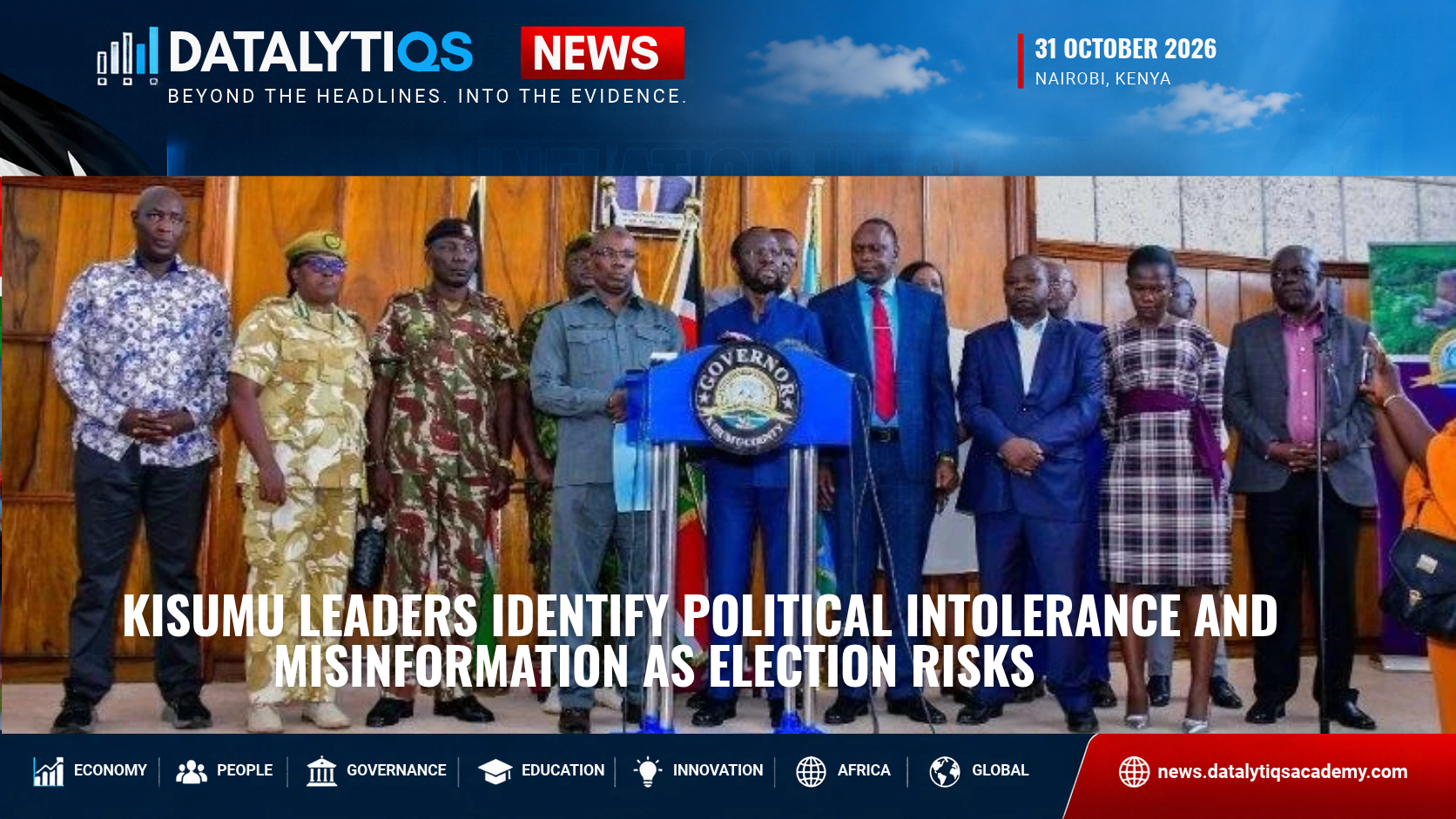
Peace and security stakeholders have intensified consultations in Kisumu ahead of Kenya’s 2027 General Election. Editorial image subject to source verification and licensing.
KISUMU, Kenya — Political intolerance, misinformation, hate speech, unresolved community grievances and declining confidence in electoral justice institutions have emerged as major concerns in Kisumu County as leaders intensify preparations to prevent violence ahead of Kenya’s August 2027 General Election.
The concerns were raised during a two-day Peace and Leadership Summit organised by Pamoja for Transformation Trust in collaboration with the national government through the Office of the County Commissioner.
The summit brought together representatives of government institutions, security agencies, civil society, religious organisations, independent institutions, women and youth groups to examine potential sources of conflict and identify preventive measures.
Kisumu County Commissioner Ramadhan Mwabudzo presented a communiqué containing six resolutions addressing peacebuilding, information sharing, inclusive governance and coordinated responses to emerging security threats.
The summit’s findings have acquired additional significance following further engagements by the National Cohesion and Integration Commission (NCIC) in Kisumu on October 22–23 and a parliamentary review of national election-security preparedness on October 30.
Together, these developments illustrate growing institutional attention to electoral security, digital misinformation and public confidence in democratic processes.
A county peace summit identifies interconnected threats
The Kisumu summit did not attribute the potential for election-related violence to a single political organisation or community.
Instead, participants identified several interacting risks: political intolerance, unresolved grievances, socioeconomic inequalities, organised criminal violence, misinformation, hate speech and weakening confidence in electoral justice institutions.
This distinction is important. Electoral violence may arise from a combination of political mobilisation, local disputes, economic vulnerability, institutional mistrust and inflammatory information.
The delegates warned that unresolved grievances could intensify tensions and undermine peaceful participation in the electoral process. They also called for greater cooperation among public institutions, community organisations and other stakeholders.
The summit’s conclusions are a qualitative assessment by participants. They do not constitute a statistical estimate of the probability of violence in Kisumu, nor do they establish that violence will occur.
Six areas of action emerge from the summit
The reported communiqué outlined six resolutions. Available coverage describes their broad objectives but does not reproduce the full authoritative text of every resolution.
The principal themes reported were:
- Strengthening conflict prevention and peacebuilding.
- Improving information sharing among relevant institutions.
- Promoting inclusive leadership and community participation.
- Responding to emerging security and digital threats.
- Establishing more effective early-warning and response mechanisms.
- Coordinating implementation and reviewing progress through a multi-stakeholder forum.
These are thematic summaries of the reported commitments, not verbatim reproductions of the six resolutions.
A central outcome was the proposed coordination forum, intended to periodically assess progress, identify implementation gaps and support corrective action.
The practical importance of this mechanism will depend on whether participating institutions agree on responsibilities, measurable deliverables, reporting intervals and procedures for responding to warnings.
Political intolerance and the right to peaceful participation
Political intolerance was identified as a threat because democratic competition requires citizens and political organisations to express differing views without intimidation or violence.
Intolerance may take several forms, including threats against political opponents, disruption of lawful meetings, coercion of participants and inflammatory rhetoric.
However, disagreement, criticism of government and peaceful protest are not themselves evidence of intolerance or criminality.
The distinction is constitutionally significant.
Kenya’s Constitution protects freedom of expression, political rights and the right to assemble, demonstrate, picket and present petitions peacefully and unarmed.
Efforts to prevent electoral violence must therefore protect lawful political participation while addressing actual threats, incitement and violence through appropriate legal processes.
A conflict-prevention strategy that suppresses legitimate political expression could undermine the same democratic confidence it seeks to strengthen.
Misinformation, artificial intelligence and digital electoral risks
Digital communication featured prominently in the summit’s deliberations.
Participants raised concerns about cyberbullying, online harassment, harmful AI-generated material and technology-facilitated gender-based violence.
These concerns extend beyond conventional political rumours.
Digitally manipulated photographs, fabricated statements, impersonated social media accounts and synthetic audio or video can complicate the public’s ability to distinguish authentic political communication from misleading material.
The risks are particularly serious when false information concerns electoral procedures, ethnic relations, security incidents or the conduct of public officials.
Three concepts need to be distinguished.
Misinformation refers to false or misleading information shared without necessarily intending deception.
Disinformation involves deliberately creating or spreading false or misleading information to deceive.
Hate speech concerns expression that may fall within specific legal prohibitions, depending on its content, context and applicable law. It should not be used as a blanket label for unpopular political opinions.
The distinction matters because each problem requires a different response.
Misinformation may be addressed through corrections, accessible official information and media literacy. Deliberate manipulation may require more extensive investigation. Alleged criminal incitement requires appropriate evidence and due process.
AI-generated content introduces additional challenges because a convincing fabricated recording can circulate rapidly before its authenticity is established.
For journalists, election administrators and community organisations, verification protocols will become increasingly important.
Declining trust in electoral justice institutions
Summit participants also expressed concern about weakening public confidence in institutions responsible for electoral justice.
Institutional trust influences how citizens respond to contested political developments and electoral disputes.
When voters believe official information is unreliable or that complaints will not be addressed fairly, rumours and unverified allegations may become more influential.
However, the summit reports do not provide a representative survey measuring the extent of declining trust among Kisumu residents.
The concern should therefore be reported as an assessment expressed by participants, not a quantified finding about the entire county population.
Restoring confidence requires more than public appeals for calm. It also depends on transparent procedures, timely communication, accessible complaints mechanisms, consistent enforcement of the law and demonstrable institutional impartiality.
NCIC intensifies engagement in Kisumu
The summit’s concerns were reinforced by separate activities undertaken by the National Cohesion and Integration Commission.
On October 16, the Kenya News Agency reported that NCIC Director of Research and Knowledge Management Millicent Okatch had identified public mistrust, political violence and online incitement among the challenges to peaceful elections.
Speaking during a youth engagement in Kisumu, Okatch emphasised the importance of involving young people in decision-making and addressing economic vulnerabilities that could expose them to political exploitation.
She also called for conflict-sensitive journalism and greater collaboration with media editors.
The commission subsequently conducted further engagements in Kisumu on October 22 and 23, involving county officials and civil society organisations.
According to reporting published on October 24, NCIC Chairperson Bishop Kepha Omae and Chief Executive Officer Daniel Mutegi Giti participated in discussions aimed at strengthening early intervention and cooperation among local stakeholders.
The commission urged civil society organisations to address misinformation, hate speech and emerging tensions before they escalate.
These engagements suggest that Kisumu’s election-preparedness discussions are extending beyond a single conference into wider institutional consultations.
Whether those consultations produce sustained operational programmes remains an important question.
National institutions identify similar election risks

Kisumu’s concerns are consistent with the national risk categories identified by NCIC in its second Uchaguzi Bila Noma roadmap, launched on August 25, 2026.
The roadmap identifies political intolerance, ethnic mobilisation, misinformation, unemployment, historical grievances, organised criminal gangs and emerging technological threats among factors requiring preventive action.
It proposes conflict-hotspot mapping, stronger mediation structures, social media monitoring, civic education and greater engagement with political parties and communities.
NCIC also indicated that approximately KSh308.7 million would be required to implement its proposed interventions.
That amount represents the commission’s reported programme requirement, not confirmation that the full sum has been appropriated or disbursed.
Senate reviews election-security readiness
On October 30, the Senate Standing Committee on National Cohesion, Equal Opportunity and Regional Integration examined the preparedness of several public institutions during a meeting in Naivasha.
The committee, chaired by Marsabit Senator Mohamed Chute, engaged representatives from the National Police Service, NCIC, Communications Authority, Media Council of Kenya and Independent Policing Oversight Authority.
According to Parliament, the National Police Service presented a 16-month election-security roadmap covering September 2026 to December 2027.
The roadmap contains 28 activities across six phases, covering stakeholder engagement, preparation, operational planning, training, election operations and post-election review.
16 months
Sept 2026–Dec 2027
Planned activities
28
Across six phases
NCIC funding need
KSh 308.7m
Reported requirement
Sources: Parliament of Kenya, October 30, and Kenya News Agency, August 25, 2026.
The national police presentation also included comparative figures for arrests of suspected gang members.03507001,0501,400
Sep 2024–Aug 2025
Sep 2025–Aug 2026
- Sep 2024–Aug 2025: Arrests of suspected gang members 602
- Sep 2025–Aug 2026: Arrests of suspected gang members 1,316
National Police Service figures presented to the Senate on 30 October 2026. These are arrests of suspected gang members, not verified election-related offences or convictions.
The figures represent an increase of 714 arrests, approximately 119%, between the two reported periods.
That change cannot independently establish that organised criminal activity increased by the same proportion. Arrest numbers are influenced by enforcement intensity, operational priorities, reporting practices and other factors.
Nor should the figures be interpreted as specific to Kisumu or as proof that the arrests were election-related.
Economic inequality and youth vulnerability
The summit’s inclusion of socioeconomic inequality among potential conflict drivers highlights the relationship between economic conditions and political mobilisation.
Unemployment, precarious livelihoods and limited opportunities can create vulnerabilities that political actors or organised groups may exploit.
However, economic disadvantage does not imply that an individual or community is predisposed to violence.
NCIC’s October youth engagement in Kisumu emphasised young people’s participation in decision-making, economic opportunities and the importance of resisting political exploitation.
The commission also referred to discussions with young people in Obunga, where participants described experiences and attitudes concerning earlier protests.
Such accounts provide useful qualitative insight, but they are not representative survey findings for all young people in Kisumu.
A more rigorous prevention programme would combine youth dialogue with employment and education data, documented security incidents, access to public services and evidence about recruitment into organised violence.
The objective should be to identify structural vulnerabilities without stigmatising particular neighbourhoods, age groups or socioeconomic categories.
Women, online harassment and inclusive political participation
Summit participants also highlighted the need for women and young people to participate meaningfully in leadership and conflict prevention.
Technology-facilitated gender-based violence was identified as an emerging concern, reflecting the ways harassment, threats, impersonation and non-consensual distribution of personal material can affect participation in public life.
For women candidates, journalists, activists and community organisers, online abuse can create barriers to public engagement.
Preventive responses should include confidential reporting channels, victim support, digital-security training, evidence preservation and appropriate law-enforcement procedures.
At the same time, election-security measures should not unnecessarily restrict lawful expression or legitimate scrutiny of public officials.
Inclusive participation is therefore both a democratic objective and a component of conflict prevention.
Why Kisumu’s historical experience matters
Kisumu’s concern with electoral peace cannot be separated from Kenya’s wider history of contested elections and political violence.
The 2007–2008 post-election crisis caused extensive loss of life, displacement and economic disruption across Kenya.
More than 1,100 people were killed and approximately 650,000 displaced, according to figures cited in reporting on Kenya’s election-violence history.
That national experience influenced subsequent institutional reforms, including the establishment of NCIC.
Historical experience helps explain why election-related tension receives serious attention. It does not establish that the same pattern will recur in Kisumu in 2027.
The relevant policy question is whether lessons from earlier crises are being translated into effective safeguards: accountable policing, credible electoral administration, accessible dispute resolution, community mediation and reliable public communication.
The media’s responsibility: Verification without censorship
The October 30 parliamentary meeting placed particular emphasis on the responsibilities of journalists and media organisations.
Media Council of Kenya Chairman Maina Muiruri called for balanced reporting, fact-checking, professional standards and protection of journalists.
He also highlighted the risks of fabricated AI-generated audio, images and videos.
For newsrooms, this creates several operational obligations.
A political statement should be attributed to its speaker rather than automatically presented as fact. An allegation of incitement should be distinguished from a formal charge or conviction. A viral video should be authenticated before publication, including checks on its original source, location, date and context.
Images of earlier disturbances should not be republished as evidence of new incidents.
Likewise, claims that a particular community or political party is responsible for impending violence require credible supporting evidence.
These safeguards are essential for responsible election coverage, particularly when rapidly circulating information could affect public safety.
DatalytIQs News analysis: From peace declarations to measurable prevention
INDEPENDENT ANALYSIS — DISTINGUISHED FROM REPORTED EVENTS
The Kisumu summit and subsequent national engagements reveal a common institutional concern: identifying risks is necessary, but prevention depends on timely and measurable responses.
A credible framework should separate risk identification, response capacity, institutional accountability and outcomes.
Proposed election-peace monitoring framework
| Monitoring area | Suggested indicator | Evidence source |
|---|---|---|
| Political intolerance | Verified incidents of meeting disruption, intimidation or violence | Police records, observer reports |
| Misinformation | Verified false election-related claims and correction times | Fact-checking logs, media monitoring |
| Hate speech | Complaints, investigations and legally established outcomes | NCIC, ODPP, court records |
| Community grievances | Complaints received, mediated and resolved | Peace committees, county records |
| Youth participation | Participation in peace forums and decision-making | Programme attendance and governance records |
| Gender-based harassment | Reported cases and referral outcomes | Designated support and investigative institutions |
| Early warning | Time between verified alert and documented response | Coordination forum records |
| Institutional trust | Representative survey measures over time | Independently designed public surveys |
These are proposed indicators, not existing published Kisumu performance statistics.
The framework would require agreed definitions, reliable reporting systems, privacy safeguards and regular independent review.
Why data quality matters
An increase in reported incidents does not necessarily mean that underlying violence has increased. It may reflect better reporting, improved public awareness or greater access to complaints mechanisms.
Conversely, a low number of complaints does not necessarily demonstrate safety, particularly where victims fear retaliation or lack confidence in authorities.
Monitoring should therefore combine administrative records, independent observation, representative surveys and carefully documented qualitative evidence.
For meaningful comparisons, incident rates should use appropriate population denominators, consistent reporting periods and transparent definitions.
The risk of treating peace as a security operation alone
One of the summit’s most important conclusions was that lasting peace cannot be achieved through security enforcement alone.
This is consistent with a broader governance perspective: electoral security depends on lawful policing, credible institutions, public trust, social inclusion and functioning dispute-resolution mechanisms.
A strategy focused exclusively on surveillance or arrests could overlook unresolved grievances and institutional weaknesses.
Equally, dialogue programmes without practical enforcement against threats and violence may fail to protect vulnerable participants.
The two approaches need to be coordinated within constitutional and legal safeguards.
Institutional responsibilities ahead of 2027
National Police Service
Prepare election-security operations, protect lawful assemblies, investigate offences and maintain political neutrality.
NCIC and community peace organisations
Support cohesion, investigate matters within statutory mandates, coordinate dialogue and identify emerging conflict indicators.
IEBC and electoral institutions
Provide reliable election information, transparent procedures and accessible channels for resolving electoral concerns.
Media Council, journalists and digital platforms
Strengthen verification, correct false information and support safe, responsible election reporting.
Political parties, religious leaders and civil society
Promote peaceful competition, respect political rights and participate in accountable conflict-prevention initiatives.
What happens next?
The immediate test for Kisumu’s peacebuilding commitments will be the establishment and effectiveness of the proposed multi-stakeholder coordination forum.
Several developments merit continued scrutiny.
First, participating organisations should clarify who is responsible for implementing each agreed resolution and how progress will be reported.
Second, the county’s early-warning arrangements should demonstrate how verified information moves from community observers to institutions capable of responding.
Third, youth and women’s participation should extend beyond attendance at public meetings to meaningful involvement in programme design and decision-making.
Fourth, election-related misinformation should be addressed through rapid verification and accessible corrections, rather than unsubstantiated accusations or blanket restrictions on political expression.
Finally, institutions should publish sufficient information for citizens to assess whether peacebuilding commitments are being implemented.
These are proposed accountability measures; they should not be mistaken for programmes already confirmed as operational.
Conclusion
Kisumu’s warning about political intolerance, misinformation and unresolved grievances reflects a wider national effort to identify electoral risks before the 2027 General Election.
The October peace summit, NCIC’s subsequent engagements and the Senate’s review of security preparedness demonstrate that several institutions are addressing overlapping concerns.
The central issue is now implementation.
Preventing electoral violence requires more than identifying threats or issuing statements of commitment. It demands coordinated early-warning systems, accountable public institutions, protection of constitutional rights, responsible political leadership and reliable information.
The quality of those arrangements will be measured not simply by the number of meetings held, but by whether documented risks are addressed promptly, fairly and effectively.
For Kisumu, the immediate priority is to convert the summit’s commitments into transparent, measurable and sustained preventive action.
DatalytIQs News — Beyond the Headlines. Into the Evidence.
Sources and further reading
1. Kisumu Peace and Leadership Summit
The Star, October 22, 2026. Reports on the summit, political intolerance, identified threats and the six-resolution communiqué.Read the report
2. Summit resolutions and early-warning commitments
Capital FM, October 17, 2026. Details the participants, organisers, conflict risks and proposed coordination mechanism.Read the report
3. NCIC’s Kisumu youth engagement
Kenya News Agency, October 16, 2026. Covers institutional trust, youth participation, online incitement and conflict-sensitive reporting.Read the report
4. NCIC’s national election-peace roadmap
Kenya News Agency, August 25, 2026. Documents the Uchaguzi Bila Noma programme and reported funding requirement.Read the report
5. Senate review of election-security preparedness
Parliament of Kenya, October 30, 2026. Primary institutional reporting on the NPS roadmap, digital risks and election-security preparations.Read the parliamentary report