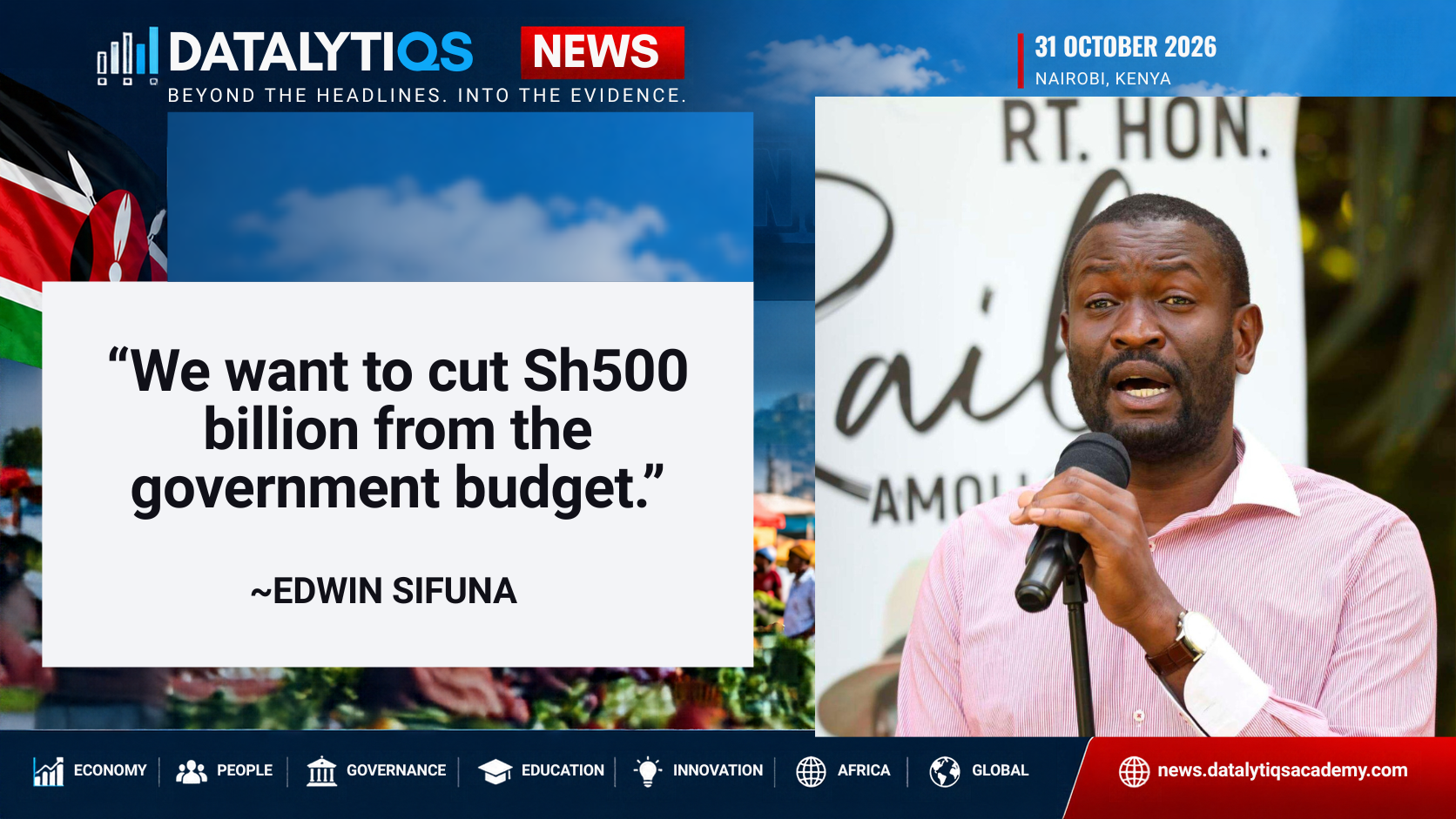
At the launch of the Linda Mwananchi political party, Nairobi Senator Edwin Sifuna promised to eliminate Sh500 billion in government expenditure, abolish taxes on fuel and electricity, and scrap the Affordable Housing Levy. The proposal targets Kenya’s cost-of-living pressures, but its fiscal credibility depends on identifying actual savings, replacing lost revenue and protecting essential services.
NAIROBI, KENYA — 31 October 2026
Nairobi Senator Edwin Sifuna has unveiled an ambitious fiscal reform proposal that would cut Sh500 billion from Kenya’s national budget while removing selected taxes and levies affecting households and businesses.
Speaking on Friday, October 30, during the launch of the Linda Mwananchi Movement’s party headquarters in Lavington, Nairobi, Sifuna pledged to reduce government waste and redirect resources towards easing the cost of living if elected President in 2027.
“We want to cut Sh500 billion from the government budget and, once we have done that, return the money to Kenyans.”
His proposed measures include eliminating taxes on fuel and electricity, abolishing the Affordable Housing Levy and reducing what he describes as excessive expenditure within the Presidency and other government institutions.
Sifuna also criticised the government’s spending priorities, questioning why public resources continued to support administrative expenditure while health workers and other public-sector employees faced unresolved employment grievances.
The proposal introduces one of the most consequential fiscal questions in the emerging 2027 political debate:
Where exactly would Sh500 billion in annual expenditure reductions come from, and would those savings be sufficient to finance the promised tax relief without undermining public services?
The answer requires an examination of Kenya’s approved budget, the distinction between discretionary and legally committed expenditure, and the financial consequences of reducing government revenue.
The Sh500 Billion Promise: What Sifuna Actually Proposed
At the launch, Sifuna said a Linda Mwananchi administration would prioritise eliminating government wastage during its first 100 days.
He identified expenditure at State House as an example of what he considers excessive administrative spending.
He also promised relief from taxes and levies contributing to the cost of fuel, electricity and housing.
The proposal combines two distinct fiscal interventions.
The first is expenditure rationalisation: reducing or eliminating government spending considered unnecessary, inefficient or excessively costly.
The second is tax reduction: lowering the compulsory payments collected from households and businesses.
These interventions affect different sides of the national budget.
Expenditure reductions decrease government financial obligations.
Tax reductions decrease government revenue.
For the package to remain fiscally sustainable, the government would need to establish whether the proposed expenditure savings can accommodate the resulting revenue losses.
Sifuna’s public remarks, as reported by The Standard and The Star, did not identify the complete list of expenditure votes to be reduced or provide a detailed estimate of the revenue that would be lost through the proposed tax changes.
That missing breakdown is central to evaluating the proposal.
How Large Is Sh500 Billion in Kenya’s Budget?
Kenya’s Parliamentary Budget Office reports total approved budgetary allocations of approximately Sh4.85 trillion for the 2026/27 financial year.
The amount comprises ministerial expenditure, Consolidated Fund Services and transfers to county governments.
The Parliamentary Budget Office identifies approximately Sh2.92 trillion in ministerial expenditure, including Sh2.08 trillion in recurrent expenditure and Sh844.4 billion in development expenditure.
Consolidated Fund Services account for approximately Sh1.5 trillion, while equitable-share transfers to counties amount to Sh428 billion.
Against the Sh4.85 trillion total, Sifuna’s proposed Sh500 billion reduction represents approximately 10.3 per cent of the national budget.
However, comparing the target with the total budget can be misleading.
Not every shilling appropriated by Parliament is equally available for discretionary cuts.
Some allocations finance legally required obligations, debt-related payments, public-sector compensation, pensions and constitutionally mandated transfers.
Others support ongoing contracts, infrastructure projects and essential public services.
The actual fiscal space available for expenditure reductions is therefore considerably more constrained than the headline budget total might suggest.
Kenya’s 2026/27 Budget: Where the Money Goes
The Parliamentary Budget Office’s classification provides a useful starting point.
| Budget component | Allocation |
|---|---|
| Ministerial recurrent expenditure | Sh2.08 trillion |
| Ministerial development expenditure | Sh844.4 billion |
| Consolidated Fund Services | Approximately Sh1.5 trillion |
| Equitable-share transfers to counties | Sh428 billion |
| Total budgetary allocations | Approximately Sh4.85 trillion |
Figures are rounded from the Parliamentary Budget Office’s FY 2026/27 budget explainer. Components may not sum exactly because of rounding.
Ministerial recurrent expenditure includes personnel costs, operations, maintenance and programme administration.
Development expenditure finances capital projects and other development-related programmes.
Consolidated Fund Services cover obligations including public debt-related payments, pensions and specified constitutional responsibilities.
Transfers to counties finance devolved public services and development responsibilities.
The distinction matters because reducing spending in one category can have consequences different from reductions in another.
Cutting nonessential administrative expenditure may improve efficiency without materially affecting frontline services.
Cutting hospital supplies, school funding, road maintenance or development commitments may reduce expenditure while simultaneously diminishing service delivery.
A credible savings programme must therefore identify the actual expenditure items rather than relying solely on broad classifications.
The State House Question: Can It Deliver Sh500 Billion?
Sifuna specifically criticised expenditure associated with State House.
According to reporting based on the approved 2026/27 estimates, State House was allocated approximately Sh13.54 billion.
Of this amount, Sh12.52 billion was recurrent expenditure and Sh1.03 billion was development expenditure.
The allocation finances the institution’s administrative and operational responsibilities, including State House and State Lodges.
Sifuna questioned the allocation against the financial demands facing public services, particularly healthcare.
However, the arithmetic places an important limit on what reductions to this institution could achieve.
Even eliminating the entire reported Sh13.54 billion allocation would account for only about 2.7 per cent of the proposed Sh500 billion savings target.
That hypothetical elimination is not a realistic policy recommendation, since the institution performs constitutionally relevant executive functions.
It demonstrates the scale of the broader reductions required.
A reduction of 20 per cent in the State House allocation would yield approximately Sh2.71 billion.
A reduction of 50 per cent would yield approximately Sh6.77 billion.
These would be substantial reductions within the institution itself, but they would remain small relative to the national target.
Therefore, achieving Sh500 billion would require expenditure changes across multiple government programmes and institutions.
The Difference Between Waste and Budgeted Expenditure
One of the most important analytical distinctions is between expenditure that is legally authorised and expenditure that is genuinely wasteful.
A budget allocation does not automatically establish waste.
Government spending becomes questionable when evidence demonstrates unnecessary expenditure, procurement irregularities, inflated prices, duplication, nonperformance or failure to achieve intended outcomes.
Similarly, the existence of an administrative budget does not mean every item within it can be removed without consequences.
A rigorous expenditure review would require examination of the actual budget lines, procurement contracts, expenditure returns and audit findings.
For example, eliminating duplicate software subscriptions may create savings without reducing public services.
Cancelling a nonessential consultancy contract may release resources, subject to its contractual terms.
Reducing procurement overpricing may improve value for money.
However, cutting expenditure on medicine, teacher salaries or road maintenance could have direct service-delivery consequences.
The distinction is essential because budget cuts are not automatically efficiency gains.
A genuine efficiency gain occurs when government achieves the same or better public outcomes using fewer resources.
Where Could the Sh500 Billion Come From?
Several expenditure categories could be examined for potential savings.
Administrative overheads, travel, hospitality, vehicle procurement, consultancy contracts and duplicated programmes are frequently cited in public expenditure debates.
Government procurement could also be reviewed for inflated prices, unnecessary contracts and weak competitive procedures.
State corporations and public agencies may present opportunities for restructuring where their mandates overlap or their operations are inefficient.
Delayed or low-priority development projects could be reconsidered through formal budget processes.
However, each category requires supporting data.
An assertion that government is wasteful does not establish the amount recoverable from that waste.
Nor does an audit finding automatically mean that the entire questioned expenditure can be recovered as cash.
Some audit findings concern documentation, compliance, valuation or accounting deficiencies rather than expenditure that can simply be cancelled.
To demonstrate Sh500 billion in achievable savings, a proposed reform programme would need to identify specific expenditure lines, estimated reductions, implementation timelines and the institutions responsible.
It would also need to distinguish recurring annual savings from one-off reductions.
This distinction matters because permanent tax cuts require a sustainable fiscal financing arrangement, not merely temporary expenditure reductions.
What Would a Sh500 Billion Savings Plan Need to Show?
A complete fiscal proposal should reconcile the savings target with the approved budget.
| Required information | Why it matters |
|---|---|
| Specific ministry or agency | Identifies the institution affected |
| Programme and budget line | Establishes exactly what would be reduced |
| Current approved allocation | Provides the expenditure baseline |
| Proposed reduction | Quantifies the savings |
| Legal or contractual obligations | Identifies implementation constraints |
| Service-delivery consequences | Establishes possible effects on citizens |
| Implementation timetable | Distinguishes immediate from future savings |
| Independent verification | Allows Parliament and the public to assess results |
Without this information, the Sh500 billion remains a political fiscal target rather than a fully costed expenditure-reduction programme.
The Fuel Tax Proposal: What Would Actually Be Removed?
Sifuna has promised to remove taxes on fuel.
However, fuel prices incorporate several different statutory charges and cost components.
Petroleum taxation includes value-added tax, excise-related charges and other applicable levies.
Some levies finance specified public purposes, including road maintenance and petroleum-sector functions.
A proposal to eliminate fuel taxes therefore requires precision.
Would the government remove VAT on petroleum products?
Would it abolish excise duty?
Would it remove specific petroleum levies?
Would it retain road-maintenance financing through an alternative mechanism?
The financial implications differ considerably depending on which charges are affected.
Eliminating a tax may reduce the statutory tax component of fuel prices, but the eventual retail price also depends on international petroleum costs, exchange rates, transportation, margins and the applicable pricing formula.
A credible proposal would therefore quantify both the expected revenue loss and the potential effect on pump prices.
It would also need to explain how programmes financed by earmarked levies would continue operating.
Electricity Taxes: Would Lower Charges Reduce Household Bills?
Electricity bills contain several components beyond the underlying energy charge.
These can include applicable taxes, statutory levies, fuel-cost adjustments, foreign-exchange adjustments and other regulated charges.
Consequently, a promise to remove electricity taxes requires clarification about the exact charges targeted.
Some components represent government revenue.
Others recover costs associated with electricity generation, transmission or distribution.
Removing a statutory tax is not equivalent to eliminating the economic cost of producing electricity.
If government were to abolish selected charges, the resulting reduction in consumer bills would depend on the size of those charges and the remaining tariff components.
The legal process would also depend on whether the relevant charge is established by tax legislation, subsidiary legislation or a regulatory tariff decision.
The proposal should therefore distinguish tax relief from electricity-sector pricing reform.
Scrapping the Housing Levy: Immediate Relief, Long-Term Obligations
Sifuna has also promised to abolish the Affordable Housing Levy.
Under the existing framework, employees contribute 1.5 per cent of gross monthly salary, with employers required to make a corresponding contribution.
Removing the levy would increase affected employees’ take-home pay and reduce the corresponding employer contribution.
However, the Affordable Housing Levy is established through legislation.
A future administration could not simply abolish the statutory obligation through a political announcement.
Repeal or amendment would require the appropriate legislative process.
The fiscal implications would extend beyond household deductions.
The government would need to establish the levy revenue affected, the status of ongoing housing projects and any contractual or financing commitments supported by the programme.
It would also need to determine whether existing affordable-housing obligations would continue through alternative funding.
The decision would therefore involve both tax policy and the financing of an established public programme.
The Revenue Problem: Savings Are Not Automatically Available for Tax Relief
Sifuna’s proposal is built around returning resources to households through reduced taxation.
However, the government must distinguish expenditure savings from revenue foregone.
Suppose a government identifies Sh500 billion in sustainable annual expenditure reductions.
If the proposed tax measures reduce annual revenue by Sh300 billion, the remaining Sh200 billion could potentially improve the fiscal balance or finance other priorities, subject to the wider budget position.
If the tax measures instead reduce revenue by Sh600 billion, the government would face a Sh100 billion gap even after achieving the entire expenditure-reduction target.
These are illustrative scenarios, not estimates of Sifuna’s actual programme.
The central requirement is a properly costed fiscal statement showing the expected revenue effects of each proposed tax measure.
Without those estimates, it is impossible to determine whether the Sh500 billion target would be sufficient.
Public Debt: Why Kenya Cannot Treat Every Budget Item as Discretionary
Public debt obligations represent another major constraint.
Kenya’s 2026/27 parliamentary budget deliberations identified substantial debt-service requirements.
The National Assembly’s June 2026 Hansard recorded projected public debt service of approximately Sh2.31 trillion, comprising around Sh1.25 trillion in interest and Sh1.06 trillion in principal repayments.
These figures require careful interpretation because principal repayments and interest payments are not economically identical.
Interest is a financing cost.
Principal repayment reduces an existing debt obligation and may be financed partly through refinancing.
Both create cash-flow and financing requirements, but they should not simply be added to ordinary programme expenditure without accounting for the relevant budget framework.
A government cannot ordinarily create fiscal savings by declining to meet lawful debt obligations without potentially serious consequences for creditworthiness, borrowing costs and financial stability.
Debt restructuring, refinancing and liability-management operations are separate policy instruments requiring their own analysis.
This limits the extent to which the headline budget can be treated as immediately available for discretionary reductions.
What Happens to Public Services?
The consequences of expenditure reductions depend on where they occur.
Savings from unnecessary procurement, duplicated administration or inflated contracts may release resources for public services.
However, reductions affecting frontline personnel, medical supplies, education funding or infrastructure maintenance could reduce the quality or availability of those services.
The effect on county governments would also require examination.
Counties finance substantial responsibilities in healthcare, agriculture and other devolved functions.
Changes affecting transfers, conditional allocations or national programmes supporting devolved services could have consequences for county budgets.
Any proposed expenditure-reduction programme should therefore include an assessment of service-delivery risks.
The relevant indicators would include staffing, service coverage, waiting times, infrastructure functionality and programme outputs.
A reform should be evaluated not merely by the amount removed from the budget, but by the public outcomes achieved after the reduction.
Nurses’ Strikes and the Question of Government Priorities
During the Linda Mwananchi launch, Sifuna compared expenditure at State House with funding demands from striking nurses.
His argument was that government could redirect resources from administrative spending towards essential public services.
The comparison illustrates a question of expenditure priorities, but the financial amounts require consistent interpretation.
An institutional budget may cover numerous activities, while a strike-related funding demand may concern a particular collective bargaining agreement, arrears or employment obligation.
The two amounts cannot be treated as directly interchangeable without examining their underlying expenditure classifications.
Resolving public-sector labour disputes may require recurrent funding for salaries and benefits, not merely a one-time transfer.
Consequently, a government proposing to finance collective bargaining agreements through administrative savings would need to establish that the savings are recurring and legally available for that purpose.
The First 100 Days: What Could Legally Be Achieved?
Sifuna has identified the first 100 days of a prospective administration as the period in which he would begin reducing wasteful expenditure.
A new administration could initiate expenditure reviews, procurement audits and administrative reforms during that period.
However, implementing substantial budget reductions would depend on the applicable public finance procedures.
Kenya’s Constitution assigns Parliament a central role in authorising public expenditure.
The Public Finance Management Act establishes requirements for budget preparation, implementation and adjustment.
Where changes require supplementary appropriations or amendments to legislation, the Executive would need to follow the relevant procedures.
Similarly, abolishing statutory taxes and levies would require appropriate legislative action.
The first 100 days could therefore be used to identify savings, introduce legislative proposals and begin administrative reforms.
That is different from demonstrating that Sh500 billion in annual savings had already been realised.
A credible implementation timetable would distinguish proposed legislation, approved changes, expenditure commitments cancelled and cash savings actually achieved.
Sifuna Criticises Ruto’s Football Announcement Amid Russia Concerns
Sifuna’s economic proposals were accompanied by criticism of President Ruto’s announcement concerning a proposed exhibition football match involving Bayern Munich and Ajax Amsterdam.
According to The Standard, Sifuna questioned the government’s priorities while reports circulated about Kenyans facing difficulties in Russia, including individuals allegedly recruited into the Russia–Ukraine war.
He argued that the President should have prioritised efforts to assist affected citizens.
The criticism concerns a separate public-policy question: the government’s responsibility to provide consular assistance and respond to the welfare of Kenyans abroad.
However, the number of affected citizens, their circumstances and the status of any repatriation efforts require verification through official records.
The reported football proposal should also be distinguished from a confirmed event with finalised contracts, expenditure and scheduling.
An announcement about a proposed exhibition match does not independently establish the amount of public money committed to it.
Nor does the announcement establish that consular assistance was unavailable or had been discontinued.
A meaningful accountability assessment would examine the Ministry of Foreign and Diaspora Affairs’ documented response, verified consular cases and any official expenditure commitments associated with the proposed sporting event.
The Political Context: Linda Mwananchi Enters the 2027 Debate
Sifuna presented the proposals during the October 30 launch of the Linda Mwananchi Movement’s political headquarters in Nairobi.
The event brought together opposition figures including former Deputy President Rigathi Gachagua, Wiper leader Kalonzo Musyoka and Democratic Action Party of Kenya leader Eugene Wamalwa.
The gathering was part of wider efforts to coordinate opposition political activity ahead of the 2027 General Election.
However, attendance at a political event does not establish agreement on every policy proposal.
Nor does it confirm the final selection of a common presidential candidate.
The Sh500 billion proposal should therefore be understood as a policy commitment publicly advanced by Sifuna.
Whether it becomes part of a formally adopted coalition manifesto would depend on subsequent political and institutional decisions.
DatalytIQs Fiscal Intelligence Assessment
Sifuna’s proposal raises several measurable questions.
First, the Sh500 billion target is substantial. It represents approximately 10.3 per cent of the 2026/27 national budget and would require expenditure reductions across multiple institutions or programmes.
Second, the State House allocation cannot independently finance the target. Its reported Sh13.54 billion allocation is only a small fraction of the proposed savings.
Third, the source of savings remains unspecified. The reports reviewed do not provide a ministry-by-ministry or programme-by-programme reduction schedule.
Fourth, tax abolition creates a separate revenue challenge. The government would need to estimate the revenue lost from fuel taxes, electricity charges and the housing levy.
Fifth, legal implementation would require institutional action. Statutory tax changes, appropriations and expenditure adjustments must comply with applicable legislation.
Sixth, service delivery must be protected and measured. Savings achieved through genuine efficiency improvements differ from reductions that merely transfer costs to citizens or weaken public services.
Seventh, timing matters. Announcing cuts, obtaining legal authority and realising cash savings are separate implementation stages.
These considerations provide a basis for examining the fiscal proposal without assuming that it is either achievable or unachievable before a detailed costed programme is available.
The Documents That Would Test the Sh500 Billion Proposal
An independent assessment should begin with the approved 2026/27 national budget and the relevant programme-based expenditure estimates.
The proposed reductions should then be reconciled with actual expenditure and existing contractual obligations.
The National Treasury’s financial statements and the Controller of Budget’s implementation reports would help establish spending patterns.
The Auditor-General’s reports could identify weaknesses requiring corrective action, although audit findings would need to be examined individually before assigning recoverable savings.
The Kenya Revenue Authority’s tax-revenue data would be necessary to estimate the fiscal consequences of eliminating selected taxes and levies.
The Parliamentary Budget Office could provide independent analysis of the implications for expenditure ceilings, fiscal deficits and public services.
Together, these records would permit a comparison between the proposed savings and the actual financing requirements of the tax-relief programme.
Conclusion: Sh500 Billion Is a Target. The Budget Must Show the Savings.
Edwin Sifuna has placed expenditure reduction and tax relief at the centre of his emerging economic programme.
His proposal addresses concerns about the cost of living, public spending priorities and the financing of essential services.
However, a commitment to reduce expenditure by Sh500 billion requires a detailed explanation of the budget lines to be affected.
The removal of fuel taxes, electricity taxes and the housing levy would also require estimates of lost revenue, lawful implementation procedures and arrangements for programmes currently financed by those charges.
The central fiscal question is not simply whether government expenditure can be reduced.
It is whether the proposed reductions are identifiable, recurring, legally achievable and sufficient to support the promised tax relief without undermining essential services or worsening the fiscal balance.
Sh500 billion is a measurable promise. Its credibility will ultimately depend on a measurable budget: which expenditure disappears, how much revenue is lost, and what happens to the services Kenyans depend upon.
DatalytIQs News — Beyond the Headlines. Into the Evidence.
Sources and References
- The Standard — We expected a rescue plan, not a football match announcement: Sifuna faults Ruto, 31 October 2026. Reporting on Sifuna’s fiscal proposals and criticism of the President’s football announcement.
- The Star — Sifuna vows to scrap fuel, electricity and housing levies using Sh500bn budget cuts, 30 October 2026. Reports the proposed spending reductions, tax changes and State House allocation.
- The Star — Opposition bets on Kibaki’s 2002 playbook to beat Ruto, 31 October 2026. Political context of the Linda Mwananchi launch.
- Parliamentary Budget Office — Publications and Budget Explainers. FY 2026/27 approved budget classifications and expenditure totals.
- Parliament of Kenya — Appropriation Act, 2026, 26 June 2026. Parliamentary report on the approved national budget and county allocations.
- National Treasury — FY 2026/27 Budget Highlights. Official budget priorities and sector allocations.
- National Assembly Hansard — 9 June 2026. Parliamentary discussion of debt service and expenditure obligations.
- Office of the Controller of Budget. Public expenditure implementation oversight.
- Office of the Auditor-General. Public-sector financial and performance audits.
- Kenya Law. Constitution of Kenya, Public Finance Management Act and applicable tax legislation.