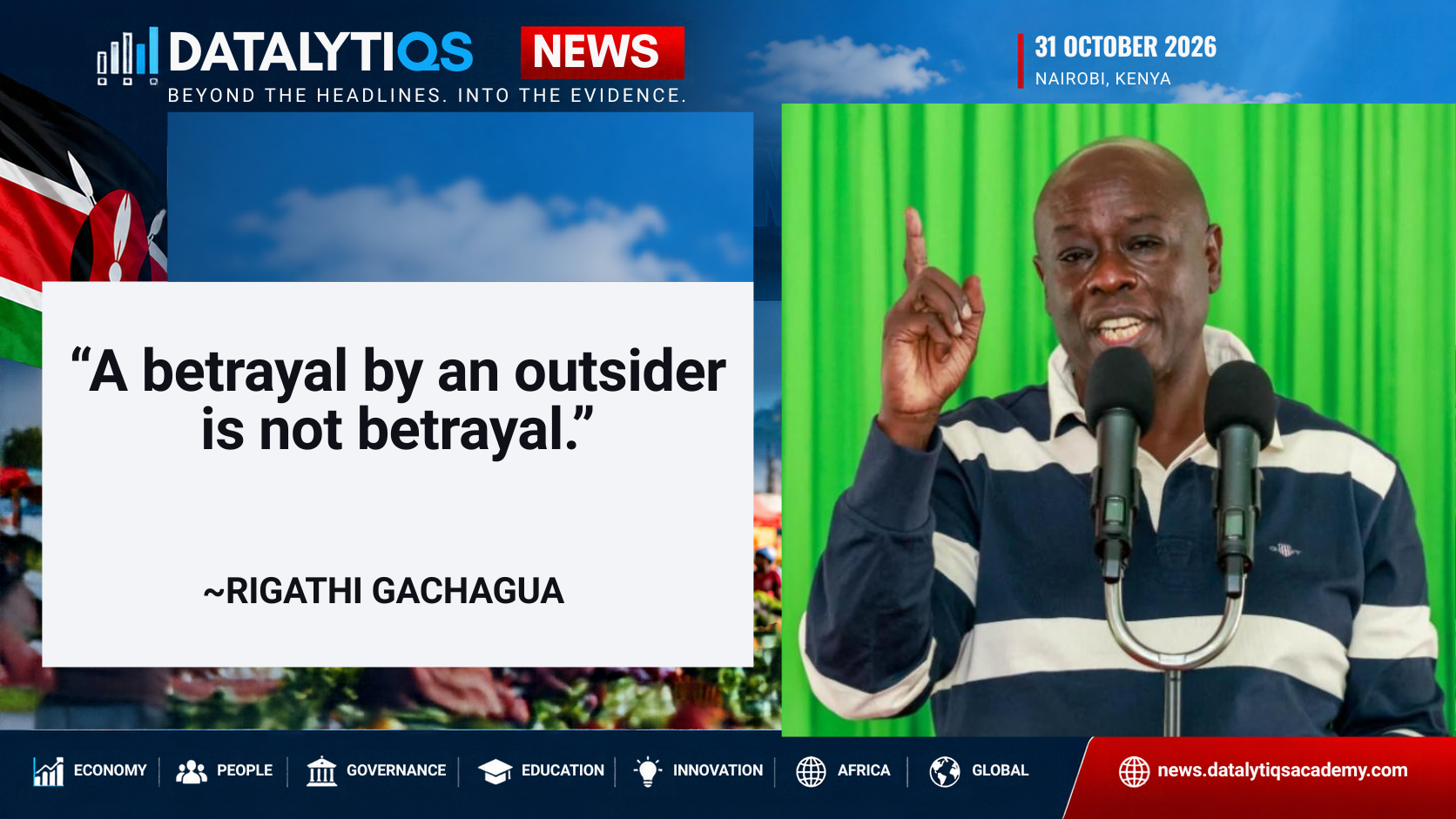
Former Deputy President Rigathi Gachagua says he holds no grudge against ODM Secretary-General Edwin Sifuna over his role in the 2024 impeachment process. His explanation offers a revealing distinction between political opposition and betrayal by trusted allies, but it also raises questions about the durability of emerging opposition relationships ahead of Kenya’s 2027 General Election.
NAIROBI, KENYA — 31 October 2026
Former Deputy President Rigathi Gachagua has explained why he does not blame Orange Democratic Movement (ODM) Secretary-General Edwin Sifuna for participating in the political process that culminated in his impeachment in October 2024.
Gachagua argues that Sifuna was operating from an opposing political camp and therefore owed him no obligation of political loyalty.
His position is captured in a pointed observation:
“A betrayal by an outsider is not betrayal.”
The former Deputy President distinguished Sifuna’s actions from those of politicians who had supported his rise to office, served alongside him in the Kenya Kwanza administration or previously presented themselves as his political allies.
The distinction provides an insight into Gachagua’s interpretation of political loyalty and his willingness to reconsider relationships with former opponents.
It also raises a broader question about Kenya’s changing opposition politics: Can politicians who once worked against one another establish a credible political partnership without first agreeing on policy, leadership and electoral strategy?
Gachagua’s Argument: Political Opposition Is Not Personal Betrayal
Gachagua’s explanation rests on the difference between an adversary and an ally.
During the 2022 General Election, Gachagua was William Ruto’s running mate on the Kenya Kwanza presidential ticket.
Sifuna, meanwhile, was elected Nairobi Senator on an ODM ticket and belonged to the political formation that opposed Ruto’s presidential campaign.
Their political positions were therefore fundamentally different.
When Gachagua faced impeachment in 2024, Sifuna’s participation occurred within an established relationship of political opposition.
Gachagua now argues that he cannot reasonably describe such conduct as betrayal because Sifuna had never pledged political loyalty to him.
In contrast, he considers the actions of former Kenya Kwanza allies through the expectations created by their earlier political association.
This is Gachagua’s personal and political interpretation of the events.
It should not be confused with a legal determination about the motivations of individual legislators or the validity of the impeachment proceedings.
The 2024 Impeachment That Changed Kenya’s Political Landscape
Gachagua’s removal from office was one of the most consequential political developments of President Ruto’s first term.
On 8 October 2024, the National Assembly voted to impeach the Deputy President.
The motion was supported by 281 Members of Parliament, exceeding the constitutionally required threshold.
The charges concerned allegations relating to constitutional violations, misconduct and abuse of office.
Gachagua denied wrongdoing and challenged the process.
The Senate subsequently considered the impeachment charges and, on 17 October 2024, upheld sufficient grounds for his removal.
The proceedings involved constitutional and parliamentary processes rather than a simple political vote of no confidence.
Nevertheless, the substantial parliamentary support for his removal demonstrated how dramatically his relationship with the governing coalition had deteriorated.
The impeachment also revealed the extent to which politicians from different parliamentary formations could converge on a particular institutional decision despite their wider political disagreements.
That convergence did not necessarily mean those politicians had entered a lasting electoral alliance.
Why Gachagua Feels Betrayed by Former Allies
Gachagua’s explanation places greater emphasis on politicians who had previously supported his leadership within Kenya Kwanza.
The former Deputy President had campaigned alongside President Ruto and other coalition leaders in 2022.
Their political partnership helped deliver the presidential victory that brought the administration to office.
His subsequent removal represented a fundamental breakdown in that relationship.
From Gachagua’s perspective, political actors who had previously expressed loyalty to him were subject to different expectations from those who had consistently opposed him.
However, political betrayal is a subjective description of changing loyalties.
A legislator’s decision to support impeachment must also be assessed within the constitutional responsibilities of Parliament.
The legal question concerns whether the impeachment complied with the Constitution and applicable procedures.
The political question concerns why legislators supported it and how their decisions affected relationships within the governing coalition.
Those questions should be examined separately.
Edwin Sifuna’s Position in ODM
Sifuna occupies an influential position as ODM Secretary-General and Nairobi Senator.
He has frequently taken positions critical of the Ruto administration, including on governance, taxation and public accountability.
His political profile has also become significant amid disagreements within ODM over the party’s relationship with the President.
Some ODM leaders favour continued cooperation with the administration and have discussed possible arrangements ahead of the 2027 General Election.
Others have raised concerns about the party’s independence, its opposition mandate and the conditions under which it should enter future political agreements.
Sifuna’s public positions have made him an important figure in these debates.
However, his individual political views should not automatically be treated as the final institutional position of ODM.
The party’s formal decisions remain subject to its recognised governing structures and applicable rules.
This distinction becomes especially important when discussing possible cooperation with Gachagua.
From Political Adversaries to Potential Partners
Kenyan political history contains numerous examples of leaders who moved from rivalry to cooperation.
Such realignments often emerge when electoral interests change, governing coalitions fracture or political actors identify common objectives.
Gachagua and Sifuna have a potentially shared political interest in scrutinising the Ruto administration.
That shared interest could support cooperation on particular issues.
However, opposition to the same government does not automatically establish agreement on how the country should be governed.
Politicians may agree on constitutional accountability while disagreeing on taxation, devolution, economic policy or electoral nominations.
They may also agree to cooperate politically without joining the same party or signing a coalition agreement.
Consequently, Gachagua’s willingness to forgive Sifuna should be understood as a possible reduction in personal political hostility.
It is not, by itself, evidence that a formal alliance has been concluded.
Three Levels of Political Reconciliation
The emerging relationship can be examined at three distinct levels.
Personal reconciliation
This occurs when political leaders decide to set aside past grievances and engage without hostility.
Gachagua’s remarks fall most clearly within this category.
By distinguishing Sifuna’s opposition from the conduct of former allies, he creates room for future dialogue.
However, personal reconciliation does not establish any institutional commitment.
Policy cooperation
This involves agreement on particular public issues, such as constitutional governance, economic management, electoral reforms or accountability.
Such cooperation can occur through parliamentary voting, joint policy statements or coordinated political activity.
It does not necessarily require a formal electoral coalition.
Electoral coalition
This involves a more substantial political arrangement concerning candidates, party responsibilities, campaign coordination or the formation of a government.
A formal coalition may require approval through party institutions and compliance with the Political Parties Act.
No such agreement between Gachagua and Sifuna is established by the reported forgiveness statement.
Confusing these three levels risks overstating the significance of political gestures.
What Would a Gachagua–Sifuna Political Understanding Actually Mean?
Any future cooperation would require clarity about the capacity in which each politician was acting.
Gachagua leads the Democracy for the Citizens Party, commonly known as DCP.
Sifuna remains associated with ODM through his position as Secretary-General.
The two politicians therefore operate within different party structures.
A personal understanding between them would not automatically bind either party.
For a formal interparty arrangement, the relevant institutions would need to establish the objectives, scope and authorisation of the proposed cooperation.
Such an arrangement could involve coordinated opposition activity without necessarily requiring either politician to leave their party.
Alternatively, a future electoral alliance could raise more complex questions about party nominations, candidate selection and coalition governance.
Those possibilities remain hypothetical unless supported by formal announcements or documented decisions.
The ODM Question: Can Sifuna Cooperate With Gachagua While the Party Negotiates With UDA?
The political significance of Gachagua’s remarks becomes clearer against the background of ODM’s ongoing debate over cooperation with President Ruto’s UDA.
Senior ODM politicians have expressed different views about the conditions for any future arrangement.
Homa Bay Governor and ODM Chairperson Gladys Wanga has advocated a 50–50 power-sharing formula.
Migori Woman Representative Fatuma Mohammed has insisted that cooperation should be formalised through party institutions.
Homa Bay Senator Moses Kajwang’ has called for caution based on historical coalition experiences.
Other politicians, including Mark Nyamita and Jared Okello, have emphasised political goodwill and questioned whether written agreements can guarantee compliance.
These differences demonstrate that ODM’s future political direction remains contested.
Sifuna’s relationship with Gachagua therefore raises a significant institutional question.
Could cooperation with an opposition figure remain compatible with ODM’s official position if the party eventually enters a formal electoral arrangement with UDA?
The answer would depend on the nature of the cooperation, ODM’s governing rules and any obligations adopted by the party.
It cannot be determined solely from personal statements by individual politicians.
Political Forgiveness Is Not a Coalition Agreement
Gachagua’s remarks should not be interpreted as an announcement that he and Sifuna have agreed to support the same presidential candidate.
Nor do they establish a common manifesto, shared campaign structure or agreement on the allocation of political positions.
A formal electoral partnership would require considerably more information.
The participating parties would need to determine their political objectives, nomination arrangements and decision-making procedures.
They would also need to address how disagreements would be resolved.
Where the arrangement constitutes a coalition under Kenya’s Political Parties Act, the applicable statutory requirements and party approval procedures would become relevant.
Until such decisions are documented, the relationship is best understood through the public statements and observable political actions of the individuals involved.
The 2027 Presidential Candidate Question
One of the most consequential challenges facing any broad opposition arrangement is candidate selection.
Political figures may agree that they want to challenge an incumbent President while disagreeing over who should lead that challenge.
A common opposition platform would need to determine whether it intends to support a single presidential candidate or pursue separate electoral strategies.
It would also need to establish how participating parties would select parliamentary, gubernatorial and county assembly candidates.
These decisions can become contentious where parties have competing local support bases.
Gachagua’s reconciliation with Sifuna does not resolve those questions.
Neither does it demonstrate that Sifuna has endorsed Gachagua for the presidency or that Gachagua has accepted another politician’s leadership.
Such conclusions would require separate evidence.
The Electoral Geography of a Possible Alliance
The political interest in cooperation between Gachagua and Sifuna is partly connected to their different regional and electoral networks.
Gachagua’s political base has been associated strongly with Mount Kenya.
Sifuna’s prominence comes through Nairobi politics and his national role within ODM.
A political understanding involving figures from these constituencies could attract attention because of the possibility of cooperation across established political divides.
However, the electoral implications should not be overstated.
An individual politician’s popularity does not automatically transfer to another candidate.
Similarly, cooperation between political leaders does not establish that their supporters will vote as a unified bloc.
A credible electoral assessment would require constituency-level voting data, party organisation indicators and reliable measures of voter preferences.
Public rallies, endorsements and social-media engagement can provide information about political mobilisation.
They cannot independently establish future electoral outcomes.
Can Former Adversaries Build a Common Policy Agenda?
The durability of any political relationship depends partly on whether the participants can agree on substantive issues.
For Gachagua and Sifuna, potential areas of convergence could include constitutional accountability, parliamentary oversight and criticism of government policy.
However, these are possibilities requiring verification through actual policy statements and political conduct.
The two politicians’ positions would need to be compared on economic policy, taxation, devolution, public debt, institutional reforms and public-service delivery.
Differences in these areas could become important if informal cooperation developed into a formal political arrangement.
A common opposition identity may be sufficient for coordinated criticism of government.
It is not necessarily sufficient for governing together.
The distinction matters because electoral coalitions must eventually address decisions involving budgets, legislation and executive responsibilities.
The Risk of Alliances Built Primarily Around Personal Grievances
Political realignments sometimes emerge from disputes over leadership, exclusion from government or disagreements within ruling coalitions.
Such experiences can provide a strong initial incentive for cooperation.
However, personal grievances do not automatically translate into a coherent governing programme.
An alliance built mainly around opposition to a particular leader may encounter difficulties when required to make decisions on public policy or candidate selection.
That risk is relevant to any emerging opposition formation, not specifically to Gachagua and Sifuna.
A stronger institutional basis would involve clearly articulated objectives, agreed procedures and measurable policy commitments.
For voters, the central question should extend beyond whether former rivals have forgiven one another.
It should include what they propose to do differently if entrusted with public office.
DatalytIQs Political Intelligence Assessment
Gachagua’s explanation provides several insights into Kenya’s changing political relationships.
First, political reconciliation can be selective. Gachagua distinguishes conduct by established opponents from actions by politicians he previously regarded as allies.
Second, personal forgiveness can facilitate dialogue. It may remove an obstacle to engagement without creating a formal political obligation.
Third, shared opposition does not establish policy agreement. Politicians must still demonstrate convergence on substantive governance questions.
Fourth, institutional authority remains essential. Individual politicians cannot automatically commit their parties to electoral arrangements without the required approval.
Fifth, candidate selection remains unresolved. Any future opposition coalition would need procedures for determining leadership and coordinating electoral nominations.
Sixth, electoral arithmetic requires evidence. The political networks of individual leaders cannot simply be added together to predict voting outcomes.
These considerations suggest that Gachagua’s statement is significant as a signal of political openness, but insufficient to establish the existence or likely success of a future alliance.
What Should Be Monitored Next?
Several developments would help determine whether the reconciliation has broader political consequences.
The first is whether Gachagua and Sifuna begin participating in coordinated political activities.
The second is whether they issue common statements on identifiable policy priorities.
The third is whether their respective party institutions authorise any structured cooperation.
The fourth concerns ODM’s ongoing negotiations with UDA and whether those discussions produce a formally approved agreement.
The fifth is the emergence of clear procedures for selecting presidential and other electoral candidates within any wider opposition formation.
Finally, attention should be paid to whether political cooperation produces a substantive programme addressing governance, public finance and service delivery.
These developments would provide stronger evidence of an emerging alliance than expressions of personal forgiveness alone.
Conclusion: Forgiveness Opens the Door, but Politics Requires More
Rigathi Gachagua’s explanation for forgiving Edwin Sifuna reflects his distinction between political opposition and betrayal by trusted allies.
He does not hold Sifuna to the same expectations of loyalty that he associates with former Kenya Kwanza colleagues.
The statement creates room for political engagement between two figures who previously occupied opposing camps.
However, it does not establish agreement on policy, party cooperation or electoral leadership.
Those questions would require separate decisions, formal commitments and observable political action.
Forgiving a former opponent may make cooperation possible. But only shared objectives, institutional approval and credible political commitments can turn reconciliation into a durable alliance.
As Kenya moves towards the 2027 General Election, the important question is not simply who has forgiven whom, but whether emerging political relationships can produce coherent alternatives that voters can evaluate.
DatalytIQs News — Beyond the Headlines. Into the Evidence.
Sources and References
- The Star — Kenya Politics — Reporting on Gachagua’s remarks concerning Edwin Sifuna and the 2024 impeachment. The precise article URL was not supplied.
- Parliament of Kenya — National Assembly and Senate records concerning the October 2024 impeachment proceedings.
- Kenya Law — Constitution of Kenya — Constitutional provisions concerning the Deputy Presidency, impeachment and parliamentary responsibilities.
- Kenya Law — Political Parties Act — Statutory requirements concerning political parties and coalition arrangements.
- Office of the Registrar of Political Parties — Official guidance on political party governance and coalition formation.