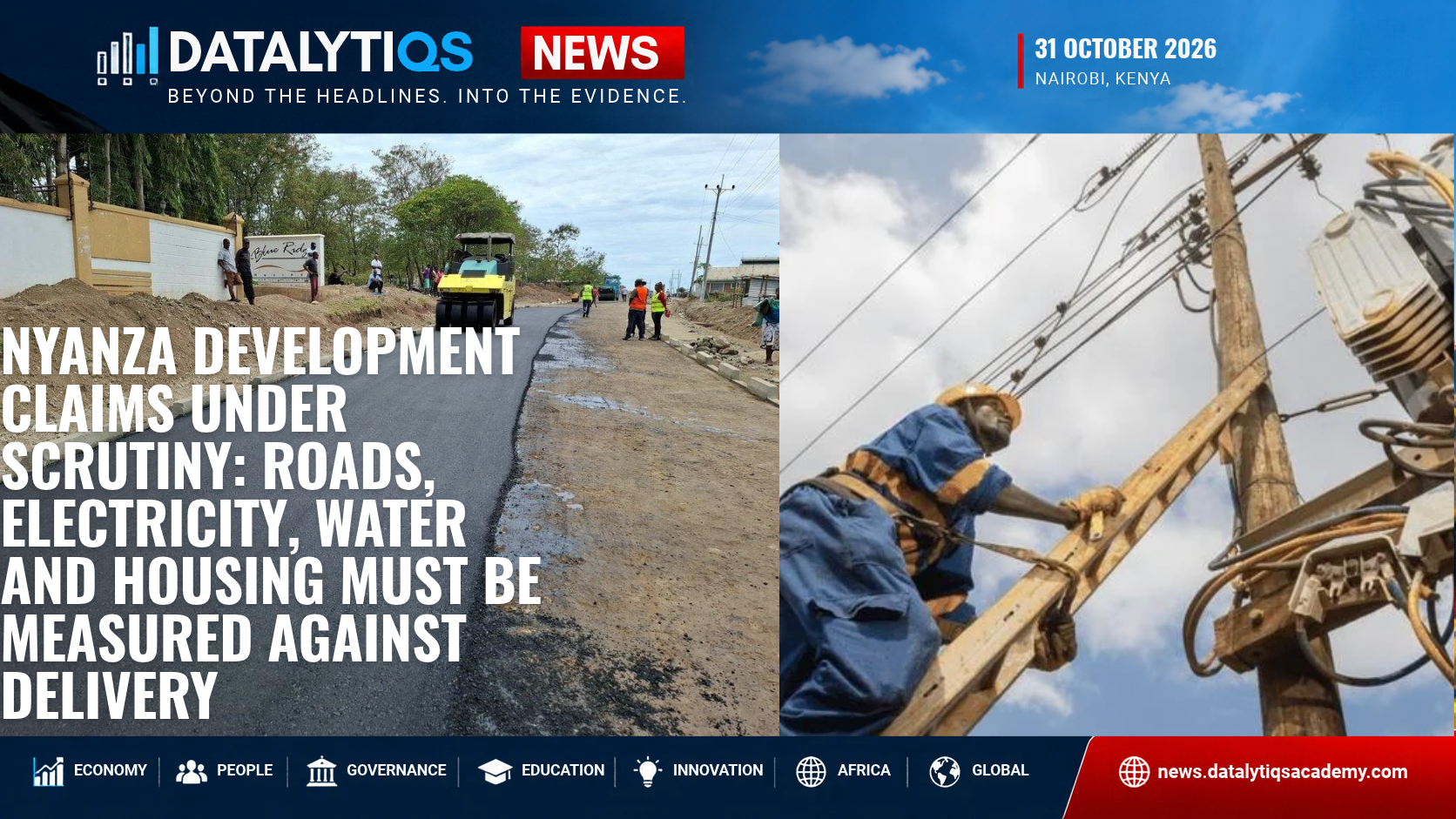
As political leaders highlight government investments across Nyanza, questions are emerging over how development promises compare with approved budgets, procurement records, completed infrastructure and the services actually reaching residents.
KISUMU, KENYA — 31 October 2026
Development has become an increasingly prominent subject in political discussions across Nyanza as Kenya approaches the 2027 General Election. Political allies of President William Ruto have pointed to road construction, rural electrification, water connections, affordable housing and market infrastructure as evidence of the national government’s commitment to the region.
The claims have featured in public engagements across Homa Bay and neighbouring counties, where leaders have highlighted infrastructure projects as examples of government investment.
However, a fundamental question remains: How much of the development being celebrated has actually been completed, commissioned and translated into measurable improvements in people’s lives?
The distinction is important. A project announcement is not evidence of construction. An approved budget does not establish that funds have been released. A signed contract does not demonstrate completion. Even completed infrastructure does not necessarily mean that residents are receiving reliable services.
For DatalytIQs News, the appropriate measure of development is not the number of projects mentioned in political speeches but the relationship between public commitments, financial expenditure, verified implementation and actual benefits to citizens.
Political Claims and the Development Debate
According to an October 1, 2026, report by the Kenya News Agency, political leaders attending a women’s and girls’ education and development forum in Mbita, Homa Bay County, defended the government’s development record in Nyanza.
National Assembly Majority Whip Silvanus Osoro cited investment in roads, electricity, water and affordable housing as evidence of the administration’s commitment to the region.
Suba North MP Millie Odhiambo highlighted the Rusinga Ring Road, while Homa Bay Woman Representative Joyce Bensuda referred to road development, including works on Mfangano Island.
These statements provide a useful starting point for public scrutiny because they identify sectors and locations where government performance can be independently examined.
They do not, however, establish the precise amounts spent, contractual progress, engineering quality or number of residents benefiting from each investment.
The appropriate response is neither to accept the claims without verification nor to dismiss them without examining the evidence.
Instead, each claim should be tested against official project records and observable outcomes.
Road Construction: From Announcements to Usable Infrastructure
Road construction is among the most visible forms of public investment.
In Nyanza, projects such as the Rusinga Ring Road and road works on Mfangano Island have been cited in political discussions about development.
Road projects can improve market access, reduce transport costs, facilitate movement to schools and health facilities, and support agricultural and commercial activity.
However, these benefits depend on whether the infrastructure is completed to specification, maintained and accessible throughout the year.
A credible assessment should establish the road’s approved scope, implementing agency, contractor, contract value, commencement date and scheduled completion date.
It should then determine how many kilometres have been completed and whether the completed sections meet the required engineering standards.
Road inspections should examine drainage, surface condition, bridges, culverts, road safety features and connectivity to existing transport networks.
For communities, the most meaningful indicators are practical.
Has travel time decreased? Are transport services more reliable? Can traders move produce to markets more easily? Are previously inaccessible areas connected during rainy seasons?
A road may be described as substantially complete while critical sections remain unusable.
Similarly, a newly constructed road may deteriorate prematurely because of inadequate drainage, construction defects or insufficient maintenance.
The relevant development outcome is therefore not merely kilometres constructed, but the accessibility, reliability and economic value of the resulting transport network.
Electrification: Installed Infrastructure Is Not the Same as Household Access
Rural electrification is another frequently cited development achievement.
Electricity infrastructure can improve household welfare, support education, strengthen health services and create opportunities for small enterprises.
Yet electrification statistics require careful interpretation.
The installation of poles and transformers does not necessarily mean that every intended household has been connected.
Likewise, a completed connection does not establish that a consumer receives reliable or affordable electricity.
An independent assessment should distinguish between the number of transformers installed, households targeted, meters activated and consumers receiving functioning supply.
The financial burden on households also matters.
Connection costs, wiring expenses, electricity tariffs and recurring bills may prevent some households from benefiting fully from nearby infrastructure.
For schools, health facilities and businesses, the investigation should examine supply reliability, outages and whether electricity has improved service delivery.
The appropriate measure of electrification success is therefore the number of functioning connections and the benefits arising from actual electricity use, rather than the number of poles erected or projects announced.
Water Projects: The Difference Between Infrastructure and Reliable Supply
Water infrastructure is particularly important for households, schools, health facilities and agricultural communities.
Government leaders may cite boreholes, pipelines, storage tanks and household connections as evidence of progress.
However, water infrastructure must be assessed against service delivery.
A completed pipeline does not necessarily mean that water reaches households consistently.
A commissioned borehole may experience mechanical failure, inadequate maintenance or insufficient yield.
A water distribution network may serve fewer households than originally projected.
For every water project, investigators should establish its original design capacity, planned beneficiaries, funding arrangements, implementation status and operating institution.
They should then verify whether water is available, safe, affordable and reliable.
Household-level evidence can help establish whether residents spend less time collecting water, whether supply interruptions have decreased and whether water-related expenditure has changed.
Water quality testing and maintenance records are also important.
A successful water project is not simply one that has been constructed. It is one that consistently delivers safe and accessible water to its intended users.
Affordable Housing: Construction Progress Versus Actual Occupancy
Affordable housing has become a prominent component of the national government’s development agenda.
Across Kenya, housing projects are presented as investments intended to expand access to accommodation, stimulate construction and generate employment.
However, claims about housing delivery require distinctions between planned units, units under construction, completed units, handed-over units and occupied homes.
A historical example from Migori County illustrates why these distinctions matter.
In April 2025, the Kenya News Agency reported that the Mabera affordable housing project in Kuria West comprised 60 planned units at an estimated cost of KSh187.16 million.
At the time of that report, construction progress was stated to be approximately 95 per cent, despite an earlier scheduled completion date in September 2024.
That historical progress figure does not establish the project’s status in October 2026.
A current assessment would require updated completion records, inspection certificates, handover documentation and occupancy information.
It would also need to examine affordability.
Who qualifies for the housing units? What are the required deposits, monthly payments or rental costs? Are the intended beneficiaries financially able to access them?
Housing delivery should ultimately be measured through completed, habitable and occupied units, alongside the accessibility of those units to the target population.
Modern Markets: Investment Must Translate Into Economic Activity
Market infrastructure is another area requiring scrutiny.
In September 2026, the Kenya News Agency reported President Ruto’s announcement that the government was implementing 21 modern markets in Homa Bay County at an estimated cost of KSh3.7 billion.
This is a significant reported investment commitment that can be examined through an individual project inventory.
The investigation should identify the location, contract value, contractor, implementation schedule and current status of each market.
However, construction alone does not establish economic impact.
A completed market may remain underutilised because of inadequate transport access, high trading fees, unsuitable stall allocation, limited customer traffic or insufficient supporting infrastructure.
Market facilities should be assessed for water, sanitation, electricity, waste management, security and accessibility.
The number of traders actually operating within completed markets is especially important.
Where markets replace existing informal trading spaces, investigators should establish whether traders have been accommodated fairly and whether their operating costs have increased or decreased.
The economic value of a market depends on its functionality, accessibility and contribution to commercial activity.
Following the Money: Budgets, Procurement and Public Expenditure
The financial dimension of development accountability is as important as physical construction.
Public infrastructure is funded through approved budgets, government revenues, borrowing and, in some cases, development-partner financing.
Every project should therefore have a traceable financial history.
The investigation must establish what was originally budgeted, what was subsequently approved, how much was committed through contracts and how much has actually been paid.
These figures should not be treated as interchangeable.
An approved allocation represents authority to spend within the applicable budget framework.
A contract creates obligations subject to its terms.
A payment represents financial execution.
Physical completion requires separate verification.
The Office of the Controller of Budget publishes budget implementation reports that can help establish expenditure performance.
The Office of the Auditor-General provides independent audit findings on public financial management and the use of public resources.
The Public Procurement Regulatory Authority and relevant procuring entities provide additional avenues for examining procurement compliance, tender awards and contract information.
Official records should be cross-referenced rather than interpreted in isolation.
Where expenditure appears high relative to physical progress, the discrepancy warrants examination.
Possible explanations include mobilisation payments, variations in project scope, delays, disputed certifications or other contractual arrangements.
Such discrepancies do not automatically establish corruption or financial misconduct.
Any allegation of wrongdoing must be supported by specific documentary or investigative evidence.
Why Constituency-Level Verification Matters
Regional development claims often aggregate projects across several counties and constituencies.
This can obscure important differences in implementation.
A region may receive substantial investment while individual constituencies experience very different levels of project completion and service access.
A constituency-level investigation would make those differences more visible.
DatalytIQs News proposes a structured project register covering Kisumu, Homa Bay, Siaya and Migori counties, with each project linked to its constituency, ward, implementing institution and funding source.
The register should distinguish projects inherited from previous administrations from those newly initiated, expanded or completed under the current administration.
This is essential for accurate attribution.
A project may have been conceived under one administration, funded under another and completed under a third.
Political credit should therefore be assessed against documented institutional responsibilities and project timelines.
The same principle applies to national and county government roles.
Some roads are implemented through national agencies, while others fall under county government responsibility.
Water, housing, electrification and market projects may similarly involve several institutions.
Accountability requires identifying the entity responsible for financing, procurement, implementation, supervision and operation.
A Development Accountability Framework
A credible investigation should follow the complete development cycle, from initial promise to public benefit.
First, establish the original commitment. Identify the project, its location, the date of announcement, intended beneficiaries and promised outputs.
Second, verify budget authorisation. Determine whether funding was approved and identify the relevant financial year and implementing institution.
Third, examine procurement. Establish the contractor, contract amount, scope of work, procurement reference and contractual completion date.
Fourth, trace expenditure. Compare approved allocations, disbursements, certified payments and any contract variations.
Fifth, verify physical implementation. Examine inspection reports, completion certificates, site conditions and evidence of operational readiness.
Sixth, measure actual benefits. Establish whether the intended population is receiving reliable, accessible and affordable services.
This approach separates political communication from administrative evidence and measurable outcomes.
It also provides a consistent method for assessing development under different governments.
Measuring Performance Through Data
Development accountability should rely on clearly defined indicators.
A project’s financial absorption rate measures actual expenditure as a proportion of the approved budget.
Its physical completion rate compares verified completed work with planned outputs.
Schedule variance measures the difference between planned and actual completion dates.
Cost variance identifies changes between approved contract values and final expenditure.
For electricity and water, a service activation rate can show the proportion of completed connections that are operational.
For housing, the occupancy rate measures the proportion of completed, habitable units actually occupied.
For markets, indicators may include trader occupancy, facility utilisation and the availability of essential services.
These measures should be interpreted together.
High expenditure does not necessarily indicate strong performance.
Similarly, high physical completion does not guarantee that a project is delivering its intended benefits.
A completed but unused market, an unoccupied housing development or a water system without reliable supply may represent a gap between infrastructure output and public-service outcomes.
What Residents Say Must Also Count
Official reports are indispensable, but they cannot provide the complete picture.
Residents are the intended beneficiaries of many development projects and can supply important evidence about whether services are functioning.
Road users can describe transport reliability and changes in travel time.
Households can report electricity access, connection costs and outages.
Water consumers can document supply interruptions, affordability and collection times.
Traders can describe whether new markets have improved working conditions and commercial opportunities.
Housing beneficiaries can explain allocation procedures, payment obligations and occupancy challenges.
These experiences should be collected systematically.
Where a report seeks to estimate the prevalence of a problem across a constituency, representative sampling is necessary.
Individual interviews remain valuable, but they should not be presented as evidence of the views of an entire population.
Combining administrative records, field observations and appropriately designed surveys would provide a stronger assessment of development outcomes.
Transparency and the Right to Public Information
Development accountability is closely connected to the public’s constitutional right of access to information.
Article 35 of the Constitution of Kenya recognises the right of citizens to access information held by the state, subject to the applicable legal framework.
The Access to Information Act provides procedures for requesting public information.
These provisions offer a basis for seeking project documents from relevant institutions.
Information requests may include approved budgets, procurement records, contracts, implementation reports, payment certificates, inspection reports and completion documentation.
Public institutions should also make routinely disclosable project information accessible without requiring citizens to navigate unnecessarily complex administrative processes.
Transparent project records can improve public understanding and reduce the space for unsupported claims, whether made by government supporters or critics.
The Political Question Ahead of 2027
As the 2027 General Election approaches, development projects are likely to remain part of political debate.
Government supporters may highlight completed infrastructure and investment commitments.
Critics may question delays, expenditure, project quality or the distribution of resources.
Both types of claim should be subjected to the same evidentiary standards.
A government project should not be classified as successful merely because a political leader inaugurates it.
Equally, an investment should not be dismissed simply because it is associated with a political opponent.
The relevant questions concern the public resources used, obligations undertaken and benefits delivered.
This distinction matters because public development programmes are financed and implemented through institutions that must remain accountable beyond electoral cycles.
Infrastructure is a public asset, not the personal property of an elected leader.
Its performance should be assessed in relation to citizens’ needs and the objectives for which public funds were authorised.
What the Evidence Currently Establishes
The available reporting confirms that political leaders have publicly cited infrastructure and service-delivery projects as evidence of government development in Nyanza.
It also identifies specific projects and programmes that warrant further examination.
However, the evidence reviewed does not provide a complete, independently verified register of all projects across the region.
It does not establish the current completion status of every cited road, housing development, water system, electrification programme or market.
Nor does it establish constituency-level totals for expenditure, operational infrastructure or verified beneficiaries.
Those findings require access to current administrative records and physical verification.
The absence of such information in the available reporting should not be interpreted as evidence that projects have failed or do not exist.
It means that the claims cannot yet be comprehensively evaluated.
Conclusion: Development Must Be Verified, Not Merely Announced
Nyanza’s development debate presents an important opportunity to strengthen public accountability.
Political statements have drawn attention to roads, electricity, water, housing and market infrastructure.
The next stage should be a systematic examination of what was promised, what was funded, what was implemented and what residents are actually receiving.
A credible assessment must follow the money, inspect the projects and measure the services.
It must also distinguish between the responsibilities of national government, county governments, implementing agencies and contractors.
Ultimately, development accountability should not depend on political allegiance.
It should depend on evidence.
A promise is not a completed project. A budget is not a delivered service. And a ribbon-cutting ceremony is not proof of public benefit.
For the people of Nyanza, the most meaningful development record will be found not in political speeches but in functioning roads, reliable electricity, accessible water, habitable housing, productive markets and transparent public expenditure.
DatalytIQs News — Beyond the Headlines. Into the Evidence.
Sources and References
- Kenya News Agency, 1 October 2026. Reporting on development claims made by political leaders during a women’s and girls’ education and development forum in Mbita, Homa Bay County.
- Kenya News Agency, 18 September 2026. Reporting on government investment commitments in Homa Bay County, including the proposed modern markets programme.
- Kenya News Agency, April 2025. Reporting on the implementation status of the Mabera affordable housing project in Kuria West, Migori County.
- Office of the Controller of Budget — National and county government budget implementation reports.
- Office of the Auditor-General — Public-sector audit reports and financial accountability findings.
- Public Procurement Regulatory Authority — Public procurement regulatory information and reporting.
- National Treasury — National budget documents, public financial management information and expenditure reports.
- Kenya Law — Constitution of Kenya, Access to Information Act and applicable public finance and procurement legislation.