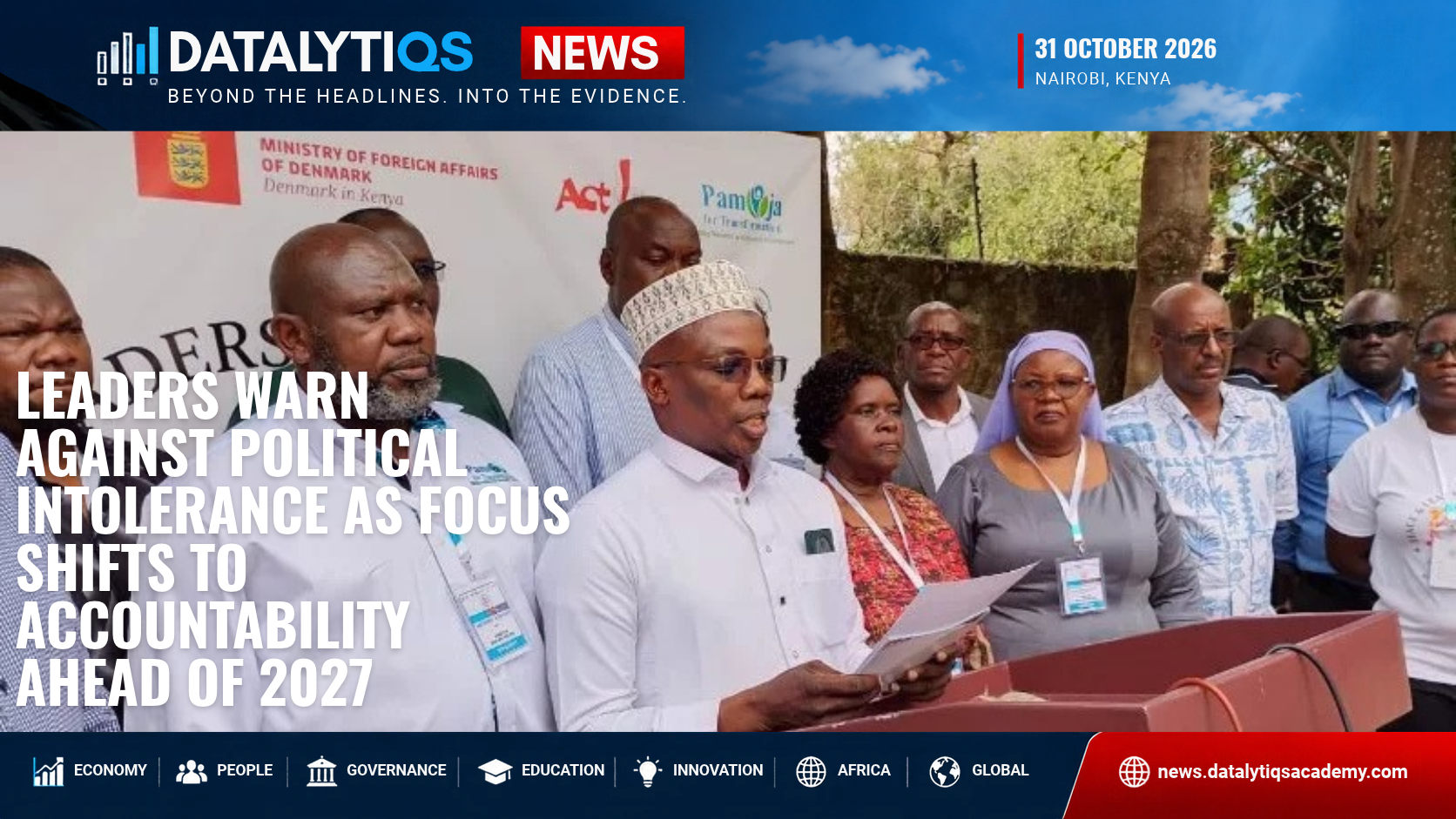
Following the October Peace and Leadership Summit, attention is turning to whether commitments to counter misinformation, political hostility, inequality and institutional distrust will translate into measurable action before Kenya’s next General Election.
The Kisumu Peace and Leadership Summit has placed electoral conflict prevention and institutional accountability at the centre of the county’s preparations for Kenya’s 2027 General Election.
The summit, reported on October 22, brought together government officials, security agencies, civil society organisations, religious representatives and community stakeholders to examine factors that could undermine peaceful political participation.
Participants identified political intolerance, economic inequality, misinformation, hate speech and declining public trust in institutions as potential sources of electoral tension.
They also called for stronger early-warning arrangements and peacebuilding initiatives extending beyond election periods.
The summit’s six resolutions provide a framework for cooperation. Their significance, however, will depend on whether participating institutions establish clear responsibilities, implementation schedules and transparent mechanisms for monitoring progress.
The central public-interest question is whether Kisumu’s peace commitments will become an operational governance programme rather than remain declarations made at a conference.
1. The summit and its six-point peace agenda
The summit was convened by Pamoja for Transformation Trust in partnership with the national government through the Office of the Kisumu County Commissioner, with support from Act Change Transform and the Royal Danish Embassy in Kenya.
County Commissioner Ramadhan Mwabudzo presented the communiqué, while Pamoja for Transformation Trust Executive Director Stephen Kadenyo committed to working with participating organisations on implementation.
The published reports confirm six resolutions, although the complete signed communiqué was not available for independent examination.
A more detailed account of the roadmap identifies the following six areas:
- Sustained investment in peacebuilding and conflict prevention.
- Stronger early-warning and response systems.
- Inclusive leadership and decision-making.
- Action against misinformation, hate speech and digital threats.
- Economic inclusion and alternative livelihoods.
- Protection of peace actors’ safety and psychosocial well-being. The Focus Paper
These are reported thematic summaries, not verbatim quotations from the signed resolutions.
2. Political intolerance and unresolved grievances
Participants warned that political intolerance, unresolved community grievances and organised criminal violence could contribute to tensions in Kisumu and the wider Nyanza region.
Political intolerance can undermine democratic participation when citizens face intimidation, threats or disruption because of their political affiliations.
However, disagreement with political leaders, criticism of government and peaceful demonstrations are protected forms of democratic expression. Conflict-prevention measures must distinguish lawful political activity from threats, incitement and violence.
Unresolved grievances also require attention. These may concern public services, institutional decisions or disputes within communities. The summit reporting does not provide a comprehensive register identifying individual grievances or their prevalence.
A practical response would require an accessible complaints mechanism, clear referral procedures and documented resolution outcomes.
3. Misinformation and the growing challenge of AI-generated content
The summit identified cyberbullying, online harassment, harmful AI-generated material and technology-facilitated gender-based violence as emerging concerns.
These threats require different responses.
False information circulating without deliberate intent to deceive may be corrected through timely public communication. Deliberate disinformation may require further investigation. Allegations of unlawful hate speech must be assessed under the relevant legal framework.
AI-generated recordings and manipulated images create additional verification difficulties, especially when circulated as evidence of political statements or security incidents.
For journalists and public institutions, the response should include source authentication, date and location verification, clear correction procedures and protection against the amplification of unverified allegations.
The goal should be to reduce harmful falsehoods while safeguarding lawful political speech.
4. Institutional trust and electoral justice
Participants expressed concern about declining confidence in institutions responsible for electoral justice.
This is a significant governance concern, but the available summit reports do not provide a representative public-opinion survey measuring trust levels across Kisumu County.
The claim should therefore be understood as a concern expressed by stakeholders rather than a quantified county-wide finding.
Institutional trust depends partly on whether citizens can obtain reliable information, report grievances, access fair procedures and observe consistent enforcement of the law.
Public institutions can strengthen accountability by publishing complaints procedures, response timelines, aggregate case statistics and explanations of major decisions.
5. Youth, women and socioeconomic inclusion
The summit also linked peacebuilding to inclusive participation and economic opportunity.
Participants emphasised the importance of involving women and young people in leadership and decision-making.
This concern is consistent with separate NCIC engagements in Kisumu. On October 16, the Kenya News Agency reported that NCIC Director of Research and Knowledge Management Millicent Okatch had called for greater youth participation, improved civic education and interventions addressing economic vulnerability.
Economic disadvantage does not imply that an individual is predisposed to political violence. Rather, inclusive economic and civic programmes can help address grievances and reduce opportunities for exploitation.
Meaningful participation should be assessed through documented involvement in decision-making, not attendance at ceremonial meetings alone.
6. Kisumu’s agenda within the national election-peace framework
The Kisumu summit is part of a wider effort to prepare for the 2027 elections.
In August, the National Cohesion and Integration Commission launched the second edition of its Uchaguzi Bila Noma roadmap.
The initiative focuses on early warning, responsible political leadership, community engagement and cooperation among security agencies, electoral institutions and civil society.
NCIC identified political intolerance, ethnic mobilisation, misinformation, unemployment, historical grievances and emerging technological threats among the issues requiring attention.
The commission also reported a funding requirement of approximately KSh308.7 million for its proposed interventions. That figure is a stated programme requirement, not confirmation of funding disbursement.
Further NCIC engagements with Kisumu stakeholders on October 22–23 addressed institutional coordination and prevention of electoral violence.
The overlapping initiatives create an opportunity to coordinate activities, avoid duplication and establish common reporting arrangements.
7. The accountability test: Measuring implementation
DATALYTIQS INDEPENDENT GOVERNANCE ANALYSIS
The six resolutions provide a starting point, but implementation cannot be assessed without baseline measurements, assigned responsibilities and periodic reporting.
A proposed monitoring framework is set out below.
| Performance area | Suggested indicator | Accountability question |
|---|---|---|
| Political violence | Number of verified incidents by month and location | Are documented incidents being addressed? |
| Security response | Median time from verified report to response | How promptly are authorities intervening? |
| Early-warning systems | Percentage of verified alerts receiving documented action | Do warnings lead to responses? |
| Community grievances | Number received, resolved and outstanding | Are complaints being addressed? |
| Youth participation | Percentage of decision-making positions held by young people | Is participation substantive? |
| Women’s participation | Representation in peace committees and leadership | Are decision-making structures inclusive? |
| Misinformation | Verified incidents and median correction time | Are false claims being corrected promptly? |
| Institutional trust | Comparable representative survey results | Is public confidence changing? |
| Coordination | Meetings held against an agreed schedule | Is the proposed forum functioning? |
| Implementation | Percentage of agreed actions completed by deadline | Are summit commitments being fulfilled? |
Proposed indicators for DatalytIQs analysis. These are not reported results from the summit.
A practical monitoring dashboard
Proposed Kisumu Electoral Peace Scorecard
Baseline pending
Illustrative monitoring structure — no actual performance measurements have been supplied.
| Indicator | Unit | Status |
| Peacebuilding actions completed | % | Not reported |
| Verified security incidents | Monthly count | Not reported |
| Median response time | Minutes | Not reported |
| Community grievances resolved | % | Not reported |
| Youth and women represented | % | Not reported |
| Coordination meetings completed | Count | Not reported |
The scorecard would require disaggregation by location, age, sex and incident type where lawful and statistically appropriate.
Confidentiality protections would also be essential, particularly for complainants, victims of harassment and individuals reporting threats.
Why measurement must be interpreted carefully
An increase in reported incidents may indicate greater violence, but it may also reflect improved reporting or enforcement.
Likewise, fewer complaints do not necessarily demonstrate that communities feel safer. Fear of retaliation and limited access to reporting channels can suppress recorded complaints.
Administrative data should therefore be complemented by independent observation, documented community feedback and representative surveys.
8. The proposed coordination forum
One of the summit’s most consequential commitments was the establishment of a multi-stakeholder forum to review implementation, monitor agreed actions and identify gaps.
Its effectiveness will depend on several practical decisions.
Participating institutions will need to identify responsible officers, establish meeting schedules, agree on information-sharing procedures and determine how urgent threats will be referred to competent authorities.
The forum should also distinguish preventive dialogue from criminal investigations, which remain the responsibility of legally mandated agencies.
Publishing periodic, appropriately anonymised implementation summaries would make the forum’s work more transparent.
The available reports confirm a commitment to support the forum, but do not establish that it is already fully operational.
9. Peacebuilding beyond election day
The summit called for peacebuilding programmes to continue after the 2027 elections.
This is significant because the sources of community tension do not necessarily disappear when voting ends.
Unresolved grievances, mistrust and economic exclusion may persist across electoral cycles.
A sustained programme could integrate conflict prevention into existing county and national institutional planning, with periodic reviews rather than relying exclusively on election-season interventions.
On October 27, the Kenya News Agency also reported the launch of a separate 20-month early-warning initiative, Peace Pulse, covering several counties, including Homa Bay and Migori.
Although this is not the Kisumu summit programme, it illustrates the wider regional relevance of sustained early-warning and conflict-prevention initiatives.
10. What should happen next?
The immediate priorities for evaluating the Kisumu commitments are documentary and operational.
The full signed communiqué should be made accessible, together with the six resolutions, participating institutions and agreed responsibilities.
The proposed coordination forum should publish an implementation calendar and clarify how incidents, grievances and early-warning alerts will be recorded and acted upon.
Participating institutions should also establish baseline indicators before reporting progress.
Finally, the programme should define how citizens, civil society and independent observers can assess its performance without compromising security operations or personal privacy.
These are recommended accountability measures, not actions confirmed as completed.
Conclusion: Peace must be demonstrated through institutions
The Kisumu Peace and Leadership Summit identified a broad set of potential electoral risks, including political intolerance, misinformation, economic inequality, organised violence and declining institutional confidence.
Its six resolutions establish areas for cooperation, while the proposed coordination forum offers a mechanism for reviewing implementation.
The next stage is to move from commitments to evidence.
The number of peace conferences held is not a sufficient measure of conflict prevention. More meaningful indicators include documented interventions, timely responses, resolved grievances, inclusive participation and transparent institutional follow-through.
As Kenya approaches the 2027 General Election, Kisumu’s peace agenda provides an opportunity to demonstrate how local governance, community participation and evidence-based monitoring can work together to protect democratic rights and public safety.
DatalytIQs News — Beyond the Headlines. Into the Evidence.