DATALYTIQS NEWS | NYANZA AFFAIRS, CULTURE & GOVERNANCE | 31 OCTOBER 2026
More than a decade after a succession dispute divided the Luo Council of Elders, rival claims by Nyandiko Ongadi and Odungi Randa continue to challenge the institution’s unity. Fresh accusations of political interference, an earlier court intervention and competing interpretations of the council’s constitution have renewed questions about cultural authority, institutional independence and reconciliation.
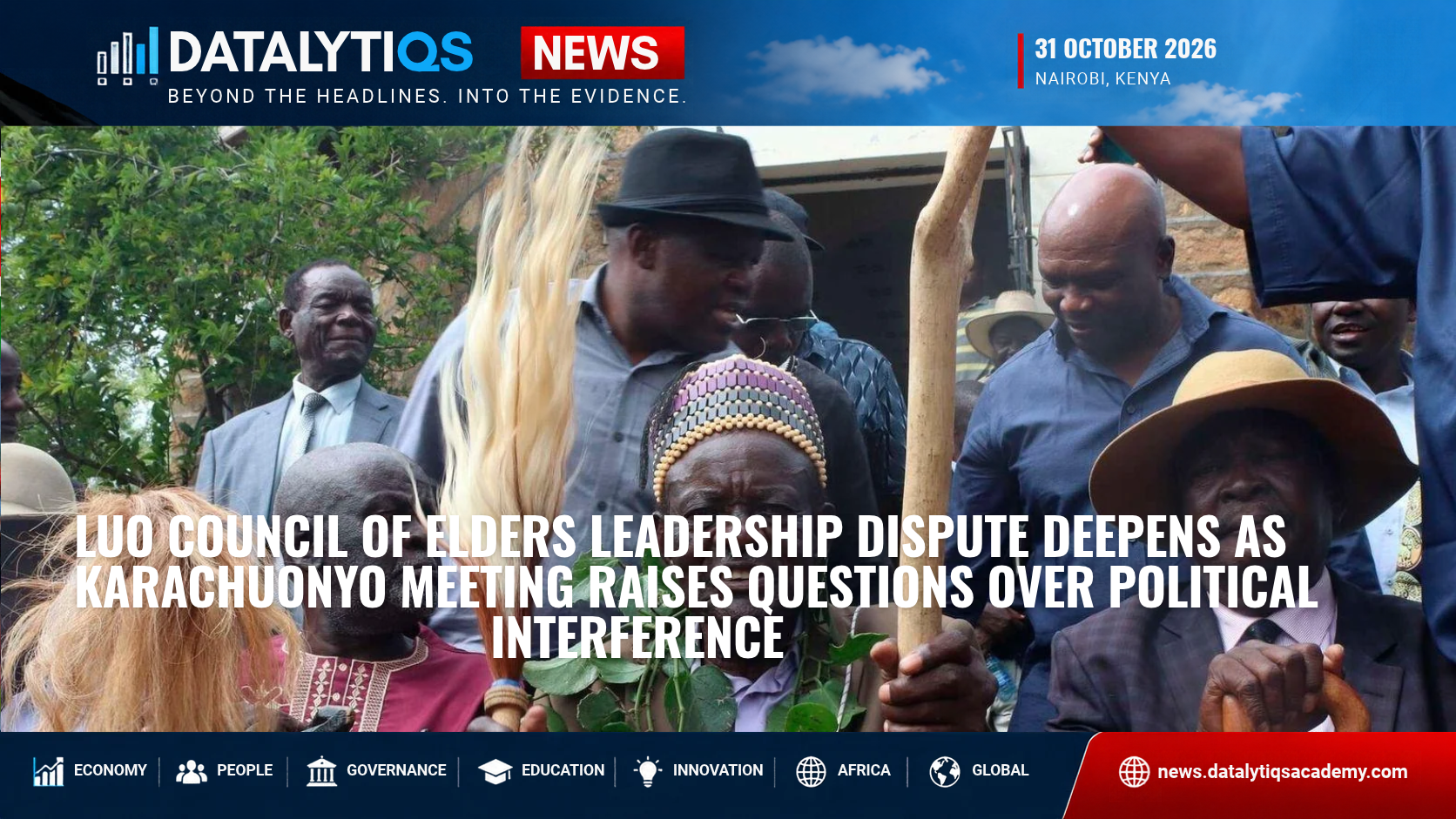
Nyandiko Ongadi’s faction convened elders in Karachuonyo, Homa Bay County, on October 26, 2026. The original meeting photograph was published by The Star and credited to Robert Omollo; publication rights must be obtained separately.
KARACHUONYO, HOMA BAY COUNTY — A longstanding leadership dispute within the Luo Council of Elders has returned to public attention after elders meeting in Karachuonyo accused unnamed political leaders of interfering in the affairs of the cultural organisation.
The meeting, held at Alaw Rachuonyo Ground on October 26, 2026, was convened by Nyandiko Ongadi, who maintains that he is the council’s legitimate chairman and holds its registration documents.
His faction accused politicians from Kisumu, Homa Bay, Siaya and Migori counties of contributing to divisions within the council by allegedly supporting rival leadership arrangements.
The allegations were not accompanied by independently verified evidence identifying particular politicians or establishing their involvement.
The dispute centres on competing leadership claims by Ongadi and Odungi Randa, each of whom has asserted authority over the institution.
The controversy extends beyond the question of who should hold the traditional title of Ker. It raises wider issues concerning the council’s constitution, succession procedures, organisational registration, the relationship between cultural institutions and political actors, and the mechanisms available for resolving internal disputes.
1. Karachuonyo meeting calls for an end to political interference
According to reporting by The Star and The Standard, more than 500 elders from Homa Bay, Kisumu, Siaya, Migori and Nairobi attended the gathering.
Ongadi was accompanied by senior members of his faction, including Owuor Akede, John Maji and Ogada Fundi-Tosha.
Participants expressed concern that political involvement had prolonged the leadership dispute and weakened efforts to restore unity.
Ongadi insisted that the council’s constitution provides for the election of its chairman and maintained that the organisation could not legitimately operate under two competing chairpersons.
He also invited Randa’s faction to participate in reconciliation discussions.
Akede argued that politicians should respect the distinction between cultural leadership and partisan political activity.
Maji similarly cautioned that elders who become closely associated with political parties may encounter conflicts of interest when called upon to mediate community disagreements.
These statements represent the positions expressed by Ongadi’s faction. They should not be treated as findings of an independent investigation into the conduct of the politicians accused.
2. A succession dispute dating back more than a decade
The current controversy has roots in competing succession arrangements following changes in the council’s leadership.
Historical reporting identifies the death of Riaga Ogalo in August 2015 as a major point in the dispute.
Ongadi, who had served as Ogalo’s deputy, subsequently claimed succession through a process associated with Ofafa Memorial Hall in Kisumu.
Another leadership line was associated with Willis Opiyo Otondi, who had been appointed at an earlier gathering in Awendo.
After Otondi’s death in 2023, Randa was elected during the Piny Luo cultural festival in Homa Bay and later formally installed at Ofafa Memorial Hall in December 2023.
Ongadi’s faction contested the process. staging.
The overlapping succession histories are significant because they suggest that the disagreement is not limited to the personalities currently involved.
It also concerns which organisational processes, membership groups and governing records should determine leadership authority.
Timeline of the dispute
| Period | Reported development |
|---|---|
| 2015 | Death of Riaga Ogalo and intensification of competing succession claims |
| 2023 | Odungi Randa elected during the Piny Luo festival |
| July 2023 | Siaya High Court intervenes through conservatory orders concerning the disputed election |
| December 2023 | Randa formally installed at Ofafa Memorial Hall |
| August 2026 | Rival factions publicly reaffirm their claims while discussing reconciliation |
| September 2026 | Reports emerge of a proposed truce and memorandum of understanding |
| 26 October 2026 | Ongadi’s faction meets in Karachuonyo and alleges political interference |
The timeline establishes a history of competing processes. It does not, by itself, determine which faction currently holds legally recognised authority.
3. The legal question: Registration documents versus election claims
Ongadi has repeatedly asserted that his possession of the council’s registration certificate and related documents establishes his authority as chairman.
Randa has challenged that interpretation, maintaining that his election followed consultations among elders and that Ongadi’s possession of the documents is disputed.
In August, Daily Nation reported that Randa defended his 2023 election and rejected the suggestion that he should relinquish his position.
These positions raise several separate legal questions.
A registration certificate may establish that an organisation is registered. It does not necessarily establish that the person physically holding the document is the current lawful officeholder.
Similarly, an election ceremony does not automatically settle a leadership dispute if the applicable constitution, membership rules or court orders have not been complied with.
The decisive evidence would include the organisation’s registered constitution, the official register of officeholders, election notices, voting records, minutes and applicable judicial decisions.
The 2023 court intervention
A particularly important development occurred in July 2023.
Citizen Digital reported that the Siaya High Court issued conservatory orders concerning Randa’s election following an application by members aligned with Ongadi.
The report described orders intended to maintain the status quo and prevent changes to the organisation’s registration records arising from the disputed election, pending further court directions.
This historical intervention is material to the current controversy.
However, a conservatory order is not necessarily a final judgment determining permanent leadership rights.
The current status of the proceedings, including any subsequent rulings, variations, appeals or final orders, has not been established from the sources reviewed.
Consequently, neither faction’s legal claim should be presented as conclusively settled on the basis of the 2023 reporting alone.
4. Randa’s position: Election, representation and regional balance
Randa’s faction has presented a different account of the council’s leadership.
According to Daily Nation, Randa maintains that he was elected through consultations involving elders and that his selection reflected a desire for broader regional representation.
He has argued that previous holders of the Ker title disproportionately came from Homa Bay County and that the 2023 process sought to address this historical pattern.
Randa also acknowledged the importance of reconciliation while maintaining his own leadership claim.
This introduces an institutional issue that cannot be resolved simply by comparing the public visibility of the two factions.
If the council’s constitution provides for regional representation or leadership rotation, the relevant provisions must be examined. If those arrangements were adopted through later resolutions, their validity would depend on the procedures followed.
Equally, if the organisation’s constitution establishes specific membership and voting requirements, a leadership election must be assessed against those requirements.
The available reporting does not establish that either faction’s interpretation has been conclusively validated through a current, final legal determination.
5. The September reconciliation initiative
The October confrontation followed an earlier attempt to reduce tensions.
On September 1, the Kenya News Agency reported that the factions had moved towards a truce and a proposed memorandum of understanding.
Speaking at his home in Kendu Bay, Ongadi called for unity and invited Randa’s faction to cooperate.
Randa welcomed discussions but maintained his claim to the position of Ker. staging.
The development demonstrates that the factions have previously expressed a willingness to engage, even while disagreeing over the leadership question.
It also illustrates the limitations of reconciliation efforts that do not settle the underlying institutional issues.
A sustainable agreement would need to establish the membership entitled to participate, the rules governing leadership selection, the status of existing officials and a mutually accepted dispute-resolution procedure.
Without those elements, declarations of reconciliation may coexist with continuing rival claims.
6. Why politicians are interested in traditional leadership
The Luo Council of Elders occupies a cultural and social space distinct from the formal institutions of electoral politics.
Its activities have historically included cultural representation, community guidance and engagement with questions of identity and social cohesion.
However, the institution also operates within a society where political leaders regularly seek the support of community organisations, religious figures and respected elders.
This creates opportunities for cooperation but also potential conflicts of interest.
An elder may participate in public debate as an individual citizen. A cultural organisation may also engage public authorities on matters affecting its members.
The difficulty arises when personal political preferences are presented as the collective position of an institution without a clear mandate.
It becomes particularly consequential where rival groups claim authority to speak for the same organisation.
The 2027 political context
Recent reporting has linked the council’s internal divisions to differing political positions ahead of the 2027 General Election.
Daily Nation reported that Randa’s faction had publicly expressed support for President William Ruto’s broad-based administration, while the wider council remained divided over political direction and leadership authority.
That report provides evidence of a publicly stated position by one faction. It does not establish that all Luo elders, council members or members of the Luo community share that position.
Nor does it prove that politicians caused the leadership dispute.
Political involvement and internal organisational disagreements may interact, but a causal allegation requires evidence beyond temporal association or public endorsements.
7. Cultural authority is not an electoral mandate
The distinction between cultural leadership and electoral representation is fundamental.
The Luo Council of Elders may perform important cultural, consultative and mediation functions, but it is not a constitutionally established electoral college authorised to select political representatives on behalf of an entire ethnic community.
Individual citizens retain their constitutional political rights, including the freedom to support different parties and candidates.
A declaration by an elder, faction or cultural organisation should therefore be reported as an attributed political position rather than a binding decision by the wider community.
This is particularly important in election reporting, where claims of community-wide endorsement can obscure political diversity.
The same caution applies when politicians attend cultural ceremonies or receive symbolic blessings. Such participation does not establish a measurable level of electoral support.
8. Institutional independence and financial vulnerability
A further issue concerns the council’s operational independence.
An October report by Western Insight described proposals from elders associated with Ongadi’s faction for clearer membership rules, a formal leadership election and improved financial independence.
The report also conveyed concerns that reliance on political donations could expose the organisation to external influence.
These concerns deserve examination without assuming that every donation or interaction with a politician constitutes improper interference.
Financial dependence can create conflicts of interest when donors seek influence over appointments, public endorsements or institutional decisions.
A cultural organisation can reduce such risks through transparent funding records, conflict-of-interest declarations, independently approved expenditure and clear rules on political engagement.
The extent of the Luo Council of Elders’ current financial dependence has not been independently quantified in the material reviewed.
9. The constitutional and organisational framework
Kenya’s Constitution protects freedom of association and recognises the importance of culture.
These protections support the ability of communities to establish cultural organisations and preserve their traditions.
They do not eliminate the obligation of registered organisations to comply with their governing constitutions and applicable law.
Where an organisation is registered under the Societies Act, the relevant questions may include its registered officials, constitution, membership procedures, annual returns and compliance with lawful administrative directions.
If a dispute reaches court, judicial orders and the status of proceedings become particularly important.
For the Luo Council of Elders, an authoritative legal assessment would require inspection of the actual registration and litigation records rather than reliance on competing statements.
10. DatalytIQs News institutional intelligence assessment
INDEPENDENT ANALYSIS — NOT A LEGAL FINDING OR POLITICAL ENDORSEMENT
The dispute can be assessed through five dimensions.
| Dimension | Central question | Evidence required |
|---|---|---|
| Legal identity | What is the registered organisation and who are its recorded officials? | Registrar of Societies records |
| Constitutional authority | How should the Ker and other officials be selected? | Registered constitution and amendments |
| Electoral legitimacy | Were disputed elections conducted under valid procedures? | Notices, membership rolls, minutes and results |
| Judicial compliance | What orders currently govern the dispute? | Certified court orders and case status |
| Political independence | Are institutional decisions subject to improper outside influence? | Documented transactions, correspondence and decisions |
The available evidence establishes the existence of competing leadership claims and publicly reported allegations of interference.
It does not establish that a named politician unlawfully influenced the council, that either faction has exclusive current legal authority, or that the September reconciliation initiative resolved the dispute.
Three possible institutional approaches
Mediation under an agreed framework: Both factions could engage through a mutually accepted process that preserves their legal rights while examining the disputed records.
Constitutional clarification: The organisation could seek an authoritative interpretation of its governing provisions, including membership eligibility, succession and voting procedures.
Fresh elections where legally permissible: If the constitution and applicable court orders allow, an agreed electoral process could provide a means of selecting officials. Such a process would first require clarity about the electorate and procedural rules.
These are potential dispute-resolution approaches, not confirmed decisions or instructions binding on the council.
11. Questions requiring answers
Several unresolved questions should guide further reporting:
- What does the council’s registered constitution specify about succession, elections and the tenure of the Ker?
- What is the current official register of officeholders maintained by the relevant authority?
- What became of the Siaya High Court proceedings initiated in 2023?
- Was the September 2026 reconciliation memorandum signed, and what obligations did it establish?
- Can either faction substantiate allegations of political interference through documents, testimony or other verifiable evidence?
- What membership and regional representation rules would govern any future election?
The answers would allow the dispute to be assessed through institutional evidence rather than competing declarations.
12. Implications for cultural cohesion
The continuing division may affect the council’s ability to perform its cultural and community functions.
Where rival leadership groups issue contradictory statements, members of the public may be uncertain about which decisions represent the organisation.
Such uncertainty can complicate cultural ceremonies, mediation initiatives, institutional partnerships and communication with public authorities.
However, the council’s internal disagreement should not be interpreted as evidence that the Luo community as a whole is divided into two uniform political or cultural camps.
Communities contain diverse institutions, traditions and political opinions. A dispute within one organisation does not determine the collective identity or preferences of its members.
Conclusion
The October 26 Karachuonyo meeting has renewed attention on a leadership controversy that has persisted within the Luo Council of Elders for more than a decade.
Nyandiko Ongadi’s faction maintains that its leadership is supported by the council’s registration documents and governing constitution. Odungi Randa’s faction relies on its account of the 2023 election and subsequent installation.
Both have publicly expressed interest in unity, but the underlying dispute remains unresolved in the evidence reviewed.
The allegations of political interference introduce an additional concern about the independence of cultural institutions as Kenya approaches the 2027 General Election.
The decisive next step in understanding the controversy is documentary verification: the council’s constitution, official registration particulars, election records and current court orders.
The wider public-interest issue is how cultural organisations can maintain credible leadership, internal accountability and institutional independence while operating in an increasingly competitive political environment.
DatalytIQs News — Beyond the Headlines. Into the Evidence.
Sources and further reading
The Star — Luo elders accuse politicians of fuelling leadership wrangles26 October 2026 · Robert Omollo’s reporting from the Karachuonyo meeting.
The Standard — Politicians told to stop polarising Luo Council of Elders27 October 2026 · Statements by Ongadi, Akede and Maji.
Daily Nation — Luo elders’ power struggle deepens31 August 2026 · Detailed history and competing claims by both factions.
Kenya News Agency via The Star — Luo Council of Elders enter into a truce1 September 2026 · Reconciliation discussions and rival leadership positions.
Citizen Digital — Siaya High Court intervention5 July 2023 · Historical conservatory orders concerning Randa’s election.