DATALYTIQS NEWS | POLITICS & GOVERNANCE | 31 OCTOBER 2026
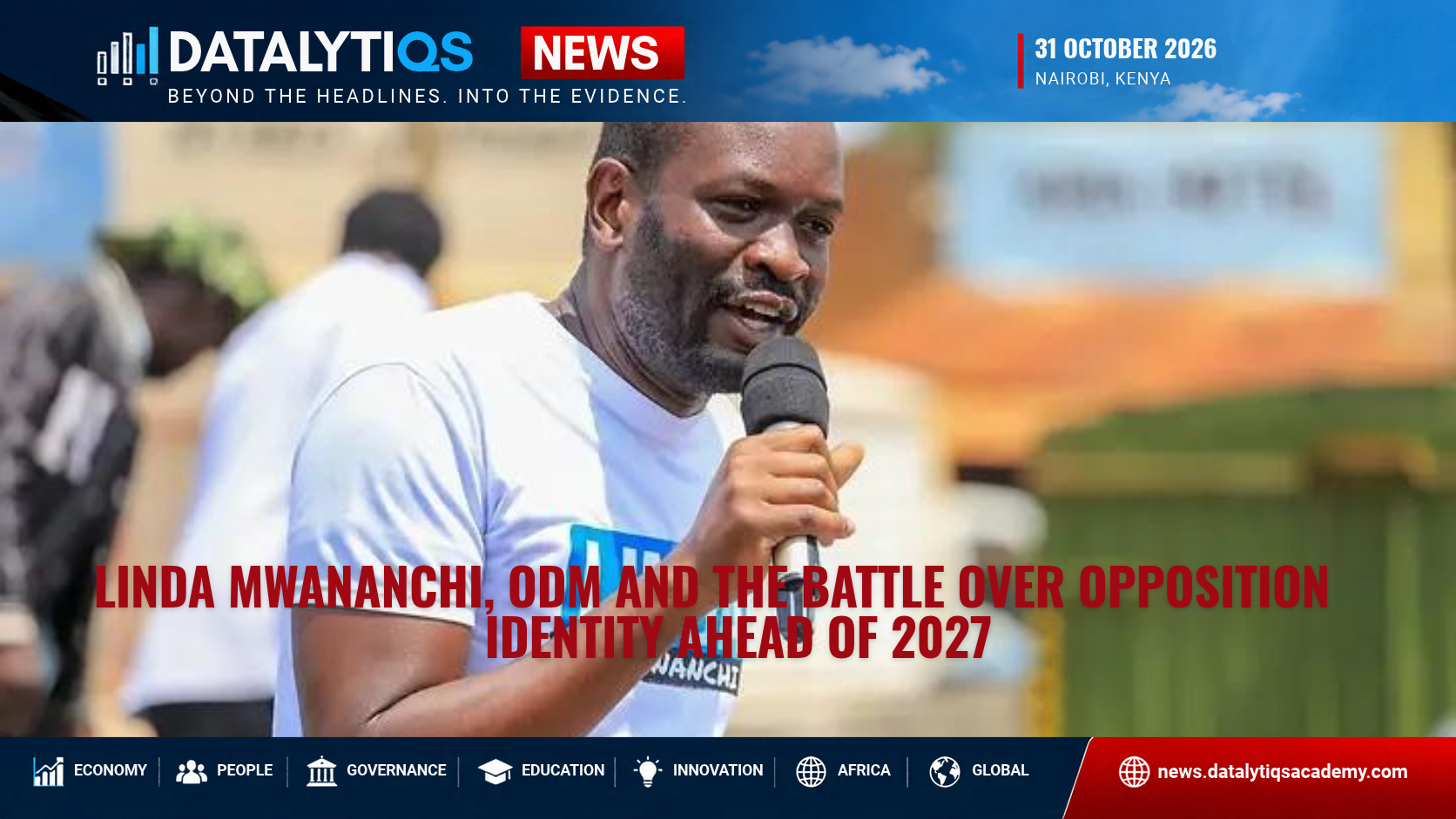
Edwin Sifuna’s Linda Mwananchi initiative and ODM’s planned Jacaranda Grounds rally highlight competing approaches to political organisation in Nairobi. Beyond crowd numbers, the more consequential questions concern party identity, grassroots structures, coalition relationships and the electoral choices that remain unsettled.
NAIROBI, Kenya has become a prominent stage for competing political mobilisation efforts as Edwin Sifuna’s Linda Mwananchi initiative develops its organisational identity while the Orange Democratic Movement (ODM) prepares to demonstrate its continuing political presence through a rally announced for Jacaranda Grounds on Saturday, October 31, 2026.
The developments have drawn attention because they involve political actors and organisations with overlapping histories, constituencies and relationships, even as their positions on cooperation with President William Ruto’s administration differ.
Reports concerning the Linda Mwananchi initiative describe a headquarters launch in Lavington on October 30, attended by several opposition leaders. Separately, ODM’s planned Jacaranda event has been presented as an opportunity for the party to mobilise supporters and reinforce its organisational identity.
These are distinct political events. Their proximity in time creates an opportunity to examine competing political narratives, but it does not establish that the organisers are participating in a formally coordinated contest or that one event is a direct response to the other.
The most important question is therefore not simply which gathering attracts greater visibility. It is what the events reveal about the changing structures, alliances and policy positions of Kenya’s political parties ahead of the August 2027 General Election.
1. Why Nairobi matters
Nairobi is both Kenya’s capital and an important arena for national political communication.
Events held in the city attract national media coverage, bring together party officials and supporters from different areas, and provide opportunities for political organisations to communicate their messages to wider audiences.
However, Nairobi is not a single, politically homogeneous constituency.
The county contains constituencies and wards with different socioeconomic characteristics, electoral histories and local political concerns.
A public gathering in one part of the city cannot therefore be assumed to represent the preferences of voters throughout Nairobi County.
This distinction becomes especially important when political organisations use rally attendance to demonstrate support.
Crowd size can provide information about mobilisation capacity, but it is not equivalent to a representative opinion poll or a verified membership count.
2. Linda Mwananchi’s emerging organisational identity
Sifuna’s Linda Mwananchi initiative has developed amid disagreements over ODM’s political direction and its relationship with the governing coalition.
Its reported headquarters launch brought together politicians associated with several opposition formations, including Kalonzo Musyoka, Rigathi Gachagua and Eugene Wamalwa.
Their participation illustrates the movement’s engagement with a wider group of opposition leaders.
Nevertheless, attendance at a political event does not establish that those leaders or their parties have entered a binding coalition agreement.
The movement’s organisational development also raises questions about the reported rebranding of The Equitable Party.
A political initiative may operate as a movement, while a registered political party is subject to additional statutory and administrative requirements.
The relevant distinction is between a publicly announced political identity and the formal legal status recorded by the Office of the Registrar of Political Parties.
Until the applicable registration particulars are confirmed, descriptions of Linda Mwananchi should avoid assuming that every proposed organisational change has been legally completed.
3. ODM’s Jacaranda rally and the question of continuity
ODM’s announced Jacaranda Grounds rally places attention on the party’s continuing organisational activity and its capacity to communicate with supporters.
The party has an established history of political mobilisation in Nairobi and elsewhere in Kenya.
However, its evolving relationship with UDA and President Ruto’s administration has generated disagreements among political figures previously associated with ODM.
For some ODM leaders, cooperation with UDA has been presented as an opportunity to pursue negotiated governance and policy commitments.
Other political actors have argued for a more clearly differentiated opposition position.
The planned Jacaranda rally therefore takes place against a background of disagreement over political identity, policy priorities and coalition arrangements.
It would be premature to infer the rally’s attendance, speeches, resolutions or political impact before those details are independently confirmed.
4. Jacaranda Grounds: A shared political stage
The symbolic importance of ODM’s October 31 rally becomes clearer when placed alongside an earlier Linda Mwananchi gathering at the same venue.
Citizen Digital reported that Sifuna, Embakasi East MP Babu Owino and Siaya Governor James Orengo participated in a Linda Mwananchi rally at Jacaranda Grounds on September 13, 2026.
ODM subsequently announced its own gathering at Jacaranda, with Lang’ata MP Phelix Odiwuor, popularly known as Jalang’o, publicising the event on October 17.
The October 31 gathering carries the slogan Nairobi ni ODM and also forms part of the party’s commemorative activities honouring its late founding leader, Raila Odinga.
This creates two overlapping interpretations of the event.
ODM leaders have presented the rally as part of their ongoing party activities, commemorations and organisational consolidation.
Some media coverage, meanwhile, has framed it as a demonstration of political strength in a city where Linda Mwananchi has also attracted attention.
These interpretations are not necessarily mutually exclusive. A rally may serve commemorative, organisational and political communication purposes simultaneously.
However, it is important to distinguish the organisers’ stated objectives from interpretations offered by journalists and commentators.
5. ODM disputes the idea of a direct showdown
Makadara MP and Nairobi ODM chairman George Aladwa has rejected suggestions that the October 31 gathering was organised primarily to compete with Sifuna’s movement.
According to The Star, Aladwa described the event as part of ODM’s preparations for 2027, including efforts to retain and increase the party’s representation in elective offices.
He emphasised communication with supporters and the party’s future political roadmap.
This response is significant because it challenges a straightforward interpretation of the two events as a direct contest.
The available evidence supports describing the situation as competing political mobilisation within a changing political environment, rather than asserting that the parties formally agreed to test their relative strength at Jacaranda.
6. Sifuna’s October 30 headquarters launch adds a new dimension
On Friday, October 30, Linda Mwananchi unveiled offices in Nairobi’s Lavington area.
The ceremony was attended by Kalonzo Musyoka, Rigathi Gachagua, Eugene Wamalwa, George Natembeya, Babu Owino and other opposition figures. the-star.co.ke
Sifuna announced plans for a National Delegates Convention on November 13 and proposed establishing offices in all 47 counties by the end of November.
These announcements distinguish the headquarters event from a conventional political rally.
A rally demonstrates the ability to organise a public gathering. A headquarters launch, leadership appointments and a delegates’ convention relate to the establishment of a continuing administrative structure.
Neither automatically establishes the movement’s electoral support, but they provide different kinds of evidence about its organisational activities.
The formal registration and rebranding status of the party vehicle should still be checked against official records, rather than relying solely on descriptions used at the launch.
7. Competing political narratives
The emerging differences between the two formations can be examined through their publicly reported activities and statements.
| Dimension | ODM | Linda Mwananchi |
|---|---|---|
| Immediate Nairobi activity | October 31 Jacaranda rally | October 30 Lavington headquarters launch |
| Earlier Jacaranda event | Established party history at the venue | September 13 mobilisation |
| Institutional position | Established political party | Movement developing a formal party structure |
| Organisational priority | Grassroots consolidation and 2027 preparations | Leadership formalisation and county expansion |
| Coalition context | Discussions concerning cooperation with UDA | Engagement with opposition parties |
| Unresolved issue | Terms of future political partnerships | Nomination procedures and coalition arrangements |
The comparison reflects reported positions and activities, not a judgment about the relative strength or electoral prospects of either organisation.
8. Crowd attendance: What it measures and what it does not
Rally attendance is frequently used in political commentary as a proxy for public support.
Methodologically, this requires considerable caution.
A crowd at a political gathering is a self-selected group. It is not a probability sample of registered voters.
Attendance can be influenced by transport availability, event publicity, venue capacity, weather, scheduling, personal interest and the presence of prominent speakers.
Individuals may also attend multiple political events, while supporters unable to attend may still participate in elections.
Consequently, comparing photographs of crowds cannot establish the proportion of Nairobi voters supporting ODM or Linda Mwananchi.
Better indicators of organisational development
What each indicator can establish
| Rally attendance | Ability to mobilise participants at a particular event |
| Verified membership | Documented participation in party structures |
| Constituency branches | Geographical organisational coverage |
| Nomination records | Candidate recruitment and internal electoral processes |
| Representative polling | Measured preferences within a defined population, subject to sampling limitations |
| Official election results | Votes cast and declared under the electoral framework |
No independently verified comparative crowd count or representative Nairobi voter-preference survey was established in the reporting reviewed for this article.
The October 31 rally should therefore not be described as proving that either formation has greater electoral support.
9. ODM–UDA negotiations complicate the political landscape
The Nairobi mobilisation events also intersect with ODM’s discussions concerning a possible electoral partnership with UDA.
Some ODM leaders have advocated a formal written agreement defining the terms of cooperation, including proposals concerning the allocation of senior government positions.
Other political figures have questioned whether cooperation should be conditional on such guarantees.
These debates concern party governance, the scope of any future coalition and the authority of party organs to approve agreements.
They also help explain why ODM’s political identity has become a subject of public discussion.
However, the existence of negotiations does not establish that a final 2027 coalition agreement has been concluded.
Nor does participation in a Linda Mwananchi event necessarily establish that an individual has formally resigned from another party.
Party membership, leadership positions and coalition commitments require separate verification.
10. Political tolerance and public safety
Large political gatherings also create practical obligations concerning public safety and constitutional rights.
On October 30, Nairobi Regional Police Commander Issa Mohamud outlined security arrangements for ODM’s Jacaranda rally.
According to The Standard, police planned deployments along the route from Uhuru Park to Jacaranda Grounds, including traffic management, protection of participants and maintenance of public order.
The commander said the arrangements followed a notification from organisers and emphasised the responsibility to facilitate lawful assembly.
These arrangements are relevant because competing political mobilisation should not be confused with an entitlement to disrupt other groups’ lawful activities.
Political organisations and their supporters have the right to express differing positions peacefully.
Public authorities, in turn, are expected to apply the law impartially and protect participants regardless of political affiliation.
At the time of the reporting reviewed, the existence of security preparations did not establish that violence had occurred or was inevitable.
11. The 2027 organisational calendar
13 September 2026 — Linda Mwananchi at Jacaranda
Sifuna and allied politicians held a major Nairobi mobilisation event.
17 October 2026 — ODM announces Jacaranda rally
Party publicity confirmed the October 31 event.
30 October 2026 — Linda Mwananchi headquarters launch
Sifuna unveiled the movement’s Nairobi headquarters and proposed organisational structures.
31 October 2026 — ODM Jacaranda gathering
The party scheduled its Nairobi rally as part of mobilisation and commemorative activities. Its final attendance and resolutions require post-event verification.
13 November 2026 — Planned Linda Mwananchi convention
Leadership ratification and further party decisions are expected to be considered.
12. DatalytIQs political intelligence assessment
INDEPENDENT ANALYSIS — NOT AN ELECTORAL FORECAST
The competing Nairobi events highlight three distinct developments.
First, political identity is being renegotiated. ODM’s evolving relationship with UDA and Linda Mwananchi’s development have created overlapping political networks whose future institutional relationships remain unsettled.
Second, mobilisation and organisation are different. Public rallies demonstrate event-level participation, while party structures require sustained administration, membership management, nomination procedures and financial accountability.
Third, coalition negotiations remain central. ODM’s discussions concerning UDA and Linda Mwananchi’s engagement with opposition principals may shape the parties’ formal arrangements, but the eventual terms must be established through documented decisions.
The most useful evidence will therefore come from official party resolutions, membership and organisational records, published coalition agreements, costed policy commitments and representative electoral data.
What to monitor
The immediate questions concern the speeches and resolutions adopted at ODM’s October 31 gathering, the formal status of Linda Mwananchi’s party structure, the outcome of its November 13 convention and any documented changes in coalition negotiations.
Further scrutiny should examine whether Nairobi’s constituency-level party organisations are expanding, changing affiliation or maintaining their existing structures.
Claims about public support should be assessed through appropriate evidence rather than impressions generated by political crowds.
Conclusion
Nairobi’s recent political gatherings illustrate a period of organisational and ideological repositioning ahead of Kenya’s 2027 General Election.
Linda Mwananchi has unveiled a headquarters and announced plans to formalise its leadership and expand nationwide.
ODM has organised a Jacaranda rally intended to communicate its political direction, commemorate Raila Odinga and consolidate its grassroots presence.
Although the events have attracted comparisons, the available evidence does not establish a direct, agreed contest between the two organisations.
Nor can their relative electoral support be determined from rally attendance.
The developments are better understood as part of a broader process in which political parties and movements are defining their identities, negotiating alliances and preparing institutional structures for the next electoral cycle.
The enduring questions concern formal organisation, policy commitments, coalition accountability and the choices ultimately made by voters—not which event produces the most striking crowd photograph.
DatalytIQs News — Beyond the Headlines. Into the Evidence.
Sources and further reading
Citizen Digital — ODM announces Jacaranda rally17 October 2026 · Original rally announcement and historical context.
The Star — ODM mobilisation in Nairobi31 October 2026 · Grassroots mobilisation and George Aladwa’s response.
The Star — Linda Mwananchi headquarters launch30 October 2026 · Event coverage and participating leaders.
Capital FM — Linda Mwananchi’s national expansion plans30 October 2026 · November convention and 47-county target.
The Standard — Police security preparations30 October 2026 · Security arrangements and lawful assembly.