DATALYTIQS NEWS | POLITICS & GOVERNANCE | 31 OCTOBER 2026
As debate intensifies over a possible 2027 electoral partnership between ODM and UDA, demands for a 50–50 power-sharing arrangement have brought questions of party authority, enforceable commitments and political accountability into sharper focus.
NAIROBI, Kenya — The emerging debate over negotiations between the Orange Democratic Movement (ODM) and President William Ruto’s United Democratic Alliance (UDA) is increasingly centred on the conditions under which the two political organisations might enter an electoral partnership ahead of the 2027 General Election.
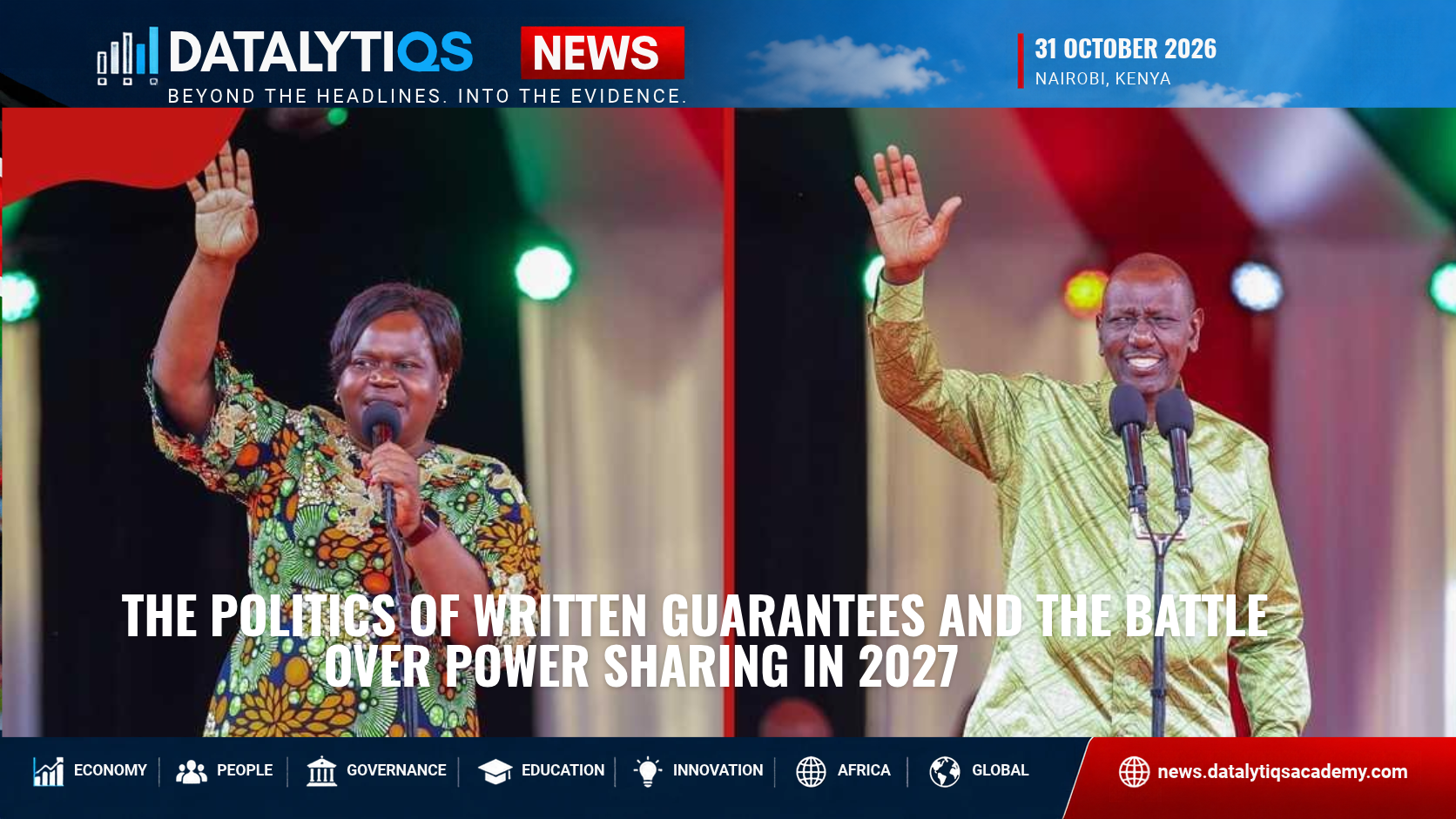
Homa Bay Governor Gladys Wanga and other ODM figures have advocated a proposed 50–50 arrangement, including representation in senior government positions. Homa Bay Senator Moses Kajwang’ has emphasised the importance of formal agreements, while Interior Principal Secretary Raymond Omollo has argued against making such conditions a prerequisite for cooperation.
The disagreement raises a question extending beyond the distribution of government offices: Who has the authority to negotiate on behalf of ODM, what would a political agreement legally establish, and how would party members verify whether its commitments were fulfilled?
The positions above are drawn from the supplied news brief. Their exact wording, dates and context require checking against the original reports and public statements before publication as a fully verified news account.
1. The central dispute: Political cooperation versus contractual certainty
Political parties can cooperate in several ways without necessarily entering a single, comprehensive electoral agreement.
They may support government legislation, participate in policy consultations, appoint representatives to joint committees or negotiate a formal coalition.
These arrangements carry different political and legal implications.
The current disagreement concerns whether ODM should require a written agreement before committing to an electoral partnership with UDA.
Supporters of formal guarantees can argue that documented commitments clarify responsibilities, prevent conflicting interpretations and create a basis for internal accountability.
Those opposed to imposing conditions at the outset may argue that rigid demands could complicate negotiations or restrict the flexibility needed to develop a broader political understanding.
Neither position, by itself, establishes what agreement the parties will ultimately reach.
2. What would a 50–50 agreement mean?
The phrase 50–50 power sharing is politically significant but institutionally ambiguous.
It could refer to an equal allocation of specified government positions, equal representation in coalition committees, a negotiated distribution of electoral nominations or an agreed balance of influence within a future administration.
These are materially different arrangements.
For example, a commitment to share Cabinet positions equally would not necessarily imply equal representation in Parliament, control of public budgets or an equal share of all government appointments.
Likewise, equal representation in a coalition management committee would not automatically translate into equal authority over executive decisions.
Before any proposed arrangement can be meaningfully evaluated, the parties would need to specify its scope, the positions covered, the appointment procedures and the mechanisms for resolving disagreements.
A political promise of equal representation should therefore not be reported as a concluded agreement unless the parties have formally adopted and documented it.
3. Wanga’s 50–50 proposal places the deputy presidency at the centre
Recent reporting confirms that ODM national chairperson Gladys Wanga has publicly proposed an equal division of government positions between ODM and UDA.
Under the formula she described, UDA would provide the presidential candidate, ODM would provide the running mate, and Cabinet positions would be shared equally.
National Assembly Minority Leader Junet Mohamed and other ODM officials have also advocated substantial representation for ODM in any future arrangement.
This is a negotiating demand, not a concluded allocation of government positions.
The proposed deputy presidency is particularly contentious because the office is currently held by Kithure Kindiki, who has expressed an interest in continuing as President Ruto’s running mate.
Any agreement allocating that position to ODM would therefore have implications for UDA’s existing political arrangements and other leaders seeking the position.
4. Kajwang’ argues for documented commitments
Homa Bay Senator Moses Kajwang’ has presented written agreements as a form of political risk management.
He has pointed to historical experiences in which political partnerships generated disputes over the implementation of commitments.
Homa Bay Town MP Peter Kaluma has similarly said that technical negotiations between ODM and UDA are underway and that the outcome should be recorded in a written agreement.
According to The Star, the joint broad-based committee is co-chaired by Carey Orege for ODM and Emmanuel Nzai for UDA.
Kajwang’s position rests on a distinction between personal trust and institutional accountability.
Personal goodwill may facilitate negotiations, but a documented agreement can establish what was promised, which institutions approved it and what steps are required for implementation.
Nevertheless, documentation alone does not guarantee compliance. Its practical significance depends on the agreement’s legal status, provisions and enforcement mechanisms.
5. Omollo argues against conditional support
Interior Principal Secretary Raymond Omollo has challenged demands for a pre-election pact that makes political support conditional on a written agreement.
Speaking in Ndhiwa, Homa Bay County, on October 24, Omollo argued that cooperation should be approached through mutual trust and goodwill.
He referred to the political relationship between the Luo and Kalenjin communities during the 2007 presidential election, suggesting that political support need not always be preceded by contractual conditions.
His remarks were reported by the Kenya News Agency on October 26.
The argument raises an important distinction between historical political solidarity and contemporary party-to-party negotiations.
Community-level electoral cooperation is not necessarily equivalent to a formal agreement between registered political parties with separate constitutions, officeholders and members.
The dispute therefore concerns both the substance of negotiations and who is entitled to determine their terms.
6. Oburu Oginga asserts ODM’s institutional independence
ODM party leader Oburu Oginga intervened in the debate through a statement dated October 29.
He warned against attempts by individuals outside ODM to direct the party’s negotiations with UDA and emphasised that ODM has established leadership structures capable of determining its own negotiating position.
He also maintained that the party’s engagement with UDA must remain connected to the implementation of the 10-point agenda previously agreed between President Ruto and Raila Odinga. standardmedia.
His intervention introduces a question of institutional authority.
A political party may receive advice, criticism and proposals from outside actors. However, its formal decisions must be taken through the institutions and procedures established by its constitution and applicable law.
Whether a particular agreement requires approval by the National Executive Committee, National Governing Council, National Delegates Convention or another organ depends on ODM’s governing documents and the nature of the proposed arrangement.
A public statement by an individual leader should not automatically be treated as a final institutional resolution.
7. The existing 10-point agenda remains relevant
The debate is not taking place in the absence of earlier cooperation.
President Ruto and Raila Odinga entered a political cooperation framework in March 2025, commonly associated with a 10-point agenda addressing governance and national concerns.
The reported priorities include electoral reform, devolution, human rights, corruption, economic pressures, youth employment and other institutional reforms.
This creates two separate questions.
The first concerns whether commitments under the existing cooperation framework have been implemented.
The second concerns the terms of any new electoral agreement for 2027.
A future power-sharing agreement would not, by itself, demonstrate completion of the earlier governance agenda.
For public accountability, the two should be assessed separately, with documented milestones, responsible institutions and verifiable outcomes.
8. Written agreements: What does Kenyan law provide?
Kenya’s Political Parties Act provides a framework for coalition agreements between political parties.
Section 10 and the Third Schedule address the formation of coalitions and matters to be included in coalition agreements, including governance arrangements, dispute resolution, decision-making and the distribution of responsibilities.
The precise requirements depend on whether the parties establish a coalition, coalition political party or another form of cooperation.
A formal coalition agreement is therefore different from an informal memorandum, a public political promise or a private understanding between individual leaders.
Importantly, a written agreement cannot override the Constitution or automatically compel a future President to make appointments contrary to constitutional procedures.
For example, the appointment of Cabinet Secretaries is governed by constitutional requirements, including parliamentary approval where applicable.
Likewise, a political agreement concerning the deputy presidency would need to be implemented through the constitutional and electoral procedures governing presidential tickets.
What a meaningful agreement would need to address
| Component | Accountability question |
|---|---|
| Authorisation | Which party organs approved the negotiations and final agreement? |
| Coalition structure | Is the arrangement a formal coalition or another cooperation framework? |
| Presidential ticket | What process determines the presidential candidate and running mate? |
| Government positions | Which positions are covered by the proposed 50–50 formula? |
| Electoral nominations | How will the parties manage competing candidates? |
| Policy commitments | Which reforms and public programmes are included? |
| Implementation | What deadlines and responsibilities are specified? |
| Dispute resolution | How will disagreements be addressed? |
| Transparency | What terms will be available to party members and the public? |
| Withdrawal | What procedures apply if either party leaves the arrangement? |
These are analytical criteria, not confirmed provisions of an ODM–UDA agreement.
9. The nomination dilemma: Power sharing extends beyond Cabinet
Although the deputy presidency has dominated public discussion, constituency and county nominations present additional questions.
ODM and UDA have elected representatives and aspiring candidates operating in overlapping political constituencies.
A coalition arrangement could preserve competition between the parties in some races, introduce negotiated nomination arrangements in others or establish a common approach to selected seats.
Each option carries implications for party autonomy and candidate rights.
Reporting by The Star has already identified competing nomination interests as a source of concern in the emerging ODM–UDA relationship. the-
The challenge is to distinguish national-level cooperation from local electoral arrangements.
An agreement to support the same presidential candidate does not necessarily require every coalition partner to field joint candidates for all other elective offices.
The parties would need to clarify their approach through formal rules rather than leaving candidates and members to interpret general political declarations.
10. ODM’s national identity and the Nyanza question
The disagreement has also generated debate over whether ODM’s negotiating position should be framed around the interests of the Luo community or those of the party as a national institution.
Kisumu Woman Representative Ruth Odinga has rejected attempts to reduce ODM to a regional political organisation, emphasising its presence in multiple counties and calling for a binding agreement.
The distinction matters because a registered national political party is accountable to members across its organisational structures.
Its electoral interests may include counties outside its traditional strongholds, while its policy commitments may address national rather than exclusively regional concerns.
The political debate should therefore distinguish between regional voting patterns, party membership and the institutional authority to enter agreements.
These are related but different matters.
11. DatalytIQs political intelligence assessment
INDEPENDENT ANALYSIS — NOT A PREDICTION OF ELECTORAL OUTCOMES
The emerging dispute can be examined across four dimensions.
Institutional legitimacy. A negotiated agreement derives greater procedural clarity when authorised by the appropriate party organs and communicated to members.
Contractual specificity. A written document may reduce ambiguity, but vague promises can remain difficult to interpret or implement.
Political accountability. Members need a means of determining whether leaders have complied with the commitments made in the party’s name.
Constitutional feasibility. Political agreements must operate within the constitutional and statutory framework governing elections, appointments and public administration.
These considerations apply to both ODM and UDA. Neither the existence of a written agreement nor an appeal to political goodwill, by itself, resolves all four.
Key evidence still missing
The reviewed reporting does not establish that ODM and UDA have concluded and publicly released a final 2027 coalition agreement.
Nor does it provide a complete, officially authenticated draft specifying the 50–50 formula, the allocation of the deputy presidency or procedures for resolving disputes.
It would therefore be premature to describe those demands as settled commitments.
12. What to monitor next
The next developments worth examining are formal resolutions of ODM and UDA party organs, statements from the joint negotiating committee, and any publicly available agreement.
Particular attention should be paid to whether the proposed power-sharing formula is defined precisely, whether it covers elective and appointive positions, and whether party members have an opportunity to review the terms through established procedures.
The implementation status of the earlier 10-point agenda should also be documented separately.
Finally, any coalition agreement should be assessed against the Political Parties Act and the constitutional rules governing public appointments and electoral nominations.
Conclusion: The difference between trust and accountability
The ODM–UDA debate has moved beyond the general question of whether the two parties should cooperate in 2027.
It now concerns the terms of that cooperation, the institutions authorised to negotiate, and the mechanisms through which commitments could be verified.
Gladys Wanga’s proposed 50–50 arrangement has given the negotiations a concrete political focus. Moses Kajwang’ and other ODM leaders have emphasised written commitments, while Raymond Omollo has questioned the necessity of conditional support.
Oburu Oginga’s intervention has added another dimension by asserting ODM’s right to determine its own negotiating position.
The immediate public-interest question is not which negotiating style will prevail. It is whether any resulting arrangement will be properly authorised, legally coherent, transparent and capable of being assessed against measurable commitments.
A political agreement is more than a document bearing signatures. Its significance lies in what it commits the parties to do, how those commitments are implemented and how compliance can be established.
DatalytIQs News — Beyond the Headlines. Into the Evidence.
Sources and further reading
The Star — ODM debate over a written agreement29 October 2026 · Wanga, Kajwang’, Omollo and the proposed power-sharing formula.
Daily Nation — Written pact or goodwill?29 October 2026 · Competing ODM positions, historical concerns and coalition negotiations.
Kenya News Agency — Omollo cautions against pre-election conditions26 October 2026 · Omollo’s arguments concerning political goodwill and formal agreements.
The Standard — Oburu responds to negotiation pressure29 October 2026 · ODM institutional authority and negotiations with UDA.
The Star — Joint negotiating committee28 October 2026 · Technical negotiations and anticipated written agreement.