DATALYTIQS NEWS | GLOBAL GEOPOLITICS, ENERGY & ECONOMIC SECURITY | 2 NOVEMBER 2026
SPECIAL REPORT — UNITED STATES, RUSSIA, UKRAINE AND THE EUROPEAN UNION
WASHINGTON / BRUSSELS / KYIV — The United States is reportedly exploring a controversial proposal to restore Russian natural gas exports to Europe through Ukraine as part of negotiations aimed at securing a ceasefire covering energy infrastructure before winter.
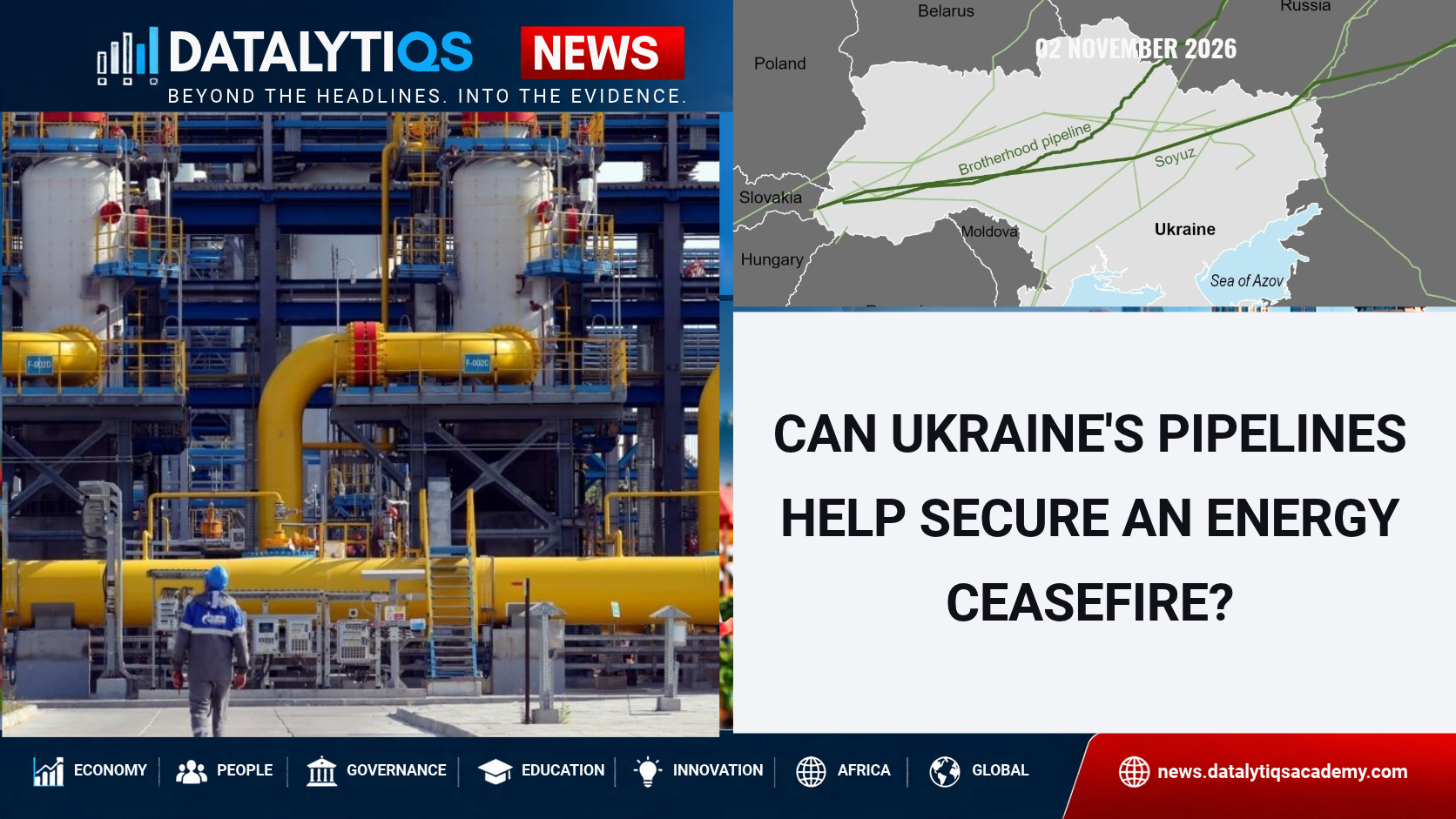
The initiative, first reported by The Wall Street Journal and subsequently carried by Reuters on November 2, would potentially reconnect Russia’s gas supplies to European customers through Ukrainian pipelines that have been inactive since January 2025.
The proposal reportedly involves American commercial intermediaries, arrangements to restrict Russia’s access to gas revenues, and a wider diplomatic effort to reduce attacks on energy facilities.
However, the central qualification is significant: Reuters said it could not independently verify the Wall Street Journal’s account. No final agreement, formal Ukrainian consent, European regulatory approval or confirmed restart of gas transit has been established.
The report nevertheless raises a consequential geopolitical question: can the same energy relationship that Europe has spent years dismantling become an instrument for negotiating a reduction in hostilities?
1. WHAT THE WALL STREET JOURNAL REPORTED
According to the November 2 report, American envoys Steve Witkoff and Jared Kushner discussed the idea during visits to Moscow and Kyiv in September.
The proposed arrangement would involve Russian gas moving through Ukraine to European markets, potentially with a US intermediary purchasing or handling the gas.
American negotiators reportedly believe that renewed access to European customers could provide Moscow with an economic incentive to agree to restrictions on attacks against energy infrastructure.
Ukraine, meanwhile, could receive transit revenue while securing relief from attacks on its electricity and heating systems.
A further proposal would place Russian gas-sale proceeds into an escrow account in a third country, intended to prevent immediate use of the money for military expenditure.
These details are attributed to unnamed officials and participants cited by The Wall Street Journal. They should not be treated as an announced US government policy or an accepted peace agreement.
2. WHY THE PROPOSAL IS POLITICALLY CONTROVERSIAL
The reported initiative would reverse the direction of European energy policy at a particularly sensitive moment.
Following Russia’s full-scale invasion of Ukraine in February 2022, European governments accelerated efforts to reduce dependence on Russian fossil fuels.
The EU subsequently adopted a framework for phasing out Russian natural gas imports, with final restrictions on long-term pipeline contracts scheduled for 2027.
Restoring Russian gas through Ukraine would therefore require confronting the legal, political and strategic commitments underlying that policy. consilium.
The dispute involves competing priorities:
| Stakeholder | Relevant interest | Principal complication |
|---|---|---|
| United States | Negotiate an energy ceasefire and potentially reduce global energy prices | Reconciling commercial arrangements with European restrictions |
| Ukraine | Protect energy infrastructure, civilians and economic activity | Avoiding arrangements that strengthen Russia’s capacity to sustain the war |
| Russia | Restore export revenues and access to European customers | Accepting enforceable limits on military operations |
| European Union | Maintain energy security and reduce strategic dependence | Balancing immediate energy costs against long-term security policy |
| European gas buyers | Secure reliable and competitively priced supplies | Legal compliance, contractual risk and supply reliability |
These interests are not necessarily mutually exclusive, but they cannot be reconciled merely by reopening a pipeline.
3. WHY RUSSIAN GAS STOPPED FLOWING THROUGH UKRAINE
Russian gas continued crossing Ukrainian territory for almost three years after Moscow launched its full-scale invasion in February 2022.
That arrangement ended on January 1, 2025, when a five-year transit agreement expired and Ukraine declined to renew it.
Ukraine argued that continued gas exports generated revenue for Russia during the war. Moscow’s Gazprom said the expiration deprived it of the contractual basis for continuing deliveries.
The interruption ended a longstanding commercial relationship in which Ukrainian infrastructure carried Russian gas to customers in Central and Western Europe.
Gas transit through Ukraine, 2024
~15 bcm
Billion cubic metres annually
Transit stopped
1 JAN 2025
Following contract expiration
Estimated Ukrainian revenue exposure
UP TO $1B
Annual transit fees, historical estimate
Estimated Gazprom sales exposure
~$5B
Annual historical estimate
Historical volumes and estimated revenue losses, not figures for the proposed 2026 arrangement.
The pipeline system remains strategically important because it connects Russian production networks to Slovakia and onward European markets.
The United States Energy Information Administration identifies the Brotherhood and Soyuz systems among the principal historical routes through Ukraine. U.S. Energy Information Administration (EIA)
The reported proposal would seek to reactivate some of this infrastructure, although the commercial terms, transit volumes, operating arrangements and required inspections have not been established.
4. THE AMERICAN INTERMEDIARY: A COMMERCIAL SOLUTION OR A SANCTIONS PROBLEM?
One of the most consequential elements of the report is the possible involvement of an American company as an intermediary.
Under the reported concept, Russian gas could be purchased or handled by a US-linked commercial entity before being supplied to European customers.
The arrangement could create a role for American investors while potentially providing a mechanism for monitoring payments.
However, changing the identity of the intermediary would not automatically change the gas’s Russian origin or exempt it from European law.
The EU’s Regulation 2026/261 explicitly covers Russian-origin gas imported directly or indirectly. It also establishes authorisation and monitoring requirements.
A legally workable arrangement would therefore need to address the EU’s existing prohibitions, any applicable exceptions and the legal status of the proposed transactions.
The relevant distinction is between using an intermediary to administer a legally authorised arrangement and using one to evade restrictions.
The first could form part of a negotiated legal framework. The second would create serious compliance concerns.
5. THE ESCROW PROPOSAL: CAN RUSSIA SELL GAS WITHOUT IMMEDIATELY ACCESSING THE MONEY?
The Wall Street Journal reports that US officials have discussed depositing Russian gas-sale proceeds into a third-country escrow account.
The stated objective would be to prevent Moscow from immediately using the revenue to finance military operations.
Conceptually, the arrangement would separate the physical delivery of gas from Russia’s unrestricted access to the resulting payments.
RUSSIAN GAS PRODUCERSupplies gas under a negotiated arrangement
UKRAINIAN TRANSIT NETWORKTransports gas, potentially generating transit fees
EUROPEAN CUSTOMERSReceive gas and make contractually agreed payments
RESTRICTED ESCROW ACCOUNTProceeds held or released under agreed conditions
Illustrative mechanism based on the reported proposal; not a confirmed transaction structure.
The effectiveness of such an arrangement would depend on several unresolved issues: who owns the account, who controls withdrawals, how payments are audited, whether funds can be pledged as collateral and what happens if either party violates the ceasefire.
Escrow would not necessarily eliminate all economic benefits to Russia. Even restricted revenue could improve expectations about future income, preserve commercial relationships or affect financial arrangements.
An enforceable mechanism would therefore require more than simply placing money in a designated account.
6. EUROPE’S LEGAL OBSTACLE: THE RUSSIAN GAS PHASE-OUT IS ALREADY LAW
This is the most important distinction in the current debate.
Europe’s Russian gas phase-out is not merely an informal political promise.
The EU formally adopted Regulation 2026/261 in January 2026, establishing a legally binding, staged prohibition on Russian pipeline gas and liquefied natural gas. Consilium
| Category | Applicable EU phase-out date |
|---|---|
| Short-term Russian LNG contracts | 25 April 2026 |
| Short-term Russian pipeline contracts | 17 June 2026 |
| Long-term Russian LNG contracts | 1 January 2027 |
| Long-term Russian pipeline contracts | 30 September 2027, potentially 1 November under specified conditions |
These dates reflect the regulation’s transitional provisions for eligible existing contracts.
The regulation also provides limited emergency arrangements for security-of-supply situations.
However, those provisions do not constitute a general authorisation to restore Russian gas imports through a new American intermediary.
Consequently, any proposed restart would have to be examined against the regulation and any separate applicable sanctions.
A political agreement involving Washington, Moscow and Kyiv would not, by itself, amend EU legislation.
7. WHY EUROPEAN GOVERNMENTS ARE RESISTING
The reported US proposal faces substantial opposition among European officials.
The Wall Street Journal describes European concerns that restoring Russian gas would recreate strategic dependence on a supplier whose actions during the war demonstrated the security risks of energy reliance.
EU Energy Commissioner Dan Jørgensen has publicly argued against returning to Russian gas dependence, including after a potential peace settlement.
The concern extends beyond prices.
European policymakers must consider whether renewed gas imports could create future vulnerabilities through supply interruptions, commercial disputes or the use of energy contracts as geopolitical leverage.
There is also a difference between securing affordable gas for the coming winter and committing Europe to long-term purchases from Russia.
A short-term arrangement might be proposed as a humanitarian or security measure. But the legal and commercial design would determine whether it also recreates a lasting dependency.
8. EUROPE HAS ALREADY RESTRUCTURED ITS ENERGY SUPPLIES
The decline in Russian gas imports since 2022 provides essential context.
The EU Council estimated that Russian gas accounted for approximately 13% of EU imports in 2025, with an annual value exceeding €15 billion. Consilium
The Wall Street Journal reports a different measure: Russia’s share of European gas consumption fell from approximately 45% before the invasion to around 11% in the current period. wsj.com
These figures use different reference populations and measures—EU imports versus European consumption—and should not be combined as though they describe the same statistical series.
Europe has expanded LNG imports and alternative pipeline supplies, including purchases from Norway and the United States.
Russian gas has not disappeared completely. Some supplies continue through TurkStream and LNG shipments, subject to applicable restrictions and transitional arrangements.
Reuters reported that TurkStream deliveries to Europe totalled approximately 13.2 billion cubic metres during the first nine months of 2026. bairdmaritime.com
The proposed Ukrainian route would therefore not be restoring Europe’s only access to gas. It would add a politically sensitive supply corridor to an already diversified network.
9. THE IRAN WAR ADDS A NEW DIMENSION
The reported proposal is emerging during another major international energy disruption.
Conflict involving Iran has affected Gulf energy exports, shipping risks and global fuel prices.
The Wall Street Journal reports that restrictions on Qatari LNG movements and higher energy costs have increased pressure on European governments ahead of winter.
This creates a complex policy trade-off.
European governments have sought to reduce dependence on Russia, but disruptions in other energy-producing regions can make alternative supplies more expensive or less reliable.
A restoration of Russian gas flows could add supply and reduce some market pressure under certain conditions.
Yet it could also conflict with Europe’s security strategy and its existing import restrictions.
The economic case therefore depends on actual delivered prices, available alternatives, transit charges, contractual conditions and the duration of the proposed arrangement.
10. THE UKRAINIAN POSITION: TRANSIT REVENUE VERSUS NATIONAL SECURITY
Ukraine’s position is central because the pipelines cross its territory.
Restarting transit could generate revenue for its gas-transmission system and potentially form part of a broader agreement protecting civilian energy infrastructure.
That is especially relevant as Russian attacks continue to damage Ukraine’s electricity and heating facilities.
However, Ukraine previously refused to renew the transit agreement because it opposed facilitating revenue for Russia during the war.
The reported proposal would therefore require Ukraine to reconsider an important element of its wartime economic policy.
The immediate security context remains difficult. Reporting on November 1 described renewed Ukrainian attacks on Russian refineries and continuing Russian strikes against Ukrainian energy infrastructure. theguardian.com
A limited energy ceasefire would also not necessarily end fighting elsewhere.
A credible agreement would need to define which facilities are protected, what constitutes a violation, how incidents are investigated and whether both parties have accepted reciprocal obligations.
11. WHAT A NEGOTIATED ENERGY CEASEFIRE COULD LOOK LIKE
Several arrangements are conceivable, although none has been confirmed.
| Potential arrangement | What it would involve | Principal challenge |
|---|---|---|
| Limited energy ceasefire | Reciprocal restrictions on attacks against energy facilities | Monitoring and enforcement |
| Restricted gas transit | Specific volumes transported through Ukraine | Ukrainian consent and EU legal compliance |
| Escrow payments | Russian export proceeds held under conditions | Preventing misuse and verifying controls |
| Broader peace package | Energy arrangements incorporated into wider negotiations | Territorial, security and political disputes |
| No transit restart | Europe maintains diversification while diplomacy continues | Higher costs or supply pressures under adverse market conditions |
The reported possibility of further US–Russia–Ukraine talks in Abu Dhabi later in November is another diplomatic development to monitor.
However, scheduled or anticipated negotiations should not be mistaken for an agreed settlement.
12. WHAT THIS COULD MEAN FOR AFRICA AND KENYA
The direct commercial effects on Kenya would be limited because Kenya is not a major consumer of European pipeline natural gas.
The more important consequences would arise through global energy markets, trade and financial conditions.
Energy prices: Additional gas supplies to Europe could influence global LNG demand and prices, potentially affecting competition for energy cargoes elsewhere.
Inflation: Changes in international energy costs can influence transport, manufacturing and imported goods prices, although Kenya’s retail fuel prices depend on petroleum-product markets rather than European pipeline gas alone.
Exchange rates: Large energy-price movements can affect import bills, foreign-exchange demand and external balances in energy-importing economies.
Geopolitical risk: A credible reduction in attacks against energy infrastructure could affect international market sentiment, while renewed escalation could sustain uncertainty.
These are transmission mechanisms, not quantified forecasts.
For Kenya, the relevant monitoring indicators include Brent crude prices, global LNG benchmarks, the USD/KES exchange rate, domestic inflation, shipping costs and official fuel-price reviews.
13. THE KEY QUESTIONS THAT REMAIN UNANSWERED
The current reporting leaves several important matters unresolved.
- Has Washington formally submitted the proposal to Ukraine, Russia and the European Union?
- Would the EU be asked to amend Regulation 2026/261 or invoke a narrowly defined legal exception?
- Who would own the gas, receive payments and administer the proposed escrow account?
- What gas volumes, prices and transit fees are contemplated?
- What would Russia commit to in exchange, and how would compliance be verified?
- Would an energy ceasefire protect Ukrainian civilians without weakening broader security guarantees?
- Would the arrangement be temporary or establish a longer-term commercial relationship?
Answers to these questions would be necessary before assessing the proposal’s legal feasibility, economic value or likely operational effects.
14. FACT-CHECK: WHAT IS ESTABLISHED?
| Claim | Assessment |
|---|---|
| The Wall Street Journal reported US support for restarting Russian gas transit | Confirmed |
| Reuters independently verified the proposed arrangement | No |
| US intermediaries and escrow payments are reportedly under discussion | Reported, not formally confirmed |
| Russian gas transit through Ukraine stopped in January 2025 | Confirmed |
| The EU has adopted a legally binding Russian gas phase-out | Confirmed |
| Ukraine has agreed to restart transit | Not established |
| The EU has authorised the reported proposal | Not established |
| Russian gas is already flowing again through Ukraine | Not established |
| An energy ceasefire has been concluded | Not established |
CONCLUSION: THE PIPELINES MAY BE AVAILABLE, BUT THE POLITICAL AGREEMENT IS NOT
The reported US initiative illustrates the difficult intersection of diplomacy, economic incentives and national security.
Washington is reportedly considering whether renewed Russian gas exports could help secure an energy ceasefire, protect Ukrainian infrastructure and relieve pressure on European energy markets.
But any arrangement would confront Ukraine’s security concerns, Russia’s financial interests, European opposition to renewed dependence and the EU’s existing legal restrictions.
The infrastructure may offer a technically feasible transit route. That does not mean the political, commercial and legal obstacles have been resolved.
The central question is not simply whether Russian gas can flow through Ukraine again. It is whether such an arrangement could produce enforceable security benefits without recreating the vulnerabilities that Europe has spent four years attempting to reduce.
DATALYTIQS POLITICAL SATIRE
WASHINGTON WANTS RUSSIAN GAS BACK—THROUGH THE SAME UKRAINE!
According to a Wall Street Journal report, Washington is exploring a proposal to send Russian gas back to Europe through Ukrainian pipelines as part of an energy ceasefire.
Europe has spent years reducing dependence on Russian energy. Ukraine stopped the transit. Now American negotiators are reportedly considering reconnecting the pipes!
Geopolitics has extraordinary plumbing arrangements.
The countries disagree over territory, security and sanctions—but may soon be negotiating who opens the gas valve and who collects the bill.
The proposal is not yet an agreement, and European law presents a serious obstacle.
Apparently, diplomacy can reconnect utilities faster than politicians can rebuild trust. The landlord wants the gas flowing, but the tenants are still arguing over who damaged the house!
SOURCES AND FURTHER READING
REUTERS — 2 NOVEMBER 2026
Reuters’ report on the Wall Street Journal allegations, explicitly noting the absence of independent verification.US pushes to restore Russian gas sales to Europe via Ukraine
THE WALL STREET JOURNAL — 2 NOVEMBER 2026
Original reporting on the alleged US proposal, American intermediaries and escrow arrangements.US pushes to restore Russian gas sales to Europe via Ukraine
COUNCIL OF THE EUROPEAN UNION — 26 JANUARY 2026
Official adoption of the Russian gas phase-out regulation.EU Council approves stepwise ban on Russian gas imports
EUR-LEX — REGULATION (EU) 2026/261
Legal provisions governing Russian gas imports, transitional contracts and emergency exceptions.Read the official EU regulation summary
US ENERGY INFORMATION ADMINISTRATION — UKRAINE COUNTRY ANALYSIS
Background on pipeline infrastructure, the 2025 transit shutdown and Ukraine’s energy system.Ukraine energy profile and gas-transit infrastructure
DATALYTIQS NEWS — BEYOND THE HEADLINES. INTO THE EVIDENCE.
Reporting cut-off: 2 November 2026. The central diplomatic proposal remains attributed to Wall Street Journal reporting and has not been independently verified by Reuters. No confirmed transit restart, legal exemption or binding energy ceasefire has been established.