DATALYTIQS NEWS | POLITICS & GOVERNANCE | 2 NOVEMBER 2026
NAIROBI, KENYA | INVESTIGATIVE NEWS REVIEW AND POLITICAL ANALYSIS
Former Deputy President Rigathi Gachagua has dismissed fresh efforts by Mt Kenya elders to reconcile him with former President Uhuru Kenyatta, insisting that the two already enjoy a cordial relationship, communicate regularly and share a common political understanding.
But the declaration has exposed a more consequential political question: if the two leaders are already united, why are influential elders still attempting to organise a formal reconciliation meeting involving them and Deputy President Kithure Kindiki?
A review of reporting by The Standard, Daily Nation and The Star reveals that the dispute extends beyond personal relations. It involves competing claims to regional leadership, disagreements over the 2027 presidential election and the political positioning of Mt Kenya within both government and opposition.
The evidence suggests that personal reconciliation and political consolidation are being treated as though they are the same process, when they are not.
1. WHAT GACHAGUA ACTUALLY SAID
Speaking at PCEA Kamangu in Kikuyu Constituency on November 1, 2026, Gachagua questioned why elders wanted to reconcile two people he considers brothers.
He stated:
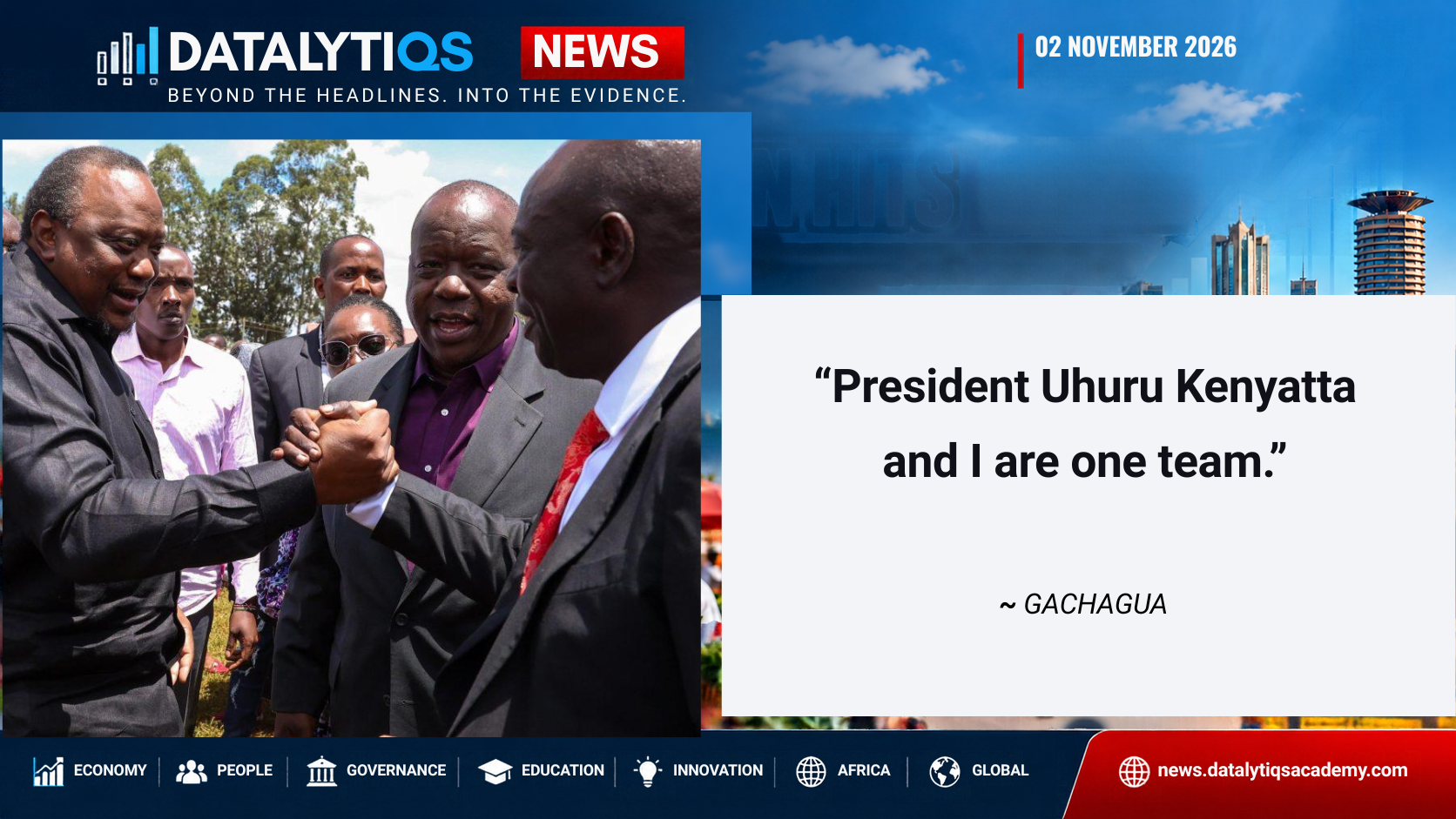
“President Uhuru Kenyatta and I are one team.”
Gachagua maintained that they communicate, meet, discuss political issues and reach understandings. He asked elders to concentrate instead on bringing the wider Mt Kenya community together.
His central argument was straightforward: there is no personal quarrel requiring mediation.
The Standard reports that Gachagua characterised the proposed reconciliation as unnecessary and insisted that his relationship with Uhuru remained intact.
This is a clear public statement from Gachagua. However, it is important to distinguish his description of the relationship from independent evidence of a formal political alliance.
What is established: Gachagua says they are on good terms and work together.
What is not established: Uhuru has publicly endorsed Gachagua’s presidential ambitions, agreed to a common electoral strategy or accepted a particular Mt Kenya leadership arrangement.
2. THE RELATIONSHIP DID BREAK DOWN AFTER 2022
The present claims of brotherhood must be understood against the political history of the two leaders.
Gachagua previously worked closely with Uhuru before entering elective politics. Their political differences became pronounced during the 2022 presidential election.
Uhuru supported Raila Odinga, while Gachagua joined William Ruto’s Kenya Kwanza campaign and subsequently became Deputy President.
The disagreement was not merely electoral. The campaign period and its aftermath involved sustained public criticism of Uhuru’s administration, political legacy and family interests.
The relationship deteriorated further amid controversy surrounding the March 2023 invasion of the Kenyatta family’s Northlands property in Ruiru.
Daily Nation reports that Gachagua subsequently apologised to the Kenyatta family for past political hostilities, although Uhuru has remained comparatively restrained in his public response.
It would therefore be inaccurate to suggest that the two never experienced a political fallout.
The more defensible conclusion is that they experienced a serious political rupture and that Gachagua now maintains that their relationship has been repaired.
3. GACHAGUA HAD ALREADY DISMISSED THE NEED FOR A HANDSHAKE IN MARCH
The November declaration is not an entirely new position.
On March 27, 2026, The Star reported that Gachagua had similarly rejected suggestions that he needed a political handshake with Uhuru.
During a podcast interview, he acknowledged their acrimonious differences over the 2022 election but said he had apologised for remarks that might have offended the former President.
He maintained that their families retained longstanding personal relationships and that the political disagreements had been resolved.
He also presented himself as a defender of Uhuru against public attacks. sports.
This earlier statement matters because it demonstrates that Gachagua’s latest remarks are consistent with a position he has publicly advanced for several months.
It also raises a question about the continuing mediation efforts: are the elders trying to repair a personal relationship, or are they attempting to formalise a regional political settlement that has not yet been achieved?
4. THE ELDERS ARE PURSUING A BROADER POLITICAL ARRANGEMENT
Reporting by Daily Nation on November 1 provides important evidence that the elders’ ambitions extend beyond bringing Uhuru and Gachagua together.
Kung’u Muigai, patron of the Kiama Kia Ma Council of Elders, confirmed that efforts were underway to arrange a meeting involving Uhuru, Gachagua and Kindiki.
He said the organisers were waiting for Uhuru to provide a suitable date.
The newspaper reported that a proposed meeting had failed to materialise because Uhuru was unavailable.
According to the elders, the objective is to strengthen regional unity and establish a common approach to the 2027 elections.
That is significantly different from a private reconciliation between two former allies.
A meeting involving Kindiki would necessarily bring together leaders who currently occupy competing political positions: Gachagua in opposition, Kindiki in government and Uhuru as an influential former President.
Their political interests cannot be assumed to align simply because they share regional connections.
5. THE OCTOBER 7 MEETING: THE PLAN WAS BIGGER THAN UHURU AND GACHAGUA
On October 7, a group of 25 elders reportedly met at Kung’u Muigai’s Kiambu home. They represented Agikuyu, Ameru, Akamba and Aembu communities.
Their objective was to establish a common political framework involving four leaders: Uhuru, Gachagua, Kindiki and Wiper leader Kalonzo Musyoka.
The elders proposed differentiated roles rather than immediately demanding that all four join the same political party.
The proposals included recognising Uhuru as a senior adviser, Gachagua as a political mobiliser, Kalonzo as an important opposition figure and Kindiki as a representative of the region within the government.
These were proposals from the elders, not positions formally accepted by the politicians.
The meeting also exposed disagreements within the elders’ organisations themselves, including competing claims to legitimacy and the authority to appoint a regional spokesperson.
This makes the unity campaign more complex than a straightforward attempt to end a personal disagreement.
6. KINDIKI’S INVOLVEMENT CHANGES THE POLITICAL EQUATION
The inclusion of Deputy President Kithure Kindiki introduces a fundamental contradiction.
Gachagua is positioning himself as a major opposition leader challenging President Ruto.
Kindiki is Ruto’s serving Deputy President and has a direct political interest in maintaining the government’s electoral support in Mt Kenya.
Uhuru, meanwhile, remains a former President with political influence and connections across different opposition formations.
A meeting of the three could promote dialogue and reduce political hostility. But dialogue is not the same as agreement on whom to support in 2027.
Kindiki has previously sought Uhuru’s involvement in regional unity efforts, including through former Meru Governor Kiraitu Murungi.
The unresolved question is whether the proposed regional understanding would accommodate both government and opposition interests or ultimately force participants to choose sides.
7. THE BATTLE FOR THE MT KENYA SPOKESPERSONSHIP
A particularly revealing aspect of the reconciliation effort is the continuing debate over who should speak for Mt Kenya.
In September, Kindiki was installed as a regional spokesperson at Kirigiti Stadium in Kiambu County.
However, rival factions of the Kiama Kia Ma Council subsequently challenged the legitimacy of the process.
Daily Nation reported on October 7 that a meeting of 63 elders had concluded that the organisation was divided and lacked an undisputed mandate to crown a regional leader.
Kindiki distanced himself from the dispute, describing the ceremony as an initiative of the elders.
This controversy demonstrates why symbolic endorsements alone cannot resolve the competition for regional leadership.
No council of elders can legally confer exclusive ownership of an electorate upon a politician.
The ultimate test of political leadership remains the ability to persuade voters and win their democratic mandate.
8. FOUR RECONCILIATION ATTEMPTS SINCE 2022
According to the November 1 Daily Nation investigation, the latest effort is the fourth since 2022.
- 2022 — THE FIRST ATTEMPTEfforts were made to bring Uhuru and Gachagua together during the presidential contest, when they supported opposing candidates. The initiative did not produce a common political position.
- 2022–2024 — THE SECOND ATTEMPTElders attempted to repair the relationship after Gachagua became Deputy President. The process was affected by continuing political hostility and subsequently disrupted by his impeachment.
- AFTER OCTOBER 2024 — THE THIRD ATTEMPTFollowing Gachagua’s removal from office, another unity initiative sought to prevent further political fragmentation in the region.
- OCTOBER–NOVEMBER 2026 — THE FOURTH ATTEMPTElders renewed the initiative, this time explicitly seeking to include Kindiki and establish a wider political understanding before the 2027 election.
The chronology is based on accounts provided by the elders and reported by Daily Nation. It should not be interpreted as evidence that four formal reconciliation agreements were negotiated or signed.
9. WHAT THIS MEANS FOR THE 2027 PRESIDENTIAL ELECTION
The implications extend well beyond the personal relationship between Uhuru and Gachagua.
The region is central to competing strategies for the next presidential election, but its electorate is not politically homogeneous.
Several possible outcomes emerge.
| Scenario | Potential political implications |
|---|---|
| Uhuru and Gachagua coordinate within the opposition | Could reduce competition for opposition support in parts of Mt Kenya |
| Kindiki remains firmly aligned with Ruto | Government and opposition continue competing for regional votes |
| All three support a nonpartisan regional agenda | May reduce hostility without producing a joint electoral ticket |
| Reconciliation talks fail | Competing political centres remain, with voters deciding among them |
| Elders agree on a spokesperson | Symbolic unity may improve, but electoral support is not guaranteed |
These are scenarios, not forecasts. Their probabilities cannot be estimated credibly from political statements alone.
For statistical analysis, the relevant indicators would include constituency-level voter registration, turnout, candidate support, party identification, issue priorities and longitudinal opinion polling.
Crowd sizes, public endorsements and elders’ declarations are insufficient substitutes for representative electoral data.
10. THE UHURU FACTOR: ADVISER, KINGMAKER OR INDEPENDENT POLITICAL ACTOR?
Uhuru’s role remains especially consequential because he has not publicly accepted the specific political arrangement described by the elders.
The Daily Nation investigation also documents speculation involving Fred Matiang’i, Kalonzo Musyoka and Edwin Sifuna.
President Ruto has accused Uhuru of sponsoring opposition figures, while Gachagua has been seeking to strengthen his own political position.
These accusations and interpretations should not be mistaken for independently verified evidence of Uhuru’s preferred presidential candidate. Daily Nation
Uhuru could support a particular candidate, encourage cooperation among several opposition leaders or maintain a less explicit political role.
Until he states his position or an agreement is publicly established, assigning him a definitive 2027 strategy would be speculative.
11. DATALYTIQS ANALYSIS: THE FIVE BIGGER QUESTIONS
First, is the reconciliation personal or political? Gachagua’s statements suggest he considers the personal relationship repaired. The elders’ actions suggest that political coordination remains unresolved.
Second, who has the mandate to speak for Mt Kenya? The legitimacy disputes surrounding the elders’ councils demonstrate the limitations of self-appointed regional spokespersons.
Third, can Kindiki and Gachagua share a regional political platform while backing opposing presidential candidates? They can cooperate on regional development issues, but their electoral objectives remain fundamentally different.
Fourth, what is Uhuru’s actual position? Gachagua has described them as one team, but the reporting does not establish Uhuru’s acceptance of a common 2027 electoral arrangement.
Fifth, what will voters gain? A political settlement should be evaluated against public priorities: agricultural incomes, employment, enterprise development, taxation, infrastructure, healthcare and equitable public investment.
The greatest risk is that a discussion presented as regional unity becomes a contest over political succession and bargaining power without producing a measurable development agenda.
12. FACT-CHECK: WHAT IS VERIFIED?
| Claim | Assessment |
|---|---|
| Gachagua says he and Uhuru are brothers and one team | Verified as Gachagua’s statement |
| They communicate and meet | Reported by Gachagua; not independently documented in full |
| They previously experienced a political fallout | Supported by the historical record |
| Gachagua says he apologised to Uhuru | Verified as his public account |
| Elders are organising a broader unity meeting | Confirmed through statements by organisers |
| Kindiki is among the intended participants | Confirmed as an organisers’ proposal |
| Uhuru has endorsed Gachagua for 2027 | Not established |
| The three leaders have agreed on a regional spokesperson | Not established |
| A binding 2027 political alliance exists | Not established |
CONCLUSION: THE BROTHERHOOD MAY BE REAL, BUT THE POLITICAL AGREEMENT IS STILL MISSING
Gachagua’s latest remarks represent a deliberate attempt to remove the perception of hostility between himself and Uhuru.
They also strengthen his claim to political legitimacy among supporters who regard Uhuru as an influential former regional leader.
But the elders’ continuing efforts reveal a broader unresolved question: how will Mt Kenya’s competing political leaders relate to one another as the 2027 presidential election approaches?
The evidence supports a reported personal rapprochement. It does not yet establish a unified political command, an agreed presidential candidate or a binding regional electoral arrangement.
The most consequential issue is therefore not whether Uhuru and Gachagua can share a meal.
It is whether the leaders competing for the region’s support can articulate a credible, accountable political agenda, and accept that voters, rather than political elders, will make the final decision.
NTV Kenya: Uhuru, Gachagua spark truce speculation with rare public show of camaraderie
Stop dragging Uhuru’s name into political disputes, Gachagua tells Duale – The Standard
Opposition unity big headache for Ruto as Uhuru joins the fray
Kindiki urges Mt Kenya to reject divisive politics – The Standard