DATALYTIQS NEWS | POLITICS & GOVERNANCE | 2 NOVEMBER 2026
SPECIAL REPORT | KENYA’S 2027 PRESIDENTIAL ELECTION
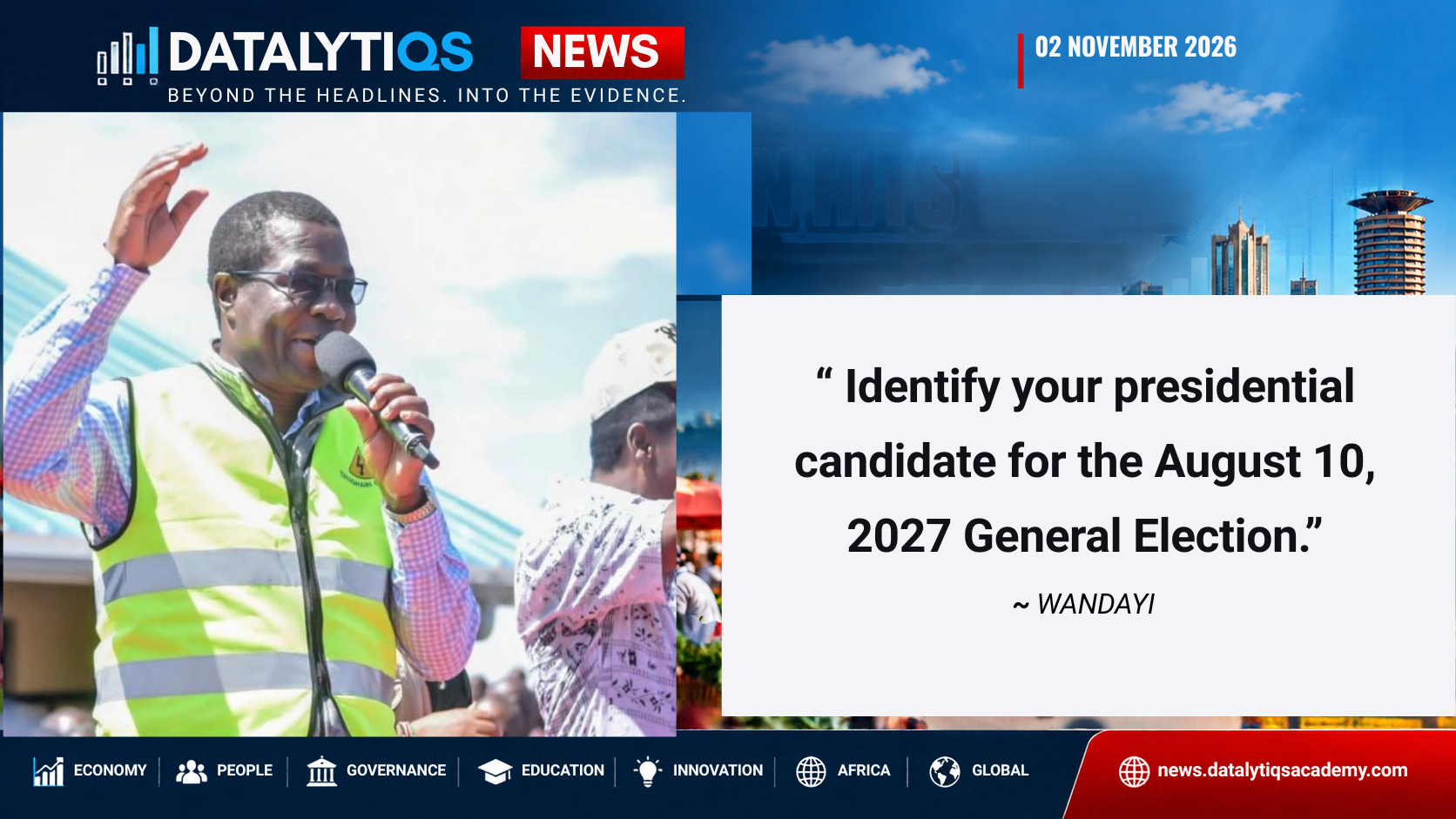
Energy Cabinet Secretary Opiyo Wandayi has challenged Kenya’s opposition leaders to identify their presidential candidate for the August 10, 2027 General Election, accusing them of lacking a coherent leadership strategy and questioning their capacity to challenge President William Ruto.
The challenge, delivered during a government electricity-connectivity event in Kakamega County, comes as the opposition struggles to resolve a consequential disagreement: whether to unveil its presidential candidate before Christmas 2026 or delay the announcement until approximately five months before the election.
Research across The Standard, Daily Nation and The Star reveals that the disagreement is not merely about timing. It reflects deeper differences over presidential ambitions, coalition formation, regional electoral calculations, campaign organisation and the political risks of selecting one candidate from several competing personalities.
1. WHAT WANDAYI ACTUALLY SAID
Wandayi made the remarks at Khalaba Village in Matungu Constituency, Kakamega County, while commissioning an electricity-connectivity project.
According to The Standard’s report published on November 1, he challenged the opposition to resolve its internal leadership question and present a candidate capable of competing against Ruto.
He dismissed the opposition’s efforts to unite as ineffective and argued that its leaders lacked a sufficiently persuasive development record.
Wandayi also urged residents of Western Kenya and Nyanza to support Ruto’s re-election, portraying the administration as committed to expanding development opportunities in the two regions.
Verification distinction: The published report establishes the substance of Wandayi’s challenge. It does not provide a complete verbatim transcript of his speech, so the headline should not be treated as an exact quotation.
The intervention is politically significant because Wandayi previously served as a prominent ODM opposition figure and now holds a Cabinet position in Ruto’s administration. His criticism therefore carries an additional dimension: a former opposition leader is questioning the readiness of politicians who remain outside government.
2. THE DEVELOPMENT PROJECT BEHIND THE POLITICAL CHALLENGE
Wandayi’s remarks were delivered during an official government activity, not solely at a political rally.
Matungu allocation
Sh165M
Reported project funding
Target households
4,000
Planned connections
Kakamega allocation
Sh2.5B
Current financial year
Wandayi announced that the government had allocated Sh165 million to connect 4,000 households in Matungu, within a wider Sh2.5 billion electricity-connectivity allocation for Kakamega County.
At the commissioning event, 162 households and three institutions—Matungu Kenya Medical Training College, Khalaba Dispensary and Khalaba Secondary School—were reported connected to the national grid.
These figures are reported government announcements, not independently audited expenditure or completion data.
They nevertheless provide a measurable basis for assessing the government’s development claims.
The Matungu allocation represents approximately Sh41,250 per targeted household, calculated by dividing Sh165 million by 4,000. This is a simple funding-to-target ratio, not a verified unit connection cost, because the allocation may cover distribution infrastructure and other expenditure.
The more consequential accountability question is whether the announced connections will be completed within the planned period, at the approved cost and with reliable electricity supply.
There is also an institutional question: should government development launches become platforms for partisan electoral mobilisation? Cabinet Secretaries retain political affiliations, but the use of public resources and official functions must remain consistent with constitutional and public-service obligations.
3. THE REAL DISAGREEMENT: DECEMBER 2026 OR MARCH 2027?
The opposition’s immediate dispute centres on two competing timetables.
DEC 2026
Early decision
KALONZO’S PREFERRED APPROACH
Kalonzo Musyoka’s allies want the presidential candidate selected by December, giving the nominee more time to mobilise resources, establish campaign structures and build nationwide support.
MAR 2027
Delayed decision
GACHAGUA’S PREFERRED APPROACH
Rigathi Gachagua and his allies favour waiting until roughly five months before the election to allow more consultations and reduce the risk of political fragmentation.
At a high-level meeting hosted by Gachagua at Wamunyoro in Nyeri County on October 26, opposition leaders reaffirmed their intention to field one candidate against Ruto.
But they did not resolve when that candidate should be announced. Daily
Kitui Senator Enoch Wambua, a Kalonzo ally, argued that the public was becoming impatient with the delays.
Gatanga MP Edward Muriu and Embakasi Central MP Benjamin Gathiru, associated with Gachagua’s camp, urged caution, arguing that premature selection could leave dissatisfied political leaders vulnerable to approaches from the government.
The disagreement is therefore partly strategic and partly about trust among coalition partners.
4. THE WAMUNYORO MEETINGS: UNITY IN PRINCIPLE, COMPETITION IN PRACTICE
The October 26 consultations at Gachagua’s Wamunyoro residence involved Kalonzo Musyoka and Eugene Wamalwa, while Nairobi Senator Edwin Sifuna had also held discussions with Gachagua.
The meetings demonstrated a willingness to coordinate politically, but they also exposed the difficulty of selecting a presidential candidate acceptable to the different parties.
Gachagua publicly maintained that the opposition’s best prospect was to unite behind one candidate.
However, The Star reported on October 28 that no final agreement had been reached on the proposed presidential ticket.
This is the central contradiction in the opposition’s current position.
Its leaders broadly agree on the objective of defeating Ruto, but the available reporting does not establish consensus on the leadership structure through which they intend to achieve that objective.
A shared opponent can create an electoral alliance. It cannot automatically resolve competing ambitions.
5. THE SIFUNA FACTOR: A NEW GENERATION COMPLICATES THE EQUATION
Nairobi Senator Edwin Sifuna has emerged as an important figure in discussions about the opposition’s 2027 presidential ticket.
His political appeal introduces a generational dimension to negotiations previously dominated by experienced national figures.
But the possibility of Sifuna leading the ticket has also generated disagreements.
DCP deputy leader Cleophas Malala publicly claimed that his party had settled on Sifuna as its preferred candidate.
The Star subsequently reported that Gachagua had distanced himself from that claim and maintained that no final decision had been reached.
That distinction is essential: Malala’s endorsement does not constitute an agreed coalition nomination.
Sifuna’s growing visibility also creates a political challenge for Kalonzo, who has maintained presidential ambitions over several electoral cycles.
The opposition must decide whether experience, popularity, organisational capacity, regional reach or perceived electability should carry the greatest weight in candidate selection.
A transparent selection process could reduce disputes. An informal elite agreement may be quicker, but risks leaving supporters questioning how the decision was reached.
6. WHAT THE OPINION POLLS REVEAL—AND WHAT THEY DO NOT
The opposition’s candidate-selection dilemma is complicated by differing public-opinion estimates.
Daily Nation reported the following findings from a July 2026 TIFA survey.
REPORTED PRESIDENTIAL PREFERENCES — JULY 2026 TIFA SURVEY
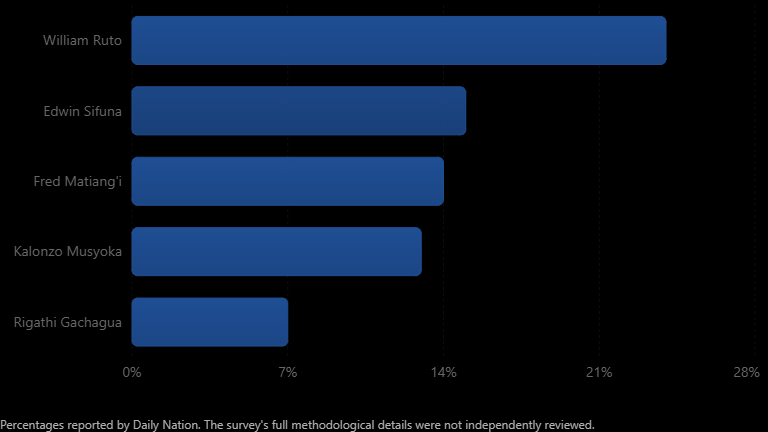
A separate Politrack Africa survey, reported in October, placed Ruto at 45.1% and Sifuna at 19.6%. Daily Nation
These findings should not be combined into a single trend without reviewing their sampling designs, fieldwork dates, question wording, weighting procedures and margins of error.
In particular, support for an individual candidate is not equivalent to support for a unified opposition ticket.
It would be statistically unsound to add the percentages recorded by different opposition politicians and assume that their supporters would automatically vote for whichever candidate the coalition selects.
The analytical implication: The opposition needs reliable voter-preference research that tests actual candidate pairings, second-choice preferences, regional support, turnout intentions and the willingness of supporters to accept a compromise nominee.
7. THE GOVERNMENT’S STRATEGIC INTEREST IN AN EARLY ANNOUNCEMENT
Wandayi’s challenge may be presented as a demand for political accountability, but it also potentially benefits the incumbent administration.
A named opposition candidate would give the government a clearly identifiable political opponent.
That could allow Ruto’s campaign to concentrate its messaging on one rival’s record, public statements, political alliances and vulnerabilities.
It could also expose disagreements among opposition politicians who had hoped to secure the nomination.
Conversely, a delayed announcement could preserve flexibility and make it more difficult for the government to focus its political attacks.
These are plausible strategic interpretations—not evidence of Wandayi’s private intentions.
The government has also begun making this challenge through more than one Cabinet Secretary.
On November 1, Health Cabinet Secretary Aden Duale separately challenged the opposition to announce its candidate, arguing that Ruto’s political coalition was ready to compete against any challenger.
Speaking in Masalani, Ijara Constituency, Duale claimed the government’s support base was sufficiently strong to secure another victory.
Duale’s assertion that the government could win with 18 million votes is a political projection, not a verified electoral forecast.
8. THE OPPOSITION’S TWO STRATEGIC OPTIONS
| Dimension | Announce by December 2026 | Announce around March 2027 |
|---|---|---|
| Campaign organisation | More preparation time | Compressed preparation period |
| Fundraising | Longer period to mobilise resources | Less time after nomination |
| Public scrutiny | Candidate faces prolonged examination | Shorter period of concentrated scrutiny |
| Coalition negotiations | Earlier resolution of leadership disputes | More time to accommodate competing interests |
| Risk of defections | Dissatisfied aspirants emerge earlier | Disputes may persist closer to polling |
| Voter familiarity | More time to build national recognition | Greater reliance on existing recognition |
| Policy development | Earlier opportunity to communicate a unified agenda | Parties may continue presenting separate agendas |
Neither strategy guarantees electoral success.
The choice depends on the opposition’s organisational readiness, the credibility of its selection mechanism and the willingness of unsuccessful aspirants to support the eventual nominee.
The greatest danger is not necessarily choosing too early or too late. It is selecting a candidate without first agreeing on a process that all coalition partners will respect.
9. THE DRAFT COALITION FRAMEWORK: IMPORTANT DEADLINES ARE EMERGING
A Daily Nation investigation published on October 28 reported the existence of a draft opposition coalition framework.
The document reportedly proposed several milestones, including completing the mapping of constituency arrangements by the end of February 2027 and lodging a coalition agreement with the Office of the Registrar of Political Parties by March 31, 2027.
It also contemplated negotiations over political positions and arrangements for coordinating parliamentary and other electoral contests. Daily Nation
These dates should be treated as proposals contained in a draft, not binding deadlines already approved by the opposition principals.
The framework nevertheless reveals that candidate selection is only one part of a much larger organisational challenge.
A functioning electoral coalition also requires agreement on campaign management, resource mobilisation, candidate nominations, dispute resolution, regional coordination and the allocation of responsibilities.
10. THE CONSTITUTIONAL AND ELECTORAL DIMENSION
Kenya’s Constitution requires a presidential candidate to obtain more than half of all votes cast and at least 25% of the votes cast in more than half of the counties to win in the first round.
This means that a successful opposition candidate must assemble support that is both numerically sufficient and geographically distributed.
A coalition concentrated in a few large regional voting blocs may remain electorally vulnerable despite commanding significant numbers of supporters.
Similarly, the timing of candidate selection must ultimately accommodate the IEBC’s legally prescribed nomination and election timetable.
The opposition’s internal preference for a December or March announcement is a political decision. It does not replace statutory nomination requirements.
11. THE BIGGER ACCOUNTABILITY QUESTION: WHAT IS THE OPPOSITION OFFERING?
The current public debate is dominated by the identity of the presidential candidate.
But an opposition seeking to replace an incumbent government must also articulate what it would do differently.
Several policy questions deserve priority:
- Taxation and household welfare: What specific tax reforms would the opposition implement, and how would it finance any revenue reductions?
- Public debt and fiscal management: How would it address debt-service pressures while sustaining essential expenditure?
- Employment and enterprise development: What measurable interventions would create productive opportunities for young people?
- Healthcare and education: What financing, governance and service-delivery reforms would be introduced?
- Constitutional governance: How would the opposition strengthen independent institutions, electoral credibility and public accountability?
Without a coherent policy programme, selecting a presidential candidate risks becoming an exercise in distributing political positions rather than presenting a credible alternative government.
The same standard applies to the incumbent administration: government performance must be assessed through verifiable outcomes, not campaign declarations alone.
12. DATALYTIQS ANALYTICAL VERDICT
ESTABLISHED FACT
Wandayi publicly challenged the opposition to identify its 2027 presidential candidate. Kalonzo’s allies favour an earlier announcement, while Gachagua’s camp prefers a later decision.
UNRESOLVED QUESTION
No agreed joint opposition presidential candidate has been established in the reviewed reporting. Nor is there a publicly confirmed, binding candidate-selection formula.
STRATEGIC ASSESSMENT
A delayed announcement may protect negotiating flexibility, but it becomes increasingly costly if it postpones campaign organisation, fundraising, candidate recognition and policy coordination.
The opposition’s greatest vulnerability may therefore be less about the calendar than about its internal political architecture.
A coalition capable of defeating Ruto must demonstrate that its leaders can subordinate individual ambitions to an agreed electoral strategy.
Equally, the government should not mistake the opposition’s organisational difficulties for evidence that the presidential election is already decided.
CONCLUSION: THE CANDIDATE CANNOT REMAIN A SECRET FOREVER
Wandayi’s challenge has exposed a genuine strategic dilemma for Kenya’s opposition.
Naming a presidential candidate early could accelerate national mobilisation, but risks provoking internal divisions and sustained attacks.
Waiting could preserve negotiating flexibility, but may also weaken the opposition’s capacity to organise a coherent campaign.
The decisive question is not simply when the opposition will name its candidate. It is whether the chosen candidate will command sufficient legitimacy, organisational support and public confidence to mount a credible national campaign.
President Ruto’s administration is already presenting its development record and preparing for re-election.
The opposition must eventually offer voters something more substantial than the promise of a united front.
It must present a candidate, a credible programme and a convincing explanation of how it intends to govern differently.