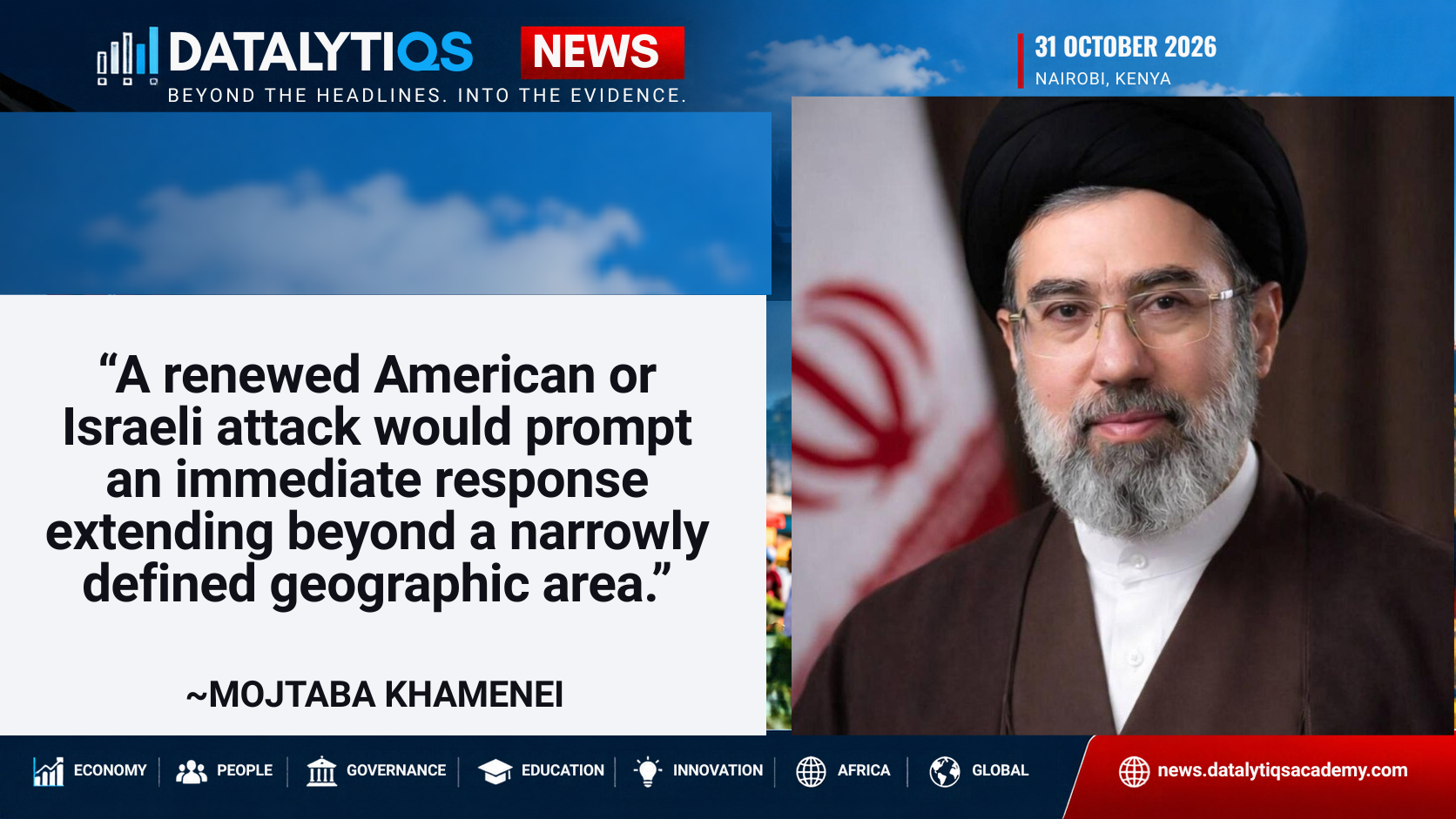
Iran’s Supreme Leader, Mojtaba Khamenei, has warned that another American or Israeli attack could trigger retaliation extending beyond the immediate battlefield. The statement signals a potentially wider regional confrontation, but it is a conditional warning—not confirmation that an attack has been authorised or is imminent.
TEHRAN | 31 October 2026
Iran has warned that any renewed military attack by the United States or Israel would provoke an immediate response without narrowly defined geographic limits, increasing concerns about the potential regional consequences of another confrontation.
According to the Associated Press account supplied for this report, Supreme Leader Mojtaba Khamenei issued the warning as diplomatic intermediaries continued efforts to prevent another round of hostilities.
The statement raises questions about the possible exposure of American military facilities in neighbouring countries, Israeli territory, regional maritime routes and infrastructure supporting international commerce.
However, the warning must be interpreted precisely.
A declared willingness to retaliate is not the same as an operational decision to launch an attack.
The statement describes Iran’s publicly asserted response to a future contingency. It does not, on its own, establish that American or Israeli forces are preparing an imminent strike or that Iran has issued orders for offensive military action.
1. What Does “No Geographic Limits” Mean?
The phrase suggests that Iran does not intend to restrict its potential response to the location from which an attack originates.
In strategic terms, this is a warning about the possible geographic expansion of a conflict.
It could be intended to discourage military action by emphasising that the consequences might extend beyond Iran and Israel.
However, the statement does not identify a verified list of targets, an operational timetable or a specific military plan.
It would therefore be premature to interpret it as confirmation that particular countries, bases, ports or shipping corridors have been selected for attack.
The distinction matters because broad deterrent language can be deliberately ambiguous.
Ambiguity may increase uncertainty for potential adversaries, but it also complicates independent assessments of actual military intentions.
2. Four Principal Areas of Regional Exposure
American military facilities in neighbouring states
The United States maintains military relationships and facilities across the Middle East.
A geographically expansive Iranian response could raise concerns about the security of US personnel and installations in the region.
However, the existence of American facilities does not establish that the countries hosting them are participants in a particular military operation.
Nor does Iran’s warning prove that any specific installation is being targeted.
An assessment of immediate risk would require verified changes in force protection, official security advisories or independently documented military activity.
Israeli territory
Israel remains a central party to the confrontation described in the warning.
Renewed attacks could create risks to military installations, civilian populations and essential infrastructure.
The severity and geographic distribution of those risks would depend on the weapons employed, defensive capabilities and decisions taken by the parties involved.
No particular attack trajectory or target should be inferred from the warning alone.
Regional shipping and energy infrastructure
The Gulf and surrounding maritime corridors are important to international energy transportation and trade.
Any expansion of hostilities affecting shipping could increase insurance premiums, disrupt vessel movements and influence energy-market expectations.
These are plausible economic transmission channels rather than confirmed consequences of the latest statement.
Evidence of an actual disruption would require shipping advisories, verified incidents, vessel movements or market data.
Wider regional escalation
A confrontation involving additional countries, armed groups or military installations could complicate diplomatic efforts to contain the conflict.
The involvement of other actors should not be presumed without evidence.
The principal analytical concern is the possibility that an initially limited military exchange could produce additional retaliatory actions, misunderstandings or decisions by other governments.
3. Why Diplomatic Mediation Matters
The reported diplomatic efforts are significant because they indicate that communication channels remain relevant despite public threats.
Mediators may seek to clarify demands, communicate assurances or identify measures that reduce the likelihood of renewed fighting.
However, the existence of diplomatic contacts does not establish that an agreement has been reached.
Similarly, threatening statements do not necessarily mean that diplomacy has ended.
Governments can negotiate while maintaining public military warnings.
The appropriate evidence of diplomatic progress would include official announcements, confirmed agreements, verifiable implementation measures and consistent statements from the participating governments.
4. Deterrence Versus Operational Readiness
Iran’s statement can be analysed as a form of deterrent signalling.
Deterrence seeks to influence an adversary’s decisions by communicating the potential costs of a particular action.
But deterrent language should be separated from indicators of operational readiness.
The following distinctions are essential:
| Indicator | What it establishes | What it does not establish |
|---|---|---|
| Official warning | A publicly declared position on retaliation | An imminent strike |
| Military readiness announcement | A stated change in preparedness | An order to attack |
| Independently verified deployment | A documented movement or change in force posture | Necessarily an intention to initiate hostilities |
| Confirmed strike or interception | An actual military event | Automatically the identity or intention of every participant |
| Diplomatic meeting | Contact between parties or intermediaries | A completed settlement |
This framework helps prevent political rhetoric from being reported as an accomplished military event.
5. A Significant Diplomatic Development: The Strait of Hormuz
The Associated Press also reports that Iranian Foreign Minister Abbas Araghchi said mediators had received a proposal under which the Strait of Hormuz could be fully reopened within two days.
Iran’s stated conditions reportedly include the lifting of the US blockade and sanctions. Tehran has not agreed to direct negotiations with Washington.
This is significant because the Strait of Hormuz is a critical international energy corridor.
A proposal to reopen the waterway is not the same as an implemented agreement. Its significance depends on whether the parties accept the conditions and whether maritime traffic can resume under verifiable arrangements.
The diplomatic initiative and Khamenei’s military warning should therefore be reported together: Iran is signalling readiness to retaliate while simultaneously participating in efforts to avert renewed confrontation.
6. Additional Reported Incident Near Qeshm Island
Reuters reported separately on October 31 that an Iranian provincial official accused the United States of attacking two fishing boats near Qeshm Island, reportedly injuring one fisherman.
At the time of reporting, the United States had not confirmed the alleged attack, and the White House and Pentagon had not immediately responded to requests for comment.
The allegation warrants monitoring but must not be presented as an independently established US military operation.
It also does not, without additional evidence, establish that Khamenei’s warning has triggered a new exchange of hostilities.
7. Implications for Kenya and African Economies
For Kenya and other petroleum-importing economies, the principal concern is the possibility of disruption to energy supplies and international shipping.
A sustained confrontation could affect imported fuel costs, freight rates, marine insurance, inflation expectations and foreign-exchange demand.
These risks are especially relevant to economic monitoring because changes in global energy and transport costs can eventually influence domestic production and household expenditure.
However, the magnitude of any effect would depend on the duration of disruption, market responses, exchange rates and domestic pricing mechanisms.
No specific increase in Kenyan inflation or pump prices can be attributed to this warning alone.
DatalytIQs Geopolitical Intelligence Assessment
The October 31 warning establishes a publicly communicated Iranian military posture, not a verified decision to initiate an attack.
The central analytical distinction is between four developments:
- Declared deterrence: Iran says it will respond forcefully and without geographic restriction if attacked.
- Military preparation: Iranian state media reports instructions to commanders to update readiness and potential target information. This does not establish that particular targets have been selected for an imminent strike.
- Diplomatic engagement: Mediators continue discussions, including proposals concerning the Strait of Hormuz.
- Verified military events: These require independent confirmation of the action, responsible forces, location and consequences.
The possibility of escalation is material because a renewed exchange could involve additional military installations, states and maritime infrastructure.
Nevertheless, the warning does not establish when, where or whether another attack will occur.
What to Monitor Next
The most consequential indicators are official US and Israeli decisions, independently verified military deployments, Iranian operational announcements, diplomatic agreements and maritime-security developments.
Particular attention should be paid to whether the proposed reopening of the Strait of Hormuz is accepted and implemented, and whether the reported Qeshm Island incident receives independent confirmation.
Conclusion: A Warning Designed to Deter, Not Proof That War Is Imminent
Iran’s warning communicates that renewed American or Israeli military action could carry consequences extending beyond the immediate confrontation.
It is an important official statement, particularly because it was reportedly accompanied by instructions to senior military commanders.
But the distinction between military preparedness, retaliatory intent and actual hostilities remains essential.
The central question is not how far Iran says its response could reach. It is whether further attacks occur, what actions are independently verified, and whether diplomatic negotiations can prevent another cycle of regional escalation.
DatalytIQs News — Beyond the Headlines. Into the Evidence.
Verified sources
Editorial verification: AP and additional reporting corroborate the official Iranian warning. Claims concerning particular future targets, attack timing or responsibility for the Qeshm Island incident remain unverified. The assessment distinguishes declared intentions from confirmed military events.