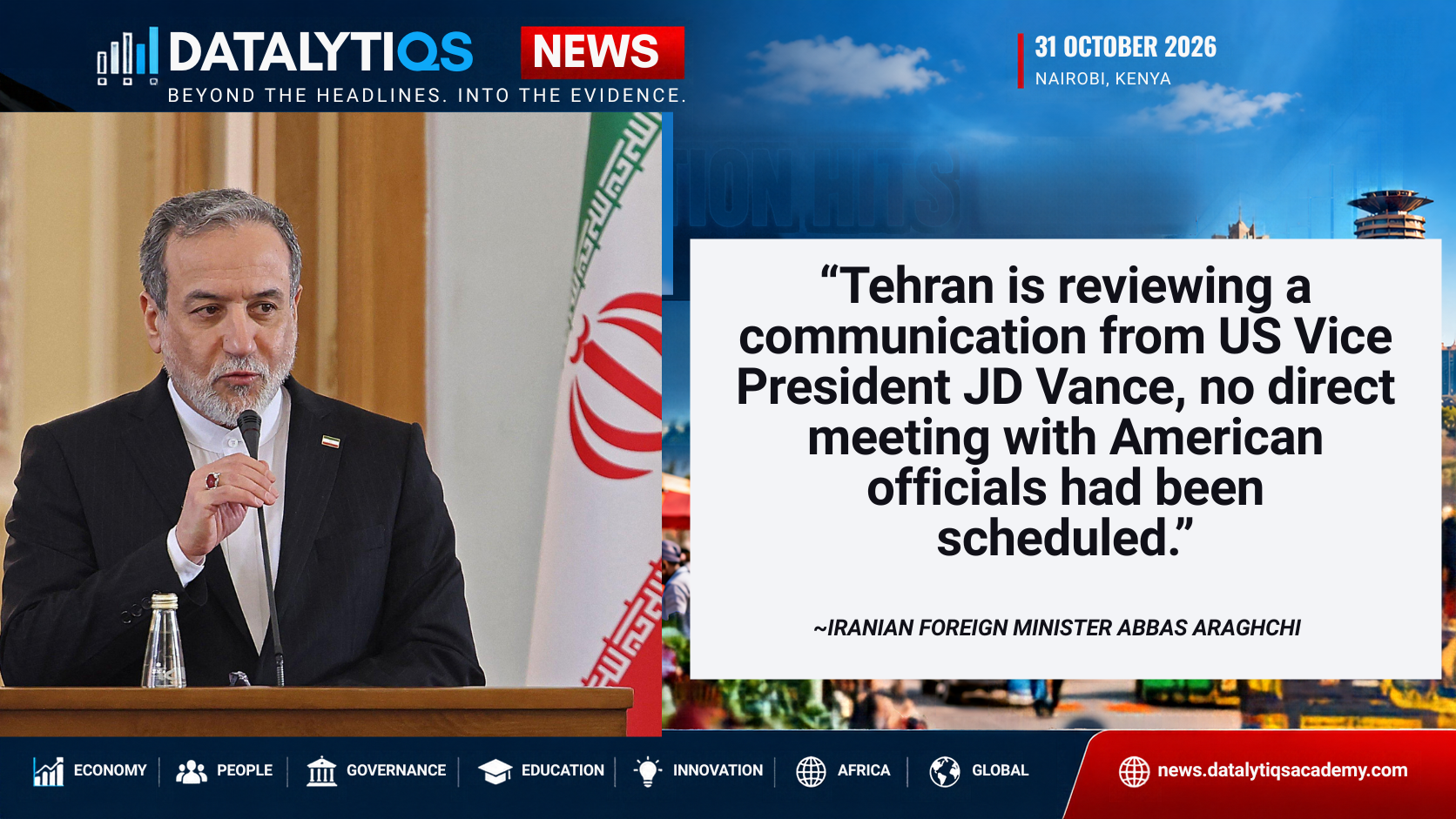
Iranian negotiators have held fresh discussions with Qatari mediators as Washington and Tehran explore competing proposals to prevent renewed fighting. The negotiations have exposed a fundamental disagreement over sequencing: Iran wants sanctions relief and other concessions before reopening the Strait of Hormuz, while Washington is seeking credible commitments on maritime access and Iran’s nuclear programme.
DOHA / TEHRAN / WASHINGTON | 31 October 2026
Iranian negotiators met Qatari mediators in Doha on Saturday, October 31, following more than 12 hours of discussions in Tehran the previous day, as regional diplomatic efforts intensified to prevent another round of military confrontation between Iran and the United States.
Reuters reported that the negotiations were being coordinated through regular communications with Washington, according to a source briefed on the discussions.
The latest diplomatic engagement comes amid speculation about whether President Donald Trump could authorise further military action following the United States’ November 3 midterm elections.
However, US Secretary of State Marco Rubio said on Saturday that Trump had not decided whether to conduct additional strikes and preferred a diplomatic solution.
Iranian Foreign Minister Abbas Araghchi separately confirmed that Tehran was reviewing a communication from US Vice President JD Vance, while maintaining that no direct meeting with American officials had been scheduled.
The central development is the continuation of indirect diplomatic engagement—not the conclusion of a ceasefire or a negotiated settlement.
Qatar’s Mediation: Two Days of Intensive Consultations
According to Reuters, Iranian and Qatari representatives held extensive discussions in Tehran on Friday before continuing negotiations in Doha on Saturday.
The meetings form part of Qatar’s continuing role as an intermediary between governments that remain deeply divided over security, sanctions and maritime access.
The reported coordination with Washington is significant because it indicates that the United States remains connected to the diplomatic process despite the absence of confirmed direct US–Iran negotiations.
However, the existence of indirect contacts does not demonstrate that the parties have agreed on a common framework.
Mediators may communicate proposals, clarify positions and identify potential compromises without securing formal acceptance.
The distinction between receiving a proposal and accepting its terms is therefore essential.
JD Vance’s Letter: An Opening, but Not an Agreement
Vice President JD Vance reportedly sent a letter to senior Iranian security official Mohsen Rezaei earlier in the week.
According to reporting cited by Reuters, the communication was intended to explore the possibility of restarting diplomatic negotiations.
President Trump subsequently characterised the communication more narrowly, saying he had approved discussions concerning medical supplies for Iran.
The differing public descriptions create uncertainty about the letter’s precise diplomatic scope.
Araghchi confirmed that Iranian authorities had examined the communication at senior levels.
He described the American attempt to open dialogue as a potentially positive development but emphasised that Tehran had not scheduled direct talks with Washington.
This establishes three separate facts: a communication was delivered, Iranian officials reviewed it, and no direct negotiating meeting had been confirmed.
It does not establish that Iran accepted an American negotiating framework.
The Strait of Hormuz: The Central Bargaining Issue
The Strait of Hormuz remains one of the most consequential issues in the negotiations.
The maritime passage connects the Persian Gulf with international shipping routes and is strategically important to global petroleum and liquefied natural gas transportation.
Disruption to navigation can affect shipping costs, insurance premiums, supply chains and international energy prices.
The latest negotiations involve competing proposals for reopening the waterway.
Reuters reports that Qatar presented a seven-day confidence-building arrangement under which Washington and Tehran would undertake reciprocal steps before entering broader negotiations.
Iranian officials considered that proposal unsatisfactory.
Tehran has advanced its own seven-day proposal, which would require Washington to lift its blockade of Iranian ports, release frozen assets and accept an Iranian-backed shipping arrangement through the Strait of Hormuz before the waterway is reopened.
The United States has not accepted those conditions.
The disagreement is therefore not simply whether maritime access should be restored.
It concerns what each side must do first.
Why the Sequence of Concessions Matters
The order in which obligations are implemented is a central challenge in international negotiations.
Iran is seeking concessions that would provide economic and security benefits before committing to the restoration of maritime access.
Washington is seeking commitments that would address its security concerns and establish confidence that any agreement will be implemented.
Both positions reflect concerns about whether the other party will fulfil its obligations.
A possible arrangement could involve simultaneous steps, phased implementation or third-party verification.
However, those are potential negotiating mechanisms rather than confirmed terms of the current discussions.
The key questions concern timing, verification and reversibility.
If one government provides concessions that are difficult to reverse while the other offers commitments that can be withdrawn quickly, the agreement may be politically difficult to sustain.
Conversely, requiring all obligations to be fulfilled before any reciprocal action could prevent negotiations from progressing.
Iran’s Conditions Extend Beyond Shipping
Araghchi’s public remarks indicate that Iran’s demands encompass several issues beyond the Strait of Hormuz.
These include relief from sanctions, restoration of oil-export waivers, access to frozen financial assets and changes to the American military presence in the region.
Iran has also sought recognition of a maritime transit arrangement developed with Oman.
These demands have economic, legal and security implications.
Sanctions relief may involve different American authorities and legal instruments.
Access to frozen assets may depend on the jurisdictions and institutions holding the funds.
Changes to regional military deployments would involve separate security decisions.
An agreement addressing these matters would therefore require more than a general declaration of political goodwill.
It would need clearly defined obligations and mechanisms for implementation.
Washington’s Position: Diplomacy Remains Open
Speaking on Saturday, Secretary of State Marco Rubio said Trump had not made a decision to conduct further strikes against Iran.
Rubio indicated that the administration preferred a diplomatic resolution while maintaining confidence in American military capabilities.
This position combines continued diplomatic engagement with the preservation of military options.
It should not be interpreted as a declaration that military action has been authorised.
Nor does it establish that Washington has permanently ruled out additional strikes.
The distinction matters because public statements about military capability and readiness can serve diplomatic or deterrent purposes without corresponding to immediate operational decisions.
The Nuclear Question Remains Unresolved
The negotiations also involve disagreements over Iran’s nuclear programme.
Washington has sought commitments concerning Iran’s nuclear activities, including arrangements for addressing highly enriched uranium.
Iran has expressed concern about making irreversible nuclear concessions before receiving economic relief that Washington could subsequently reverse.
This creates another sequencing problem.
The parties would need to agree not only on the substance of nuclear restrictions but also on verification, inspection arrangements and the timing of reciprocal obligations.
Without a credible implementation framework, an agreement on broad principles may not resolve the underlying dispute.
Diplomatic Contacts Continue Amid Military Warnings
The renewed discussions are taking place alongside explicit Iranian warnings about retaliation.
Supreme Leader Mojtaba Khamenei has ordered the armed forces to prepare for a substantial response to any renewed attack.
Iranian officials have indicated that retaliation would not necessarily be geographically confined to the immediate area of confrontation.
These statements are important indicators of Iran’s declared security posture.
However, they do not independently establish that an attack is imminent.
Similarly, American statements preserving military options do not constitute confirmation of an operational order.
The simultaneous existence of diplomatic negotiations and military warnings reflects the continuing uncertainty surrounding the conflict.
The Economic Stakes for Kenya and Africa
A negotiated reopening of the Strait of Hormuz could have implications for international energy markets and shipping.
For Kenya, the principal transmission channels include imported petroleum prices, maritime freight charges, insurance costs, exchange-rate pressures and the eventual effects on domestic transport and consumer prices.
However, the scale of any economic effect would depend on actual shipping conditions, global market responses and domestic pricing mechanisms.
The announcement of talks alone does not establish that oil prices will decline or that Kenyan fuel prices will change.
A credible assessment would monitor shipping movements, international petroleum benchmarks, freight and insurance costs, and official domestic fuel-price adjustments.
DatalytIQs Geopolitical Intelligence Assessment
| Diplomatic indicator | Current evidence | What remains unresolved |
|---|---|---|
| Iran–Qatar meetings | Talks held in Tehran and Doha | Whether the parties can agree on a common framework |
| US involvement | Mediators maintain communications with Washington | Whether Washington accepts any proposed sequence |
| Vance communication | Iran confirms reviewing the message | The full agreed purpose and diplomatic outcome |
| Strait of Hormuz | Competing reopening proposals exist | Transit arrangements, implementation and verification |
| Sanctions | Iran demands relief and access to assets | Scope, timing and legal mechanisms |
| Nuclear programme | Negotiations involve nuclear commitments | Verification and reciprocal obligations |
| Military options | US and Iranian officials maintain security warnings | Whether any new operation will be authorised |
The central intelligence question is whether diplomatic contacts produce an agreement that can be implemented and independently verified.
What Should Be Monitored Next?
The most consequential indicators are whether Washington and Tehran formally accept a common negotiating framework, whether Qatar announces agreed implementation steps, and whether either side begins carrying out verifiable commitments.
Particular attention should be paid to the Strait of Hormuz, sanctions relief, frozen assets, nuclear verification and security guarantees.
Any confirmed changes in military deployments or maritime restrictions should be reported separately from political statements about potential action.
Conclusion: The Negotiations Are Active, but the Settlement Remains Uncertain
The latest meetings in Tehran and Doha demonstrate that diplomatic channels remain operational despite serious disagreements and renewed military threats.
The exchange involving Vice President JD Vance indicates continued communication between Washington and Tehran, but it has not produced a publicly confirmed negotiating agreement.
The central obstacle remains the sequence of reciprocal commitments.
Iran wants economic and security concessions before reopening the Strait of Hormuz. Washington seeks credible assurances that maritime access and broader security concerns will be addressed.
The decisive development will not be another diplomatic meeting. It will be an agreed framework specifying who acts first, what each side must deliver and how compliance will be verified.
Until such arrangements are confirmed, the negotiations represent an opportunity to reduce tensions rather than an established settlement.
DatalytIQs News — Beyond the Headlines. Into the Evidence.
Verified sources
- Reuters, 31 October 2026 — <Link url={turn384931news8.url.uri} title=”Iranian envoys meet Qatari mediators as threat looms of US strikes after midterms”/>.
- Al Jazeera, 31 October 2026 — <Link url={turn384931search1.url.uri} title=”Iranian foreign minister discusses US outreach and conditions for talks”/>.
- Associated Press — <Link url={turn384931news9.url.uri} title=”Mediators work toward a US–Iran agreement amid major obstacles”/>.
- The Guardian, 29 October 2026 — <Link url={turn384931news10.url.uri} title=”JD Vance’s letter and the dispute over nuclear commitments and sanctions”/>.
Editorial verification: Reuters confirms the Tehran and Doha meetings, the reported coordination with Washington, Rubio’s statement and the competing proposals. Araghchi’s comments confirm Iran’s review of Vance’s communication. The evidence does not establish a newly agreed ceasefire, direct US–Iran negotiations or an accepted settlement framework.