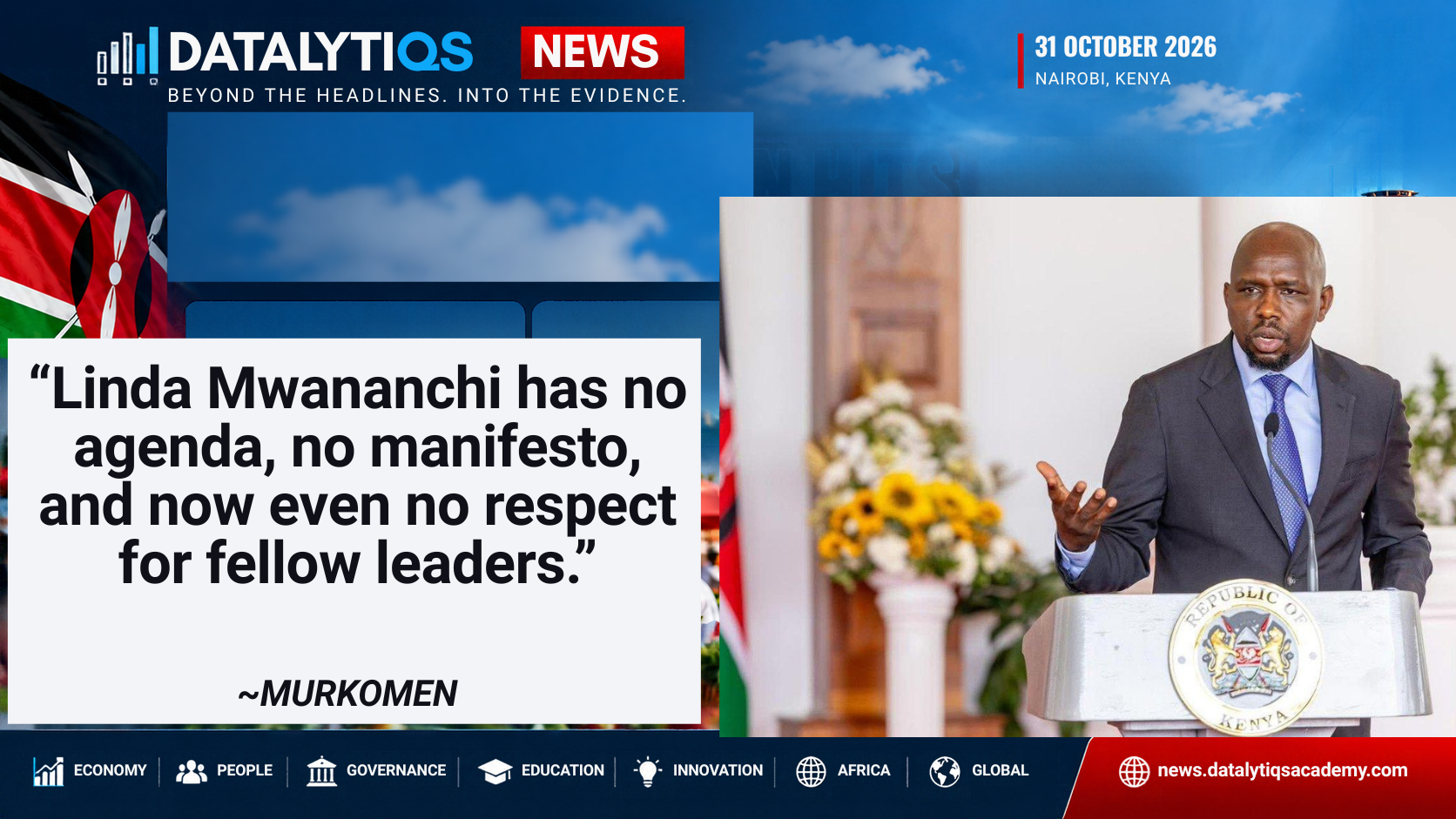
Interior Cabinet Secretary Kipchumba Murkomen has condemned the heckling of Wiper leader Kalonzo Musyoka during the Linda Mwananchi Movement’s headquarters launch. But the incident raises questions beyond political rivalry: who is responsible for maintaining order at rallies, and can the behaviour of some supporters fairly be attributed to an entire political movement?
NAIROBI, KENYA | 31 October 2026
Interior Cabinet Secretary Kipchumba Murkomen has criticised the Linda Mwananchi Movement following the disruption of Wiper leader Kalonzo Musyoka’s speech at the movement’s headquarters launch in Lavington, Nairobi, on Friday, October 30.
Speaking during a women’s empowerment event in Narok County on Saturday, Murkomen accused the movement of failing to demonstrate political tolerance.
“Linda Mwananchi has no agenda, no manifesto, and now even no respect for fellow leaders.”
He also invited Kalonzo to consider joining the broad-based government, arguing that his political experience would be respected.
The remarks followed an incident in which sections of the audience interrupted Kalonzo after he questioned the premature endorsement of Nairobi Senator Edwin Sifuna as a presidential candidate.
However, the confrontation requires a distinction between three issues: the conduct of individual supporters, the responsibility of event organisers and the official positions of the political leaders involved.
What Happened at the Linda Mwananchi Launch?
The disruption began when Kalonzo challenged remarks by Democratic Action Party of Kenya leader Eugene Wamalwa, who had referred to Sifuna as a presidential candidate.
Kalonzo argued that the movement had not yet completed the formal process required to nominate its candidate.
He referred to November 13 as the relevant date for the movement’s anticipated nomination proceedings.
His remarks prompted sections of the crowd to chant in support of Sifuna’s presidential ambitions.
As the interruptions continued, Kalonzo questioned whether the audience wanted him to continue speaking.
Sifuna subsequently intervened, asking supporters to respect the visiting leaders and allow Kalonzo to finish his address.
The former Vice President eventually continued his speech.
Importantly, Kalonzo also indicated that he would support Sifuna if the Nairobi Senator emerged as the opposition’s agreed presidential candidate.
These details establish that the incident involved disagreement over candidate selection, but they do not establish that the movement’s leadership had instructed supporters to heckle Kalonzo.
Murkomen’s Criticism: A Question of Political Tolerance
Murkomen interpreted the disruption as evidence of intolerance within the emerging opposition movement.
He argued that political leaders should discourage hostility among supporters, particularly as Kenya approaches the 2027 General Election.
His criticism raises a legitimate democratic concern.
Political gatherings should provide opportunities for leaders to communicate their positions, including positions that may be unpopular with sections of the audience.
Supporters are entitled to express disagreement, but sustained disruption can prevent speakers from exercising that opportunity.
Nevertheless, Murkomen’s wider claim that Linda Mwananchi lacks an agenda or manifesto is a separate political assessment.
The heckling incident does not, by itself, establish whether the movement has developed a policy programme.
That question requires examination of its published documents, institutional commitments and formal political proposals.
Crowd Behaviour Is Not Automatically Party Policy
One of the most important distinctions concerns political responsibility.
A section of a crowd may behave in a manner that political leaders neither authorised nor anticipated.
Such behaviour should not automatically be treated as an official party position.
In this case, contemporary reporting confirms that Sifuna intervened and appealed for tolerance.
That intervention is relevant evidence when assessing the movement leadership’s response.
It does not eliminate the disruption or the need for organisers to review their crowd-management arrangements.
But it does mean that a conclusion that Sifuna endorsed the heckling would contradict the documented intervention unless additional evidence emerged.
Similarly, the crowd’s chants supporting Sifuna cannot substitute for a formal nomination decision.
Enthusiasm among attendees and institutional authorisation are different matters.
What Responsibilities Do Rally Organisers Have?
Organisers of political gatherings have practical responsibilities to facilitate orderly proceedings and reduce foreseeable risks.
These responsibilities may include coordinating speakers, communicating expected standards of conduct, arranging appropriate stewarding and responding promptly to disruptions.
Where an event is a public assembly, Kenya’s constitutional and statutory framework governing peaceful assembly and public order also becomes relevant.
Article 37 of the Constitution protects the right to assemble, demonstrate, picket and petition peacefully and unarmed.
That right must be understood alongside the lawful responsibilities of public authorities and organisers to maintain safety.
However, not every instance of booing or political heckling constitutes a criminal offence.
The legal assessment depends on the conduct involved, its consequences and the applicable law.
There is an important distinction between expressing disagreement and engaging in intimidation, threats or violence.
In the Linda Mwananchi incident, the reporting reviewed establishes verbal disruption and an intervention by Sifuna. It does not independently establish that organisers directed violence or that the crowd’s behaviour constituted a particular criminal offence.
Political Tolerance Must Apply Across Party Lines
Murkomen’s criticism also raises a broader question about consistency.
Political tolerance should not depend on whether a speaker belongs to the governing coalition or the opposition.
The same democratic standards should apply when government officials address public gatherings, opposition leaders speak at rallies or politicians participate in events organised by potential coalition partners.
Disagreement is a legitimate feature of political competition.
Preventing speakers from being heard is a different matter.
A meaningful commitment to tolerance requires leaders to discourage intimidation among their own supporters, not merely condemn similar conduct by opponents.
The relevant test is therefore behavioural and institutional: how do organisers and leaders respond when disagreement becomes disruptive?
The Underlying Dispute: Who Selects the Opposition’s Presidential Candidate?
The confrontation was not simply about personal respect.
It arose from disagreement over the process of selecting a presidential candidate.
Kalonzo objected to what he considered a premature endorsement of Sifuna.
His argument was procedural: political leaders should complete the relevant consultations and nomination requirements before treating any aspirant as the agreed candidate.
That position is distinct from rejecting Sifuna’s candidacy altogether.
Indeed, Kalonzo subsequently indicated his willingness to support Sifuna if the appropriate process selected him.
The incident therefore exposed a potential tension between grassroots enthusiasm and institutional candidate-selection procedures.
Such tensions can arise when supporters develop strong preferences before political parties or coalitions have completed their formal decisions.
Resolving them requires clear rules, transparent consultations and respect for the agreed process.
Murkomen’s Invitation to Kalonzo: Political Courtesy or Coalition Outreach?
Murkomen also invited Kalonzo to consider joining the broad-based government.
The invitation followed the heckling incident and was presented as an assurance that Kalonzo’s experience would receive recognition.
However, a public invitation does not establish that formal negotiations have begun or that Kalonzo intends to accept.
Nor does it amount to an agreement on a government position, electoral partnership or coalition membership.
The invitation should therefore be treated as a political statement unless supported by subsequent institutional developments.
Its significance lies partly in the wider contest to establish political relationships ahead of 2027.
Government-aligned and opposition politicians have incentives to engage potential partners, but their public statements must be distinguished from concluded arrangements.
Did the Incident Reveal Divisions Within the Opposition?
The heckling highlighted differences over candidate selection among politicians seeking greater opposition coordination.
However, disagreement does not automatically mean that a coalition has collapsed.
Political organisations frequently negotiate leadership arrangements while accommodating competing presidential ambitions.
The relevant evidence concerns whether those negotiations continue, whether participating parties accept common procedures and whether disagreements are resolved through recognised institutions.
Kalonzo’s subsequent willingness to support an agreed candidate is relevant because it demonstrates that his objection concerned the nomination process rather than necessarily excluding cooperation with Sifuna.
At the same time, reactions from some Wiper-associated politicians indicate that the incident generated dissatisfaction requiring political attention.
The available evidence therefore supports a conclusion that the gathering exposed tensions.
It does not establish an irreversible breakdown in opposition cooperation.
DatalytIQs Political Intelligence Assessment
| Issue | Verified observation | Analytical implication |
|---|---|---|
| Crowd conduct | Sections of the audience interrupted Kalonzo | Demonstrates a failure to maintain uninterrupted speaking conditions |
| Sifuna’s response | He intervened and asked supporters to listen | Relevant evidence of leadership action to restore order |
| Candidate selection | Kalonzo questioned premature endorsement | Highlights unresolved nomination procedures |
| Murkomen’s criticism | He condemned the incident and criticised the movement | An attributed political assessment, not a finding about all supporters |
| Government invitation | Murkomen invited Kalonzo to join the administration | Political outreach, not a confirmed agreement |
| Organiser accountability | Disruption occurred at the movement’s launch | Warrants examination of event management and preventive arrangements |
The evidence supports five broader conclusions.
First, political enthusiasm must be distinguished from political intolerance. Supporters may advocate strongly for a candidate without preventing other leaders from speaking.
Second, organisers carry practical responsibility for event management. Their response to disruption is relevant when assessing accountability.
Third, the conduct of some attendees should not automatically be attributed to an entire movement. Such attribution requires evidence of authorisation, encouragement or institutional endorsement.
Fourth, nomination procedures matter. Crowd chants cannot replace the decisions required by party rules and applicable electoral law.
Fifth, political criticism should be applied consistently. The standard of tolerance expected from opposition gatherings should also apply to government-aligned political events.
What Should Be Monitored Next?
The immediate questions concern whether Linda Mwananchi adopts clearer event-management arrangements and whether participating leaders publicly reaffirm agreed standards of conduct.
Attention should also focus on the movement’s November 13 nomination proceedings and whether they produce an authorised decision concerning Sifuna’s presidential ambitions.
For the broader opposition, the key institutional question is whether potential coalition partners establish transparent candidate-selection procedures capable of accommodating competing ambitions.
Murkomen’s invitation to Kalonzo should be monitored separately for any formal response or documented political engagement.
Without those developments, conclusions about a new alliance would remain speculative.
Conclusion: Political Tolerance Is Tested When Supporters Disagree
Murkomen’s condemnation of the heckling raises an important question about the quality of political debate in Kenya.
The disruption of Kalonzo’s speech was a documented incident that warranted intervention.
Sifuna’s decision to ask supporters to allow Kalonzo to continue is equally relevant to a fair assessment of what occurred.
The incident should neither be dismissed merely as political excitement nor exaggerated into proof that an entire movement officially endorses intolerance.
The real test of political tolerance is not whether supporters agree with every speaker. It is whether leaders and organisers protect the opportunity to speak when disagreement arises.
For Linda Mwananchi and other political formations preparing for 2027, credible democratic practice will depend on transparent nominations, orderly public engagement and the willingness to accommodate competing views.
DatalytIQs News — Beyond the Headlines. Into the Evidence.
Sources
- Capital FM — Murkomen condemns heckling of Kalonzo at Sifuna’s party launch, 31 October 2026.
- The Standard — Sifuna forced to intervene as Kalonzo is jeered, 30 October 2026.
- Daily Nation — Opposition unity faces test after Sifuna’s launch, 31 October 2026.
- The Star — Murkomen challenges Linda Mwananchi after Kalonzo heckling, 31 October 2026.
- Constitution of Kenya, Article 37 — Freedom of peaceful assembly.