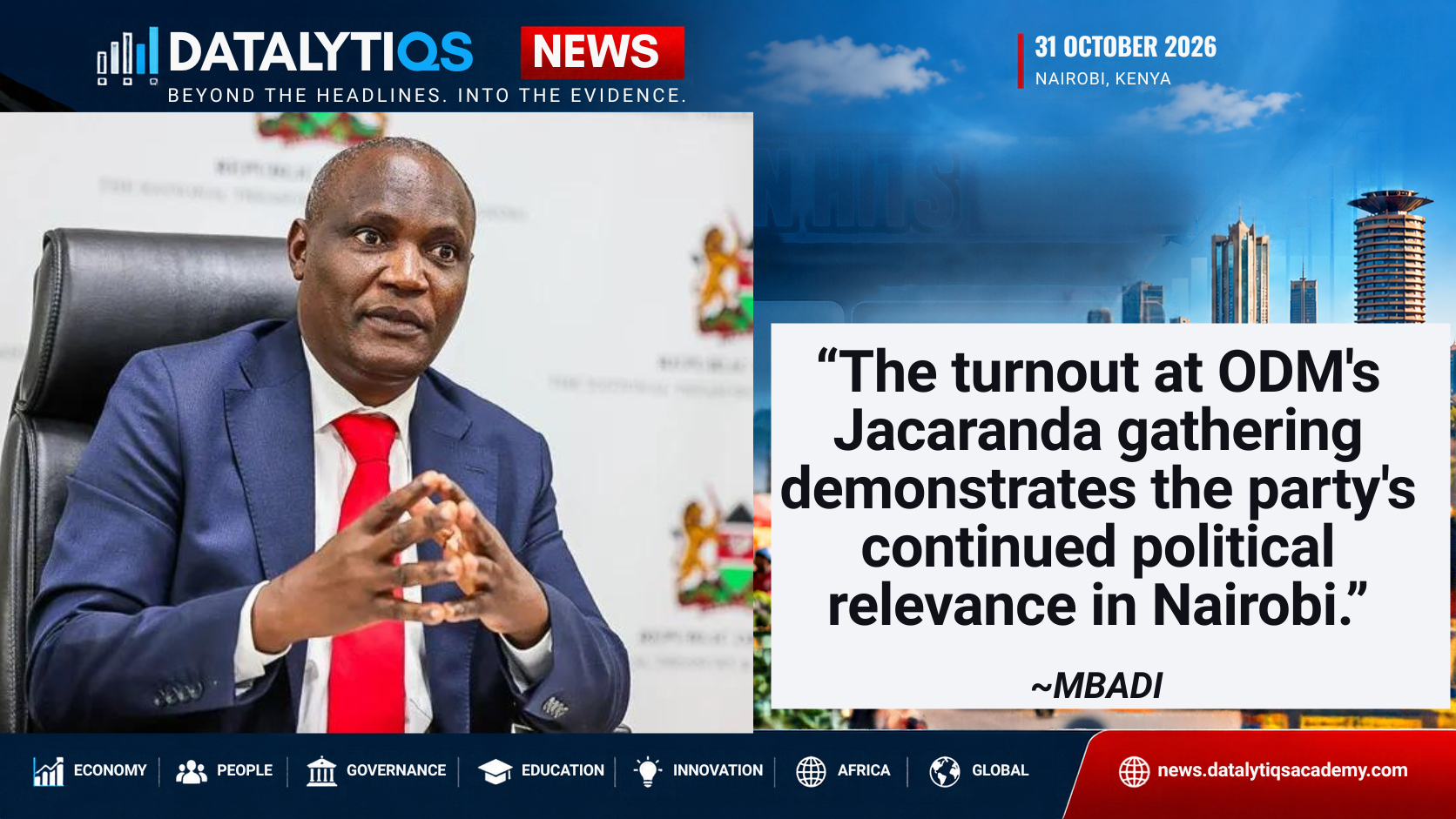
National Treasury Cabinet Secretary John Mbadi says the turnout at ODM’s Jacaranda gathering demonstrates the party’s continued political relevance in Nairobi. His remarks also highlight a deeper institutional question: how can senior officials serving in a UDA-led administration defend ODM’s independent political identity while the two parties explore closer cooperation ahead of 2027?
NAIROBI, KENYA — 31 October 2026
National Treasury Cabinet Secretary John Mbadi has defended the Orange Democratic Movement’s political relevance, pointing to attendance at the party’s Jacaranda gathering in Nairobi as evidence of its continuing ability to mobilise supporters.
Addressing the gathering, Mbadi rejected suggestions that ODM had lost its political significance and urged those seeking to preserve the legacy of former party leader Raila Odinga to remain associated with the movement.
His remarks come amid disagreements over ODM’s political direction, its relationship with President William Ruto’s administration and the terms of any possible electoral partnership with the United Democratic Alliance (UDA).
The gathering provided a visible demonstration of ODM’s organisational activity in Nairobi.
However, its implications require careful interpretation.
A political rally can demonstrate mobilisation capacity. It cannot, by itself, establish the distribution of voter preferences across Nairobi or Kenya.
Mbadi’s intervention also raises questions about the relationship between executive office, party affiliation and the autonomy of political organisations participating in broad-based government arrangements.
What Jacaranda Demonstrated
The Jacaranda event demonstrated that ODM could convene supporters, coordinate a public political gathering and attract the participation of prominent leaders.
These are observable indicators of organisational activity.
Political mobilisation requires communication networks, local organisers, logistical arrangements and the ability to persuade individuals to attend an event.
A successful gathering can therefore provide information about a party’s operational capacity and the engagement of its supporters.
But turnout is not equivalent to an election result.
The number of people attending a rally does not establish how many registered voters support the party.
Nor does it reveal whether attendees intend to vote for its candidates in 2027.
Some participants may attend because of particular speakers, the significance of the occasion or their interest in specific political issues.
Others may travel from constituencies outside the rally’s immediate location.
Consequently, the Jacaranda gathering supports a conclusion about ODM’s capacity to organise that event.
It does not establish a nationwide electoral mandate.
The Difference Between Mobilisation and Electoral Support
Political mobilisation and electoral support are related but distinct concepts.
Mobilisation concerns a party’s ability to activate supporters and organise participation in political activities.
Electoral support concerns the preferences and voting behaviour of an electorate.
A party may organise well-attended rallies without securing equivalent support at the ballot box.
Conversely, a party may perform strongly in elections without consistently holding large public gatherings.
The distinction is especially important when comparing political events held under different conditions.
Venue size, accessibility, timing, transport arrangements, publicity and the presence of prominent speakers can influence attendance.
These factors make comparisons between rallies methodologically difficult.
Even where attendance is counted accurately, the participants do not constitute a randomly selected sample of the electorate.
Therefore, crowd size cannot legitimately be converted into a percentage of national or county-level voter support.
Why Nairobi Is an Important Political Test
Nairobi is politically significant because it combines a large electorate with diverse communities, competing party networks and multiple closely contested elective positions.
ODM has maintained a political presence in the capital through elected representatives, party structures and campaign activity.
The Jacaranda rally provides evidence that the party continues to engage supporters in the city.
However, Nairobi’s political landscape cannot be assessed as a single homogeneous voting bloc.
The county contains constituencies with different electoral histories, demographic characteristics and local political issues.
Support for a presidential candidate may also differ from support for a gubernatorial, senatorial or parliamentary candidate.
An assessment of ODM’s position would therefore require constituency-level analysis rather than conclusions drawn from a single gathering.
Raila Odinga’s Legacy and ODM’s Institutional Identity
Mbadi’s appeal to those wishing to preserve Raila Odinga’s political legacy introduces another dimension to the debate.
Raila played a central role in ODM’s development and national political identity.
His leadership helped shape the party’s organisational networks, electoral alliances and political messaging.
Following his death, ODM faces the challenge of maintaining institutional continuity while adapting to changing political circumstances.
However, a political legacy can be interpreted in different ways.
Some party officials may emphasise continuity through established party structures.
Others may focus on particular policy positions, democratic principles or forms of political cooperation associated with Raila’s leadership.
These interpretations are political arguments.
The formal authority to determine ODM’s leadership, nominations and institutional decisions remains governed by the party constitution and applicable law.
Consequently, an appeal to Raila’s legacy may reinforce political identity, but it does not independently resolve disagreements over the party’s future strategy.
The Mbadi Question: A Cabinet Secretary Defending Party Autonomy
Mbadi’s remarks are particularly significant because he serves as National Treasury Cabinet Secretary in President Ruto’s administration.
His position places him within the national executive, where he is responsible for implementing government policy and performing duties associated with public financial management.
At the same time, his political history is closely associated with ODM.
His defence of the party therefore illustrates the complexities of Kenya’s broad-based governing arrangement.
The Constitution distinguishes Cabinet office from parliamentary representation and regulates the responsibilities of Cabinet Secretaries.
Cabinet Secretaries are appointed through the constitutional process and are accountable for the functions of their offices.
Political affiliation does not automatically disappear when an individual enters the Cabinet.
However, executive responsibilities must be exercised in accordance with constitutional requirements, public-service standards and applicable law.
The institutional question is therefore not simply whether Mbadi may express support for ODM.
It is how political advocacy is separated from the exercise of public authority and the use of public resources.
Party Loyalty and Executive Responsibility Are Different Obligations
Mbadi’s political position highlights two distinct forms of accountability.
The first concerns responsibility to the national executive and the public.
As Treasury Cabinet Secretary, he participates in implementing the government’s fiscal policies and managing responsibilities assigned to his office.
The second concerns his political relationship with ODM and its supporters.
These responsibilities can coexist, but they are not identical.
Defending ODM’s organisational relevance does not automatically establish that the party agrees with every policy adopted by the administration.
Similarly, serving in the Cabinet does not, by itself, demonstrate that ODM has formally merged with UDA.
The relevant questions concern institutional decisions, legal obligations and the practical separation of public administration from partisan activity.
Any allegation that official resources were improperly used for political mobilisation would require specific evidence.
Attendance at a party rally alone does not establish such misuse.
Does Participation in Government Weaken ODM’s Independence?
ODM’s cooperation with the Ruto administration has generated debate over whether the party can retain an independent political identity while some of its prominent figures serve in government.
One perspective is that participation in government provides opportunities to influence policy and pursue development priorities.
Another is that cooperation can complicate the party’s ability to criticise policies implemented by an administration in which its associated leaders serve.
Both positions concern identifiable questions of political accountability.
The issue can be assessed by examining formal party agreements, public policy positions, parliamentary voting records and the decisions of ODM’s governing institutions.
A party’s independence is not established solely through public declarations.
Nor is it automatically extinguished because politicians associated with it accept executive appointments.
The extent of institutional autonomy depends on the actual commitments, governance arrangements and decision-making authority retained by the party.
Broad-Based Cooperation Is Not Necessarily a Formal Coalition
The distinction between cooperation and coalition formation is especially relevant ahead of the 2027 General Election.
ODM leaders have discussed the possibility of entering a more formal arrangement with UDA.
Party leader Oburu Oginga has distinguished the existing broad-based relationship from a concluded electoral coalition.
Negotiations over a possible agreement have included questions about executive positions, candidate selection and political representation.
However, proposals advanced during negotiations should not be treated as agreed terms.
A formal coalition would need to comply with the applicable provisions of the Political Parties Act and the internal approval requirements of the participating parties.
Until the relevant agreement is concluded, ODM’s future electoral obligations remain subject to further decisions.
Mbadi’s defence of the party’s identity therefore takes place within an evolving political relationship rather than a fully settled electoral framework.
What the Verified Reporting Adds
Contemporary reporting supports Mbadi’s account of the rally’s significance, but also provides context that limits what can be concluded.
The Standard confirms that Mbadi cited the Jacaranda turnout as evidence of ODM’s continuing support in Nairobi and encouraged those wishing to preserve Raila’s legacy to remain in the party. <Cite refs={[“turn161199search0”]}/>
The Star reported that thousands attended, including supporters from Nairobi and beyond. That geographic detail is important: the crowd cannot be treated as a sample of Nairobi residents alone. <Cite refs={[“turn161199search1”]}/>
Before the event, ODM Nairobi chairperson George Aladwa projected approximately 100,000 attendees. That was an organisers’ expectation, not a verified count of actual attendance. <Cite refs={[“turn161199search2”]}/>
Separate reporting also indicates that the rally ended amid disruption around the main dais. This should be reported as a distinct event, without assuming the cause or responsibility beyond the available evidence. <Cite refs={[“turn161199search6″,”turn161199search14”]}/>
DatalytIQs News — Final Intelligence Assessment
Mbadi’s intervention demonstrates the distinction between defending a political party’s continued existence and proving its electoral strength.
The Jacaranda turnout supports a finding that ODM retains functioning mobilisation networks capable of assembling a substantial political gathering.
It does not establish nationwide support, predict the 2027 election or resolve internal disagreements about the party’s future.
Mbadi’s participation as Treasury Cabinet Secretary raises a separate governance question: whether ODM’s political identity and decision-making autonomy remain institutionally distinct from the administration in which some of its associated leaders serve.
The appropriate evidence includes formal party resolutions, coalition agreements, official membership records, constituency-level electoral data and documented compliance with public-office obligations.
The key distinction is straightforward: Jacaranda demonstrated that ODM can mobilise supporters. Whether it can translate that mobilisation into votes, preserve organisational autonomy and reconcile its governing relationship with UDA are separate questions requiring separate evidence.
DatalytIQs News — Beyond the Headlines. Into the Evidence.