ODM Chairperson Gladys Wanga insists her party will contest Nairobi’s governorship, Senate, parliamentary and county assembly seats in 2027. But with negotiations underway over a possible coalition with President William Ruto’s UDA, a central question remains unresolved: will the parties compete against each other, agree on joint candidates or negotiate withdrawals in selected constituencies?
NAIROBI, KENYA — 31 October 2026
Orange Democratic Movement (ODM) National Chairperson Gladys Wanga has declared that her party intends to contest Nairobi’s major elective positions in the 2027 General Election, setting out an ambitious electoral position even as negotiations continue over a possible coalition with President William Ruto’s United Democratic Alliance (UDA).
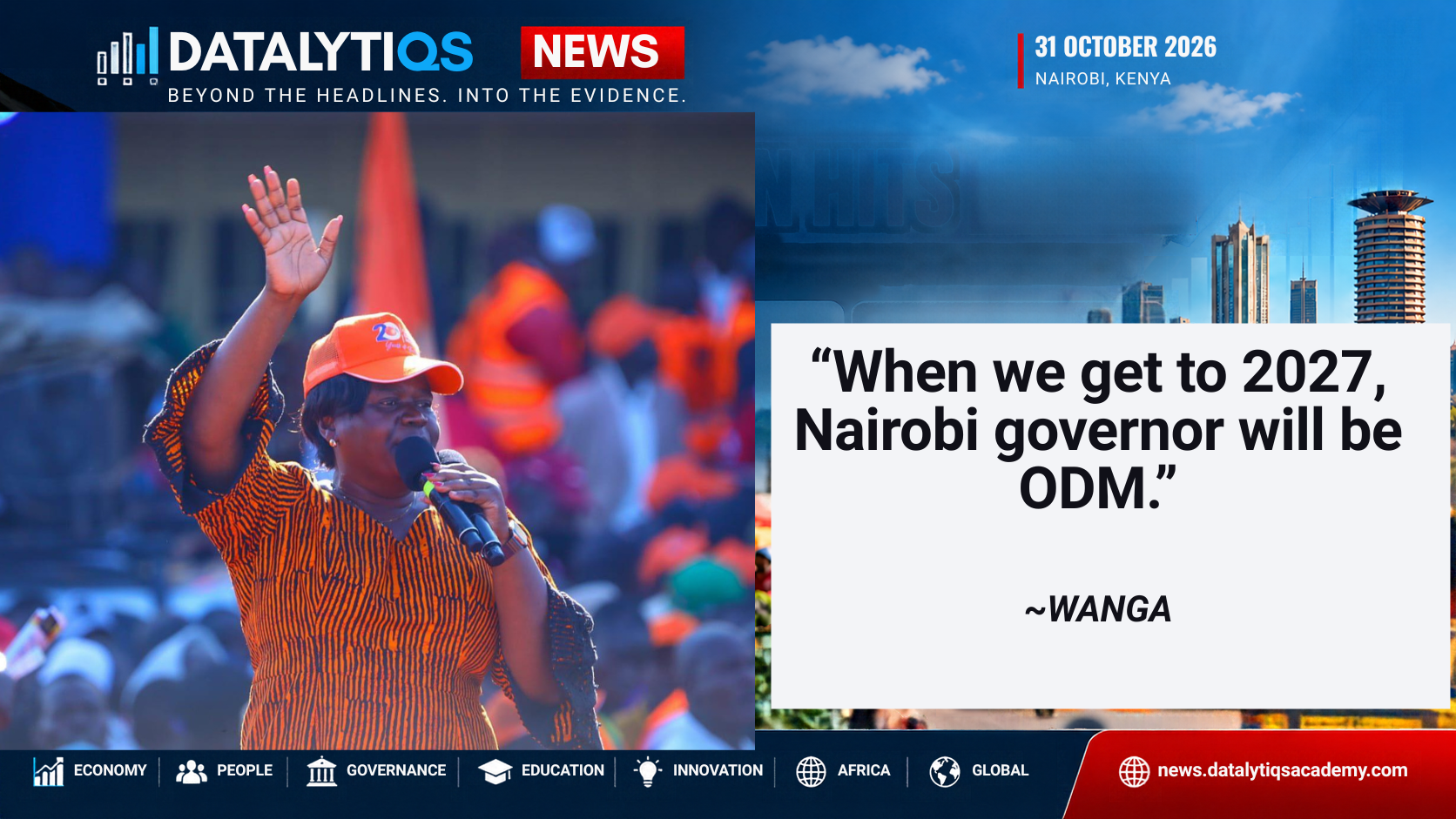
Addressing supporters at Jacaranda Grounds in Nairobi on Saturday, Wanga said ODM would seek the governorship, Senate, National Assembly and county assembly seats.
“When we get to 2027, Nairobi governor will be ODM, MCA will be ODM, MPs will be ODM, Senator will be ODM, every seat will be ODM.”
Her declaration was accompanied by demands from other ODM leaders that UDA recognise the party’s political influence in any future power-sharing arrangement.
The rally also featured calls for ODM to secure the Deputy President’s position as part of a negotiated electoral partnership.
However, the public demands are not equivalent to a concluded coalition agreement.
The most important unresolved question is whether ODM and UDA intend to support a common presidential candidate while competing independently for other elective positions, or whether their negotiations will eventually produce coordinated nominations and candidate withdrawals.
That distinction will determine whether Wanga’s Nairobi declaration becomes a binding electoral strategy or remains a negotiating position.
Wanga’s Declaration: ODM Wants More Than a Place in Government
Wanga’s statement reflects ODM’s determination to preserve its electoral identity while participating in discussions with UDA.
The party has historically maintained substantial political representation in Nairobi, particularly through parliamentary and county-level elections.
Its leaders now face the challenge of demonstrating that cooperation with the national administration does not require surrendering the party’s local electoral ambitions.
Wanga’s declaration seeks to reassure prospective candidates and party supporters that ODM intends to remain an independent electoral organisation.
The position is consistent with remarks she made earlier in October, when she argued that ODM would seek elective positions across the country while supporting President Ruto’s re-election.
But a declaration of electoral intent does not establish which candidates will ultimately appear on the ballot.
Candidate selection will depend on party nominations, statutory requirements and any formal agreements adopted before the election.
The Jacaranda Rally: Political Mobilisation and Negotiating Signals
The October 31 rally brought together senior ODM figures, including Wanga, Kisii Governor Simba Arati, Mombasa Governor Abdulswamad Nassir, Mining Cabinet Secretary Hassan Joho and National Treasury Cabinet Secretary John Mbadi.
Nairobi Governor Johnson Sakaja also attended.
The gathering was part of ODM’s commemorative activities marking the first anniversary of former party leader Raila Odinga’s death.
However, it also provided a platform for party officials to articulate their expectations concerning the proposed ODM–UDA arrangement.
Nassir argued that ODM should receive recognition commensurate with its political influence.
He asked supporters whether the party had leaders qualified to occupy the Deputy President’s office.
The crowd responded by chanting Joho’s name.
Such reactions provide evidence of sentiment among attendees, but they do not constitute a formal nomination or demonstrate the preferences of the wider electorate.
Similarly, Wanga’s demand for Nairobi elective seats establishes her publicly stated political objective, not an agreed allocation between the negotiating parties.
The Critical Distinction: Broad-Based Cooperation Is Not Yet an Electoral Coalition
One of the most consequential statements surrounding the Jacaranda rally came from ODM party leader Oburu Oginga.
Addressing supporters through a video link, Oburu explained that ODM’s existing broad-based relationship with UDA should not be mistaken for a formal coalition.
He said the parties had appointed five representatives each to negotiate a possible coalition agreement.
Oburu also indicated that ODM would not enter a formal coalition without negotiations and an agreement.
This distinction is central to understanding Wanga’s declaration.
Political cooperation within an administration can exist without the parties adopting a joint electoral nomination framework.
A formal coalition, by contrast, may establish obligations concerning candidates, campaign coordination, decision-making and the distribution of responsibilities.
The details depend on the agreement actually negotiated and approved.
As of October 31, the available reporting does not establish that ODM and UDA have finalised a binding agreement allocating Nairobi’s elective seats.
Therefore, Wanga’s announcement must be assessed as a party aspiration rather than a confirmed coalition term.
Three Possible Models for an ODM–UDA Electoral Arrangement
The parties could pursue several different approaches to the 2027 elections.
Scenario One: A Common Presidential Candidate, Independent Local Contests
Under this arrangement, ODM could support President Ruto’s presidential candidacy while retaining the right to nominate its own candidates for governor, senator, Member of Parliament, Woman Representative and Member of County Assembly.
UDA could simultaneously field candidates for the same local offices.
This would preserve each party’s organisational identity and allow candidates to compete directly.
It would also create the possibility of ODM and UDA candidates campaigning against each other locally while their national leaders supported the same presidential ticket.
Such an arrangement is politically possible.
However, it could produce disagreements over campaign messaging, the use of party resources and the allocation of government-related political credit.
Its practical operation would require clear rules.
Scenario Two: Negotiated Joint Candidates
The parties could agree to support a single candidate for selected positions.
For example, they might negotiate which party would provide the gubernatorial candidate and which would receive support for other county or parliamentary positions.
The selected candidate would still need to satisfy the applicable nomination and electoral requirements.
An agreement between party leaders cannot, by itself, override the Constitution, electoral legislation or lawful nomination procedures.
This model could reduce competition between participating parties, but it would require compromises from aspirants who expected to contest seats independently.
It could also generate disputes over how candidates are selected and whether the process is fair.
Scenario Three: Selective Withdrawals and Constituency-Level Bargaining
A third possibility is that ODM and UDA retain separate nomination processes but negotiate withdrawals or coordinated support in particular electoral contests.
The parties could identify constituencies where one party wishes to prioritise a candidate while the other refrains from fielding a competing candidate.
However, such arrangements would have to comply with electoral deadlines and the rules governing nominations, withdrawals and party membership.
The timing of negotiations would therefore matter.
An agreement reached after legally prescribed nomination or withdrawal deadlines might not be implementable in the manner originally intended.
This model would also require mechanisms for resolving disputes where both parties have strong aspirants.
These three scenarios are analytical possibilities, not confirmed terms of the ongoing ODM–UDA negotiations.
The Nairobi Governorship: Where the Contradiction Becomes Visible
The governorship presents an immediate political test of Wanga’s declaration.
Nairobi Governor Johnson Sakaja attended the Jacaranda rally and appealed for support for a second term.
At the same event, ODM leaders reiterated their intention to secure the governorship for their party.
The two positions cannot automatically be treated as identical.
Sakaja’s presence at an ODM event does not establish that he has received an ODM nomination.
Nor does it demonstrate that ODM has agreed to support his re-election.
A party endorsement would require an identifiable institutional decision.
Similarly, a negotiated coalition arrangement might alter the eventual candidate-selection process.
The question is therefore not merely whether Sakaja attended the rally.
It is whether ODM will nominate its own gubernatorial candidate, support an existing candidate through an authorised arrangement or negotiate another formula with UDA.
Until the relevant decisions are made, the contest remains institutionally unresolved.
George Aladwa’s Ambition Adds Another Dimension
Nairobi ODM Chairperson and Makadara MP George Aladwa has publicly expressed interest in the governorship.
During an ODM delegates’ meeting on October 25, he presented himself as a candidate for the party’s gubernatorial ticket and invited potential rivals to participate in the nomination process.
His position highlights an important distinction between the party’s collective ambition and the aspirations of individual candidates.
Even if ODM decides to contest the governorship independently, it must still determine who will carry its ticket.
That decision could involve party primaries or another lawful nomination method provided for under the applicable rules.
Any attempt to negotiate the seat with UDA would therefore have implications for ODM aspirants who have already begun organising their campaigns.
A transparent process would need to explain whether negotiations can affect nomination outcomes and how affected aspirants would be treated.
Nairobi’s 2022 Electoral Results: A Historical Baseline, Not a 2027 Forecast
Nairobi’s 2022 General Election results demonstrate why the county is politically significant.
In the presidential election, Raila Odinga received approximately 767,395 votes in Nairobi, compared with William Ruto’s 561,775 votes.
The results reflected the political alignments of that election.
They did not measure the current strength of ODM and UDA as independent organisations.
Presidential votes cannot automatically be attributed to individual coalition parties.
Nor can they establish how voters will respond to different alliances in 2027.
Similarly, the distribution of parliamentary and county seats in 2022 provides a historical baseline rather than a prediction of future results.
Political alliances, candidate choices, voter registration and turnout may change between elections.
A credible assessment of Nairobi’s current electoral landscape would require constituency-level data, updated party membership information and representative public-opinion research.
Can ODM Claim Every Seat While Negotiating With UDA?
Wanga’s declaration creates a negotiating question.
If ODM intends to contest every elective position in Nairobi, what precisely would UDA receive in exchange for supporting a common national political arrangement?
One possibility is that the parties distinguish presidential cooperation from local electoral competition.
Another is that the public declarations represent opening negotiating positions rather than final demands.
A third is that the parties eventually negotiate different arrangements for different counties or constituencies.
The available reporting does not establish which approach will be adopted.
Consequently, statements that ODM has already secured Nairobi’s governorship or that UDA has agreed to withdraw candidates would be premature.
The distinction between an aspiration and a binding agreement must remain explicit.
The Deputy Presidency Complicates the Negotiations
The Jacaranda rally also featured demands that ODM should receive the Deputy President’s position.
Wanga has previously advocated a 50–50 arrangement under which UDA would provide the presidential candidate and ODM would provide the running mate.
Other ODM leaders have suggested that the party should receive equal representation in Cabinet.
These demands concern national executive power sharing.
They do not necessarily determine the allocation of elective positions in Nairobi.
Moreover, Kenya’s constitutional framework places specific requirements on the presidential running mate and Cabinet appointments.
Under Article 148 of the Constitution, a presidential candidate nominates a qualified running mate before the election.
Under Article 152, Cabinet Secretaries are nominated by the President and appointed with National Assembly approval.
A political agreement may influence negotiations over these positions, but it cannot displace the applicable constitutional procedures.
The parties would therefore need to distinguish political commitments from legally required appointment processes.
What Does the Political Parties Act Require?
Kenya’s Political Parties Act provides the statutory framework for formal coalition arrangements.
Section 10 and the Third Schedule address coalition agreements and related governance requirements.
A formal agreement must satisfy the applicable legal and institutional conditions.
This matters because public statements by senior politicians do not automatically bind a party to a particular electoral arrangement.
A credible agreement should clarify the participating parties, decision-making structures, dispute-resolution procedures and any commitments concerning elections.
Where candidate selection is concerned, the agreement must also operate consistently with election laws and nomination requirements.
The existence of a negotiating committee is therefore evidence that discussions are taking place.
It is not evidence that every proposal advanced by party officials has been accepted.
The Risk of Conflicting Nomination Expectations
The most immediate organisational challenge may arise among aspirants.
ODM politicians have been encouraged to seek party tickets across Nairobi.
UDA politicians may have similar expectations within their own party.
If negotiations eventually produce a joint-candidate formula, some aspirants may discover that the positions they intended to contest have become subject to interparty bargaining.
This could create disputes over internal democracy, nomination fairness and political commitments made to party members.
The risk is not unique to ODM and UDA.
Coalition arrangements frequently require parties to reconcile their collective objectives with the ambitions of individual candidates.
The practical response would be a transparent nomination framework adopted before candidates incur substantial campaign expenses or statutory deadlines become difficult to meet.
Why Rally Attendance Cannot Settle the Nairobi Question
ODM leaders have pointed to the Jacaranda turnout as evidence of the party’s continuing political relevance.
The rally demonstrated the capacity to mobilise supporters and conduct a major public political event.
However, attendance figures cannot establish the distribution of voter preferences across Nairobi’s constituencies.
Participants may come from outside the county.
Different supporters may attend multiple political events.
Crowd estimates may also lack consistent counting methods.
A rally is therefore not equivalent to a representative electoral survey.
Likewise, public endorsements and crowd chants do not constitute party nominations.
The political significance of the event should be assessed through subsequent organisational decisions rather than inferred electoral outcomes.
DatalytIQs Political Intelligence Assessment
The Jacaranda declaration produces six important questions.
First, is ODM’s position formally authorised? Wanga has publicly stated the party’s ambitions, but any binding electoral arrangement must be distinguished from an individual leader’s declaration.
Second, has UDA accepted the proposed allocation? No verified final agreement allocating Nairobi’s elective seats has emerged from the reporting reviewed.
Third, will the parties compete independently? Supporting the same presidential candidate does not necessarily prevent competition for other offices.
Fourth, could candidate withdrawals be negotiated? Such an approach is possible in principle but would require lawful procedures and agreement before relevant electoral deadlines.
Fifth, how will nominations be conducted? Aspirants need clarity on whether party primaries will determine candidates or whether a coalition mechanism will affect nominations.
Sixth, what does the electoral evidence establish? Historical results and rally attendance provide useful context but cannot independently determine current voter preferences.
These questions should guide scrutiny of the negotiations rather than assumptions about an already concluded agreement.
What Should Be Monitored Next?
The most consequential development would be publication or formal confirmation of the ODM–UDA coalition agreement.
Attention should focus on whether it addresses presidential nominations, county-level contests and candidate-selection procedures.
The parties’ official governing bodies should also be monitored for resolutions authorising the negotiated terms.
In Nairobi, particular attention should be paid to the governorship, where ODM’s declared ambition intersects with Sakaja’s pursuit of another term.
The nomination calendar will be important because candidate selection and withdrawal procedures are subject to statutory requirements.
Finally, analysts should examine whether the parties publish a clear explanation of how coalition commitments will operate where both organisations have competing aspirants.
Conclusion: ODM Has Declared Its Ambition, but the Coalition Terms Remain Unsettled
Gladys Wanga’s declaration at Jacaranda establishes ODM’s intention to contest Nairobi’s major elective positions in 2027.
It also demonstrates the party’s desire to preserve its identity while negotiating with President Ruto’s UDA.
However, the declaration does not prove that UDA has accepted ODM’s demands or agreed to withdraw candidates.
Nor does it establish that a common presidential ticket will necessarily produce joint candidates in county and parliamentary contests.
The available evidence supports a narrower conclusion: ODM leaders have articulated their electoral ambitions while negotiations over a possible formal coalition remain ongoing.
The central issue is not whether ODM wants Nairobi’s seats. It is whether ODM and UDA will agree to compete, cooperate or withdraw in particular contests—and whether those decisions will be made through lawful, transparent party processes.
Until those terms are documented, political declarations should remain clearly distinguished from binding coalition commitments.
DatalytIQs News — Beyond the Headlines. Into the Evidence.
Sources and References
- The Standard — ODM demands deputy president’s post in return for backing broad-based deal, 31 October 2026.
- The Standard — Oburu: We are not in broad-based deal blindly, 31 October 2026.
- Daily Nation — All seats except president up for grabs: ODM sells 50–50 deal, 24 October 2026.
- Daily Nation — Keep off ODM, party tells Gachagua and opposition, 26 October 2026.
- The Star — ODM to back Ruto for president, fight for all other seats, 18 October 2026.
- The Star — Jacaranda turns orange as ODM marks final day of Mwezi wa Baba, 31 October 2026.
- Constitution of Kenya, 2010 — Articles 148 and 152.
- Political Parties Act, 2011 — Section 10 and Third Schedule.