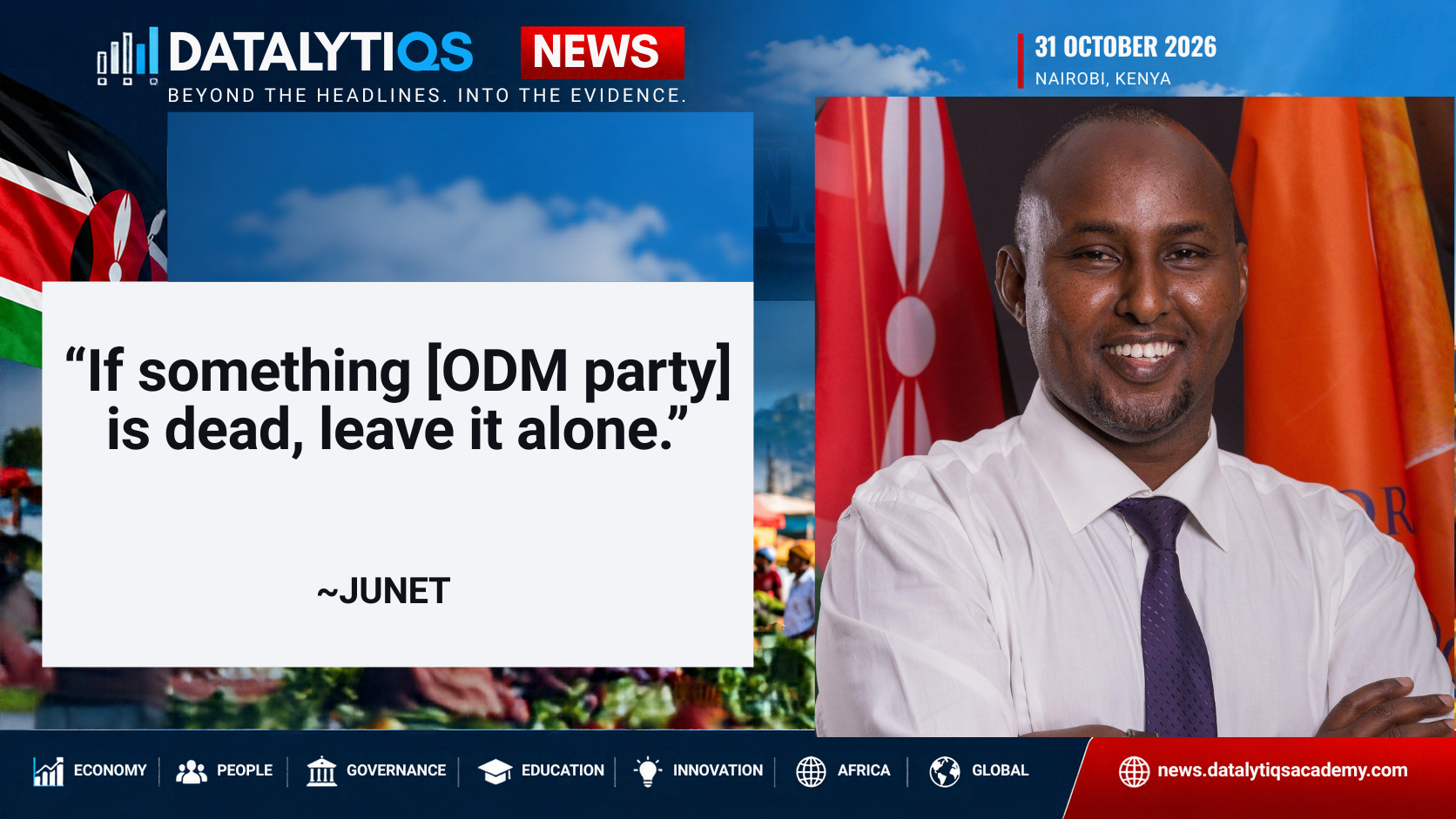
National Assembly Minority Leader Junet Mohamed has challenged former Deputy President Rigathi Gachagua over his repeated criticism of the Orange Democratic Movement. But behind the exchange lies a broader contest over ODM’s leadership, institutional legitimacy and political support ahead of the 2027 General Election. The critical question is whether public rallies, rival endorsements and claims of party decline accurately reflect the party’s organisational strength or voter preferences.
NAIROBI, KENYA — 31 October 2026
National Assembly Minority Leader and Suna East MP Junet Mohamed has challenged former Deputy President Rigathi Gachagua to explain why he continues discussing the Orange Democratic Movement (ODM) while simultaneously dismissing its political relevance.
Speaking during ODM’s Jacaranda rally in Nairobi, Junet questioned the contradiction between declaring a political party finished and continuing to devote attention to its activities.
“If something [party] is dead, leave it alone.”
His remarks were directed at Gachagua, whose criticism of ODM has become part of the increasingly contentious debate over opposition politics and President William Ruto’s prospects ahead of the 2027 General Election.
Junet also criticised politicians who had left ODM but continued to intervene in its internal affairs.
The remarks reflect a wider struggle over who can legitimately speak for the party, which institutions control its decisions and whether competing political gatherings demonstrate meaningful electoral support.
However, the exchange also exposes an important distinction frequently overlooked in political debate.
A party’s legal existence, organisational strength, leadership legitimacy and electoral popularity are separate questions.
None can be conclusively established merely by the size of a political rally or the intensity of criticism from rival politicians.
Junet’s Challenge: Why Attack a Party You Consider Finished?
Junet’s argument rests on an apparent inconsistency in Gachagua’s political messaging.
If ODM has lost its relevance, Junet suggests, there should be little reason for opponents to continue discussing its leadership, internal disputes and future alliances.
His remarks seek to portray sustained criticism as evidence that the party remains politically consequential.
However, that argument is a political interpretation rather than a measurable indicator of party strength.
Politicians may discuss rival parties for several reasons, including disagreement over their policies, concern about possible electoral alliances or attempts to influence public perceptions.
Frequent criticism does not independently establish that the criticised party is gaining or losing electoral support.
Likewise, a politician’s declaration that a party is politically finished does not alter its legal registration or invalidate its elected representation.
The competing claims therefore require evidence beyond rhetorical exchanges.
The Jacaranda Rally and ODM’s Public Mobilisation
ODM’s Jacaranda rally formed part of the party’s efforts to demonstrate organisational activity and maintain visibility amid disputes about its political direction.
Jacaranda Grounds in Nairobi has historically hosted significant political gatherings.
Its symbolic importance makes it a prominent venue for parties seeking to demonstrate grassroots engagement.
ODM leaders used the event to communicate political messages, mobilise supporters and respond to criticism from opponents.
However, a large political gathering does not provide a representative sample of voters.
Attendance can be influenced by transport arrangements, local mobilisation networks, the popularity of individual speakers, the accessibility of the venue and the wider political circumstances.
It can also include supporters from outside the constituency in which the rally is held.
For these reasons, rally attendance should not be converted into an estimate of constituency, county or national electoral support.
Even where attendance can be counted reliably, the resulting figure measures participation in that event, not the voting intentions of the wider electorate.
What Does It Mean to Say a Political Party Is Dead?
Political commentators frequently describe parties as dead, weakened, captured or irrelevant.
These expressions can refer to different conditions.
A party may remain legally registered while experiencing declining membership or electoral performance.
It may retain elected representatives but suffer internal leadership disputes.
It may maintain extensive organisational structures while struggling to mobilise support in particular regions.
Alternatively, it may retain a loyal voter base while undergoing disagreements over its national political strategy.
Consequently, describing a party as dead is analytically imprecise unless the speaker identifies the specific condition being assessed.
For ODM, an evidence-based assessment would examine its registration status, authorised leadership, membership records, elected representation, organisational structures and documented electoral performance.
These indicators measure different aspects of political strength and should not be treated as interchangeable.
Legal Existence: The First Test of Party Legitimacy
Kenya’s political parties operate within the framework established by the Constitution and the Political Parties Act.
The Office of the Registrar of Political Parties maintains the official register of political parties and administers statutory requirements relating to their registration and governance.
A political party’s legal status is therefore a documentary question.
It can be verified through official registration records.
Political criticism, internal disagreements and poor electoral performance do not automatically dissolve a registered party.
Formal deregistration or dissolution must follow the applicable legal procedures.
Accordingly, any claim that ODM has ceased to exist as a political organisation would require evidence from the relevant statutory records.
A political declaration cannot substitute for such evidence.
Leadership Legitimacy: Who Has Authority to Speak for ODM?
The second question concerns the party’s internal leadership.
ODM’s political direction has become contested amid disagreements over cooperation with President Ruto’s United Democratic Alliance (UDA).
Senior party officials have advanced different positions concerning the conditions under which ODM should participate in future political arrangements.
Some have advocated continued cooperation with the administration.
Others have questioned the implications for the party’s opposition identity and institutional independence.
These disagreements raise questions about the distinction between personal political positions and formally authorised party decisions.
A party official may publicly advocate a policy without that position necessarily constituting an approved institutional resolution.
Similarly, a former member may criticise a party without possessing authority to determine its internal decisions.
The decisive evidence includes the party constitution, authorised meeting resolutions, official notices and records maintained through the appropriate institutions.
Junet’s Criticism of Former Members
Junet’s remarks also targeted politicians who had left ODM but continued commenting on its internal affairs.
The criticism raises a distinction between participation in party governance and public political debate.
Membership may confer rights to participate in internal party processes, subject to the party constitution.
Former members generally cannot exercise those rights merely because they previously belonged to the organisation.
However, leaving a political party does not prevent a politician from commenting on its activities, policies or public conduct.
Political parties are public institutions within Kenya’s democratic system and remain legitimate subjects of public scrutiny.
Therefore, the relevant distinction is between an individual’s right to express political views and their formal authority to make binding decisions for a party.
The first does not automatically establish the second.
Membership: A More Meaningful Indicator Than Rally Attendance
Party membership provides another measure of organisational strength.
However, membership statistics require careful interpretation.
Official membership records can establish how many individuals are registered with a party at a particular time.
They do not necessarily reveal how actively those members participate in party activities or whether they intend to vote for the party’s candidates.
Some registered members may be inactive.
Others may support individual candidates from different parties in particular elections.
Membership data may also be affected by resignations, transfers, disputed registrations and record-updating procedures.
For ODM, an assessment of membership strength would therefore require dated official records and an examination of how those records have changed.
It would be inappropriate to infer membership growth or decline solely from rally attendance or social-media engagement.
Elected Representation: What the 2022 Results Establish
ODM’s performance in the 2022 General Election provides a historical baseline for assessing its institutional presence.
The party secured elected representatives in Parliament, county governments and county assemblies.
These offices provide organisational visibility and opportunities for political participation.
However, the 2022 election results describe a completed electoral contest.
They do not automatically establish the party’s current popularity or predict its performance in 2027.
Changes in political alliances, leadership, local issues and voter participation can alter electoral behaviour between elections.
A credible assessment would therefore use official Independent Electoral and Boundaries Commission results as the historical baseline while distinguishing them from contemporary measures of political opinion.
The analysis should also separate votes obtained by ODM candidates from votes received by broader coalitions or candidates supported through negotiated arrangements.
The ODM–UDA Question: Cooperation or Loss of Independence?
One of the principal sources of political disagreement concerns ODM’s relationship with President Ruto’s administration.
Following the establishment of broad-based cooperation, politicians associated with ODM assumed senior government responsibilities.
The arrangement prompted debate over whether the party should continue working with UDA and, if so, under what conditions.
Homa Bay Governor and ODM Chairperson Gladys Wanga has publicly advocated a 50–50 power-sharing formula in any future arrangement.
Other leaders have argued that cooperation should be governed by a written agreement establishing the parties’ respective obligations.
Some politicians have placed greater emphasis on government goodwill and development commitments.
These competing positions concern the party’s strategic direction.
They do not independently establish that ODM has ceased to exist or that its membership has transferred to another political organisation.
A formal coalition agreement would require the applicable institutional approvals and compliance with the Political Parties Act.
Until such an agreement is concluded, public negotiating positions should not be presented as settled coalition terms.
Gachagua’s Political Interest in ODM
Gachagua’s criticism of ODM occurs within a wider reorganisation of Kenya’s opposition politics following his removal from the Deputy Presidency in October 2024.
The former Deputy President has sought to consolidate political relationships outside the Ruto administration.
His comments about ODM are relevant because the party’s future relationship with UDA could affect the structure of political cooperation and opposition activity.
However, his criticism should not automatically be interpreted as evidence that he possesses influence over ODM’s internal decisions.
Nor should Junet’s response be treated as proof that ODM’s electoral strength has increased.
Both politicians are participating in a political contest in which public statements can serve organisational and strategic purposes.
Their claims should be evaluated against independently verifiable institutional and electoral evidence.
Can Rival Rallies Establish Who Commands Nairobi?
Political gatherings in Nairobi frequently attract attention because of the city’s diverse electorate and national political significance.
However, the number of people attending competing rallies cannot be treated as a direct comparison of electoral support.
Different rallies may occur at different venues, times and under different mobilisation conditions.
Their audiences may overlap.
Participants may travel from other constituencies or counties.
Attendance figures may also be estimated using inconsistent methods.
Consequently, even accurate crowd estimates would not provide a reliable basis for determining the distribution of voter preferences across Nairobi.
A more informative assessment would examine historical constituency-level results, party membership records and properly designed opinion surveys.
Where surveys are used, the population sampled, fieldwork dates, sampling methodology, weighting procedures and uncertainty estimates should be disclosed.
This is particularly important when political commentators attempt to convert crowd images into claims about national electoral strength.
Political Legitimacy Is More Than a Crowd
The Jacaranda rally provides evidence of ODM’s capacity to organise a significant public event.
It does not independently resolve disputes about internal party authority, membership strength or electoral support.
The same evidentiary standard applies to Gachagua’s political activities and those of other competing formations.
A more rigorous comparison would examine several indicators together.
| Dimension | Evidence required | What it establishes |
|---|---|---|
| Legal status | Official Registrar of Political Parties records | Whether a party is lawfully registered |
| Leadership authority | Party constitution, resolutions and official records | Who is authorised to make party decisions |
| Membership | Dated, verified membership records | Registered membership, not necessarily voter support |
| Organisational reach | Verified offices, branches and party activities | Geographic presence and organisational capacity |
| Electoral history | Official IEBC constituency-level results | Performance in previous elections |
| Current public opinion | Representative surveys with disclosed methodology | Voter preferences during a defined period |
| Coalition commitments | Approved agreements and statutory filings | Formally adopted interparty obligations |
No single indicator is sufficient to establish every dimension of party strength.
A party may retain significant elected representation while facing internal divisions.
It may organise well-attended rallies while experiencing weak support in particular constituencies.
It may also maintain strong membership records without achieving corresponding electoral results.
These possibilities demonstrate why political legitimacy and electoral support must be assessed separately.
DatalytIQs Political Intelligence Assessment
Junet’s challenge to Gachagua raises five important analytical issues.
First, criticism does not determine political relevance. The frequency with which opponents discuss ODM is not a reliable measure of the party’s electoral strength.
Second, institutional legitimacy is verifiable. Registration, authorised leadership and formal decisions can be examined through official records and applicable party procedures.
Third, membership is distinct from voter preference. Registered party members do not necessarily vote as a unified bloc.
Fourth, rally attendance measures mobilisation, not electoral support. The Jacaranda gathering demonstrates political activity but cannot establish the distribution of voter preferences across Nairobi or Kenya.
Fifth, the ODM–UDA debate concerns the party’s strategic direction. Competing positions over cooperation with President Ruto should be distinguished from formal party resolutions and legally recognised coalition agreements.
The most useful evidence will come from institutional records, verified membership data, documented party decisions and properly interpreted electoral information.
What Should Be Monitored Next?
The first issue is whether ODM’s governing institutions issue formal resolutions clarifying the party’s political direction.
The second is whether competing leadership claims result in official complaints, internal disciplinary proceedings or decisions by the relevant statutory institutions.
The third is whether membership changes can be verified through records maintained by the Office of the Registrar of Political Parties.
The fourth concerns any formally approved ODM–UDA coalition agreement, including its candidate-selection and governance provisions.
The fifth is the emergence of reliable survey evidence on voter preferences, particularly in constituencies where rival political formations claim substantial support.
Finally, the party’s organisational activities should be evaluated over time rather than through a single political gathering.
Conclusion: ODM’s Future Cannot Be Settled by Political Declarations
Junet Mohamed’s challenge to Rigathi Gachagua captures the increasingly confrontational debate over ODM’s future.
His central argument is that politicians who consider the party politically finished should explain their continued interest in its affairs.
However, neither repeated criticism nor a successful political rally can conclusively establish a party’s electoral strength.
ODM’s legal existence, leadership authority, membership and electoral performance are matters that can be examined through documentary and statistical evidence.
Its future political direction will depend on decisions made through party institutions and the choices of voters in subsequent elections.
A political party does not become irrelevant because an opponent declares it dead. Neither does a large rally prove that it commands the electorate. Both claims must be tested against evidence.
For ODM, the decisive questions concern institutional legitimacy, organisational cohesion and the political preferences of voters—not simply the competing declarations of its leaders and opponents.
DatalytIQs News — Beyond the Headlines. Into the Evidence.
Sources and References
- The Standard — ODM demands deputy president’s post in return for backing broad-based deal, 31 October 2026. Reports Junet’s remarks, the Jacaranda rally and ODM leaders’ positions.
- The Star — Jacaranda turns orange as ODM marks final day of Mwezi wa Baba, 31 October 2026. Reports the gathering and participating leaders.
- The Star — Junet to Gachagua: Keep off ODM, we don’t need your advice, 20 April 2026. Provides earlier context for the disagreement.
- The Star — Nairobi residents urge Sakaja to join ODM, 31 October 2026. Reports political mobilisation at Jacaranda and the governor’s remarks.
- Kenya Law — Political Parties Act. Legal framework for party membership, governance and coalitions.
- Office of the Registrar of Political Parties — Annual Report 2024/25. Explains official party and membership record management.
- Kenya Law Reform Commission — Article 91 of the Constitution. Constitutional requirements governing political parties.