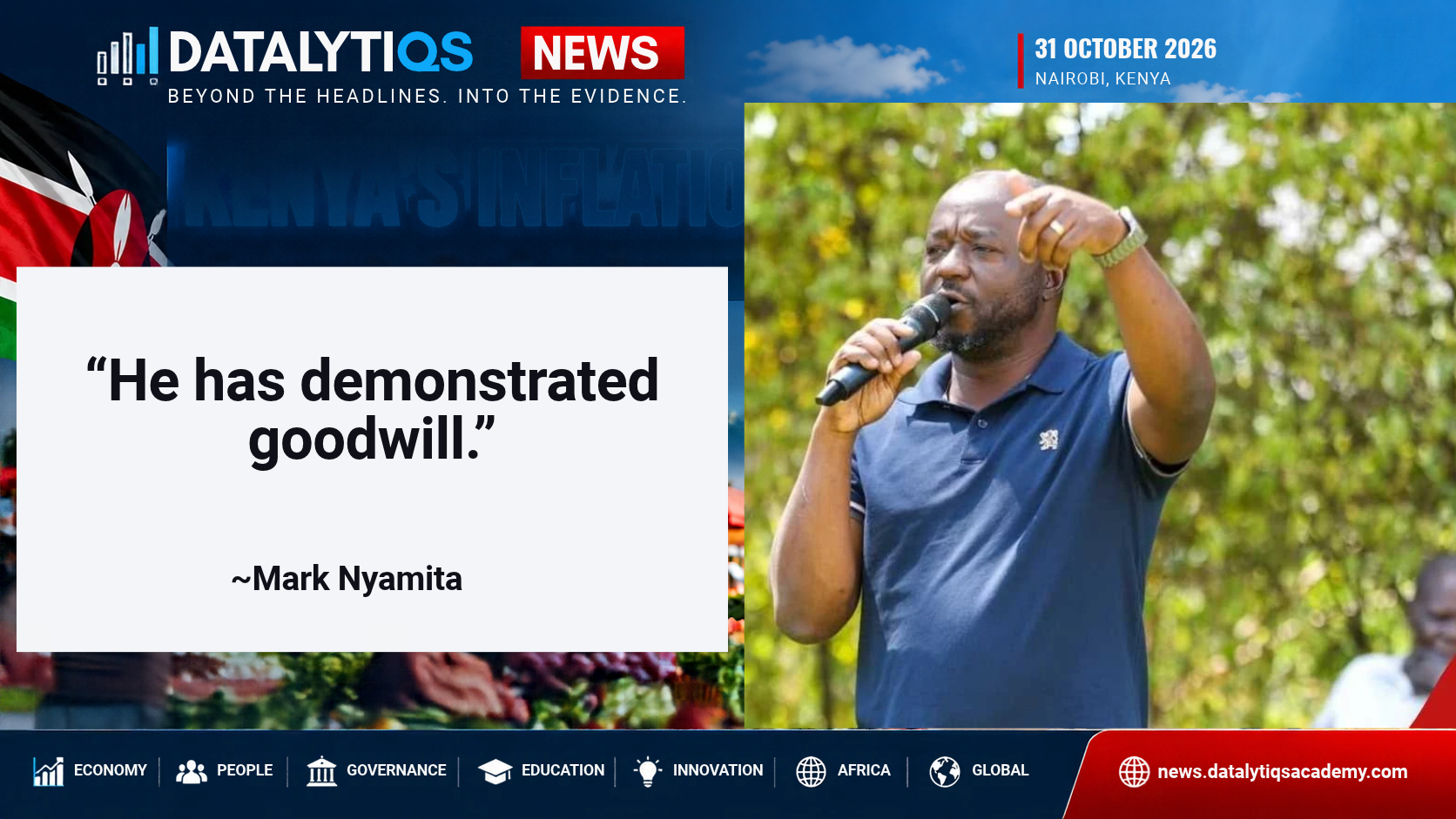
Uriri MP Mark Nyamita argues that President William Ruto’s infrastructure projects and government appointments provide sufficient evidence of goodwill towards ODM strongholds, questioning the need to make a written political agreement a condition for cooperation. But how much development has actually been delivered, where has the money gone, and can the claimed benefits withstand independent scrutiny?
MIGORI, KENYA — 31 October 2026
Uriri Member of Parliament Mark Nyamita has defended continued political cooperation between the Orange Democratic Movement (ODM) and President William Ruto’s administration, arguing that government development projects and appointments demonstrate goodwill towards regions historically associated with the opposition party.
Nyamita’s remarks, reported by The Star on October 29, come amid growing disagreement within ODM over whether the party should insist on a written agreement before supporting President Ruto’s re-election bid in 2027.
The legislator maintains that the administration has already demonstrated its willingness to work with ODM through infrastructure investment, economic development programmes and the inclusion of ODM-associated politicians in government.
“What I am saying is that the condition that we can give the President is not there, he has demonstrated goodwill.”
Nyamita also pointed to infrastructure projects in historically underserved regions, arguing that some communities are receiving tarmac roads for the first time since independence.
His remarks raise an important public-accountability question.
Can development projects cited as evidence of political goodwill be independently verified through government budgets, procurement records, implementation reports and measurable benefits to citizens?
The answer requires separating political claims from documented public expenditure and completed infrastructure.
Nyamita: Why Demand Guarantees When Projects Are Already Being Delivered?
Nyamita argues that President Ruto has demonstrated cooperation with ODM-associated regions despite their historical electoral opposition to his political formation.
He cited roads, markets and appointments to influential government ministries.
The legislator questioned why ODM should make continued cooperation conditional on signing a new political agreement when, in his assessment, the administration is already delivering development programmes.
His argument rests on the proposition that government performance provides more meaningful evidence of cooperation than political promises.
This position has been echoed by Nyando MP Jared Okello, who has argued that written political agreements do not necessarily guarantee compliance.
Other ODM politicians, including Homa Bay Senator Moses Kajwang’, Migori Woman Representative Fatuma Mohammed and Alego Usonga MP Sam Atandi, have taken a different position.
They maintain that the party should negotiate clearly documented commitments before entering a future electoral arrangement.
The disagreement concerns both political trust and institutional accountability.
However, Nyamita’s argument introduces an additional dimension that can be examined independently of the coalition debate: the actual performance of the public projects being cited.
The Uriri Tarmac Road Claim
On October 22, Nyamita praised the administration for addressing historical infrastructure inequalities.
He specifically cited the construction of a tarmac road in Uriri, Migori County, describing it as an important milestone for a constituency that had experienced longstanding infrastructure challenges.
According to The Star, Nyamita argued that providing tarmac roads to historically underserved communities was an example of tangible inclusion.
The claim deserves closer examination because road construction involves several distinct stages.
A project may be proposed, approved, funded, procured, contracted, commenced, substantially completed or formally handed over.
These stages are not interchangeable.
A road under construction may represent genuine implementation progress without yet delivering the full benefits associated with a completed and operational road.
Likewise, a road announced during a political event may not yet have received sufficient funding to support construction.
For the Uriri road cited by Nyamita, the relevant questions include its official project name, road classification, total length, implementing agency, approved contract value and physical completion status.
Those details are necessary before the project can be independently evaluated.
The available reporting confirms that Nyamita cited road construction as evidence of development.
It does not, by itself, establish the full contractual and financial history of the project.
What Would Verify the Road’s Actual Progress?
A proper infrastructure audit should begin with the agency responsible for implementing the road.
Depending on its classification, that could involve the Kenya National Highways Authority, Kenya Rural Roads Authority, Kenya Urban Roads Authority or the relevant county government.
The responsible institution should have records identifying the project and its funding arrangements.
The next step would be to establish the approved scope of work.
This includes the length of road to be constructed, the pavement specifications, drainage requirements and any associated bridges or structures.
The contract value should then be compared with actual expenditure and certified work.
A project receiving substantial payments should have corresponding evidence of completed work, subject to the terms of the contract.
Physical verification is equally important.
Independent inspection can establish whether the road exists, its current condition, the length completed and whether it is open to traffic.
Where defects or delays are identified, the relevant contractual and administrative explanations should be examined.
This approach would distinguish genuine infrastructure delivery from incomplete or inaccurately described projects.
Development Announcements Are Not Completion Certificates
Political reporting frequently presents infrastructure projects as evidence of government performance.
Such reporting can be useful, but public announcements are not substitutes for project records.
There is a material difference between an approved project and a completed project.
An approved project may have received budgetary authorisation without entering construction.
A tendered project may have attracted bids without a contract being awarded.
A contracted project may experience delays, cost variations or changes in scope.
An operational project may still have unresolved defects or outstanding payments.
Each stage requires different supporting evidence.
For Nyamita’s claims, the relevant question is not whether the administration has announced projects in Uriri or other ODM-associated constituencies.
It is whether those projects have progressed to the stages publicly attributed to them and whether expenditure corresponds with verified outputs.
That assessment should be based on official documents and site-level evidence.
Economic Stimulus Programme Markets: What Has Been Delivered?
Nyamita has also cited modern markets being developed under the Economic Stimulus Programme as examples of government investment in historically underserved areas.
These markets are intended to provide improved trading infrastructure, including organised stalls and associated facilities.
However, their effectiveness depends on more than construction expenditure.
A completed market building may not produce the intended economic benefits if traders cannot access affordable stalls, essential utilities are unavailable or management arrangements remain unresolved.
The relevant evidence therefore includes both construction and operational indicators.
For each market cited as evidence of development, the responsible government institution should be able to identify the approved budget, contractor, implementation timetable and completion status.
Where a market has been handed over, records should establish whether it is operational and how traders are allocated space.
Information about sanitation, water, electricity, security and maintenance arrangements would also be relevant.
A meaningful evaluation should distinguish completed infrastructure from actual utilisation.
The available reporting identifies markets as part of Nyamita’s argument.
It does not provide a verified constituency-by-constituency inventory of completed and operational facilities.
Government Appointments as Evidence of Political Cooperation
Nyamita has also referred to appointments of ODM-associated politicians to influential government ministries.
The administration includes senior officials who previously held prominent positions in ODM.
These include National Treasury Cabinet Secretary John Mbadi, Energy Cabinet Secretary Opiyo Wandayi, Mining Cabinet Secretary Hassan Joho and Cooperatives Cabinet Secretary Wycliffe Oparanya.
Their appointments are verifiable government decisions.
They also provide evidence of political cooperation between President Ruto and politicians associated with ODM.
However, appointments and development outcomes are different measures.
A Cabinet appointment establishes that an individual holds a particular public office.
It does not, by itself, establish that a specific constituency has received additional funding or that a particular project has been completed.
Cabinet Secretaries exercise national responsibilities within constitutional and statutory frameworks.
Their performance should be assessed through the policies, programmes and administrative responsibilities of their ministries.
The presence of politicians from a particular region or party background in government should therefore not be treated as automatic evidence of improved service delivery in that region.
The Public Finance Question: Whose Money Funds Development?
A central issue in Nyamita’s argument concerns the relationship between public investment and political goodwill.
National government projects are financed through public resources appropriated under the law.
These resources include tax revenue, borrowing and other authorised public financing.
Government infrastructure is therefore not a private benefit provided by a political party to its supporters.
It is part of the state’s responsibility to provide public services and implement approved development programmes.
The Constitution establishes principles governing the equitable sharing of public resources and the responsible management of public finances.
Consequently, infrastructure investment in an area that did not support the governing party during an election should not be treated as an exceptional concession outside normal public responsibilities.
That does not prevent politicians from debating the government’s development priorities or evaluating whether historically underserved areas are receiving increased investment.
It means that the relevant evaluation should focus on equity, legality, efficiency and actual delivery.
The question is whether public resources are being allocated and used according to legitimate development needs and established procedures.
Has Uriri Received More Development Funding?
Nyamita’s argument could be examined through a comparison of public investment before and during the current administration.
However, such a comparison requires consistent data.
For roads, it would be necessary to identify the annual allocations, actual expenditure and kilometres completed within the constituency.
For markets, the relevant measures would include projects approved, contracted, completed and operational.
For electricity, the assessment could examine new connections, transformer installations and the reliability of supply.
For water, the indicators could include infrastructure completed, households served and operational functionality.
These figures should be compared over defined financial years rather than relying on isolated announcements.
An assessment could examine the period before September 2022 alongside subsequent financial years, while accounting for projects initiated under earlier administrations but completed later.
That distinction is essential.
A project commissioned under one administration may have been planned, designed or funded under another.
Attributing the entire project to the government in office at the time of completion may therefore obscure its full implementation history.
Conversely, an administration may legitimately be credited for financing, accelerating or completing work undertaken during its tenure.
The evidence should identify those contributions separately.
The Attribution Problem: Who Deserves Credit for a Project?
Infrastructure delivery often spans multiple political administrations.
A road may be proposed during one parliamentary term, designed during another and constructed several years later.
Funding may come from national government appropriations, county allocations, development partners or a combination of sources.
The appropriate analysis should distinguish project initiation from implementation and completion.
For example, the following dates may all be relevant: initial project approval, budget allocation, contract award, commencement of works, completion and formal handover.
Without this chronology, public debate may attribute development to political actors who were involved in only one stage.
The same principle applies to markets, electricity connections and water infrastructure.
An evidence-based assessment should acknowledge the institutions and periods responsible for each documented contribution.
This is particularly important when public projects are used to justify political cooperation.
Development Equity: Are Previously Neglected Areas Catching Up?
Nyamita has framed the administration’s infrastructure investment as a response to historical exclusion.
This is a substantive policy issue.
Some communities have experienced longstanding gaps in road access, electricity, water and other public services.
Assessing whether these gaps are narrowing requires more than counting new projects.
It requires comparing service levels across places and over time.
For roads, useful measures include the proportion of the road network that is paved and the accessibility of markets, schools and health facilities.
For electricity, indicators include household connection rates and reliability.
For water, the assessment should examine access to safe and reliable supplies.
For markets, it should consider the availability and affordability of suitable trading facilities.
The results should ideally be compared against county, regional and national benchmarks.
This would help establish whether investment is reducing disparities or simply expanding infrastructure without substantially changing relative service levels.
Nyamita’s argument about historical exclusion is therefore testable, but it requires a broader evidence base than individual project announcements.
<WritingBlock id=”46282″ variant=”document”>## The ODM–UDA Agreement Debate: Two Different Tests of Accountability
The disagreement within ODM concerns whether past government performance provides sufficient grounds for future political cooperation.
Nyamita argues that visible development and government appointments demonstrate goodwill.
Other ODM leaders argue that the party should secure written commitments before entering a new electoral arrangement.
These positions involve different kinds of evidence.
Government performance can be assessed through public expenditure, project implementation and service-delivery outcomes.
A political agreement can be assessed through its legal status, institutional approval, documented commitments and implementation mechanisms.
A positive development record would not automatically establish that future coalition commitments will be honoured.
Equally, a written agreement would not guarantee that every development pledge will be implemented.
Both require independent scrutiny.
Homa Bay Town MP Peter Opondo Kaluma has said that technical negotiations between ODM and UDA are expected to produce a written agreement.
That statement establishes the anticipated direction of negotiations, not the final terms or approval status.
What a Constituency-Level Development Audit Should Examine
For Uriri and other constituencies where development projects are cited in political arguments, an evidence-based assessment should examine the following records:
| Accountability area | Evidence required |
|---|---|
| Project identification | Official name, location, implementing agency and scope |
| Budget approval | Financial-year allocations and approved estimates |
| Procurement | Tender notice, award decision and contract details |
| Expenditure | Actual payments and certified work |
| Implementation | Progress reports, inspection records and completion certificates |
| Service delivery | Operational status, beneficiaries and functionality |
| Historical comparison | Baseline infrastructure levels and comparable earlier investment |
| Oversight | Auditor-General findings, parliamentary scrutiny and corrective action |
These records would allow project claims to be evaluated against independently verifiable information.
They would also help distinguish projects inherited from earlier administrations from those initiated or completed under the current government.
No comprehensive project-by-project audit of Uriri is established by the political reports cited in this article.
Accordingly, the reported development claims should not be interpreted as verified findings that all the referenced projects have been completed.
DatalytIQs Political Intelligence Assessment
Nyamita’s intervention raises five issues of public interest.
First, development claims are measurable. Roads, markets and electricity projects can be examined through official budgets, contracts, physical inspections and service-delivery records.
Second, public expenditure must be distinguished from political goodwill. Government investment is subject to constitutional and statutory obligations, irrespective of a constituency’s electoral preferences.
Third, project attribution requires historical records. Announcements, contract awards and completion dates may fall under different administrations.
Fourth, political appointments and infrastructure delivery are separate indicators. The presence of ODM-associated officials in government does not independently establish constituency-level development outcomes.
Fifth, existing cooperation and future commitments require different accountability mechanisms. A record of delivered projects can inform political debate, but it does not establish the terms of a future coalition agreement.
These distinctions allow the public to assess Nyamita’s claims without assuming either that the administration’s development record is established by his statements or that the cited projects have produced no benefits.
The Records That Would Settle the Development Question
The most useful next step is a documented inventory of projects cited by Nyamita and other political leaders.
The inventory should identify each project, its location, responsible institution, original approval date, contract amount, cumulative expenditure and verified completion status.
The National Treasury’s budget implementation records, reports of the Controller of Budget and findings of the Auditor-General can provide important financial context.
Procurement records can establish the contractual arrangements.
The responsible roads, housing, energy and market-development agencies can provide project-specific implementation information.
Physical verification and beneficiary evidence can then establish whether the intended services are actually available.
These sources would provide a stronger basis for public accountability than either political praise or unsupported dismissal of development claims.
Conclusion: Goodwill Can Be Claimed. Development Must Be Demonstrated.
Mark Nyamita has presented President Ruto’s infrastructure programmes and government appointments as evidence of political goodwill towards ODM-associated regions.
His position forms part of an ongoing disagreement over whether ODM should insist on written guarantees before entering a future electoral partnership.
The development claims deserve examination on their own merits.
A completed road, functioning market or reliable electricity connection is a measurable public outcome.
An announced project, political promise or government appointment is not an equivalent measure of infrastructure delivery.
For Uriri and the wider Nyanza region, the relevant evidence lies in budgets, contracts, certified expenditure, project completion and the services citizens actually receive.
The question is not merely whether goodwill has been demonstrated politically. It is whether the development cited in its name can be verified financially, physically and institutionally.
DatalytIQs News — Beyond the Headlines. Into the Evidence.
Sources and References
- The Star — ODM implodes over push for written deal with Ruto, 28 October 2026. Original reporting on Nyamita’s remarks and ODM’s competing positions.
- Daily Nation — Written pact or goodwill? Fresh split in ODM over Ruto 2027 deal, 29 October 2026.
- The Star — Nyamita praises Ruto for addressing inequality, waiving sugar debt, 22 October 2026. Reporting on Nyamita’s Uriri road and market-development claims.
- National Treasury — National budget estimates and public finance reports.
- Office of the Controller of Budget — Budget implementation oversight.
- Office of the Auditor-General — Public-sector audit reports.
- Public Procurement Regulatory Authority — Procurement oversight and public procurement information.
- Kenya Law — Constitution of Kenya and public finance legislation.