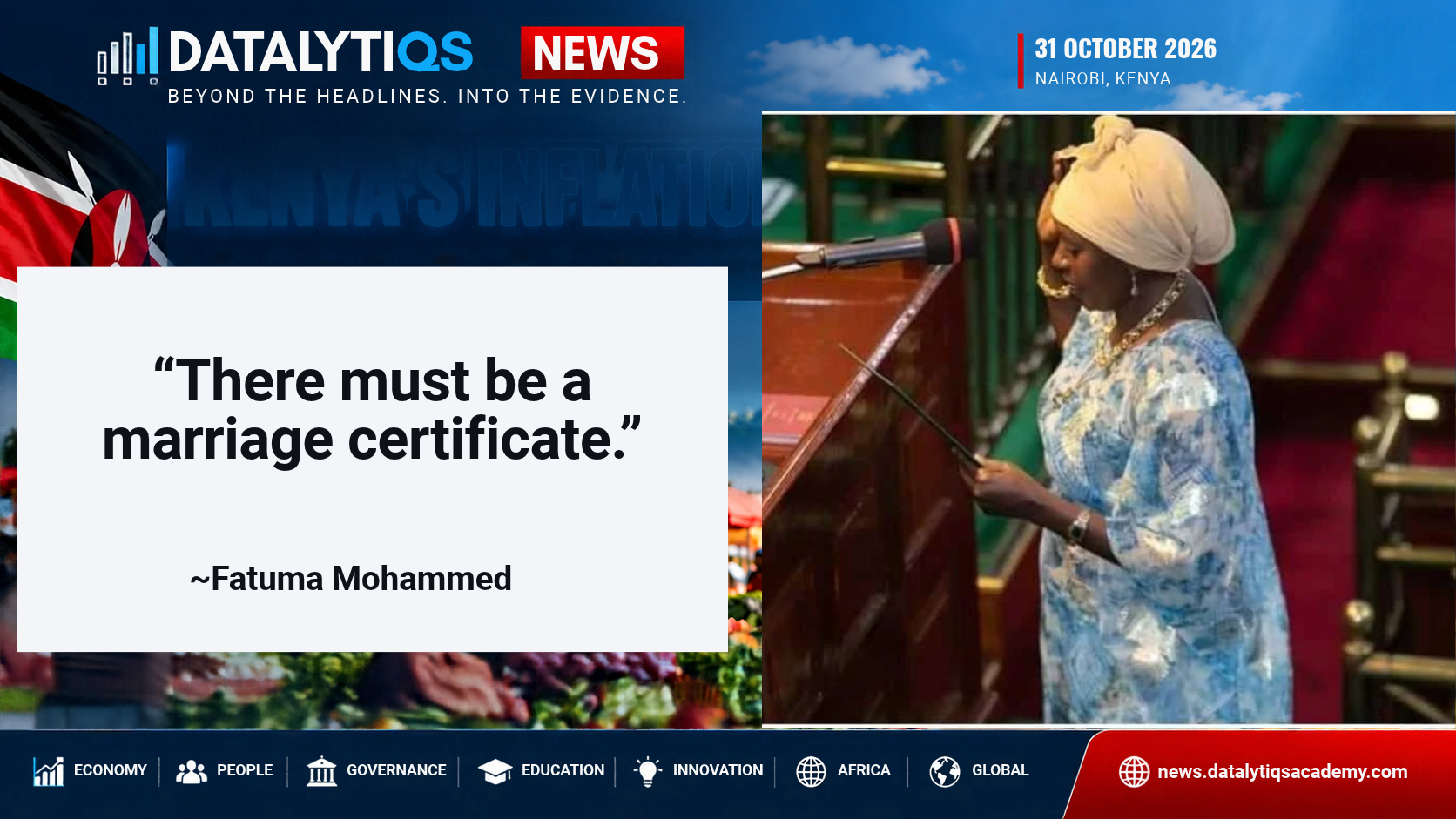
Migori Woman Representative Fatuma Mohammed says ODM must not enter a political partnership with President William Ruto’s UDA without a formal agreement. Her warning has brought a critical legal question into the coalition debate: what protections does Kenya’s Political Parties Act provide when parties negotiate power sharing, electoral cooperation and government responsibilities?
NAIROBI, KENYA — 31 October 2026
Migori Woman Representative Fatuma Mohammed has rejected the idea of an informal political arrangement between the Orange Democratic Movement (ODM) and President William Ruto’s United Democratic Alliance (UDA), insisting that any future partnership must be documented and authorised through the party’s established institutions.
Her remarks, reported by The Star on October 29, came amid disagreements within ODM over whether the party should demand a written agreement before committing its political support to President Ruto ahead of the 2027 General Election.
Mohammed used a marriage analogy to explain her position.
“As ODM party we will not do ‘come we stay’, there must be a marriage certificate. ODM is not a community, ODM is a political party whose decisions are made by its party organs and members.”
The statement draws attention to two distinct questions.
First, should ODM’s relationship with UDA be based on informal political cooperation or a formally negotiated agreement?
Second, who possesses the institutional authority to approve such an arrangement?
While the marriage analogy has attracted political attention, its deeper significance lies in the legal and organisational framework governing coalition agreements in Kenya.
Under the Political Parties Act, a formal coalition agreement is not merely a ceremonial document. It must address specific matters concerning party governance, electoral participation, power sharing, dispute resolution and the consequences of breaching agreed obligations.
The question, therefore, is not simply whether ODM and UDA will sign an agreement, but what that agreement would legally establish.
Fatuma Mohammed: ODM Must Act as a Political Institution
Mohammed’s argument challenges the suggestion that political cooperation can be determined through regional sentiment or informal understandings among influential leaders.
Her emphasis on ODM being a political party rather than a community is particularly significant.
ODM is a registered national political organisation with its own constitution, membership, leadership structures and decision-making procedures.
Its institutional decisions must be distinguished from the preferences of individual politicians or communities associated with its historical electoral support.
That distinction matters because much of the debate surrounding the proposed ODM–UDA partnership has been framed around political goodwill towards Luo Nyanza.
Some politicians have argued that President Ruto’s appointments and development initiatives in the region provide sufficient grounds for continued cooperation.
Mohammed’s position is that the party’s political commitments should instead be negotiated and approved through recognised party organs.
Her argument does not necessarily reject cooperation with UDA.
It concerns the procedures and safeguards that should govern such cooperation.
Why the Written Agreement Debate Has Divided ODM
The disagreement has produced competing positions among senior ODM politicians.
Uriri MP Mark Nyamita has argued that President Ruto has demonstrated goodwill through infrastructure projects, government appointments and engagement with ODM-associated regions.
Nyando MP Jared Okello has questioned whether a written agreement can guarantee compliance, citing previous political arrangements involving former Presidents Daniel arap Moi and Mwai Kibaki.
Okello has maintained that political commitments may be disregarded even when they have been documented.
Other ODM politicians have expressed greater concern about the risks of relying on informal assurances.
Homa Bay Senator Moses Kajwang’ has called for risk management based on historical political experiences.
Alego Usonga MP Sam Atandi has warned that parties entering negotiations without documented terms may encounter disagreements over future government positions.
Mohammed’s intervention aligns with the position that political cooperation should be formalised.
However, the opposing argument raises a legitimate institutional question: does signing an agreement necessarily ensure that the parties will honour it?
The answer depends on the nature of the agreement, the legal obligations it creates and the procedures available when disputes arise.
Kenya’s Political Parties Act Already Defines Coalition Requirements
The debate can be examined against Kenya’s existing legal framework.
Section 10 of the Political Parties Act provides for political parties to form coalitions before or after elections and to deposit coalition agreements with the Registrar of Political Parties.
The Third Schedule specifies the basic requirements for such agreements.
A formal coalition agreement must follow the participating parties’ internal rules and procedures.
It must also be sanctioned by the relevant party governing bodies, executed in writing by authorised national party officials and commissioned by a Commissioner for Oaths.
These requirements make institutional approval a substantive part of coalition formation.
A document signed by political figures who lack the necessary authority would raise questions about whether the agreement satisfies the applicable legal requirements.
Likewise, public declarations made at political rallies cannot automatically substitute for decisions by the organs authorised under a party’s constitution.
Mohammed’s emphasis on party institutions therefore corresponds with an identifiable legal principle: formal coalition decisions must be made through properly authorised structures.
What Must a Coalition Agreement Contain?
The Third Schedule to the Political Parties Act identifies matters that a coalition agreement must address.
These include the participating parties, the coalition’s policies and objectives, its organisational structure and the procedures through which it will operate.
The agreement must also address the sharing of positions within the coalition structure and the allocation of roles and responsibilities.
Electoral rules are another important component.
The parties must establish how coalition election and nomination processes will be conducted.
Decision-making procedures must also be defined, including arrangements for policy consultation and approval.
The law further requires provisions concerning dispute resolution, enforcement, sanctions for breaches, appeals, financial arrangements and dissolution.
These requirements demonstrate that a coalition agreement is intended to regulate an ongoing institutional relationship.
It is not simply a declaration that two political parties intend to cooperate.
For ODM and UDA, the relevant questions would include how decisions are made, which institutions exercise authority and what procedures apply when the parties disagree.
The Difference Between a Political Understanding and a Registered Coalition
Political parties can cooperate without necessarily establishing a formal coalition under the Political Parties Act.
They may support particular government policies, participate in parliamentary arrangements or engage in political consultations.
Such cooperation may be politically significant without automatically creating a registered coalition.
A formal coalition, however, operates within a defined statutory framework.
The Office of the Registrar of Political Parties explains that participating parties retain their separate legal identities in an ordinary coalition.
A coalition political party is a distinct arrangement with additional registration requirements.
This distinction matters because public discussions frequently use the terms political cooperation, coalition and coalition political party interchangeably.
They are not necessarily equivalent.
The legal status of a proposed ODM–UDA arrangement would depend on the agreement’s actual form and the procedures followed.
Before describing any future document as a legally recognised coalition agreement, its approval and registration status would need to be established.
The Registration Deadline Before an Election
The timing of any proposed agreement is another important consideration.
Under Section 10 of the Political Parties Act, a pre-election coalition agreement must be deposited with the Registrar at least three months before the election.
A coalition political party is subject to a separate requirement involving submission at least 120 days before a general election.
Post-election coalition agreements are subject to different filing timelines.
The applicable deadline therefore depends on the type of arrangement being established.
For ODM and UDA, the parties would need to determine whether they intend to form an ordinary coalition, establish a coalition political party or maintain another form of political cooperation.
The classification would affect the applicable procedures and deadlines.
A political announcement alone would not establish that the statutory requirements have been satisfied.
Can a Written Agreement Guarantee a 50–50 Government?
One of the most prominent proposals in the ODM–UDA debate concerns the distribution of government positions.
Homa Bay Governor and ODM chairperson Gladys Wanga has advocated a 50–50 power-sharing formula.
According to her publicly reported proposal, UDA would provide the presidential candidate while ODM would receive the running-mate position.
She has also proposed equal representation in Cabinet appointments.
However, this remains a negotiating proposal rather than an established agreement.
The publicly available reporting does not demonstrate that UDA has formally accepted the formula.
More importantly, any such arrangement must operate within Kenya’s Constitution.
The Deputy President is elected together with the President under the applicable constitutional and electoral framework.
Cabinet Secretaries are appointed through procedures involving presidential nomination and National Assembly approval.
A coalition agreement cannot override these constitutional requirements.
It may establish political expectations about how the parties intend to allocate responsibilities.
However, it cannot independently compel constitutional institutions to make appointments outside the law.
This is an important limitation on the protections a written agreement can realistically provide.
What Happens When a Coalition Partner Breaks the Agreement?
Mohammed’s demand for a written agreement raises an important question about enforcement.
The Third Schedule to the Political Parties Act requires coalition agreements to provide mechanisms for resolving disputes and addressing breaches.
These include enforcement and sanction procedures, as well as arrangements for appeals to the Political Parties Disputes Tribunal.
The existence of these requirements means that formal coalition agreements can establish processes for handling disagreements.
However, the effectiveness of those processes depends on the specific provisions and the jurisdiction of the institutions involved.
A dispute over the interpretation of coalition rules may be different from a disagreement over a political promise concerning a future appointment.
Likewise, an alleged breach must be assessed against the actual terms of the agreement.
A party cannot simply assume that every unmet political expectation constitutes a legally actionable violation.
The agreement must identify the relevant obligation, the circumstances constituting a breach and the procedure for seeking a remedy.
Where statutory dispute-resolution requirements apply, parties must also comply with the relevant legal procedures.
A written agreement therefore offers a framework for accountability.
It does not guarantee that every disagreement will be resolved in favour of the complaining party.
The Importance of Internal Party Ratification
Mohammed’s insistence that ODM decisions belong to party organs and members places particular emphasis on ratification.
Technical negotiators may discuss possible terms and prepare draft agreements.
However, the authority to approve those terms must be established through the parties’ constitutions and applicable law.
Homa Bay Town MP Peter Opondo Kaluma has said that technical negotiations between ODM and UDA are progressing towards a written agreement.
According to The Star, the joint broad-based committee is co-chaired by Carey Orege for ODM and Emmanuel Nzai for UDA.
Kaluma has expressed confidence that the negotiations will produce a document governing future cooperation.
That statement establishes the outcome he anticipates.
It does not establish that a final agreement has already been approved.
For institutional accountability, the parties should be able to identify the mandate of the negotiating committee, the approval procedures applicable to its recommendations and the officials authorised to execute any resulting agreement.
The distinction between negotiation and ratification is particularly important where the proposed terms could affect party nominations, electoral cooperation or the distribution of political responsibilities.
What About ODM’s Existing Cooperation With Government?
The proposed agreement is being discussed against the background of ODM’s existing cooperation with President Ruto’s administration.
That relationship includes the 10-point agenda announced by President Ruto and Raila Odinga in March 2025.
The agenda addressed governance, institutional reforms, economic concerns and other public-interest priorities.
Some ODM leaders have argued that implementation of the agenda should remain central to the relationship.
Others have pointed to government appointments and development projects as evidence of goodwill.
These matters should be evaluated separately from the proposed 2027 coalition arrangement.
The implementation of existing commitments can be assessed through official decisions, legislative action, approved budgets and documented outcomes.
A new coalition agreement would concern the future relationship between the participating political parties.
Signing a new document would not, by itself, demonstrate that all earlier commitments had been fulfilled.
Likewise, existing cooperation does not automatically establish the terms of a future electoral partnership.
The Problem With Treating Public Development as Political Consideration
One overlooked dimension of the ODM–UDA debate concerns the use of public development projects as evidence supporting a political agreement.
Roads, electricity connections, markets and other public investments are government responsibilities implemented through public institutions.
Their financing and delivery must comply with applicable laws and administrative procedures.
Public projects should therefore be assessed through budget allocations, procurement records, expenditure, physical completion and actual benefits to residents.
They should not be treated as private concessions belonging to a political party or community.
This distinction is important because government services are owed to citizens under the applicable public policy and legal frameworks, irrespective of their political affiliations.
A coalition agreement may establish shared policy priorities.
It cannot legitimately remove the constitutional and statutory obligations governing the allocation and use of public resources.
For citizens, the appropriate accountability question is whether public programmes are lawfully implemented and produce measurable benefits.
Can a Coalition Agreement Protect ODM’s Independence?
Another important question concerns whether formal cooperation would compromise ODM’s organisational identity.
According to guidance from the Office of the Registrar of Political Parties, parties participating in an ordinary coalition retain their independent legal existence.
This means that entering a coalition does not automatically dissolve the participating parties or merge them into a single organisation.
However, the agreement may establish common electoral procedures, shared decision-making structures and obligations affecting the participating parties.
The extent of those commitments depends on the terms adopted.
For ODM, the practical questions would include whether it retains control over its internal leadership, how parliamentary and electoral decisions would be coordinated and what procedures would apply if the parties disagreed.
A formal agreement could clarify those matters.
It could also create obligations limiting unilateral action in specified areas.
The consequences would therefore depend on the balance between institutional independence and the commitments voluntarily undertaken.
DatalytIQs Political Intelligence Assessment
Fatuma Mohammed’s intervention raises several questions that can be examined through official documents and institutional decisions.
First, the legal form of the proposed relationship remains important. Political cooperation and a registered coalition are not automatically the same arrangement.
Second, the Political Parties Act establishes minimum requirements. A formal coalition agreement must address governance, nominations, decision-making, dispute resolution, sanctions and other statutory matters.
Third, party approval is essential. Negotiating teams cannot replace the governing organs authorised to approve coalition arrangements.
Fourth, constitutional limits remain binding. Political promises concerning government appointments and public resources must comply with the Constitution and applicable legislation.
Fifth, enforceability depends on the actual terms. A signed agreement provides documentary evidence of commitments, but remedies for breach depend on the agreement and the relevant legal framework.
Sixth, implementation requires verification. Public announcements should be distinguished from approved agreements and subsequent actions.
These issues provide a framework for assessing the proposed arrangement without presuming that formalisation would necessarily succeed or that informal cooperation would necessarily fail.
What Should Be Monitored Before 2027?
The first development to monitor is the negotiating committee’s formal mandate.
Its terms of reference would establish the matters it is authorised to discuss and whether it can make binding decisions.
The second is the publication of any proposed agreement.
The document should be examined for its participating parties, political objectives, governance structures, electoral rules, power-sharing provisions and dispute-resolution mechanisms.
The third is ratification.
Official party resolutions would help establish whether ODM and UDA have approved the proposed terms through the required procedures.
The fourth is the agreement’s legal status.
Any applicable filing or registration with the Office of the Registrar of Political Parties should be verified through official records.
The fifth is implementation.
Once commitments are formally adopted, progress should be evaluated against their stated requirements, timelines and legally responsible institutions.
Conclusion: The Marriage Certificate Analogy Has a Legal Dimension
Fatuma Mohammed’s rejection of an informal ODM–UDA arrangement has brought the legal framework for political coalitions into sharper focus.
Her central argument is that ODM should act through its established institutions rather than rely exclusively on personal understandings or regional political sentiment.
Kenya’s Political Parties Act provides a framework for formal coalition agreements, including requirements concerning institutional approval, governance, elections, dispute resolution and enforcement.
However, a written agreement cannot eliminate political uncertainty or override constitutional procedures.
Its practical significance depends on the clarity of its terms, lawful approval and the availability of appropriate remedies.
For ODM and UDA, the critical questions remain whether they will reach agreement, what obligations they will undertake and how those commitments will be implemented.
A political marriage certificate may document the relationship. But the real test is whether the partners respect its terms—and whether the institutions responsible for enforcing them can act when disputes arise.
DatalytIQs News — Beyond the Headlines. Into the Evidence.
Sources and References
- The Star — Oburu’s ODM split over written Ruto pact ahead of 2027, 29 October 2026. Original reporting containing Fatuma Mohammed’s remarks and the competing ODM positions.
- Office of the Registrar of Political Parties — Mergers, Coalitions and Coalition Political Parties. Official guidance on coalition formation, legal identity and registration requirements.
- Political Parties Act, 2011 — Official ORPP PDF, Revised 2022. Section 10 and the Third Schedule establish statutory requirements for coalition agreements.
- Kenya Law — Political Parties Act. Statutory framework governing political parties, coalitions and dispute resolution.
- Kenya Law — Constitution of Kenya. Constitutional provisions governing elections, executive appointments and public institutions.