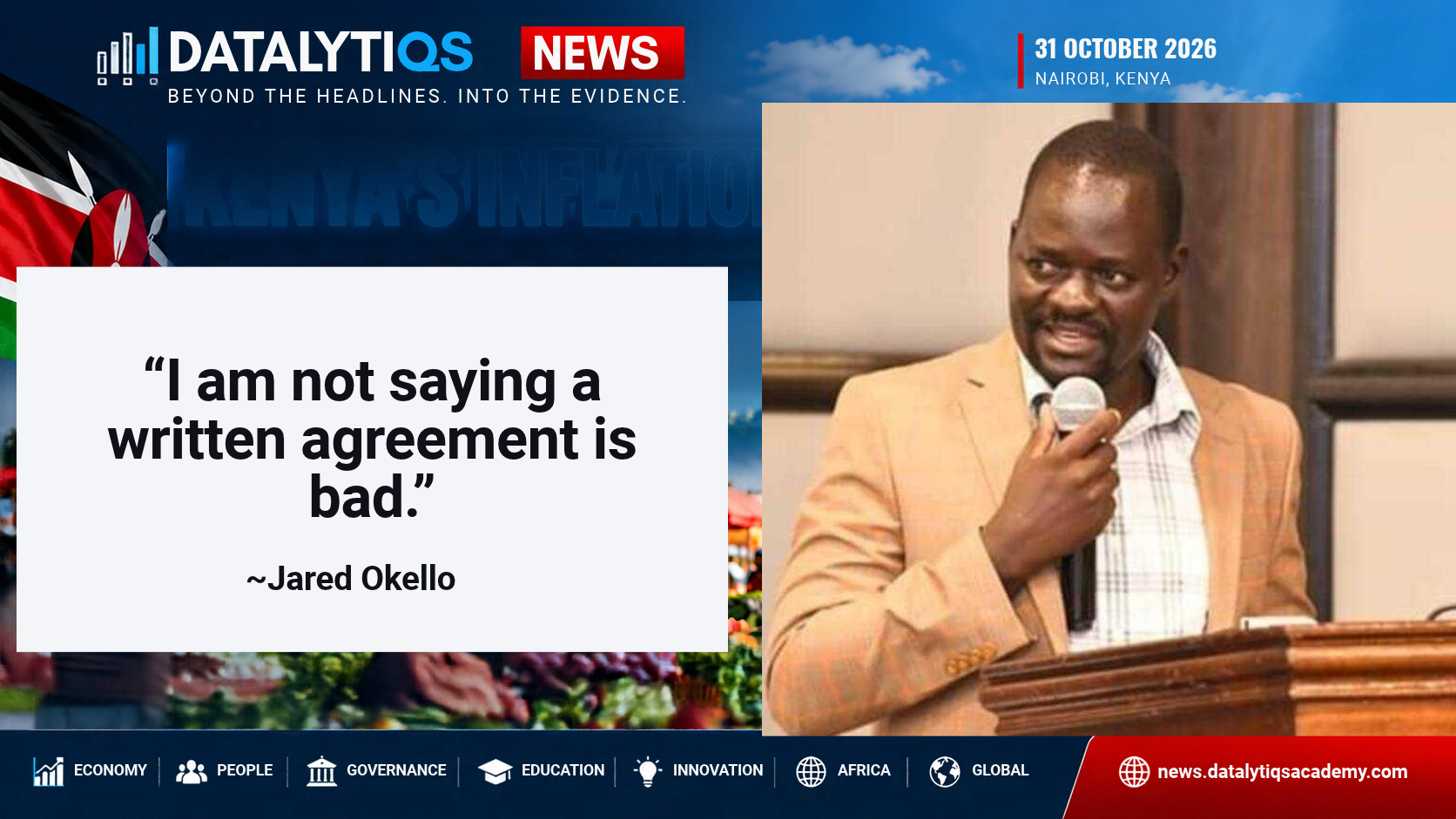
Nyando MP Jared Okello argues that President William Ruto has already demonstrated political goodwill towards ODM and that a signed agreement cannot guarantee future compliance. But his position has drawn objections from ODM delegates in Nyando, raising a wider question about political trust, party authority and the enforceability of coalition agreements.
KISUMU, KENYA — 31 October 2026
Nyando Member of Parliament Jared Okello has questioned the growing demand within the Orange Democratic Movement (ODM) for a written agreement with President William Ruto’s United Democratic Alliance (UDA), arguing that political history demonstrates the limitations of signed commitments.
Okello maintains that President Ruto has already demonstrated goodwill through government appointments, infrastructure investment and cooperation with leaders from regions traditionally associated with ODM.
Speaking in remarks reported by The Star on October 29, the legislator cautioned against treating a written political agreement as a guarantee that all future commitments will be honoured.
“I am not saying a written agreement is bad, but when you insist on inking a deal, then it means there are doubts and suspicion.”
His argument has added to a disagreement within ODM over the conditions under which the party should support President Ruto’s re-election bid in 2027.
Some party leaders favour continued cooperation based on existing political relationships and government actions. Others insist that ODM must negotiate formal commitments covering power sharing, policy priorities and implementation responsibilities.
The disagreement has now extended to Okello’s home constituency, where a group of ODM delegates has publicly rejected his position and demanded that any future political partnership be based on a documented agreement.
The dispute raises a question extending beyond individual political preferences: Can goodwill provide sufficient assurance in a political partnership, or should the parties establish written obligations that can be independently examined?
Okello Cites the Moi and Kibaki Experiences
Okello’s argument draws on historical political arrangements involving Raila Odinga and previous Kenyan administrations.
He referred to cooperation with former President Daniel arap Moi and subsequent political negotiations involving former President Mwai Kibaki.
According to Okello, commitments associated with those political relationships were not fully honoured.
His central argument is that written documents cannot, by themselves, compel political leaders to fulfil their promises.
The historical examples are relevant because coalition disputes have repeatedly featured in Kenya’s political development.
However, the different arrangements should not be treated as legally identical.
Political cooperation involving KANU before the 2002 General Election operated under a different constitutional and institutional environment from the arrangements that followed the election.
The National Rainbow Coalition also experienced disputes concerning power sharing and constitutional reform after assuming office in 2002.
These experiences demonstrate that disagreements may arise even where political partners have documented their expectations.
They do not establish that every written agreement lacks legal significance.
The enforceability of a particular agreement depends on its terms, legal status and the laws applicable when it was concluded.
Why Okello Believes Ruto Has Demonstrated Goodwill
Okello argues that the current administration has already provided evidence of cooperation with ODM through government appointments and development programmes.
He has pointed to the presence of ODM-associated politicians in senior government positions and to projects being implemented in Nyanza.
His position is that the existing relationship should be recognised rather than made conditional on an additional written document.
In separate remarks reported by Daily Nation on October 29, Okello urged ODM to maintain its relationship with the President rather than risk being excluded from future political negotiations.
He also raised the possibility that other opposition leaders could engage with the administration.
That possibility is a political scenario advanced by Okello, not an established future arrangement.
The practical question is whether the government actions he cites demonstrate fulfilment of identifiable commitments.
Appointments can be verified through official government records.
Infrastructure projects can be assessed through approved budgets, procurement documentation, completion reports and service-delivery outcomes.
However, these forms of evidence establish what has occurred under the current administration.
They do not necessarily establish the terms of future cooperation after the 2027 election.
Nyando ODM Delegates Challenge Their MP
Okello’s remarks have generated disagreement among some ODM representatives in Nyando.
In a report published on October 30 by The Focus Paper, delegates led by Kisumu County Assembly Majority Leader and Ahero Ward MCA Ken Ooko rejected the MP’s position on unconditional support for President Ruto.
The delegates argued that individual politicians should not present personal views as official ODM policy without authorisation from the party’s recognised institutions.
They maintained that any political arrangement with UDA should be documented and should clearly identify its objectives, obligations and accountability mechanisms.
The group also called on ODM’s relevant national organs to examine Okello’s remarks and determine whether any party rules had been violated.
Their statements are significant because they introduce an institutional dimension to the disagreement.
The issue is no longer confined to whether a written agreement is politically desirable.
It also concerns who has the authority to communicate ODM’s official position.
The delegates’ objections should not, however, be presented as the unanimous position of all ODM members or residents of Nyando.
The available report identifies a group of party representatives expressing opposition to Okello’s position. It does not provide a representative survey of constituency opinion.
Neither does their demand for disciplinary action establish that Okello violated the party constitution.
Any such finding would require a properly authorised process under the party’s applicable rules.
Ken Ooko: Political Agreements Need Accountability
According to The Focus Paper, Ken Ooko argued that political cooperation should be based on clearly defined terms and institutional accountability.
The delegates expressed concern that unconditional commitments could weaken ODM’s ability to negotiate future responsibilities and benefits.
They also emphasised that ODM’s national leadership and recognised party organs should determine its political direction.
Nyando ODM Women chairperson Caren Nyangoya questioned whether Okello had been authorised to speak on behalf of party members.
Youth representative Benard Awuor similarly supported structured negotiations while calling for clear terms of cooperation.
Their position does not necessarily amount to opposition to engagement with UDA.
Rather, they are challenging the conditions under which that engagement should be formalised.
This distinction matters because the debate is sometimes presented as a simple division between politicians supporting and opposing President Ruto.
The available reporting reveals a more specific disagreement over the terms, procedures and institutional authority governing political cooperation.
A Wider Disagreement Within ODM
Okello is not alone in questioning the demand for additional written guarantees.
Uriri MP Mark Nyamita has argued that President Ruto’s development record and political cooperation with ODM demonstrate goodwill.
Interior Principal Secretary Raymond Omollo has also questioned calls for the Luo community to make its support for the President conditional on a signed agreement.
Omollo has cited historical political cooperation between Raila Odinga and communities that supported his presidential ambitions.
However, other ODM politicians have advanced a different position.
Homa Bay Senator Moses Kajwang’ has called for risk management, arguing that previous political experiences justify caution.
Alego Usonga MP Sam Atandi has warned that parties entering political negotiations without documented commitments may face disagreements over future appointments and responsibilities.
Migori Woman Representative Fatuma Mohammed has advocated formalisation of any arrangement through recognised party procedures.
Kisumu Woman Representative Ruth Odinga has also insisted that ODM should negotiate a legally binding agreement and has warned against treating the party as an exclusively Luo political organisation.
These differences concern both the substance of negotiations and the identity of the institution authorised to conduct them.
ODM is a registered national political party.
Its decisions cannot automatically be equated with the political preferences of one ethnic community, individual officeholder or regional group.
Kaluma Says the Talks Will Produce a Written Agreement
The debate has become more complicated because Homa Bay Town MP Peter Opondo Kaluma has indicated that technical negotiations between ODM and UDA are already progressing towards a written agreement.
Kaluma told The Star that the negotiating committee was expected to produce a document defining the parties’ future relationship.
The reported committee is co-chaired by Carey Orege for ODM and Emmanuel Nzai for UDA.
His statement introduces an important distinction between Okello’s political preference and the direction of the reported technical negotiations.
Okello questions the necessity of making a written agreement a condition for cooperation.
Kaluma expects the formal negotiating process to produce such an agreement.
These positions are not necessarily incompatible in every respect.
A politician may believe that cooperation should continue without preconditions while accepting that a written document could subsequently clarify the arrangement.
However, the two approaches differ over whether the agreement should be a prerequisite for political support.
The final institutional position will depend on the decisions of the authorised party organs and the outcome of negotiations.
Does a Written Coalition Agreement Have Legal Weight?
One of the most consequential aspects of Okello’s argument concerns the legal significance of political agreements.
The claim that a written political agreement has no legal weight is too broad to apply to every arrangement.
Kenya’s Political Parties Act recognises formal coalition arrangements and establishes a legal framework for political party cooperation.
Where parties conclude a coalition agreement under the applicable law, its provisions and registration status may have legal consequences.
The Office of the Registrar of Political Parties performs statutory functions concerning political parties and coalition arrangements.
The Political Parties Disputes Tribunal also has jurisdiction over specified categories of political party disputes, subject to applicable legal requirements.
However, legal recognition does not mean that every political promise becomes enforceable in the same way.
For example, an agreement cannot override the constitutional procedures governing presidential elections or appointments to public office.
A promise to allocate Cabinet positions must operate within the constitutional framework for presidential nomination and National Assembly approval.
Similarly, a political commitment to implement a development project remains subject to lawful budgeting, procurement and administrative procedures.
The legal significance of a written agreement therefore depends on its contents and the applicable statutory framework.
A signed document can provide evidence of agreed obligations, but it cannot guarantee that every political expectation will be fulfilled.
The Difference Between Goodwill and Accountability
Political goodwill and formal accountability perform different functions.
Goodwill can facilitate cooperation, reduce conflict and support negotiations.
It may also encourage political partners to implement commitments without resorting to formal dispute procedures.
However, goodwill is difficult to measure independently unless it is connected to observable actions.
A written agreement provides a documented basis for identifying the parties’ stated obligations.
It can clarify responsibilities, establish implementation procedures and provide a reference point when disagreements arise.
Its limitations become apparent when commitments are ambiguous, politically aspirational or inconsistent with constitutional requirements.
For this reason, the central question is not simply whether political leaders trust one another.
It is whether the public can establish what the parties have agreed, who is responsible for implementation and what procedures apply if commitments are disputed.
Those questions are relevant whether cooperation is based primarily on political goodwill or a formal coalition agreement.
Can Government Projects Be Used as Political Guarantees?
Okello and other supporters of continued cooperation have cited public development projects as evidence of the administration’s goodwill.
Such projects can provide important information about government performance.
However, their existence and completion should be established through official records and independent verification.
A road announcement does not establish that construction is complete.
An approved budget does not demonstrate that all funds have been disbursed.
A government appointment does not necessarily establish a binding commitment to maintain a particular political arrangement after an election.
Public infrastructure is financed through state institutions and must be evaluated against the needs of citizens and the lawful use of public resources.
It should not be treated as the private consideration of a political party or community.
Similarly, the delivery of public services should remain an obligation of government irrespective of how particular constituencies voted.
The relevant accountability measures include expenditure, implementation progress, infrastructure quality and actual benefits to residents.
These indicators can be examined separately from the political negotiations between ODM and UDA.
What Would Make a Political Agreement More Accountable?
A formal agreement between ODM and UDA could establish a clearer framework for cooperation if it addresses specific institutional questions.
It would need to identify the participating parties, the scope of cooperation and the authority under which the agreement was negotiated.
It should distinguish electoral commitments from governing arrangements and specify the procedures for approving major decisions.
Where the agreement contains policy commitments, it should identify implementation responsibilities and measurable milestones.
Where it concerns government appointments, its provisions must respect constitutional requirements.
The document should also establish how disagreements will be handled, whether amendments are permitted and the circumstances under which cooperation may be terminated.
These provisions would not eliminate political uncertainty.
They would provide a framework for determining whether the parties have acted consistently with their documented commitments.
For an agreement to carry institutional legitimacy, it must also receive the approvals required by the parties’ constitutions and applicable law.
DatalytIQs Political Intelligence Assessment
Okello’s intervention highlights five issues requiring continued examination.
First, historical experience does not settle the present legal question. Earlier political agreements may have been disputed or disregarded, but their outcomes do not establish the legal status of a future ODM–UDA arrangement.
Second, political goodwill and legal enforceability are distinct. Existing cooperation may provide evidence of a working relationship, while a formal agreement may establish documented obligations.
Third, party authority matters. Okello is entitled to express a political position, but whether that position represents ODM must be established through the party’s recognised decision-making structures.
Fourth, constituency-level disagreement is now visible. The reported objections by Nyando delegates demonstrate that some local party representatives reject unconditional support. Their position should not be generalised to all constituents without further evidence.
Fifth, government development performance requires independent measurement. Political claims about projects and appointments should be assessed through administrative records rather than treated as automatic guarantees of future cooperation.
These observations clarify the institutional questions without determining which political position ODM should adopt.
What Happens Next in Nyando?
The dispute creates several developments worth monitoring.
The first is whether ODM’s national leadership responds formally to the complaints raised by Nyando delegates.
The second is whether Okello clarifies his position following their objections.
The third concerns the status of the ODM–UDA technical negotiations and whether the committee produces a proposed agreement.
Any resulting document should be examined for its legal form, approval procedures and implementation commitments.
At constituency level, attention should also turn to the development projects cited as evidence of government goodwill.
Their approved budgets, procurement records, physical progress and public benefits would provide an independent basis for evaluating those claims.
Finally, any formal disciplinary proceedings against Okello would need to follow the party’s governing rules and applicable principles of procedural fairness.
Conclusion: A Political Promise Is Not the Same as an Enforceable Commitment
Jared Okello has questioned whether ODM should insist on a written agreement before supporting President William Ruto’s re-election bid.
His argument rests on historical experiences in which political commitments were allegedly not honoured and on his assessment of the goodwill demonstrated by the current administration.
Other ODM politicians maintain that the party should negotiate clear, documented guarantees.
The disagreement has now reached Nyando, where some party delegates have challenged Okello’s position and called for greater institutional accountability.
The central issue extends beyond whether politicians sign an agreement.
It concerns what they commit to, whether those commitments are lawful, who has authority to approve them and how implementation can be verified.
A written agreement cannot manufacture political trust. But without documented commitments, determining precisely what was promised—and whether it was honoured—becomes more difficult.
For ODM, UDA and the public, those questions will remain central as negotiations continue ahead of the 2027 General Election.
DatalytIQs News — Beyond the Headlines. Into the Evidence.
Sources and References
- The Star — Oburu’s ODM split over written Ruto pact ahead of 2027, 29 October 2026.
- Daily Nation — Written pact or goodwill? Fresh split in ODM over Ruto 2027 deal, 29 October 2026.
- The Focus Paper — Nyando ODM delegates disown MP Jared Okello over unconditional support for Ruto, 30 October 2026.
- Citizen Digital — Oburu shuts down calls for written ODM–UDA agreement, 30 October 2026.
- Capital FM — Oburu dismisses calls for written pre-2027 deal with UDA, 30 October 2026.
- Office of the Registrar of Political Parties — Political party governance and coalition registration requirements.
- Kenya Law — Constitution of Kenya, Political Parties Act and applicable electoral legislation.