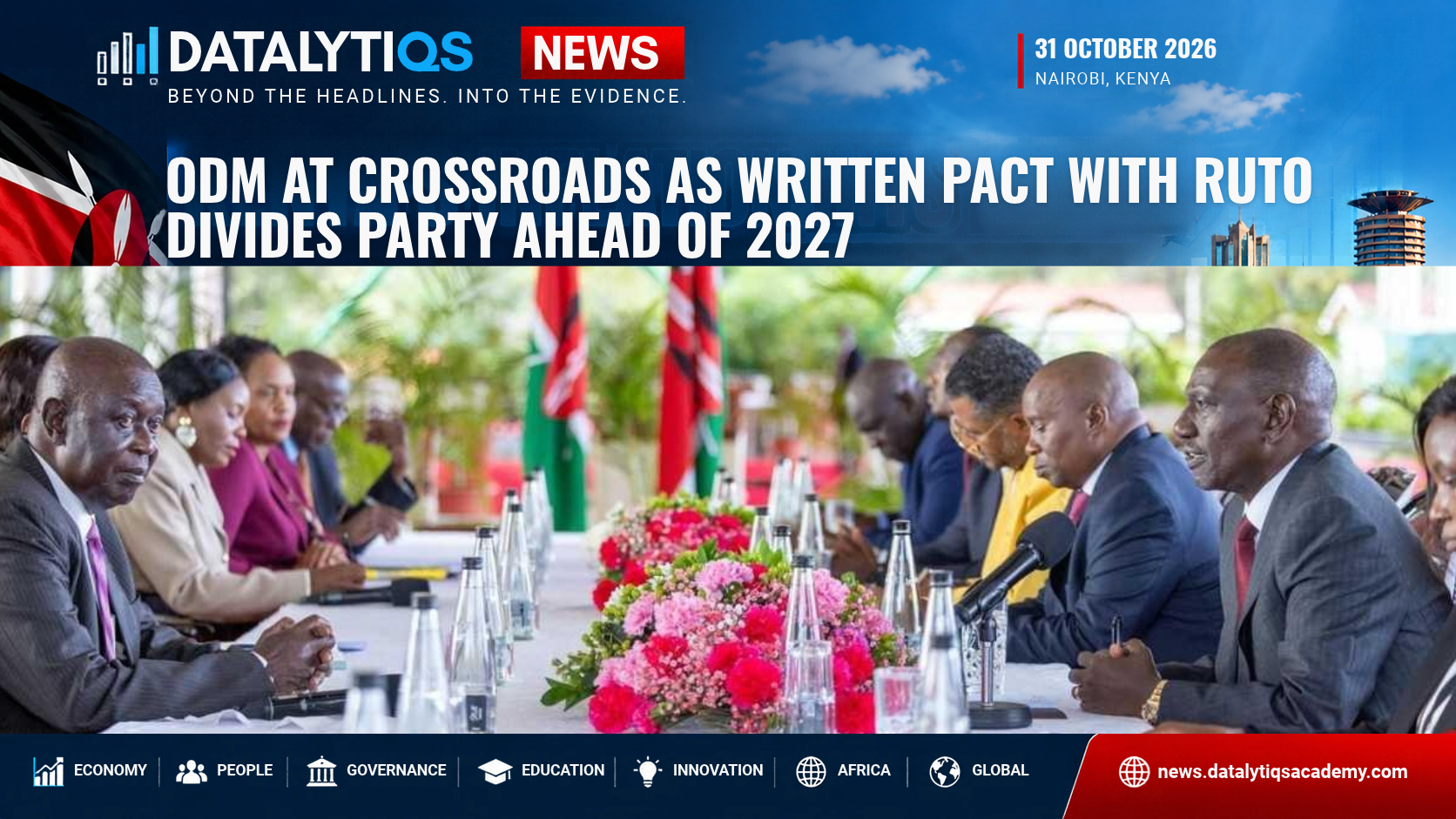
The Orange Democratic Movement (ODM) is confronting a significant internal political test as competing factions disagree over whether the party should secure a formal pre-election agreement with President William Ruto before committing its support to his 2027 re-election bid.
The dispute has developed into a broader contest over ODM’s political identity, negotiating strength and future relationship with the ruling United Democratic Alliance (UDA).
At the centre of the disagreement are two competing approaches. One group believes President Ruto has already demonstrated sufficient goodwill through development initiatives, government appointments and cooperation with ODM leaders. Another insists that political goodwill, however substantial, cannot replace a clearly negotiated agreement defining the responsibilities, benefits and obligations of both parties.
The debate comes as ODM, under the leadership of Oburu Oginga, attempts to consolidate its political position following the death of its longstanding leader, Raila Odinga.
What initially appeared to be a disagreement over political strategy is increasingly becoming a test of internal party governance and the credibility of Kenya’s evolving coalition arrangements.
The Two Camps: Political Goodwill Versus Written Guarantees
The first camp advocates continued cooperation with President Ruto without making a signed agreement a precondition for political support.
Uriri MP Mark Nyamita and Nyando MP Jared Okello have publicly defended this position, arguing that the current administration has already demonstrated its willingness to work with ODM constituencies.
Their argument rests partly on development projects and the appointment of ODM-associated politicians to influential government positions.
Supporters of this approach also question whether written political agreements provide meaningful protection when parties lack the political will to honour their commitments.
Okello has cited previous political partnerships involving Raila Odinga to illustrate how written understandings can fail to produce their intended outcomes.
The opposing camp considers unconditional support a significant political risk.
Alego Usonga MP Sam Atandi, Migori Woman Representative Fatuma Mohammed, Homa Bay Senator Moses Kajwang’ and Homa Bay Town MP Opondo Kaluma have defended the importance of a negotiated agreement.
Their central argument is that ODM must preserve its institutional independence and negotiate as a political organisation with identifiable interests rather than simply endorse a presidential candidate without formal commitments.
For this group, an agreement would provide a framework for allocating political responsibilities, managing disagreements and assessing whether negotiated promises are being implemented.
The disagreement is therefore not necessarily between supporters and opponents of cooperation with Ruto. It is primarily about the conditions under which that cooperation should proceed.
Raymond Omollo’s Intervention Intensifies the Debate
Interior Principal Secretary Raymond Omollo has emerged as an influential voice in the argument against attaching conditions to ODM’s support for the President.
Speaking in Homa Bay County, Omollo questioned why leaders in Luo Nyanza should demand a formal agreement when, in his account, Kalenjin voters supported Raila Odinga’s presidential ambitions in 2007 without insisting on equivalent written guarantees.
He argued that the President’s development record should provide a sufficient basis for political support.
His intervention has attracted attention because it introduces an additional dimension to the dispute: whether electoral cooperation should be understood as an exchange between political institutions or as an expression of reciprocal support between communities.
That distinction matters.
ODM is a registered national political party whose membership and representation extend beyond Luo Nyanza. Its political decisions cannot automatically be equated with the preferences of a single ethnic constituency.
Critics of unconditional support argue that treating ODM’s electoral strength primarily as a regional resource risks weakening its national identity and institutional negotiating authority.
The controversy also raises a governance question: who has the legitimate mandate to define the terms of ODM’s electoral cooperation?
Statements by individual politicians, government officials or regional leaders do not necessarily constitute binding decisions by the party’s authorised organs.
The 50–50 Power-Sharing Proposal
The most consequential issue in the negotiations is the demand by senior ODM figures for an equal share of power in a possible post-2027 administration.
Homa Bay Governor Gladys Wanga has publicly advocated a 50–50 arrangement between ODM and UDA.
The proposal has included demands concerning Cabinet representation and the Deputy President’s position.
Such an arrangement would represent a substantial political concession by UDA and would have implications extending beyond the two negotiating parties.
The Deputy President’s office is currently held by Kithure Kindiki, whose political allies have defended his prospects of remaining President Ruto’s running mate.
Consequently, any proposal to allocate the position to ODM would potentially affect existing alliances within the broader Kenya Kwanza political formation.
The proposed 50–50 formula also requires closer examination.
Would equal power-sharing apply only to Cabinet positions, or would it extend to parliamentary leadership, public appointments, policy formulation and political decision-making?
Would the agreement specify individual offices, or establish a mechanism for determining appointments after the election?
And would the distribution of political positions be linked to measurable electoral contributions?
These questions remain central to assessing whether the proposal constitutes a realistic coalition framework or an opening bargaining position.
Importantly, the publicly reported 50–50 proposal should not be confused with an already concluded agreement. The final negotiated terms have not been independently established.
Negotiations Are Underway, but Critical Questions Remain
The proposed arrangement has progressed beyond informal political speculation.
In August 2026, President Ruto and ODM leader Oburu Oginga announced the establishment of technical teams to develop a coalition framework and a joint political programme.
Subsequent reporting has identified negotiating structures involving representatives from both political formations.
Homa Bay Town MP Opondo Kaluma has maintained that discussions are progressing and that the eventual outcome should be captured in a written document.
Nevertheless, the existence of negotiations does not mean that the parties have resolved the most contentious issues.
These include the distribution of senior government positions, the selection of a presidential running mate, the protection of individual party identities, constituency-level electoral competition and the procedures for resolving future disagreements.
The possibility of electoral zoning has already generated friction.
Under such arrangements, coalition partners may agree not to field competing candidates in specified constituencies or regions.
While zoning may reduce competition between coalition partners, it can also restrict the political choices available to voters and create resentment among aspirants excluded from electoral contests.
For ODM, these negotiations involve a difficult balance between obtaining national executive influence and maintaining a competitive parliamentary and county-level presence.
ODM’s Identity Beyond Raila Odinga
The dispute is unfolding during an important leadership transition.
For two decades, Raila Odinga exercised exceptional influence over ODM’s political direction, coalition negotiations and electoral mobilisation.
His departure from the political scene has created a new environment in which competing leaders must establish their authority through party structures, public persuasion and organisational legitimacy.
Oburu Oginga now faces the challenge of managing divergent political interests without allowing the disagreement to undermine the party’s institutional coherence.
The stakes extend beyond personalities.
ODM must determine whether it intends to operate primarily as an independent national political party, a formal coalition partner, or a political organisation whose electoral strategy is closely aligned with the incumbent administration.
These possibilities are not necessarily mutually exclusive, but they require different organisational arrangements and political commitments.
A party can cooperate with a government while retaining its identity. However, its independence becomes harder to assess when electoral endorsements, government appointments and coalition negotiations proceed without clearly communicated institutional decisions.
Can a Written Agreement Guarantee Political Commitments?
The historical experience of Kenyan coalition politics provides arguments for both sides.
Political agreements have previously helped competing organisations coordinate electoral strategies and negotiate the distribution of responsibilities.
However, written documents have not always prevented subsequent disagreements, defections or accusations of broken promises.
The 2002 National Rainbow Coalition experience remains particularly relevant because disputes over earlier political understandings contributed to tensions among coalition partners.
A written agreement is therefore not a substitute for political trust.
Equally, political trust is not a substitute for accountability.
The practical value of an agreement depends on its terms, the authority of its signatories, compliance with applicable law, the transparency of its commitments and the mechanisms available when disagreements arise.
An effective coalition framework would need to establish more than the allocation of offices.
It should clarify the participating parties’ responsibilities, their policy priorities, decision-making arrangements, dispute-resolution procedures and the circumstances under which the partnership could be reviewed or terminated.
Whether a political commitment is legally enforceable depends on its content and the applicable legal framework. Merely describing an agreement as binding does not establish that every promise can be enforced by a court.
Development Projects Should Not Become Political Bargaining Chips
One of the most important but insufficiently examined dimensions of the debate concerns the relationship between government development programmes and electoral support.
Advocates of unconditional cooperation have cited roads, markets, agricultural interventions and government appointments as evidence that President Ruto has demonstrated goodwill towards ODM strongholds.
Such claims require careful distinction between political interpretation and public-service obligations.
National development resources are financed through public revenue and allocated through established governmental and budgetary processes.
Citizens are entitled to equitable public services regardless of their electoral preferences or party affiliations.
Consequently, the existence of development projects in a region should not automatically be interpreted as a personal political favour requiring electoral repayment.
The relevant accountability questions are whether the projects were budgeted for, whether funds were released, whether implementation met procurement and quality standards, and whether residents received measurable benefits.
This is especially important in Nyanza, where infrastructure, agriculture, employment and public-service delivery remain significant political concerns.
The performance of government programmes should be assessed through verifiable evidence rather than political declarations alone.
The Electoral Arithmetic Behind the Dispute
Behind the public disagreement lies a calculation about ODM’s electoral bargaining power.
The party’s leaders must assess the number of votes they can realistically mobilise, the constituencies they can retain and the influence they would exercise within a broader presidential coalition.
Some ODM figures have called for stronger voter registration in the party’s traditional support areas, arguing that a larger electoral base would improve its negotiating position.
However, registration targets are not equivalent to confirmed votes.
A credible assessment would require constituency-level registration data, historical turnout, voting patterns, demographic changes and evidence of shifting political preferences.
It would also need to account for ODM’s presence outside Nyanza, including parts of Western Kenya, the Coast and other regions.
The assumption that entire communities will vote uniformly for a particular candidate is analytically weak.
Electoral behaviour is shaped by multiple factors, including candidate preferences, local political networks, economic conditions, generational differences and turnout.
The bargaining strength of a political party should therefore be evaluated through measurable electoral indicators rather than declarations of ethnic or regional loyalty.
Three Possible Political Outcomes
Scenario One: A negotiated and formally approved coalition
ODM and UDA could agree on a written framework specifying political responsibilities, electoral cooperation and post-election power-sharing arrangements.
This could reduce uncertainty among senior leaders, although disagreements over individual offices and constituency-level nominations could persist.
Scenario Two: Cooperation without a comprehensive agreement
ODM could continue supporting the administration while postponing or avoiding detailed written commitments.
This would preserve flexibility but could expose the party to internal criticism if expectations regarding government positions or policy priorities are not fulfilled.
Scenario Three: Prolonged negotiations and internal fragmentation
Persistent disagreements over the terms of cooperation could deepen existing divisions within ODM.
This could weaken coordinated electoral mobilisation, encourage competing political alignments and complicate the party’s efforts to retain influence in its traditional strongholds.
These are analytical scenarios, not confirmed outcomes or statistical election forecasts.
The Test Facing Oburu Oginga
For ODM leader Oburu Oginga, the central challenge is to demonstrate that the party can negotiate from a coherent institutional position.
That requires reconciling competing views, ensuring the appropriate party organs participate in major decisions and communicating the outcome to members.
For President Ruto, the negotiations present a different challenge: expanding his electoral coalition while managing the expectations of existing political allies.
For voters, the issue is broader still.
The debate should not end with who receives the Deputy President’s position or how Cabinet appointments are distributed.
It should also address the policies that a proposed coalition intends to implement, the public resources required, the performance indicators to be monitored and the mechanisms through which citizens can demand accountability.
Conclusion: The Real Question Is Who Controls ODM’s Political Future
The disagreement over a written pre-election pact has exposed competing visions of ODM’s future.
One vision prioritises political goodwill, access to government and continued cooperation with President Ruto.
The other emphasises negotiated guarantees, institutional autonomy and the need to protect the party’s interests through formal commitments.
Both approaches involve political risks.
Unconditional support could reduce ODM’s bargaining leverage, while rigid negotiating demands could complicate coalition-building and expose divisions among existing allies.
Ultimately, the party’s most consequential decision may not be whether to support President Ruto in 2027.
It may be whether ODM can establish a transparent, collectively authorised and accountable process for determining its political direction.
A political agreement should be judged not merely by the offices it distributes, but by the public commitments it creates and the accountability it makes possible.
DatalytIQs News — Beyond the Headlines. Into the Evidence.