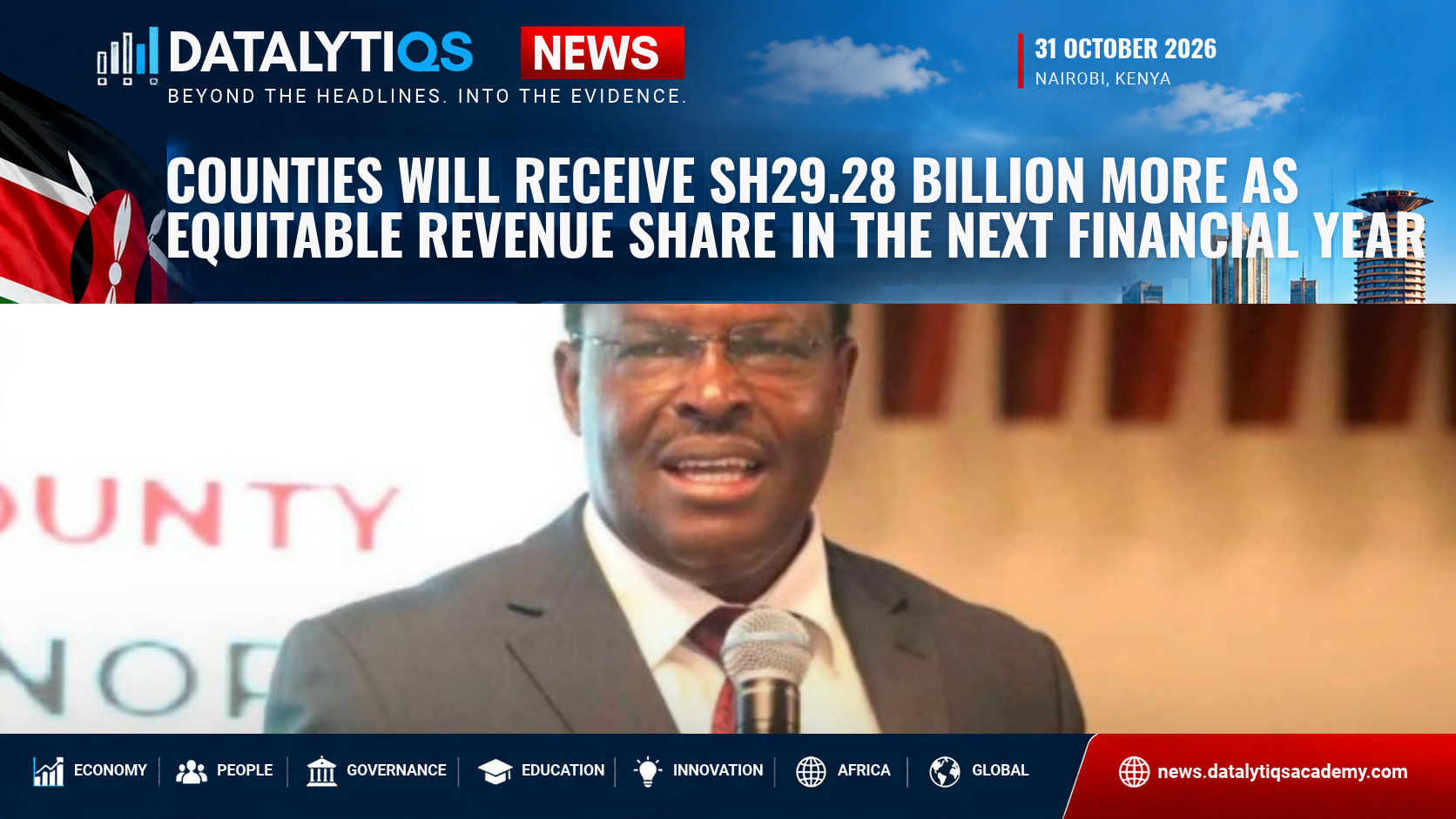
DATALYTIQS NEWS | GOVERNANCE & DEVOLUTION
31 October 2026 | Nairobi, Kenya
Beyond the Headlines. Into the Evidence.
Kenya’s 47 county governments could receive an additional KSh 29.28 billion in the 2027/28 financial year following a recommendation by the Commission on Revenue Allocation (CRA) to increase their equitable share of nationally raised revenue to KSh 457.28 billion.
The proposed allocation represents a 6.84% increase from the KSh 428 billion allocated in the current 2026/27 financial year.
CRA Chairperson Mary Wanyonyi Chebukati says the recommendation is intended to balance the financing requirements of national and county governments while accommodating rising public-service costs, healthcare staffing obligations and pressure on public expenditure.
However, the proposal raises an equally important question: Will additional funding translate into improved public services, or will recurrent expenditure absorb much of the increase?
How the Proposed Revenue Will Be Shared
According to the latest CRA recommendation, the projected pool of shareable nationally raised revenue for 2027/28 is approximately KSh 3.249 trillion.
The proposed distribution includes:
| Revenue allocation | Proposed amount |
|---|---|
| National government | Approximately KSh 2.78 trillion |
| County governments’ equitable share | KSh 457.28 billion |
| Equalisation Fund | KSh 10.25 billion |
| Increase in county equitable share | KSh 29.28 billion |
| Growth in county equitable share | 6.84% |
The Equalisation Fund is intended to help address historical disparities in access to essential services in marginalised areas.
CRA reports that the proposed county equitable share represents approximately 22.3% of the most recent audited and approved nationally raised revenue, exceeding the constitutional minimum of 15%.
Importantly, that percentage is calculated against the constitutionally relevant audited revenue base, not the projected KSh 3.249 trillion revenue pool.
The proposed figures remain subject to parliamentary consideration and approval.
Why CRA Has Recommended Additional Funding
The proposed increase is not simply an expansion of discretionary spending for governors and county assemblies.
CRA has identified several existing and emerging expenditure pressures that require additional financing.
1. Universal Health Coverage staffing
County governments are expected to shoulder increased personnel costs associated with the absorption and remuneration of Universal Health Coverage workers.
2. Public-sector salary adjustments
The proposal takes account of remuneration adjustments recommended by the Salaries and Remuneration Commission.
3. Healthcare collective bargaining agreements
Existing commitments under collective bargaining agreements involving nurses and midwives have created additional obligations for devolved healthcare systems.
4. Rising service-delivery costs
CRA has factored in an estimated 3% growth in the cost of county service provision.
These obligations are important because they suggest that part of the additional KSh 29.28 billion could be committed before counties finance new development priorities.
Healthcare Financing Remains a Major Concern
The Council of Governors has raised concerns over delays in the release of approximately KSh 8.9 billion intended to support the absorption of Universal Health Coverage staff into county employment.
Council of Governors Chairperson Muthomi Njuki has indicated that delayed transfers have forced some county governments to seek alternative financing arrangements to meet salary obligations.
The controversy exposes a structural weakness in intergovernmental financing.
When responsibilities are transferred to county governments without timely accompanying resources, devolved administrations face pressure to divert funds from other services or accumulate additional financial obligations.
For healthcare, this can affect personnel management, procurement, facility operations and the continuity of essential services.
The policy challenge is therefore not merely how much money counties receive, but whether financing arrangements correspond to the functions and obligations assigned to them.
County Assemblies Could Receive Higher Recurrent Spending Ceilings
Alongside the equitable revenue proposal, CRA has recommended a combined recurrent expenditure ceiling of approximately KSh 76.22 billion for county assemblies and executives.
The proposed ceilings are:
| County institution | Proposed recurrent ceiling |
|---|---|
| County assemblies | KSh 50.367 billion |
| County executives | KSh 25.853 billion |
| Combined | KSh 76.220 billion |
The county assembly ceiling would rise from approximately KSh 39.19 billion to KSh 50.36 billion, an increase of roughly KSh 11.17 billion.
Reported expenditure considerations include personnel emoluments, operations and maintenance, vehicle reimbursement arrangements, induction and training, and staffing requirements.
The county executive ceiling would increase by approximately KSh 602 million.
These ceilings cover specified recurrent expenditure categories and should not be confused with the entire recurrent budgets of all county departments.
Nevertheless, the proposals raise legitimate questions about expenditure priorities.
When public institutions receive additional funding for administrative and operational requirements, citizens are entitled to ask whether equivalent improvements will be realised in healthcare, water supply, infrastructure maintenance and other essential services.
The Earlier Sh440.84 Billion Proposal: What Changed?
CRA’s consultation-stage proposal, published on 27 October 2026, recommended KSh 440.84 billion for counties.
That would have represented an increase of KSh 12.84 billion, or 3%, over the current allocation.
The subsequently reported KSh 457.28 billion recommendation is KSh 16.44 billion higher than the earlier consultation figure.
This distinction is essential for accurate reporting.
The KSh 440.84 billion figure reflects an earlier draft, while KSh 457.28 billion is the more recent recommendation reported following further consideration.
The available reporting establishes the change in the proposed amount, but does not provide a complete itemised reconciliation explaining every component of the KSh 16.44 billion revision.
What the Numbers Reveal
DatalytIQs News Statistical Analysis
The nominal increase of KSh 29.28 billion appears substantial. However, three comparisons provide a clearer perspective.
First, the increase represents approximately 6.84% of the current county equitable share.
Second, dividing the proposed KSh 457.28 billion equally among 47 counties gives approximately KSh 9.73 billion per county. This is only a mathematical illustration. Actual county allocations differ according to the applicable revenue-sharing formula and other constitutional considerations.
Third, the KSh 29.28 billion increase is equivalent to approximately 18.7% of the KSh 156.84 billion in county pending bills reported by CRA as of 31 March 2026.
The pending-bills comparison is particularly revealing.
It demonstrates the scale of accumulated financial obligations relative to the proposed additional funding, although the two figures relate to different reporting periods and should not be treated as directly interchangeable budget items.
Moreover, the proposed 6.84% increase is nominal. The real expansion in county purchasing power will depend on inflation, wage adjustments and changes in the cost of public services during 2027/28.
An increase in allocation does not automatically translate into an equivalent increase in available resources for development.
Pending Bills and Own-Source Revenue: The Unresolved Fiscal Challenge
CRA’s earlier fiscal assessment showed that counties had accumulated KSh 156.84 billion in pending bills as of 31 March 2026.
It also reported that county own-source revenue collections totalled approximately KSh 525 billion between 2013/14 and the first nine months of 2025/26, against cumulative targets of KSh 808 billion.
That represents an approximate cumulative revenue mobilisation shortfall of KSh 283 billion.
These figures expose two interconnected challenges.
The first is the accumulation of unpaid obligations, which can weaken supplier confidence, disrupt service delivery and increase financial pressure on county administrations.
The second is the persistent gap between county revenue potential and actual collections.
While counties have legitimate demands for larger national transfers, stronger own-source revenue systems, realistic budgeting, transparent procurement and timely settlement of verified obligations remain essential.
Increased allocations without corresponding improvements in financial management risk perpetuating existing inefficiencies.
The 2027 Election-Year Factor
The proposed revenue-sharing framework will operate during a politically sensitive period.
Kenya’s next general election is scheduled for August 2027, shortly after the beginning of the 2027/28 financial year.
CRA has previously warned that revenue collections could fall below projections during the election period.
Its fiscal assessment also identified public debt of approximately KSh 13.12 trillion at the end of June 2026, representing 70.38% of GDP.
Debt servicing obligations and revenue collection risks constrain the fiscal space available to both levels of government.
Consequently, even an approved increase in county allocations must be evaluated against the National Treasury’s capacity to mobilise and disburse funds consistently.
A budget allocation is a legal spending provision; actual service delivery also depends on the timing and predictability of cash releases.
What Citizens Should Demand From County Governments
The debate over equitable revenue sharing should extend beyond negotiations between governors, Parliament and the National Treasury.
Citizens should demand measurable improvements in the services funded through devolution.
Five areas deserve particular attention:
Healthcare: Staffing levels, availability of essential medicines, facility functionality and settlement of verified healthcare obligations.
Infrastructure: Completion rates for county roads, markets, drainage systems and other approved development projects.
Water and sanitation: Expansion of reliable access, maintenance of existing infrastructure and improvements in service coverage.
Public financial management: Reduction of verified pending bills, improved procurement transparency and stronger budget execution.
Own-source revenue: Improved collection efficiency without imposing unjustified burdens on households and businesses.
County assemblies must also exercise meaningful oversight to ensure that increased expenditure ceilings translate into institutional effectiveness rather than unnecessary administrative expansion.
DatalytIQs News Editorial Analysis: More Money Must Produce Measurable Results
The proposed KSh 457.28 billion equitable share is a significant development for Kenya’s devolution financing framework.
It recognises the growing cost of delivering public services and the financial obligations transferred to county governments.
However, the central policy question is whether the additional resources will create measurable improvements in the lives of ordinary Kenyans.
The debate should therefore move from allocation politics to expenditure effectiveness.
County governments need stronger statistical systems, credible expenditure baselines, measurable performance indicators and publicly accessible reporting mechanisms.
A credible assessment of devolution should compare what counties receive, what they spend, what they deliver and the outcomes citizens experience.
The true success of the KSh 457.28 billion proposal will not be determined by the size of the allocation, but by the quality, efficiency and accountability of the services it ultimately finances.
More resources can strengthen devolution. But without financial discipline, timely disbursement and measurable public outcomes, larger budgets alone will not guarantee better governance.
Sources and References
- Commission on Revenue Allocation — CRA Concludes Consultations on FY 2027/28 Vertical Revenue Sharing, 27 October 2026.
https://cra.go.ke/2026/10/27/cra-concludes-consultations-with-national-assembly-council-of-governors-and-non-state-actors-on-fy-2027-28-vertical-revenue-sharing/ - Commission on Revenue Allocation — CRA Engages Senate on Vertical Revenue Sharing for FY 2027/28, 6 October 2026.
https://cra.go.ke/2026/10/06/cra-engages-senate-on-vertical-revenue-sharing-for-fy-2027-28/ - Citizen Digital — CRA Proposes KSh 457 Billion for Counties in 2027/28 Financial Year, 29 October 2026.
https://citizen.digital/article/cra-proposes-ksh457-billion-for-counties-in-202728-financial-year-n393007 - Daily Nation — Boost for Counties as CRA Proposes Sh457.28bn as Equitable Revenue for 2027/2028 Financial Year, 31 October 2026.
https://beta.nation.co.ke/kenya/counties/boost-for-counties-as-cra-proposes-sh457-28bn-as-equitable-revenue-for-2027-2028-financial-year-5652796
DATALYTIQS NEWS
Beyond the Headlines. Into the Evidence.
news.datalytiqsacademy.com