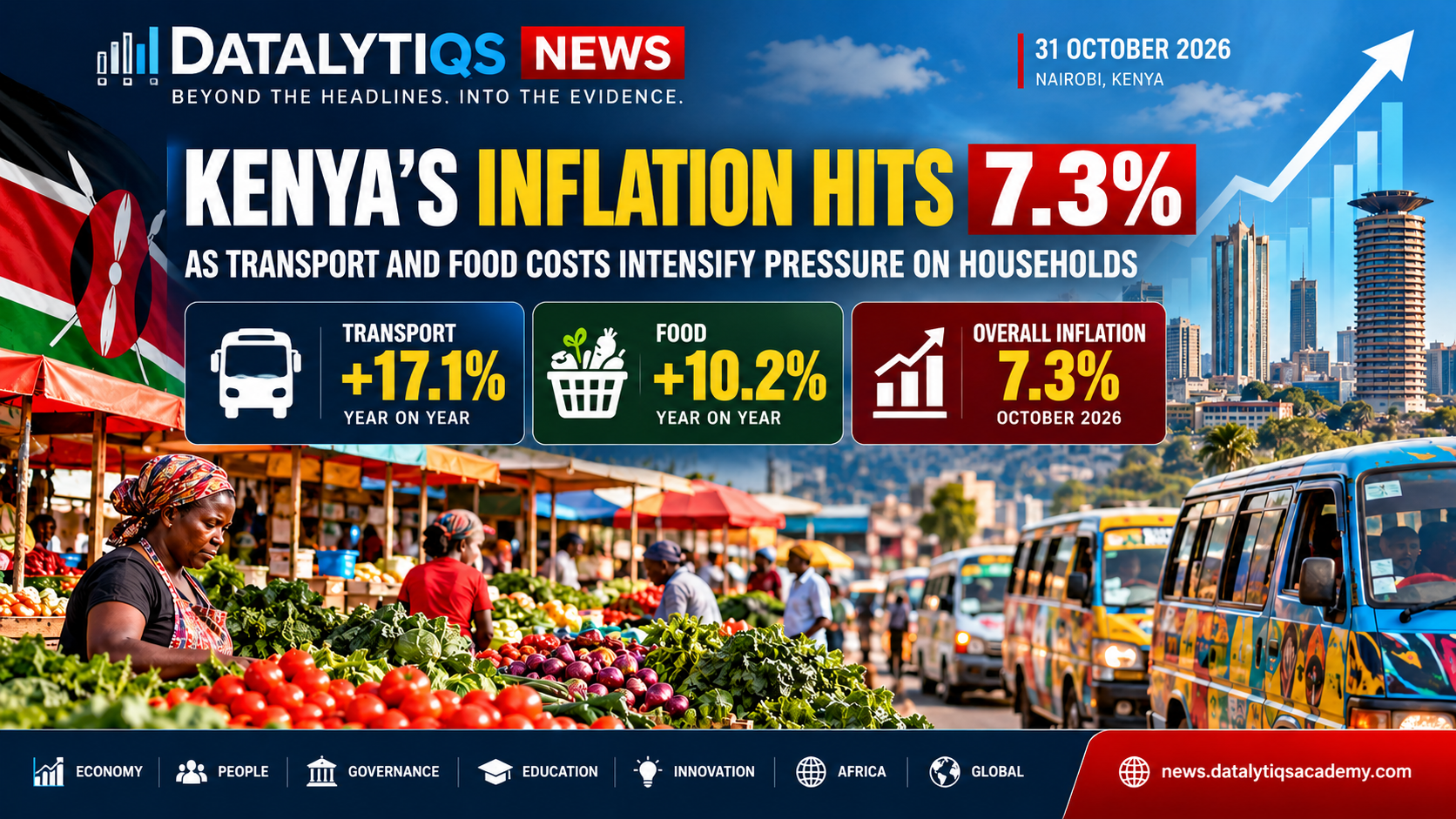
Kenya’s Inflation Hits 7.3% as Transport and Food Costs Intensify Pressure on Households
NAIROBI, 31 October 2026 — Kenya’s annual consumer price inflation rose to 7.3 percent in October, up from 6.8 percent in September, as escalating transport and food prices intensified pressure on household purchasing power.
The Kenya National Bureau of Statistics (KNBS), in its report released on 30 October, identified transport, food and housing-related expenses as the principal drivers of the increase.
Transport and Food Lead the Increase
Transport prices increased by 17.1 percent over the year to October, while food and non-alcoholic beverages rose by 10.2 percent. Housing, water, electricity, gas and other fuels recorded a 3.7 percent increase.
Together, these three expenditure divisions represent more than 57 percent of the Consumer Price Index basket.
These figures illustrate the disproportionate pressure on essential household spending. Inflation of 7.3 percent does not mean every product became 7.3 percent more expensive. It means the overall consumer price level rose by that amount compared with October 2025.
Central Bank Confirms Broader Inflationary Pressure
The Central Bank of Kenya’s weekly bulletin confirmed that core inflation increased from 4.0 percent in September to 4.3 percent in October, while non-core inflation rose from 14.0 percent to 15.1 percent.
The rise in core inflation is particularly significant because it suggests that price pressures extend beyond the most volatile consumer items.
Meanwhile, the Kenyan shilling remained relatively stable, trading at KSh 129.96 against the US dollar on 29 October, compared with KSh 129.91 a week earlier.
Foreign exchange reserves stood at USD 14.74 billion, equivalent to 5.9 months of import cover.
What the Figures Mean for Kenyans
Higher transport costs can spread through the economy as businesses face increased expenses for moving workers, agricultural produce and manufactured goods.
For households, rising food prices reduce purchasing power, particularly among lower-income families whose budgets are heavily concentrated on essential consumption.
The combination of elevated food inflation and increasing underlying price pressures also presents a policy challenge for the Central Bank.
However, the latest figures do not, by themselves, establish whether interest rates will increase at the next monetary policy meeting.
DatalytIQs Analysis: Inflation Is More Than a Headline Number
The critical issue is the composition of inflation.
When transport inflation reaches 17.1 percent and food inflation exceeds 10 percent, the economic burden is not distributed equally across households.
For policymakers, the priority should include monitoring the transmission of fuel and transport costs into food distribution, agricultural production and essential services.
For businesses, the challenge is managing operating costs without transferring an unsustainable burden to consumers.
The inflation rate is 7.3 percent. The economic pressure experienced by many households may be considerably greater.
DatalytIQs News — Beyond the Headlines. Into the Evidence.
Primary sources
Central Bank of Kenya: Weekly Bulletin, 30 October 2026 — https://www.centralbank.go.ke/uploads/weekly_bulletin/1190512301_Weekly%20CBK%20Bulletin%2C%20October%2030%2C%202026.pdf
KNBS: Consumer Price Indices and Inflation Rates, October 2026 — https://www.knbs.or.ke/reports/consumer-price-indices-and-inflation-rates-october-2026/