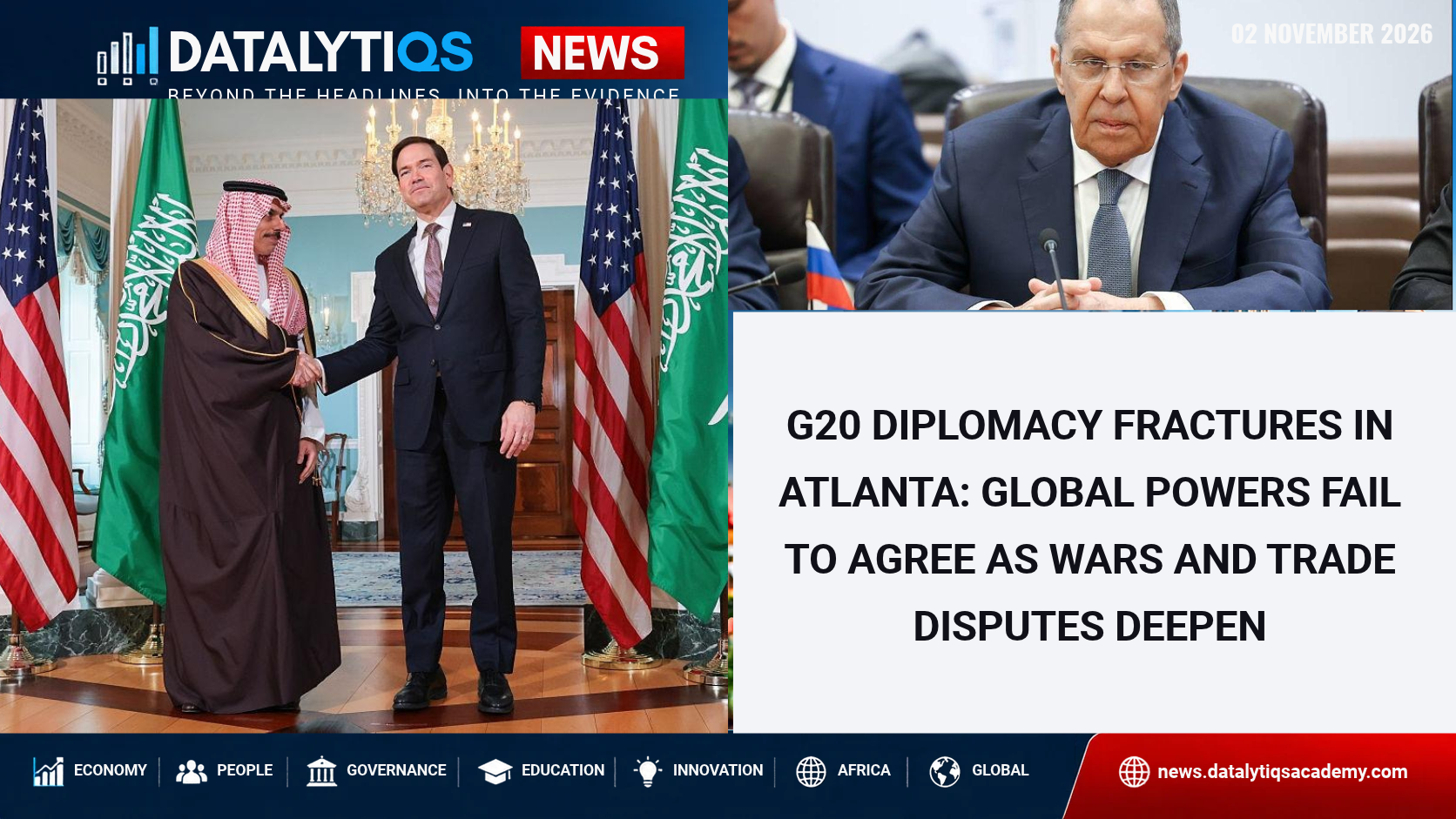
DATALYTIQS NEWS | GLOBAL GEOPOLITICS, INTERNATIONAL TRADE & ECONOMIC GOVERNANCE | 2 NOVEMBER 2026
SPECIAL REPORT — ATLANTA, UNITED STATES | G20 FOREIGN MINISTERS’ MEETING, 30–31 OCTOBER 2026
ATLANTA, UNITED STATES — Foreign ministers from the world’s major economies have concluded two days of negotiations without agreeing on a joint communiqué, exposing deep divisions over the Russia–Ukraine war, the conflict involving Iran, international tariffs and China’s maritime activities.
The meeting, chaired by US Secretary of State Marco Rubio on October 30–31, ended with a statement issued by the chair rather than a collectively agreed declaration.
Even the traditional group photograph was cancelled after European diplomats objected to appearing alongside Russian Foreign Minister Sergey Lavrov.
The dispute over the photograph was unusually visible, but the underlying disagreements were more consequential: governments could not agree on common positions concerning several conflicts and economic risks affecting international markets.
The meeting nevertheless produced discussions on energy security, food supplies, critical minerals and freedom of navigation. Rubio argued that practical cooperation remained possible despite the absence of consensus.
1. WHAT HAPPENED IN ATLANTA?
Meeting duration
2 DAYS
October 30–31
Joint communiqué
NONE
Chair’s statement issued instead
Official group photo
CANCELLED
Disagreement over Russia’s participation
Next leaders’ summit
DEC 2026
Florida, United States
The outcome was not a complete collapse of diplomatic engagement. Ministers continued meeting, including in smaller groups, and identified areas for further cooperation.
However, they did not reach a collective agreement on the major security disputes.
Rubio acknowledged at his closing news conference that universally acceptable solutions remained distant, while pointing to cooperation among some participating governments on critical minerals and supply chains.
That distinction matters. A chair’s statement records the presiding government’s summary of discussions. A negotiated joint communiqué carries a different political significance because participating governments have agreed to its language.
The absence of a communiqué therefore indicates that the meeting did not produce the level of consensus normally associated with a collective diplomatic declaration.
2. THE DISPUTES THAT DIVIDED THE G20
| Issue | Principal disagreement | Why it matters |
|---|---|---|
| Russia–Ukraine war | Russian and Western positions on the conflict and diplomatic engagement | European security, sanctions, energy and food trade |
| Iran conflict | Military escalation, regional security and navigation through Hormuz | Oil supplies, shipping and inflation |
| US tariffs | Trade restrictions and their economic consequences | Investment, exports and supply chains |
| China and maritime security | Competing views on jurisdiction and freedom of navigation | Asian shipping routes and regional stability |
| South Africa’s exclusion | US decision not to invite a founding G20 member | Representation and institutional legitimacy |
| Critical minerals and technology | How to secure supplies and coordinate standards | Industrial competitiveness and strategic dependence |
These issues were connected by a common problem: national security disputes were interfering with efforts to coordinate economic policy.
3. THE RUSSIA–UKRAINE WAR: THE MOST VISIBLE SOURCE OF DIVISION
Russia’s participation was among the most contentious aspects of the meeting.
Several European governments objected to the presence of Foreign Minister Sergey Lavrov while Russia’s war against Ukraine continued.
German Foreign Minister Johann Wadephul stated that appearing together in the customary photograph would imply a degree of normality in relations with Moscow that European governments did not accept.
Washington defended the invitation on the grounds that diplomacy requires communication with parties to a conflict.
Rubio argued that negotiations cannot advance if governments refuse to speak to one another.
The Russian delegation, meanwhile, maintained its opposition to Ukraine becoming what Moscow describes as a military threat.
The disagreement illustrates a fundamental diplomatic tension: whether engaging an adversary is necessary for conflict resolution, or whether certain forms of engagement risk weakening political pressure.
Both positions were represented in Atlanta, but they did not produce a common settlement framework.
4. THE CANCELLED PHOTOGRAPH: A SYMBOL OF A DEEPER DISAGREEMENT
The group photograph became an unexpected diplomatic controversy.
Reuters reported that approximately one-third of participants, including Australia and Canada, had expressed opposition to appearing in the photograph alongside Lavrov.
American officials said the photograph was removed from the programme to prevent the dispute from distracting from substantive discussions.
This was not a dispute over photographic protocol alone.
For European governments supporting Ukraine, the concern was that a conventional group photograph could convey a misleading impression of diplomatic normalisation.
For Moscow, the controversy was presented as evidence that Western governments were placing symbolic gestures ahead of dialogue.
The United States sought to avoid an incident in which ministers publicly refused to participate or walked out.
The cancellation did not cause the diplomatic disagreements. It made those disagreements unusually visible.
A group photograph is not an essential instrument of international law or diplomacy. Its absence therefore has symbolic rather than direct legal consequences.
But the episode revealed how difficult it had become for participants to agree even on the public presentation of the meeting.
5. THE IRAN WAR: ENERGY SECURITY WITHOUT A COMMON SECURITY POLICY
The conflict involving the United States, Israel and Iran was another major source of disagreement.
The war has disrupted energy supplies and heightened concerns about maritime security, particularly in the Strait of Hormuz.
Several Gulf governments have expressed concern about renewed military escalation. During the Atlanta meeting, Rubio held discussions with Saudi Foreign Minister Faisal bin Farhan and Turkish Foreign Minister Hakan Fidan. local.
The G20 chair’s statement emphasised secure energy flows and freedom of navigation through strategically important waterways, including Hormuz and Bab al-Mandab.
However, it did not announce a collectively agreed mechanism for ending the Iran conflict or protecting commercial shipping.
This illustrates a fundamental challenge for economic diplomacy: countries can agree that expensive energy and disrupted shipping are harmful without agreeing on the military and political measures required to address their causes.
6. TARIFFS AND TRADE: ECONOMIC COORDINATION UNDER PRESSURE
The G20 was established as a forum for international economic cooperation.
Its members collectively account for roughly 85% of global GDP, more than three-quarters of international trade and approximately two-thirds of the world’s population.
Yet the Atlanta discussions occurred amid disputes over US tariffs, supply-chain restrictions and competing industrial policies.
Tariffs can serve several policy objectives, including protecting domestic industries, generating revenue or applying negotiating pressure. They can also increase costs for importers, alter trade flows and provoke retaliatory measures.
The difficulty for the G20 is that its members have competing economic interests.
Some governments favour stronger trade liberalisation and predictable multilateral rules. Others emphasise national security, domestic manufacturing and strategic supply-chain independence.
Atlanta did not produce a new collective trade agreement. Instead, the chair’s statement focused on shared concerns about resilient supply chains, food security and energy availability.
The absence of a joint communiqué should not be interpreted as the suspension of international trade rules. Existing trade agreements and World Trade Organization obligations remain separate from the G20’s diplomatic declarations.
7. CHINA AND THE SOUTH CHINA SEA: DISAGREEMENT OVER NAVIGATION
China’s maritime activities were another contentious issue.
The United States and several partners have raised concerns about Chinese coastguard and military operations in contested waters.
Beijing maintains that its maritime enforcement activities protect legitimate territorial and jurisdictional interests.
The competing positions have implications for freedom of navigation, regional security and commercial shipping.
The Atlanta agenda included the South China Sea alongside Hormuz, the Red Sea and the Black Sea, reflecting the connection between geopolitical disputes and international trade routes.
The meeting did not produce a common G20 position resolving those disagreements.
This is not surprising given that the G20 is an economic-coordination forum rather than a maritime court or military alliance.
Nevertheless, maritime security matters directly to its economic mission because shipping interruptions can affect energy costs, manufacturing inputs and delivery schedules.
8. THE AFRICAN CONTROVERSY: SOUTH AFRICA EXCLUDED FROM THE MEETING
One of the most consequential issues for Africa received less attention than the cancelled photograph.
South Africa, a founding G20 member and the group’s only individual African country member, was not invited to the Atlanta meeting.
The decision came amid strained relations between Washington and Pretoria.
South Africa’s government said its nonparticipation was involuntary.
Its representatives welcomed objections raised by other G20 members and maintained that South Africa should participate on equal terms when Britain assumes the presidency in 2027.
This is institutionally significant for two reasons.
First, South Africa is not an external observer seeking admission. It is an established G20 member and held the presidency in 2025.
Second, the African Union became a permanent G20 member in 2023, making Africa’s representation broader than South Africa alone.
The African Union was represented in Atlanta, including through the chair of its Executive Council.
Therefore, it would be inaccurate to say Africa had no representation whatsoever.
However, the presence of the AU does not erase the separate question of South Africa’s exclusion as an individual member.
Why this matters for institutional legitimacy
The G20 operates through consensus and political cooperation rather than a comprehensive system of binding international law.
Its effectiveness depends partly on members accepting the forum as a credible venue for participation and negotiation.
When a host government excludes an established member, questions arise about the relationship between the host’s diplomatic discretion and the collective character of the institution.
The controversy could affect trust and participation in subsequent meetings, although its longer-term consequences remain uncertain.
9. WHAT DID THE CHAIR’S STATEMENT ACTUALLY SAY?
The October 31 chair’s statement is important because it provides an official record of the meeting’s stated priorities.
Energy security
The statement highlighted the economic consequences of rising energy costs and the importance of secure, reliable supplies.
Freedom of navigation
Ministers discussed maritime security, including Hormuz and Bab al-Mandab, where disruptions can affect international commerce.
Supply-chain resilience
The statement addressed the importance of critical minerals and secure industrial supply chains.
Food security
The chair’s statement argued against using food and agricultural trade as instruments of political coercion.
Global health
The document also referred to international cooperation against Ebola and previously announced fundraising efforts.
These themes demonstrate that the meeting was not devoid of substantive discussion.
But the document did not contain a negotiated settlement on Ukraine, Iran, tariffs or maritime sovereignty. Nor did it announce binding G20-wide commitments resolving those disputes.
10. THE G20’S INSTITUTIONAL PROBLEM: CONSENSUS WITHOUT ENFORCEMENT
The G20 is not the United Nations Security Council, a supranational legislature or a military alliance.
It is an informal forum for coordinating policies among major economies.
Its principal instruments include political commitments, shared policy frameworks, technical cooperation and coordination through national and international institutions.
That design provides flexibility but creates limitations.
The G20 cannot independently compel Russia and Ukraine to accept a ceasefire, impose a universally binding tariff schedule or adjudicate territorial disputes.
Its declarations generally depend on governments voluntarily implementing what they have agreed.
The Atlanta outcome illustrates another limitation: when members have fundamentally incompatible positions, the consensus-based process may produce broad statements of concern rather than specific collective commitments.
However, the absence of consensus does not necessarily make the institution irrelevant.
Its meetings can still facilitate bilateral negotiations, smaller-group cooperation and information exchange.
The appropriate assessment therefore distinguishes between the G20’s performance as a forum for dialogue and its ability to produce collective policy decisions.
11. THE SMALLER-GROUP ALTERNATIVE: DIPLOMACY CONTINUES OUTSIDE FULL G20 CONSENSUS
While the wider ministerial meeting failed to produce a joint communiqué, some governments continued discussions through smaller diplomatic groupings.
Rubio met counterparts from Australia, India and Japan in the Quad.
The participants discussed technology and supply-chain cooperation, including critical minerals and artificial intelligence.
One account of the meeting noted a terminology dispute in which the American preference for the phrase super intelligence was accompanied by clarifications from other partners that they understood it to mean artificial intelligence.
This example demonstrates that agreement may be easier among a smaller group of countries with overlapping priorities.
But smaller coalitions cannot automatically substitute for broader international cooperation.
They may advance particular projects while leaving wider disagreements unresolved.
12. THE ECONOMIC CONSEQUENCES OF DIPLOMATIC FRAGMENTATION
The G20’s disagreements are important because geopolitical shocks increasingly transmit through economic channels.
How geopolitical fragmentation affects economies
War, tariffs and maritime disputes
Energy uncertainty, shipping disruption and trade restrictions
Higher costs, investment uncertainty and supply-chain adjustments
Potential inflation, slower trade and pressure on public budgets
Conceptual economic transmission mechanism; not a quantified forecast.
The effects vary by country.
Energy importers may be exposed to higher fuel costs. Export-oriented economies may face reduced market access. Manufacturing businesses may confront shortages or higher prices for intermediate goods.
Financial markets may also respond to uncertainty about sanctions, shipping routes and international policy coordination.
The Atlanta meeting did not itself create these problems. Rather, it demonstrated the difficulty of coordinating responses to them.
13. WHY KENYA AND AFRICA SHOULD PAY ATTENTION
For Kenya, the relevance of G20 diplomacy extends beyond the formal membership of the forum.
Decisions by major economies affect international fuel prices, trade conditions, capital flows and the cost of imported goods.
| Global issue | Potential transmission to Kenya | Indicator to monitor |
|---|---|---|
| Iran conflict | Petroleum import costs and transport inflation | Brent crude, freight and EPRA fuel-price reviews |
| Russia–Ukraine war | Grain, fertiliser and energy market uncertainty | Global food and fertiliser prices |
| US tariffs | Changes in export competitiveness and supply chains | Export volumes and market-access conditions |
| China-related maritime tensions | Shipping costs and availability of imported equipment | Freight indices and port delays |
| Critical minerals policy | Investment opportunities and industrial competition | Financing commitments and mineral-sector agreements |
| South Africa’s exclusion | Questions about African participation in global economic governance | G20 membership procedures and future participation |
These are potential economic channels, not measured losses attributable to the Atlanta meeting.
For African governments, the representation dispute is particularly relevant.
The African Union’s membership gives the continent a formal place in G20 discussions. But meaningful representation also requires effective participation in agenda-setting and policy negotiations.
The exclusion of South Africa raises questions about how those arrangements operate when relations between a host government and a member state deteriorate.
14. WHAT ATLANTA ACHIEVED—AND WHAT IT DID NOT
| Outcome | Assessment |
|---|---|
| Foreign ministers met and discussed international crises | Confirmed |
| A G20-wide joint communiqué was adopted | No |
| The US chair issued an official statement | Confirmed |
| The customary group photograph was cancelled | Confirmed |
| All participants agreed on a Ukraine peace settlement | No |
| A collective G20 settlement of the Iran conflict was announced | No |
| Ministers discussed navigation, energy and supply chains | Confirmed |
| Smaller groups continued separate cooperation | Confirmed |
| South Africa participated as an individual G20 member | No; it was not invited |
| The African Union had representation | Yes |
| The December leaders’ summit was cancelled | No |
15. THE NEXT TEST: DECEMBER’S G20 LEADERS’ SUMMIT IN FLORIDA
The Atlanta meeting was intended to prepare the ground for the G20 leaders’ summit scheduled for December in the United States.
President Donald Trump is expected to host the gathering in Florida.
The ministerial disagreements leave several questions unresolved.
Will governments agree on a leaders’ declaration? Will South Africa participate? Will Russia’s representation generate further diplomatic objections? Can members reach specific understandings on energy security, trade and critical minerals?
The available reporting also indicates uncertainty about whether Russian President Vladimir Putin will attend.
These are developments to monitor, not outcomes that can presently be asserted.
A meaningful assessment of the December summit should consider both the substance of any agreements and the breadth of participation.
CONCLUSION: THE G20 CAN STILL CONVENE POWER, BUT CONSENSUS IS HARDER TO SECURE
The Atlanta foreign ministers’ meeting exposed substantial disagreements among the world’s major economies.
Russia’s war against Ukraine dominated the diplomatic atmosphere. The Iran conflict, trade restrictions, China’s maritime activities and South Africa’s exclusion added further complications.
The cancellation of the group photograph became a visible symbol of those tensions.
Yet the meeting also demonstrated that dialogue continues even when collective agreement is unavailable.
Governments discussed energy security, food supplies, maritime navigation and strategic supply chains. Smaller groups pursued their own cooperation.
The institutional challenge is not simply that the G20 failed to produce a joint statement. It is whether its members can convert areas of shared economic concern into practical cooperation despite increasingly incompatible geopolitical positions.
The December leaders’ summit will provide another opportunity to assess that question.
DATALYTIQS POLITICAL SATIRE
G20 IN ATLANTA: NO AGREEMENT, NO FAMILY PHOTO—BUT EVERYONE CAME WITH A SPEECH!
The world’s major economies gathered in Atlanta to discuss war, tariffs, energy security and international trade.
They left without a joint communiqué.
Even the traditional group photograph was cancelled because some ministers refused to stand beside Russia’s Sergey Lavrov.
Twenty major economies, countless diplomats—and apparently not enough common ground for one photograph!
The G20 remains economically indispensable, but politically it increasingly resembles a group chat where everyone is typing and nobody is listening.
And Africa had another reason to question the gathering: South Africa, a founding G20 member, was not invited.
The real challenge is not getting world leaders into the same room. It is getting them to agree on something more consequential than the seating arrangement!
DatalytIQs News — Beyond the Headlines. Into the Evidence.
SOURCES AND FURTHER READING
ASSOCIATED PRESS — 31 OCTOBER 2026
Main reporting on the conclusion of the Atlanta meeting, failure to reach consensus and the chair’s statement.G20 foreign ministers end Atlanta meeting without consensus
G20 DOCUMENT ARCHIVE — 31 OCTOBER 2026
Full text of the US presidency’s chair’s statement.Read the G20 Foreign Ministers’ Chair’s Statement
REUTERS — 30 OCTOBER 2026
Reporting on the cancelled group photograph and objections to Russia’s participation.G20 foreign ministers skip photo-op amid objections over Russia
THE GUARDIAN — 31 OCTOBER 2026
European and Australian objections to the proposed photograph.US cancels G20 family photo after objections over Russia
ASSOCIATED PRESS — 30 OCTOBER 2026
Diplomatic divisions, South Africa’s exclusion and the challenges facing the December summit.Consensus looks elusive as G20 diplomats meet in Atlanta
DATALYTIQS NEWS — BEYOND THE HEADLINES. INTO THE EVIDENCE.
Reporting cut-off: 2 November 2026. The absence of a joint communiqué is distinguished from the absence of diplomatic discussions. The chair’s statement documents the host’s summary of proceedings, not a negotiated agreement resolving the major disputes.