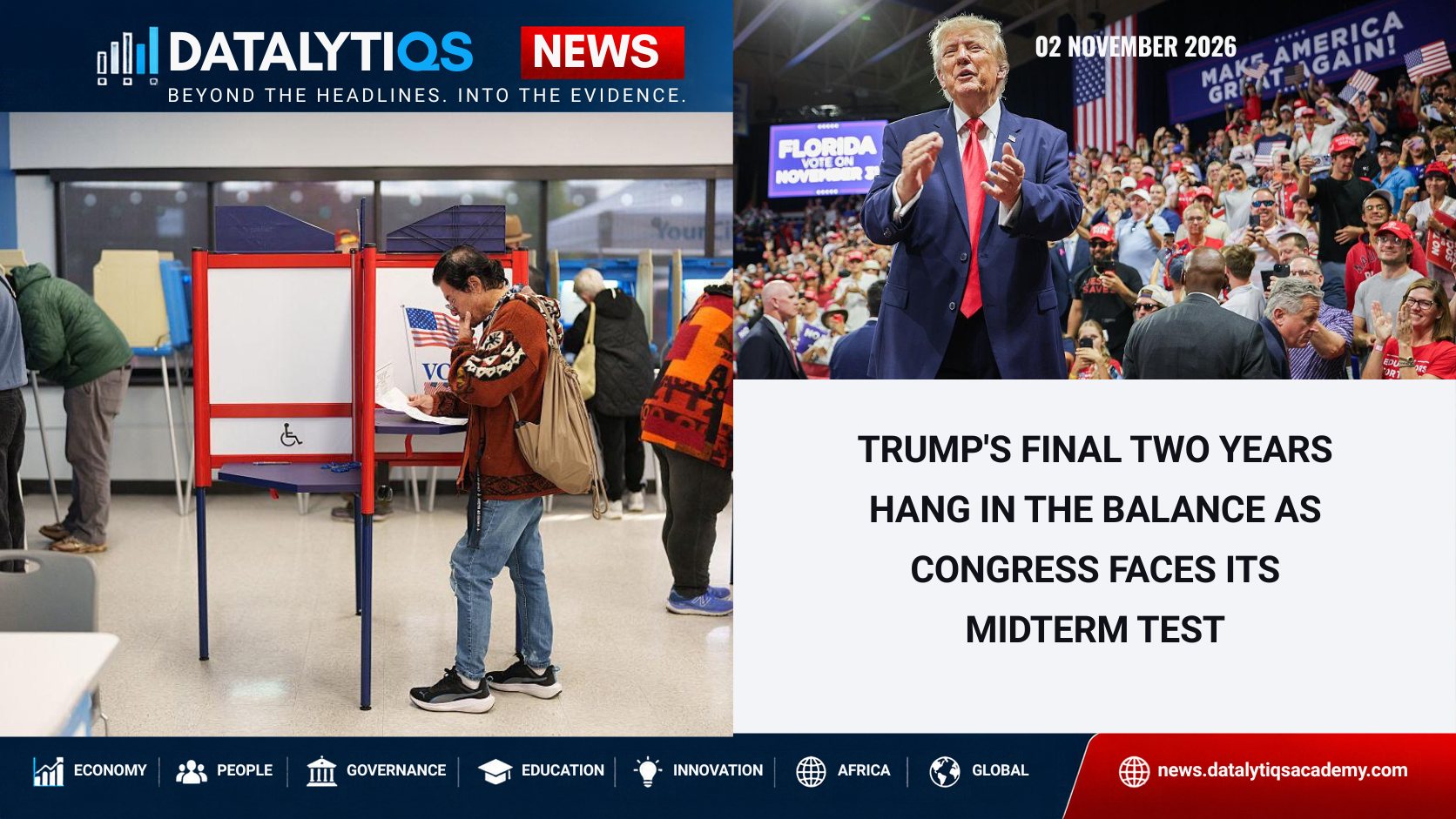
DATALYTIQS NEWS | GLOBAL POLITICS & GOVERNANCE | 2 NOVEMBER 2026
WASHINGTON, D.C. — Americans head to the polls on Tuesday, November 3, in congressional elections that will determine whether President Donald Trump governs the final two years of his second term with Republican majorities in Congress or faces stronger Democratic legislative oversight.
The elections arrive amid public dissatisfaction over living costs, economic uncertainty, disputes over immigration and the consequences of US military action against Iran.
A Reuters/Ipsos poll completed on October 26 placed Trump’s job approval at 32%, while registered voters preferred Democratic congressional candidates over Republicans by 47% to 36%.
Those figures signal substantial public discontent, but they do not determine the election outcome. Control of Congress will be decided through individual state and district contests, not a single nationwide popular vote.
1. THE ELECTION AT A GLANCE
Election day
3 NOV 2026
Tuesday
Trump approval
32%
Reuters/Ipsos, October 26
House elections
435
All voting seats contested
Senate elections
35
33 regular and 2 special elections
The US Federal Election Commission confirms November 3 as the scheduled federal election date. All 435 voting seats in the House of Representatives are contested, alongside 33 regularly scheduled Senate seats and two special Senate elections.
Trump himself is not standing for election. His presidential term continues regardless of the congressional results.
The composition of Congress, however, determines which party controls legislative agendas, committee leadership, investigations and important budget negotiations.
2. THE REUTERS/IPSOS POLL: WHAT THE NUMBERS ACTUALLY SHOW
REGISTERED VOTERS’ GENERIC CONGRESSIONAL BALLOT PREFERENCE — OCTOBER 26, 2026
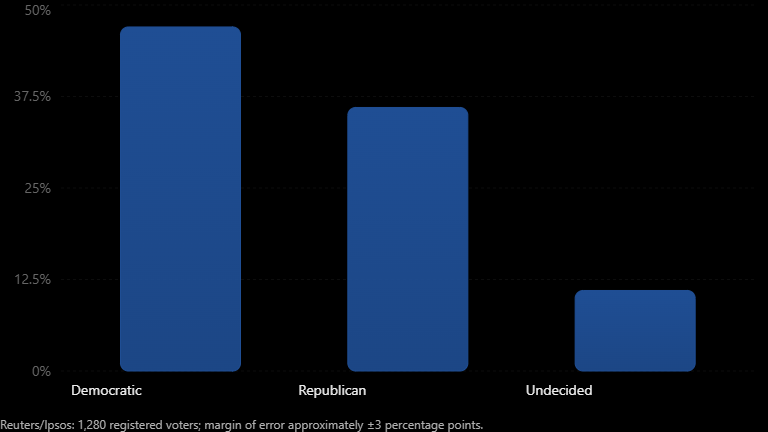
The poll was conducted online over five days and surveyed 1,679 American adults, including 1,280 registered voters.
The key findings were:
- Trump’s job approval stood at 32%, one percentage point above the previous week’s record low.
- Democrats led Republicans by 11 percentage points on the initial generic congressional ballot, 47% to 36%.
- After undecided respondents were asked which party they leaned toward, Democrats led 50% to 41%.
- Among likely voters, the reported preference was 53% Democratic to 44% Republican.
- Democratic respondents reported greater enthusiasm about voting than Republican respondents, 46% versus 30%.
The poll’s reported margin of error was approximately ±2 percentage points for all adults and ±3 points for registered voters.
Statistical interpretation: The 11-point lead is a measure of national party preference among surveyed registered voters. It is not an estimate of how many House or Senate seats Democrats will win.
The 47% and 36% figures also leave respondents outside those two categories, including undecided voters. The figures should not be presented as though they account for the entire electorate.
3. WHY THE ECONOMY HAS BECOME CENTRAL TO THE CAMPAIGN
Economic dissatisfaction features prominently in the Reuters/Ipsos findings.
73%
Of respondents in the Reuters/Ipsos reporting said the cost of living was moving in the wrong direction.
Reuters links economic anxiety partly to higher gasoline prices following US military strikes against Iran earlier in 2026.
On economic management, 37% of surveyed voters preferred Democrats’ approach, compared with 33% who preferred Republicans’. reuters.com
These findings suggest that the campaign is not solely a referendum on Trump’s personality or political rhetoric.
Households are also evaluating prices, energy costs, housing affordability, healthcare expenditure and economic security.
For Republicans, the challenge is to persuade voters that the administration’s policies are producing sustainable economic benefits.
For Democrats, the challenge is to translate dissatisfaction into support for their proposed alternatives.
Neither party can assume that dissatisfaction with the other automatically guarantees electoral support.
4. THE HOUSE OF REPRESENTATIVES: THE OVERSIGHT QUESTION
Republicans entered the final stretch with a narrow House majority.
Reuters’ October reporting described a 218–214 Republican–Democratic division, with vacancies and an independent member complicating the arithmetic. Democrats were seeking a net gain of four seats to obtain control under the reported composition. investing.com
A Democratic House majority would change several important institutional arrangements.
Democrats would control House committee chairmanships, could convene investigations and hearings, and would gain the ability to issue congressional subpoenas.
They could also influence spending legislation and decide which bills reach the House floor.
However, a Democratic House would not possess unlimited authority to compel the administration or enact legislation.
The Senate, the President’s veto power, judicial review and legal disputes over subpoena enforcement would remain important constraints.
Republican control of the House, by contrast, would preserve greater alignment between the White House and congressional leadership, although internal disagreements could still affect legislation.
5. THE SENATE: FOUR NET GAINS REQUIRED
The Senate presents a different electoral challenge because only a portion of its seats are contested.
Republicans hold 53 seats, while Democrats and the two independents who caucus with them account for 47.
Democrats need a net gain of four seats to secure a 51–49 majority. A 50–50 split would leave Republicans with the advantage of Vice President JD Vance’s tie-breaking vote.
Reuters identifies several consequential contests, including Maine, Alaska, Iowa, Ohio, Georgia, Michigan and North Carolina.
| State | Key candidates or contest | Why it matters |
|---|---|---|
| Maine | Susan Collins defending a Republican seat | A Republican-held seat in a state Trump lost in 2024 |
| Alaska | Dan Sullivan versus Mary Peltola | Ranked-choice voting adds complexity |
| Ohio | Jon Husted versus Sherrod Brown | Special election in a Republican-leaning state |
| Iowa | Ashley Hinson versus Josh Turek | Open seat with energy costs and tariffs in debate |
| Georgia | Jon Ossoff defending a Democratic seat | Democrats need to retain their existing seats |
| Michigan | Abdul El-Sayed in an open Democratic-held contest | Party unity and turnout are important |
| North Carolina | Open Republican-held seat | Another opportunity for a change in party control |
These are consequential races identified in contemporary reporting, not a ranking of which party is most likely to win. investing.com+1
6. FOUR POSSIBLE CONGRESSIONAL OUTCOMES
The election could produce four basic configurations of congressional control.
| Outcome | Institutional consequences |
|---|---|
| Republicans retain both chambers | Greater legislative alignment with the White House; Republican-led committee oversight continues |
| Democrats win the House only | Democratic House investigations and spending negotiations; Republican Senate retains confirmation authority |
| Democrats win the Senate only | Democratic Senate controls confirmations and committees; Republican House controls its legislative agenda |
| Democrats win both chambers | Broader Democratic legislative and oversight control, constrained by Trump’s veto and executive powers |
These are conditional institutional scenarios, not election forecasts.
Even if Democrats control both chambers, they would not automatically be able to reverse Trump’s policies. Overriding a presidential veto generally requires two-thirds majorities in both chambers.
Reuters reported on November 1 that Democratic control could intensify congressional scrutiny of tariffs without necessarily producing their repeal.
7. THE IMPEACHMENT QUESTION: WHAT COULD CONGRESS ACTUALLY DO?
A Democratic-controlled House could initiate impeachment proceedings against Trump.
However, impeachment by the House does not remove a president from office.
Removal requires conviction by a two-thirds majority of senators present. Consequently, a simple Democratic Senate majority would not itself guarantee removal.
A House majority could also initiate investigations into administration decisions, demand documents and summon witnesses.
Such actions might generate substantial political and legal conflict, particularly where the executive branch disputes congressional authority.
Reuters’ analysis similarly distinguishes between enhanced investigative powers and the more limited ability of a divided Congress to enact major policy changes.
8. THE FOREIGN-POLICY DIMENSION: IRAN, TARIFFS AND ENERGY PRICES
One unusual feature of the 2026 midterms is the connection between foreign policy and domestic economic concerns.
Reuters’ October 24 analysis examined how military operations against Iran and the administration’s tariff policies had affected American perceptions of living costs.
The administration argues that its trade policies protect American workers and that some market disruptions associated with the Iran conflict are temporary.
Critics argue that tariffs and military escalation have increased costs for households and businesses. investing.com
This creates an important policy debate about the economic consequences of national-security decisions.
Congress can exercise influence through appropriations, hearings, legislation and oversight. The President nevertheless retains substantial authority in diplomacy, executive administration and certain military and trade decisions.
The midterms therefore concern not only domestic legislation but also the extent to which Congress will scrutinise the administration’s international policies.
9. ELECTION ADMINISTRATION AND PUBLIC CONFIDENCE
Reuters reported on October 31 that more than 51 million Americans had already voted, a record for that stage of the election cycle.
It also documented disputes over voter records, mail ballots and federal involvement in state-administered elections.
Despite those controversies, a cited poll found that 76% of voters expressed confidence that their ballots would be counted accurately. reuters.com
US elections are administered primarily by state and local authorities rather than by a single national election commission.
This decentralised structure produces differences in voting procedures, counting timelines and certification processes.
Early election-night results should not be mistaken for certified outcomes, particularly in closely contested states where mail-ballot counting or recount procedures may continue.
10. WHAT THE MIDTERMS COULD MEAN FOR AFRICA AND KENYA
For African economies, the immediate consequences will depend less on the political symbolism of the election than on subsequent decisions concerning trade, development finance, diplomacy and international security.
Three policy areas deserve attention.
Trade and tariffs: Congressional control may affect oversight of US trade restrictions, but the President’s existing trade authorities would remain relevant. Kenya’s exporters and businesses should therefore distinguish changes in congressional rhetoric from enacted tariff changes.
Development assistance and global health: Congress influences federal appropriations. Changes in spending priorities or negotiations could affect programmes supporting health, development and humanitarian activities, subject to the final appropriations process.
Energy and global markets: Developments involving Iran, shipping routes and energy prices can affect fuel-importing economies, including Kenya. The relevant transmission channels include international oil prices, freight costs, exchange rates and domestic inflation.
These are potential channels of impact, not claims that a particular election outcome will automatically improve or worsen Kenya’s economic position.
For evidence-based monitoring, useful indicators would include Brent crude prices, the USD/KES exchange rate, US tariff announcements, congressional appropriations and official US–Kenya trade statistics.
11. THE STATISTICAL REALITY: WHY A NATIONAL POLL CANNOT DECLARE A CONGRESSIONAL WINNER
The Reuters/Ipsos figures warrant careful interpretation.
A national generic-ballot lead measures broad party preference. Congressional seats, however, are determined by geographically distinct electorates.
House districts vary in their partisan composition, incumbency, candidate characteristics and turnout patterns.
Senate races are decided statewide, with only a subset of states voting in each cycle.
Consequently, a national Democratic polling lead cannot be mechanically translated into a specified number of seats.
A credible election model would require district- and state-level polling, historical voting patterns, turnout estimates, demographic composition and an explicit uncertainty framework.
It would also need to account for correlated polling errors and the possibility that turnout differs from survey respondents’ stated intentions.
The essential distinction is between a measured national preference and an actual allocation of congressional seats.
12. DATALYTIQS ANALYTICAL CONCLUSION
The November 3 election will determine the balance of legislative and oversight authority for the final two years of Trump’s presidency.
The Reuters/Ipsos poll documents low presidential approval, an 11-point Democratic lead on the initial generic congressional ballot and substantial dissatisfaction over living costs.
Those findings explain why the election is receiving intense attention, but they do not establish the result in advance.
The most consequential institutional distinction is between control of the House, which shapes legislation and investigations, and control of the Senate, which also determines the confirmation of senior executive and judicial appointments.
Trump’s presidential powers would continue regardless of the outcome, while Congress’s ability to support, scrutinise or constrain his administration would depend on the new balance of power.
America is not voting directly on Trump’s presidency. It is voting on the congressional institutions that will interact with his presidency until January 2029.
DATALYTIQS POLITICAL SATIRE
TRUMP IS NOT ON THE BALLOT—BUT HIS PRESIDENCY IS UNDER REVIEW!
Americans vote tomorrow, and Donald Trump is not officially a candidate.
Yet his approval rating stands at 32%, while Democrats lead Republicans 47% to 36% in the latest Reuters/Ipsos generic congressional poll.
The election will determine whether Republicans retain control of Congress or Democrats acquire greater powers to investigate and challenge the administration.
Trump is not applying for another job. Americans are deciding who gets to supervise the job he already has!
If Congress changes hands, the political drama could move from campaign rallies to committee hearings.
The White House stays occupied. The question is who gets the keys to the congressional hearing rooms!
SOURCES AND FURTHER READING
REUTERS — OCTOBER 26, 2026
National approval and generic-ballot poll, with sample sizes and methodological details.Trump approval rises to 32% ahead of midterms
REUTERS — OCTOBER 22, 2026
Congressional-control scenarios, investigative powers, fiscal negotiations and presidential veto constraints.The midterm outcomes that could shape Trump’s final two years
REUTERS — OCTOBER 26, 2026
Senate battlegrounds and the arithmetic required for control.The races that will decide control of the US Senate
REUTERS — NOVEMBER 1, 2026
Implications of congressional control for trade policy and tariffs.Democratic wins would shift Congress’ trade debate
FEDERAL ELECTION COMMISSION
Official federal election date and information on state election administration.US federal election and voting information
DATALYTIQS NEWS — BEYOND THE HEADLINES. INTO THE EVIDENCE.
Reporting cut-off: November 2, 2026. All polling figures are pre-election measurements, not election results. Congressional-control scenarios are conditional explanations of institutional consequences, not forecasts.