DATALYTIQS NEWS | SPECIAL REPORT | 2 NOVEMBER 2026
With approximately nine months remaining before Kenya’s August 2027 General Election, a dispute over the public verification of election results has become a major political and constitutional controversy.
Opposition leaders have warned against weakening the Independent Electoral and Boundaries Commission’s autonomy or limiting public access to polling-station results. The government and National Assembly leadership insist that the legal requirement for livestreaming results remains intact.
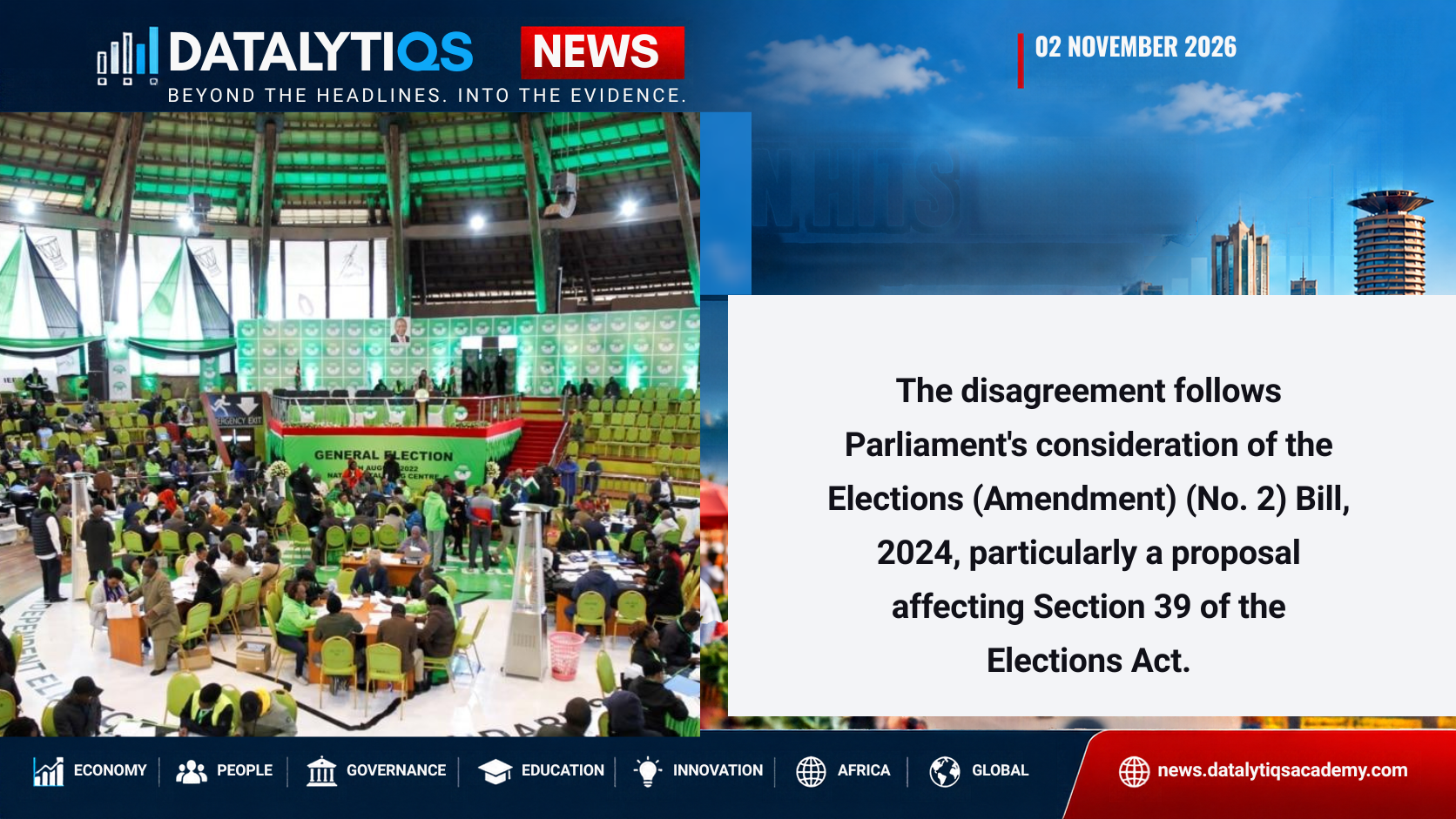
The disagreement follows Parliament’s consideration of the Elections (Amendment) (No. 2) Bill, 2024, particularly a proposal affecting Section 39 of the Elections Act.
The crucial finding from the available reporting is that the original Bill contained provisions that raised legitimate concerns about livestreaming, but the National Assembly subsequently deleted the disputed amendment and stated that the existing Section 39 requirement remained in place.
That distinction is essential to understanding the controversy.
1. HOW THE LIVESTREAMING DISPUTE DEVELOPED
- 20 OCTOBER — CONCERNS OVER PROPOSED CHANGESDaily Nation reported that the Elections (Amendment) Bill proposed replacing Section 39 in a way that would remove the express statutory requirement for livestreaming election results.
- 22–23 OCTOBER — NATIONAL ASSEMBLY CHANGES POSITIONThe National Assembly deleted Clause 22, the provision that would have replaced Section 39. Parliamentary leaders said the existing livestreaming provision was consequently retained.
- 24–25 OCTOBER — OPPOSITION AND GOVERNMENT RESPONDOpposition leaders demanded verifiable results, while government officials maintained that livestreaming had not been abolished.
- 26 OCTOBER — OFFICIAL GOVERNMENT CLARIFICATIONGovernment Spokesperson Charles Owino said Section 39 remained in force without the proposed changes to remove livestreaming.
- 28 OCTOBER — FRESH REFORM PROPOSALSA separate reform initiative proposed additional safeguards, including hourly publication of turnout figures, livestreamed constituency declarations and publicly observable national aggregation. These were proposals, not enacted requirements.
2. WAS LIVESTREAMING ACTUALLY BANNED?
The evidence reviewed does not establish that Parliament enacted a ban on livestreaming election results.
National Assembly Majority Leader Kimani Ichung’wah stated that Section 39(1G) of the Elections Act remained unchanged. Government Spokesperson Charles Owino and Parliamentary Affairs Principal Secretary Aurelia Rono gave similar explanations.
President William Ruto also rejected claims that his administration was seeking to prevent public access to election results.
However, the controversy was not entirely invented. The version of the Bill previously under consideration had prompted concern because it proposed replacing Section 39 without preserving the existing livestreaming language.
The distinction is between what an earlier legislative proposal sought to change and what the National Assembly says it ultimately retained.
A further legal issue remains: reporting refers to a September 22, 2026 High Court judgment concerning the constitutionality of Section 39 and Regulation 83(2). The precise operative orders and their effect on earlier litigation should be checked against the judgment itself, rather than relying exclusively on political interpretations.
3. WHY THE DISPUTE IS BIGGER THAN LIVESTREAMING
A public livestream is one component of election transparency, but it is not the entire results-management system.
Four distinct processes need to be understood.
| Process | Function | Accountability question |
|---|---|---|
| Polling-station declaration | Records votes counted at the polling station | Can agents and observers verify the original results? |
| Electronic transmission | Sends results data and statutory forms to tallying centres | Is the transmitted information complete and authentic? |
| Public results portal | Makes results available for public scrutiny | Can citizens access and independently reconcile every form? |
| National tallying and declaration | Verifies, aggregates and declares presidential results | Can every national total be traced to its underlying forms? |
A livestreamed total is not necessarily independently verifiable unless the underlying records are also available.
Likewise, publication of scanned forms is valuable, but discrepancies, missing forms, duplicate entries and unexplained changes must be identifiable and resolved transparently.
The IEBC’s own strategic documentation identifies secure transmission, accurate tallying, public display systems and a reliable chain of custody as central to electoral credibility.
4. WHAT THE OPPOSITION IS DEMANDING
Opposition leaders including Kalonzo Musyoka, Justin Muturi, Fred Matiang’i and Ndindi Nyoro have publicly raised concerns about electoral transparency.
Some have indicated that political parties will independently collect and publish polling-station results to enable comparison with IEBC figures.
Independent parallel tabulation can provide an additional accountability mechanism, provided the information is authentic, complete and accurately interpreted.
However, unofficial calculations must be clearly distinguished from legally authorised election declarations.
Partial tallies can also be misleading when they exclude polling stations or disproportionately reflect regions where results are transmitted more quickly.
A credible verification system should therefore distinguish between received forms, verified forms, outstanding forms and officially declared results.
5. THE GOVERNMENT AND PARLIAMENT’S POSITION
Government officials maintain that the National Assembly’s decision preserved the existing livestreaming requirement.
Their argument is supported by the reported deletion of Clause 22.
Nevertheless, retaining existing legislation is different from demonstrating that the electoral technology, transmission infrastructure and operational procedures are ready for 2027.
Those are matters for IEBC to establish through documented testing, procurement compliance, cybersecurity assessments and public engagement.
The opposition’s concerns about independence should also be assessed through evidence of actual institutional interference, rather than inferred solely from the existence of disputed legislation.
The public-interest test is the same for both sides: do the laws and operational arrangements allow independent verification of the declared results?
6. THE NEXT FRONT: HOURLY TURNOUT DATA AND CONSTITUENCY DECLARATIONS
A separate reform initiative reported on October 28 proposes additional transparency measures.
These include hourly publication of voter turnout, public broadcasting of constituency presidential declarations and open national aggregation of results from all 290 constituencies and the diaspora vote. the-star.co.ke
The proposed measures raise important technical questions.
Hourly turnout figures could provide an additional monitoring indicator, but discrepancies might arise from reporting delays, connectivity problems or corrections. Any system would need clear rules explaining how provisional figures are updated.
Similarly, open aggregation could make national totals easier to reproduce, but it would require standardised data formats, authenticated results forms and a transparent reconciliation procedure.
These measures remain proposals, not confirmed operational features of the 2027 election.
7. WHAT IEBC’S PREPAREDNESS PLAN SHOWS
The IEBC’s published Election Operation Plan 2025–2027 contains several scheduled activities directly relevant to results integrity.
| Activity | Published schedule |
|---|---|
| ICT security infrastructure | September–December 2026 |
| Electoral-system simulation framework review | November–December 2026 |
| Election technology simulation | February 2–9, 2027 |
| Election technology open day | February 11–12, 2027 |
| Technology testing and certification | February–March 2027 |
| Results transmission network setup | Scheduled from February 2027 |
These are planned activities, not proof of completed implementation.
IEBC has also reported engagements concerning election security, results transmission, stakeholder participation and general election preparedness.
The next important step is to evaluate documented progress against these milestones.
8. A STATISTICIAN’S FRAMEWORK FOR VERIFYING THE 2027 RESULTS
An independently auditable results system should permit reconciliation at each stage:
POLLING STATION
Signed Form 34A, polling-station identifier and candidate votes
CONSTITUENCY TALLY
Verify and aggregate the polling-station forms into Form 34B
NATIONAL VERIFICATION
Reconcile constituency totals, diaspora results and exceptions
OFFICIAL DECLARATION
Publish the statutory outcome with a reproducible audit trail
A robust independent audit would test completeness of expected forms, consistency of polling-station identifiers, numerical reconciliation, authenticity of source records, unexplained revisions and timeliness of publication.
For each candidate, the independently calculated total should reconcile with the authenticated source forms, subject to properly documented corrections and applicable legal procedures.
This is not a proposal to replace IEBC’s constitutional mandate. It is a framework for allowing citizens, observers, journalists and political parties to examine the evidence underlying the commission’s declarations.
9. THE CENTRAL LESSON: TRANSPARENCY MUST BE OPERATIONAL, NOT MERELY LEGAL
Kenya’s electoral debate cannot be resolved simply by declaring that livestreaming is either protected or threatened.
The statutory position matters, but so do the practical systems through which results are recorded, transmitted, published and verified.
The important unanswered questions include whether IEBC will publish a complete technical protocol, how quickly statutory forms will become accessible, what happens when transmission fails and how disputed entries will be reconciled.
The commission’s independence is also relevant to procurement, staffing, security arrangements and the handling of political pressure.
A credible electoral process requires institutional autonomy and verifiable operational procedures.
CONCLUSION: THE COUNTRY NEEDS ONE AUDITABLE RESULT, NOT COMPETING POLITICAL CALCULATORS
The October controversy illustrates how proposed legal changes, parliamentary amendments and political messaging can create uncertainty about election safeguards.
The reviewed evidence supports the National Assembly’s account that it deleted the disputed provision and retained the existing livestreaming framework. It also shows that broader concerns about the transparency and practical implementation of results management remain subjects of legitimate public debate.
The critical task before August 2027 is to ensure that every declared result can be traced through an authenticated, publicly verifiable record.
The objective should not be to determine which political coalition controls the scoreboard. It should be to ensure that no coalition needs privileged access to verify the score.
DATALYTIQS POLITICAL SATIRE
2027 ELECTION: EVERY COALITION WANTS TO HOLD THE CALCULATOR!
Kenya’s politicians are already quarrelling over election results before a single vote has been cast.
The opposition wants every polling-station result publicly verifiable. Government and Parliament insist livestreaming remains protected.
But here is the question: why should counting votes require political negotiations?
The ballot is secret. The count should be transparent. The arithmetic should be reproducible.
In 2027, Kenyans should not have to watch three political coalitions produce three different presidential totals from the same ballot boxes.
We need one credible election—not a national mathematics competition where everyone arrives with their own calculator and declares themselves the winner!
VERIFIED SOURCES
PRIMARY INSTITUTIONAL MATERIAL
Parliament of Kenya — legislative proceedings and Elections Bill explainer
Parliament — published Elections (Amendment) Bill, 2024
IEBC — Election Operation Plan 2025–2027
IEBC — strategic plan and results-management priorities
CONTEMPORARY REPORTING
Citizen Digital — National Assembly clarification, October 23
Citizen Digital — opposition concerns over IEBC autonomy, October 25
Kenya News Agency — government clarification, October 26
The Star — proposed additional transparency reforms, October 28
DATALYTIQS NEWS — BEYOND THE HEADLINES. INTO THE EVIDENCE.
Research cut-off: 2 November 2026. Proposed reforms, existing law, official statements and operational plans are distinguished from completed actions. The final enacted legislative text and the implementation of IEBC’s 2027 results systems require continued verification.