DATALYTIQS NEWS | GOVERNANCE & ELECTORAL REFORM | 2 NOVEMBER 2026
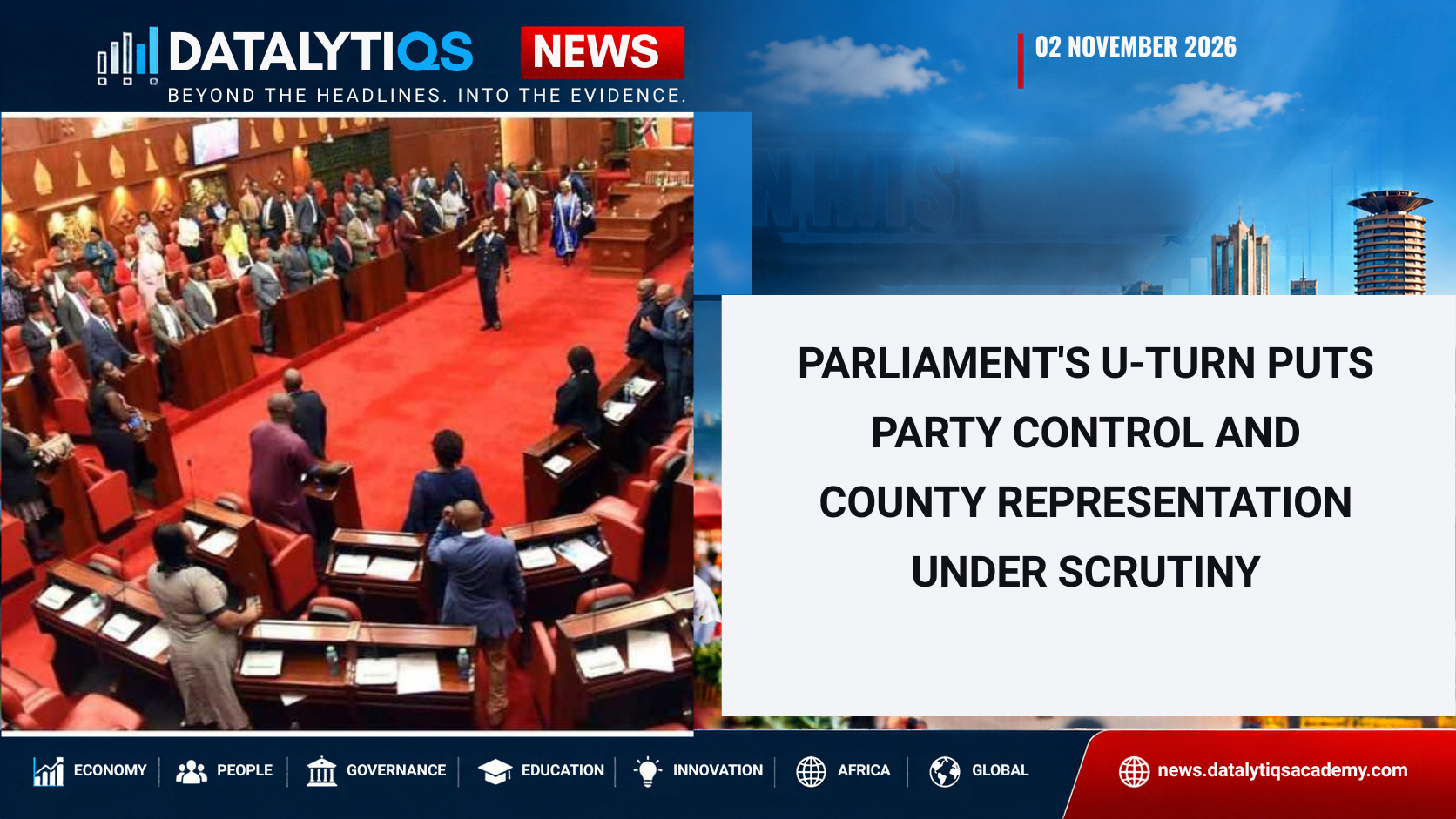
NAIROBI, KENYA — A dispute over who qualifies for nomination to Kenya’s county assemblies has returned to the Senate after the National Assembly deleted provisions intended to strengthen nominees’ connections to the counties they serve and promote more equitable representation across wards.
The amendments to the Elections (Amendment) (No. 2) Bill, 2024, have reignited a longstanding debate over the balance between political-party autonomy, local representation and the constitutional rights of women, youth, persons with disabilities and marginalised communities.
At the centre of the controversy is a straightforward question: should a political party be allowed to nominate someone to a county assembly even when that person is not registered as a voter anywhere in that county?
The National Assembly’s position would preserve that flexibility. Supporters defend it as a matter of political-party autonomy. Critics argue that it weakens the connection between nominated representatives and the communities whose affairs they help govern.
The changes are not yet law. The Bill must undergo further bicameral consideration before any amendments can take effect.
1. WHAT EXACTLY HAS PARLIAMENT CHANGED?
On October 22, 2026, the National Assembly passed the Bill with amendments, rejecting two provisions that had been included in the Senate’s version.
The first, proposed Section 34(8A), would have required a person nominated to a county assembly to be a registered voter in at least one ward within the county concerned.
The second, proposed Section 34(8B), would have required political parties to ensure equitable representation from the wards making up the county.
Both provisions were removed by the National Assembly.
| Issue | Senate’s proposed rule | National Assembly’s position |
|---|---|---|
| County voter registration | Nominee must be registered in a ward within the relevant county | Deletes this additional requirement |
| Geographical representation | Party nominations must ensure equitable ward representation | Deletes the proposed requirement |
| Party discretion | Subject to the proposed statutory conditions | Retains greater flexibility over party lists |
| Legislative status | Senate-originating proposals | Changes await further Senate consideration |
A crucial clarification: the Senate’s proposal concerned registration in any ward within the relevant county, not necessarily the particular ward a nominee might be associated with. Nominated MCAs are not elected as representatives of individual wards in the same manner as directly elected MCAs.
That distinction matters when interpreting claims that Parliament has removed a requirement for nominees to be registered in the specific wards they represent.
2. THE NUMBERS: 770 NOMINATED SEATS ACROSS 47 COUNTIES
Nominated MCA seats
770
Reported national total
Elected ward MCAs
1,450
Directly elected positions
County assemblies
47
Across Kenya
Daily Nation reports that 770 nominated MCA positions supplement the 1,450 directly elected ward seats. The special seats primarily address constitutional gender representation requirements and the inclusion of marginalised groups.
The figures illustrate the scale of the debate. Nominated representatives are not peripheral participants: they debate legislation, scrutinise county expenditure, sit on committees and participate in assembly oversight.
The integrity of the nomination process therefore affects the functioning of county government itself.
3. WHY THE NATIONAL ASSEMBLY REJECTED THE RESTRICTIONS
The debate exposed differing views among legislators.
Wajir East MP Aden Mohamed defended deletion of the clause on the grounds that political parties should retain autonomy over their lists.
Suna East MP and ODM Director of Elections Junet Mohamed similarly argued that nomination decisions belong to political parties.
Junet went further, suggesting that parties could find ways around restrictive legislation regardless of how Parliament drafted it. His reported intervention raises an accountability question about the relationship between formal electoral rules and the practices of party organisations.
National Assembly Majority Leader Kimani Ichung’wah had earlier described the proposed restrictions as retrogressive, arguing that Kenyans should be eligible for nomination even in counties where they are not registered voters.
The argument for flexibility has several dimensions.
A qualified nominee may have longstanding professional, social or family connections to a county without being registered there. Restricting eligibility exclusively by voter registration could also reduce the pool of candidates available to represent particular marginalised groups.
Political parties may further argue that national membership and internal nomination rules should determine eligibility, subject to constitutional and statutory requirements.
These are relevant considerations. But party autonomy does not eliminate the need for transparent procedures or accountability.
4. THE COUNTERARGUMENT: COUNTY REPRESENTATION SHOULD HAVE A LOCAL CONNECTION
Funyula MP Wilberforce Oundo defended the Senate’s proposed requirement, arguing that it would prevent abuses in which parties nominate individuals with little apparent connection to the county assemblies they join.
He cited Busia County as an example, alleging that some nominated representatives are unfamiliar to residents and may even live abroad.
Marakwet West MP Timothy Kipchumba and Kinangop MP Thuku Kwenya also supported the principle that nominees should have a demonstrable connection to the counties they serve.
These statements identify a potential governance concern, but they do not independently establish the number of nominees who lack local connections or whether such nominees perform their duties less effectively.
A county voter-registration requirement would provide one objective eligibility test. It would not, on its own, establish that a nominee is competent, accessible or accountable.
Conversely, being registered elsewhere does not automatically mean that a nominee lacks knowledge of or commitment to a county.
The underlying policy question is whether geographical connection should be established through voter registration, residence, documented community involvement or some other transparent criterion.
5. WHAT THE CONSTITUTION ACTUALLY REQUIRES
Article 177 of the Constitution provides for three categories of county assembly membership: directly elected ward representatives, special-seat members needed to satisfy the two-thirds gender principle, and members representing marginalised groups, including persons with disabilities and youth.
Article 90 establishes the proportional-representation framework for party-list seats.
These provisions mean nominated MCAs are not simply discretionary appointments. They form part of Kenya’s constitutional architecture for inclusive representation.
The National Assembly’s amendments do not repeal these constitutional requirements. Instead, they concern additional statutory conditions that would govern how parties select their nominees.
This distinction is important because the debate should not be reduced to whether party leaders have the right to nominate loyal supporters. It must also consider whether nomination procedures fulfil the constitutional purpose for which the seats exist.
6. THE IEBC HAD ALSO SUPPORTED A COUNTY VOTER-REGISTRATION REQUIREMENT
The Independent Electoral and Boundaries Commission had previously proposed that county assembly nominees be registered voters within the counties to which they were nominated.
According to an April 19, 2026 Daily Nation report, the commission also proposed changes to the ordering of party lists to improve women’s access to available nomination positions.
The IEBC’s involvement is significant because it brings an electoral-administration perspective to the debate.
A county registration requirement would be relatively straightforward to verify against the voters’ register. More subjective tests, such as a nominee’s familiarity with a county or history of community involvement, could be harder to administer consistently.
However, administrative convenience is not the only consideration. Parliament must also weigh political rights, inclusion and the practical consequences of restricting eligibility.
7. WHY THE DELETION OF EQUITABLE WARD REPRESENTATION MATTERS
The removal of proposed Section 34(8B) raises a separate issue from the voter-registration requirement.
The deleted provision would have required parties to ensure equitable representation from wards within a county.
Without that additional statutory requirement, parties retain greater flexibility to concentrate nominees in particular areas, subject to existing law.
This creates competing policy considerations.
On one hand, equitable geographical distribution could prevent excessive concentration of nominated positions in a few politically influential localities.
On the other hand, a rigid ward-distribution requirement could be difficult to reconcile with the limited number of nomination seats available to a party, especially where those seats must also satisfy gender and marginalised-group representation requirements.
For example, a party awarded only two special seats in a county with 30 wards could not provide a nominee from every ward.
A workable geographical-equity rule would therefore need a precise definition, rather than a general requirement that every ward receive representation.
The overlooked legislative question is how equitable representation would be measured and enforced without undermining constitutional inclusion requirements.
8. WHO ACTUALLY CONTROLS NOMINATED MCA POSITIONS?
Under Kenya’s party-list system, political parties prepare and submit ranked lists of eligible nominees to the IEBC.
The electoral commission allocates available seats according to the applicable proportional-representation rules after the general election.
The ordering of names on those lists is consequential because a party may receive fewer seats than the number of nominees it submitted.
The party-list process is also subject to legal requirements, electoral oversight and mechanisms for resolving disputes.
Nevertheless, internal party decision-making can have substantial influence over which names appear on the lists and their ranking.
That is why the debate over party autonomy is also a debate about transparency within political parties.
The central accountability questions include how prospective nominees are invited to apply, what selection criteria are used, who approves the final lists and how unsuccessful applicants can challenge decisions.
9. THE 2027 ELECTION TIMELINE
- 22 OCTOBER 2026 — NATIONAL ASSEMBLY APPROVALMPs passed the Elections (Amendment) (No. 2) Bill, 2024, with changes that included deleting the proposed county voter-registration and equitable ward-representation provisions.
- NEXT STAGE — SENATE CONSIDERATIONThe Senate must consider the National Assembly’s changes. If the two Houses disagree, the constitutional mediation process may become necessary.
- 25 JUNE 2027 — REPORTED PARTY-LIST DEADLINEUnder the 45-day submission requirement described in the reporting, parties would need to submit their lists by this date, subject to the applicable final IEBC timetable.
- 10 AUGUST 2027 — GENERAL ELECTIONThe allocation of nominated positions will depend on election results and the applicable constitutional and statutory framework.
The National Assembly’s October 22 vote was not the final legislative step. As of November 2, the reported amendments were returning to the Senate. the-star.co.ke
10. DATALYTIQS GOVERNANCE ANALYSIS: THE ISSUES THAT DESERVE CLOSER EXAMINATION
The controversy presents five distinct questions.
Internal party democracy: Do party members have a meaningful role in selecting nominees, or are lists predominantly determined by senior party officials? This requires examination of individual parties’ nomination rules and actual selection records.
Geographical inclusion: Are nominated positions distributed across counties in ways that reflect diverse communities, or do particular locations repeatedly receive disproportionate representation?
Constitutional inclusion: Do nominees genuinely represent women, youth, persons with disabilities and marginalised communities, and are the applicable legal requirements being observed?
Performance and accountability: How frequently do nominated MCAs attend sittings, participate in committees, sponsor motions, scrutinise budgets and engage the constituencies or groups they represent?
Electoral integrity: Are nomination criteria published in advance, are lists accessible for public inspection, and can irregularities be challenged effectively?
These questions can be investigated empirically. They do not require assuming that every party nomination is improper or that every nominee from outside a county is unsuitable.
A PROPOSED DATA-DRIVEN AUDIT
A useful national investigation would compile the following indicators for nominated MCAs across all 47 counties.
| Indicator | Evidence required |
|---|---|
| County connection | Registered county, residence and documented local involvement |
| Nomination transparency | Published criteria, applicant records and ranked party lists |
| Inclusion | Gender, age, disability representation and other legally relevant categories |
| Geographic distribution | Ward or subcounty associations, where documented |
| Legislative performance | Attendance, committee activity, motions and oversight contributions |
| Accountability | Disclosed conflicts of interest, applicable ethics findings and public engagement |
A national dataset could then examine whether particular nomination practices are associated with measurable differences in representation and assembly performance.
Such an analysis would need to account for differences in county size, party strength, available nomination seats and the responsibilities assigned to individual members.
11. WHAT HAPPENS NEXT?
The immediate institutional responsibility lies with the Senate.
Senators must decide whether to accept the National Assembly’s amendments or maintain their earlier position.
If disagreement persists, the two Houses may have to resolve the disputed provisions through mediation.
The public-interest questions for that process are whether geographical eligibility restrictions are justified, how equitable representation should be defined and what safeguards are needed to ensure that party autonomy does not undermine transparent nomination procedures.
The outcome will affect the rules under which political parties prepare their county assembly lists for 2027.
CONCLUSION: PARTY AUTONOMY AND PUBLIC ACCOUNTABILITY MUST BE CONSIDERED TOGETHER
The National Assembly has removed two proposed restrictions on county assembly nominations, leaving political parties with greater discretion than the Senate’s version would have allowed.
Supporters argue that this preserves legitimate party autonomy and avoids excluding qualified candidates solely because of where they are registered to vote.
Critics are concerned that the absence of geographical requirements could facilitate nominations that lack meaningful local representation.
Both positions raise questions that Parliament can address through clear eligibility rules, transparent nomination procedures and enforceable accountability mechanisms.
The broader issue is not simply whether party headquarters should control nomination lists. It is whether those lists fulfil their constitutional purpose and whether the people selected can demonstrate meaningful public service.
The Senate’s next decision will help determine how Kenya balances political-party discretion, inclusive representation and accountability in the 2027 county assemblies.