DATALYTIQS NEWS | POLITICS & GOVERNANCE | 2 NOVEMBER 2026
NAIROBI, KENYA | POLITICAL REPORTING AND ANALYSIS
Kenya’s emerging ODM–UDA political negotiations are entering a more consequential phase, with influential Orange Democratic Movement figures demanding formal guarantees on power-sharing, the deputy presidency and the party’s political influence before committing to President William Ruto’s re-election bid in 2027.
The debate is no longer simply about whether ODM and the United Democratic Alliance can cooperate. It increasingly concerns the terms of that cooperation, who would benefit from it, and how the arrangement would be enforced.
Mombasa Woman Representative Zamzam Mohamed has captured the growing assertiveness within ODM through her insistence that the party did not enter government as “flower girls”—a pointed rejection of any suggestion that ODM should offer its political support without receiving meaningful influence in return.
The language reflects a familiar reality of coalition politics: political endorsements have negotiating value, but electoral support cannot be guaranteed merely through agreements between party elites.
William Ruto, Oburu Lead ODM and UDA Officials in Talks amid Zoning Concerns
Gladys Wanga Insists ODM Will Only Join Coalition With Equal Power Split
Kindiki still preferred Deputy President if Gachagua is impeached – Infotrak
1. THE NEGOTIATIONS HAVE MOVED FROM GOODWILL TO POWER-SHARING
A People Daily investigation published on November 1, 2026, identifies three principal demands being advanced by influential ODM leaders: the Deputy President’s office, a written coalition agreement and an equal share of political power.
The report names Mombasa Governor Abdulswamad Nassir among those demanding the deputy presidency, while Homa Bay Governor Gladys Wanga has advocated a 50–50 arrangement.
ODM leader Oburu Oginga, meanwhile, faces the challenge of maintaining party unity while negotiations continue.
These demands are not equivalent to a concluded agreement. They represent the bargaining positions of different party officials, and not all ODM leaders agree with them.
The distinction matters because political debate has increasingly treated proposals, preliminary understandings and binding commitments as though they were interchangeable.
2. JUNET MOHAMED REVEALS THE EMERGING COALITION FRAMEWORK
The most detailed account of the negotiations comes from National Assembly Minority Leader and ODM Director of Elections Junet Mohamed.
In an interview reported by Daily Nation on November 1, Junet said the parties had agreed in principle that Ruto would be their presidential candidate in 2027, with the negotiations concentrating on positions below the presidency and the structure of the electoral alliance.
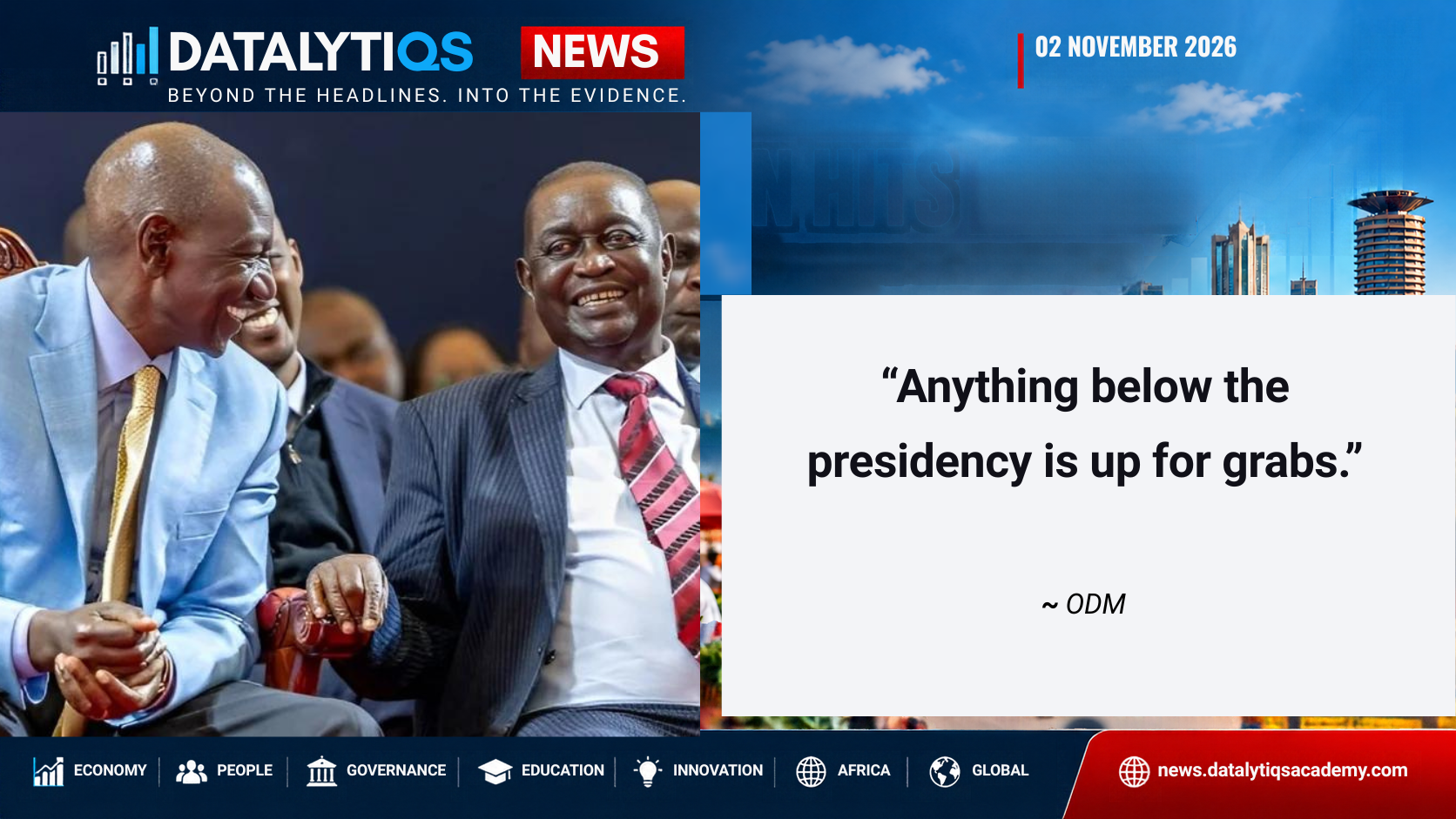
“Anything below the presidency is up for grabs.”
Junet also described plans for a single campaign committee, a joint campaign treasury account and a written agreement. A formal coalition was expected to be concluded around February 2027, according to his account.
This is the critical development: ODM’s negotiating leadership is presenting Ruto’s presidential candidacy as settled, even as the party’s share of executive power remains contested.
That sequencing raises an obvious bargaining question. If the presidency has already been conceded, how much leverage does ODM retain over the remaining positions?
3. THE DEPUTY PRESIDENCY: JOHO’S NAME ENTERS THE CONTEST
The deputy presidency has emerged as the most visible source of tension.
Mombasa Governor Abdulswamad Nassir has publicly advanced the case for former Mombasa Governor and current Mining Cabinet Secretary Hassan Joho to become Ruto’s running mate.
For ODM, securing the deputy presidency would provide a high-profile demonstration that the party is an influential coalition partner rather than merely a source of additional votes.
For UDA, however, surrendering the position would create significant political complications.
UDA Secretary-General Hassan Omar has defended incumbent Deputy President Kithure Kindiki as the party’s preferred running mate, while Nyaribari Chache MP Zaheer Jhanda has argued that the presidency and deputy presidency should remain outside negotiations.
Junet has left open the possibility of Kindiki retaining the position, depending on the coalition’s electoral calculations. Daily Nation
The emerging disagreement is therefore not simply about Joho versus Kindiki. It concerns the balance of political influence between ODM, UDA and the regional constituencies each party hopes to mobilise.
No agreed 2027 running mate has been established by these reports.
4. THE 50–50 FORMULA: EQUAL PARTNERSHIP OR AN UNDEFINED POLITICAL PROMISE?
Gladys Wanga’s demand for equal power-sharing has become one of the central negotiating benchmarks.
But what does 50–50 mean in practical terms?
It could refer to Cabinet appointments, senior government positions, parliamentary leadership, public appointments or influence over policy and government programmes. It could also concern the sharing of campaign responsibilities and political representation.
These are fundamentally different arrangements.
A numerical split of Cabinet positions, for example, does not necessarily translate into equal authority over budgets, appointments or policy implementation.
Nor can two parties simply allocate constitutionally independent offices, elected positions or public-service appointments without complying with applicable law.
A credible agreement would therefore need to specify which positions and responsibilities are negotiable, which are subject to constitutional procedures, and how compliance would be monitored.
The available reporting does not establish an agreed definition of the proposed 50–50 formula.
5. THE WRITTEN AGREEMENT: ODM WANTS MORE THAN A HANDSHAKE
ODM’s insistence on documentation reflects a concern that political assurances may not survive the election.
Junet has rejected the idea that political goodwill alone is sufficient, arguing that any coalition must be formally documented.
Kisumu Woman Representative Ruth Odinga has similarly argued that ODM must preserve its identity and secure enforceable commitments, rather than rely on verbal promises.
There is, however, a distinction between insisting on a legally structured coalition and demanding that every aspect of negotiations be conducted publicly.
On October 29, Oburu Oginga criticised outsiders seeking to dictate ODM’s negotiating process. He defended the party’s internal structures and said the talks should not become public spectacles.
He also reaffirmed that full implementation of the existing ten-point agenda remains a non-negotiable element of ODM’s engagement with UDA.
The apparent contradiction in the headlines is therefore partly a difference between who controls the negotiations, how the talks are conducted and whether the eventual agreement must be written.
6. THE UNCONDITIONAL SUPPORT CAMP: ODM’S INTERNAL DIVIDE
Not everyone in ODM believes the party should attach extensive conditions to its support for Ruto.
According to People Daily, Gem MP Elisha Odhiambo, Bondo MP Gideon Ochanda and Nyando MP Jared Okello have advocated cooperation based on trust and anticipated development benefits.
Interior Principal Secretary Raymond Omollo has also argued against attaching conditions to support for the President.
Their position is that continued cooperation with the administration can produce development benefits and stronger political relationships without extensive public bargaining.
The competing positions can be summarised as follows:
| Question | Conditional-support camp | Unconditional-support camp |
|---|---|---|
| Support for Ruto | Secure terms first | Support based on political trust |
| Written agreement | Essential safeguard | Should not obstruct cooperation |
| Deputy presidency | Major negotiating demand | Not necessarily a precondition |
| Political risk | ODM may surrender leverage | Excessive conditions may damage relations |
| Expected benefit | Guaranteed representation | Continued access and development cooperation |
The disagreement matters because a party can formally endorse a candidate without all its elected officials, grassroots organisers or supporters embracing the decision.
7. THE JACARANDA RALLY: A DISPLAY OF STRENGTH AND AN EXPOSURE OF DIVISIONS
At the October 31 ODM rally at Jacaranda Grounds, several party leaders publicly reinforced the demand for negotiated terms.
Simba Arati, Hassan Joho and Junet Mohamed all argued that ODM’s support should not be offered without conditions.
The rally also became a platform for defending the party’s political relevance amid criticism from rival opposition figures.
Nairobi Governor Johnson Sakaja publicly raised the possibility of joining ODM, but the event also experienced clashes involving supporters of Sakaja and Kasarani MP Ronald Karauri.
The contrasting developments illustrate a central challenge: ODM is attempting to demonstrate its organisational strength while simultaneously managing internal disagreements and negotiating a broader alliance.
A large political gathering can establish mobilisation capacity. It cannot, by itself, establish the number of votes a party can deliver in a national election.
8. NO ZONING, ONE CAMPAIGN FUND: THE ELECTORAL MACHINERY TAKES SHAPE
Junet has outlined three additional components of the proposed partnership.
First, ODM and UDA would retain their separate party identities rather than merge into one organisation.
Second, they would establish joint campaign coordination and financing arrangements, potentially covering contests from Members of County Assemblies to the presidency.
Third, the parties would pursue what Junet calls complementarity rather than formal constituency zoning. In practice, this could involve coordinating political support according to each party’s relative strength in different regions.
These proposals raise several governance questions.
Campaign finance: Who would contribute to the joint account, who would authorise expenditure, and how would the parties account for the funds?
Candidate selection: If both parties nominate candidates in the same constituency, how would conflicts be resolved without undermining internal party democracy?
Coalition accountability: Would elected representatives remain accountable to their respective parties, a coalition governing council or both?
Policy coherence: How would two parties with different political histories agree on taxation, public debt, devolution, healthcare and electoral reforms?
Without clear answers, a coalition may succeed at coordinating campaigns while struggling to govern coherently.
9. THE TEN-POINT AGENDA: WHAT ABOUT THE ORIGINAL REFORM COMMITMENTS?
One of the most consequential dimensions of the negotiations is the ten-point agenda associated with the earlier Ruto–Raila political understanding.
Oburu has publicly insisted that its full implementation remains fundamental to ODM’s continued engagement with UDA.
This creates an important distinction between two separate objectives: implementing the existing governance and reform commitments, and negotiating positions in a future coalition government.
The public interest requires both to be assessed independently.
If implementation of the original agenda remains incomplete, ODM must explain which commitments are outstanding, what progress has been achieved and what deadlines apply.
Otherwise, there is a risk that negotiations over government positions will overshadow the policy reforms originally presented as the justification for political cooperation.
10. THE NUMBERS BEHIND THE POLITICAL BARGAIN
Proposed power share
50–50
Demand, not an agreed allocation
Current ODM-linked Cabinet portfolios
4
As characterised in the Nation report
Target agreement
FEB 2027
Reported negotiating timetable
The current bargaining framework is politically significant, but it would be analytically unsound to translate these negotiating claims directly into projected votes.
There is no verified evidence in the reviewed reports that ODM can transfer a predetermined number of supporters to Ruto simply through a coalition agreement.
Voter behaviour depends on candidate preferences, regional political dynamics, turnout, campaign performance and economic conditions.
A coalition agreement can consolidate political elites without necessarily consolidating their electorates.
That distinction will be decisive in 2027.
11. WHAT IS CONFIRMED AND WHAT REMAINS UNRESOLVED?
| Issue | Current evidentiary position |
|---|---|
| ODM–UDA negotiations | Confirmed as ongoing |
| Ruto as proposed joint presidential candidate | Junet says this is agreed in principle |
| Deputy President’s position | Contested; no final allocation confirmed |
| Hassan Joho as running mate | Proposed by ODM figures, not confirmed |
| Kindiki retaining his position | UDA’s stated preference |
| 50–50 power-sharing | Public negotiating demand, not a concluded deal |
| Written coalition agreement | Planned, not yet finalised |
| Joint campaign committee and account | Reported preliminary understanding |
| No constituency zoning | Stated negotiating approach |
| Full implementation of ten-point agenda | Reaffirmed ODM condition |
| Party-wide consensus | Not established |
12. DATALYTIQS EDITORIAL ANALYSIS: IS ODM NEGOTIATING FROM STRENGTH OR SURRENDERING ITS LEVERAGE?
Three political interpretations emerge from the available evidence.
The first is strategic bargaining. ODM may be using its organisational networks, parliamentary representation and potential electoral support to negotiate a meaningful share of power.
The second is political self-preservation. With the party navigating a leadership transition following Raila Odinga’s death, cooperation with the incumbent administration may offer its leaders a route to retaining political relevance and access to government.
The third is a possible loss of negotiating leverage. If Ruto’s presidential candidacy has already been accepted while the deputy presidency and power-sharing formula remain unresolved, ODM could find itself negotiating the remaining benefits after conceding its most valuable bargaining position.
These interpretations are not mutually exclusive. The final agreement, rather than public speeches, will reveal which calculation dominates.
There is also a broader democratic issue: political parties are entitled to form coalitions, but public offices and government resources are not private assets that politicians may distribute without regard to constitutional and statutory requirements.
The central accountability test is whether the agreement delivers a coherent public-policy programme or merely a negotiated distribution of political positions.
CONCLUSION: THE HANDSHAKE NOW NEEDS A CONTRACT—AND THE CONTRACT NEEDS A PUBLIC PURPOSE
The ODM–UDA negotiations have moved beyond symbolic political cooperation into the difficult territory of executive positions, campaign finance, candidate coordination and enforceable commitments.
ODM leaders demanding written guarantees have a legitimate political concern: informal assurances can be difficult to enforce once elections are over.
UDA leaders defending Kindiki’s position also have a political interest in preserving the existing administration’s electoral coalition.
Neither position is inherently improper. The challenge is whether the resulting arrangement respects the law and advances public interests.
Kenyans should ultimately judge the coalition not by the number of offices allocated to politicians, but by its commitments on the economy, governance, public services and democratic accountability.
A political marriage certificate may protect the negotiating parties. It does not automatically protect the electorate.