DATALYTIQS NEWS | GLOBAL GEOPOLITICS | 31 OCTOBER 2026
Donald Trump’s endorsement of Benjamin Netanyahu ahead of Israel’s October 27 election linked electoral campaigning to the prospect of renewed military action against Iran. With the election producing no clear governing majority and diplomatic contacts continuing, the distinction between campaign rhetoric, executive authority and operational military decisions has become increasingly important.
JERUSALEM / WASHINGTON / TEHRAN — US President Donald Trump publicly urged Israeli voters to support Prime Minister Benjamin Netanyahu ahead of the October 27 parliamentary election, arguing that the two leaders needed to complete their campaign against Iran.
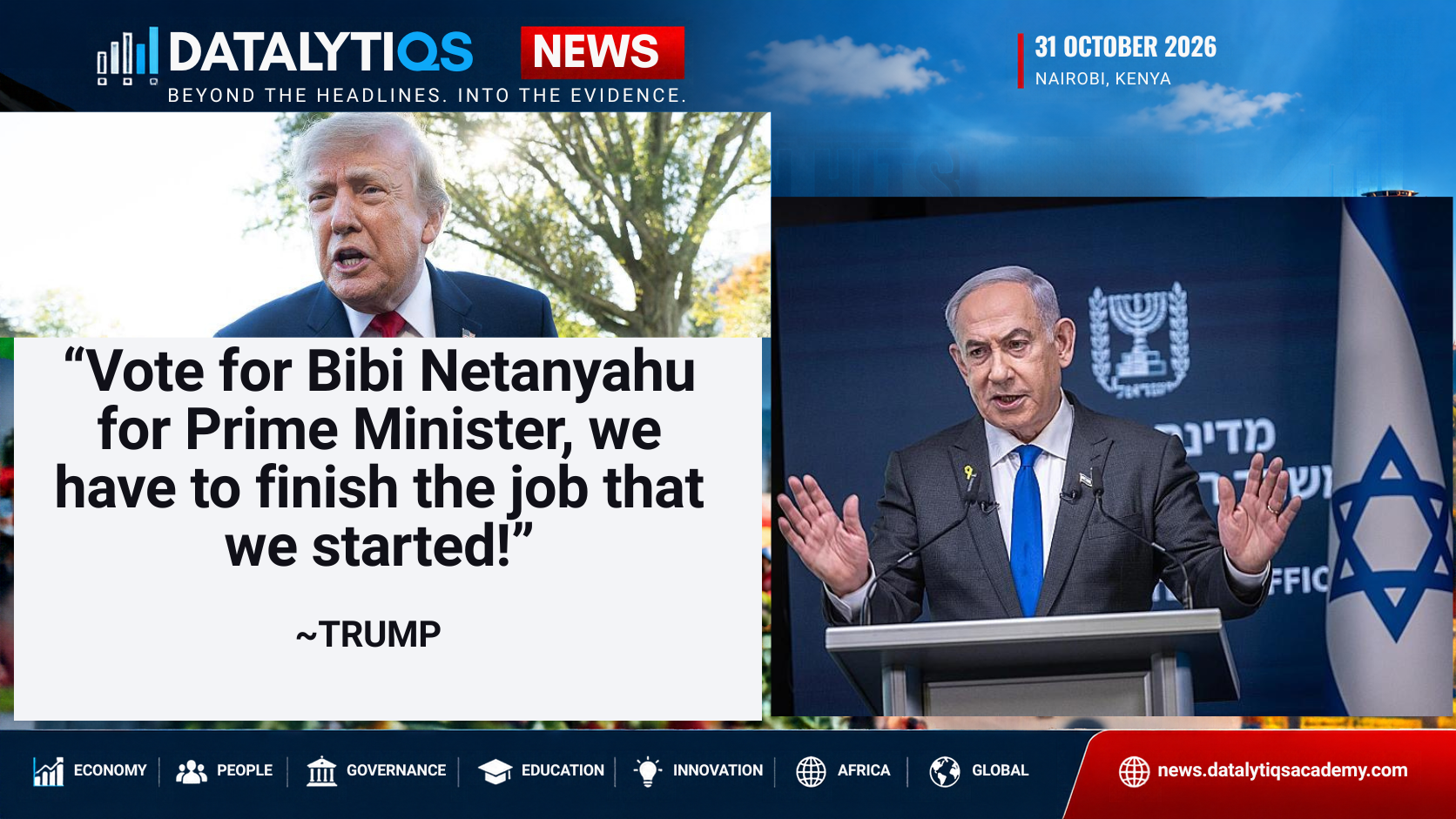
In a social-media statement published on October 25 and reported by Reuters on October 26, Trump declared:
“Vote for Bibi Netanyahu for Prime Minister, we have to finish the job that we started!”
Netanyahu subsequently suggested that further joint military action against Iran could follow. He also claimed to have instructed Israeli intelligence and military institutions to pursue the overthrow of Iran’s government.
Those statements were made during the election campaign. They are not evidence that a new US military operation was authorised on October 26 or that hostilities resumed on that date.
1. What changed after Israel’s October 27 election?
The election has now taken place, making the original campaign story part of a developing post-election security and coalition crisis.
Reuters reported on October 28 that, with approximately 86% of ballots counted, Israeli broadcasters projected the following distribution:
PROVISIONAL BLOC PROJECTIONS · 28 OCTOBER
Broadcaster projections reported by Reuters with approximately 86% counted; not certified final results.
Israel’s 120-seat Knesset requires at least 61 seats for a governing majority. These projections were provisional, not certified results.
Netanyahu’s right-wing bloc was projected to fall short of a parliamentary majority, while the opposing bloc also lacked sufficient seats to govern independently.
The outcome raised the possibility of extended coalition negotiations, during which Netanyahu could remain caretaker prime minister. Reuters noted that a caretaker administration retains substantial security powers, although constitutional and administrative expectations of restraint remain relevant.
This changes the interpretation of the October 26 statements: the question is no longer simply whether security rhetoric would influence voters, but how Israel’s post-election governing arrangements could affect subsequent decisions.
2. Election rhetoric versus military authorisation
The most consequential distinction is between what political leaders say they intend to do and what their governments have formally authorised.
| Development | Verified position | What it does not establish |
|---|---|---|
| Trump’s October 25 endorsement | Public support for Netanyahu and continuation of their Iran policy | A new US strike order |
| Netanyahu’s October 26 remarks | Public assertion that he had directed Israeli security agencies to pursue regime change | Independent confirmation of a specific operation |
| White House statement | No US attack before the November 3 midterms, according to the deputy press secretary | A permanent prohibition on later military action |
| Post-election security rhetoric | Netanyahu continued raising the possibility of renewed action | A confirmed joint US–Israeli operation |
Reuters reported that White House Deputy Press Secretary Anna Kelly explicitly ruled out US attacks on Iran before the November 3 midterm elections. That was a time-limited statement, not an unconditional commitment to avoid future hostilities.
Netanyahu’s claims about instructions to the Mossad and Israel Defense Forces are consequential, but the precise scope, legal authorisation and implementation of those instructions were not independently established in the October 26 report.
3. Final election figures complicate the security debate
By October 30, Israel’s Central Elections Committee had released its completed vote tally.
FINAL COUNT RELEASED 30 OCTOBER · 120 KNESSET SEATS
Final count reported October 30; formal presentation to President Isaac Herzog was still pending.
The final count confirmed that neither principal political bloc had independently secured the 61 seats required to govern.
This creates a significant institutional distinction: Netanyahu remains in office, but coalition negotiations have not yet produced a new parliamentary majority.
Opposition leader Gadi Eisenkot has criticised Netanyahu’s emphasis on security threats, accusing him of using fear-based electoral messaging. Netanyahu’s office has rejected accusations that the Iran conflict is being exploited for political purposes. These remain competing political interpretations, not independently established motives.
4. Iran’s response and the diplomatic track
The situation has developed further since the October 26 endorsement.
On October 31, Reuters reported that Iranian representatives met Qatari mediators in Doha as efforts continued to prevent renewed military confrontation.
The negotiations followed contacts in Tehran and involved competing proposals for confidence-building measures.
US Secretary of State Marco Rubio said Trump had not decided whether to launch further strikes and preferred a diplomatic outcome.
Iranian officials, meanwhile, warned of a substantial military response to any renewed attack.
These developments establish that both diplomatic engagement and military threats remain active.
They do not establish that a negotiated settlement is imminent or that renewed military action has been approved.
5. Why this matters to Africa and Kenya
The implications extend beyond Israeli domestic politics.
A renewed confrontation involving Iran, Israel and the United States could affect shipping security, energy markets, insurance costs and regional trade.
For Kenya, the principal economic transmission channels would include imported petroleum prices, freight charges, exchange-rate pressures and the eventual effects on domestic transport and consumer prices.
However, these are potential risk channels, not evidence that a particular Kenyan price increase has already been caused by the October 26 statements.
A rigorous economic assessment would track Brent crude prices, shipping disruptions, insurance premiums, the Kenyan shilling and official domestic fuel-price adjustments before attributing measurable effects.
DatalytIQs Geopolitical Intelligence Assessment
The developments should be interpreted through four separate dimensions.
Electoral legitimacy: Israel’s completed vote count has not produced an outright governing majority. Coalition negotiations and the president’s formal consultations remain central to the political process.
Executive authority: Netanyahu’s caretaker status does not automatically eliminate security powers, but it raises questions about the exercise of discretion during government formation.
Military decision-making: Public endorsements, campaign warnings and assertions about intelligence instructions are not interchangeable with independently verified military orders or deployments.
Diplomatic developments: Qatar-mediated contacts and statements from Washington and Tehran provide evidence of continuing negotiations alongside threats of escalation.
The central uncertainty is whether subsequent government decisions move beyond rhetoric into documented operational action.
What to monitor next
Israeli coalition formation
President Herzog’s consultations, party recommendations, formal mandates and any coalition agreement.
US military decisions
Official White House and Pentagon announcements, particularly after the November 3 midterm elections.
Verified military developments
Independently corroborated deployments, operational orders, strikes or changes in force posture.
Iranian responses and mediation
Official Iranian statements, Qatari mediation and evidence of agreements or breakdowns in negotiations.
Conclusion: A Campaign Promise Is Not a War Order
Trump’s October 25 endorsement and Netanyahu’s subsequent statements placed the Iran conflict at the centre of Israel’s election campaign.
The October 27 vote has since produced a fragmented Knesset, while October 31 reporting confirms that diplomatic efforts to avert renewed hostilities remain underway.
The defining question is not whether Trump and Netanyahu used forceful language about Iran. It is whether their governments subsequently authorise, prepare and execute military action—and what independent evidence establishes each step.
That distinction is essential to reporting on an already volatile regional security environment.
DatalytIQs News — Beyond the Headlines. Into the Evidence.
Verified sources
- Reuters, October 26 — Trump’s endorsement and Netanyahu’s Iran remarks
- Associated Press, October 30 — Final Israeli election results and coalition deadlock
- Reuters, October 29 — How Israel could resolve the election deadlock
- Reuters, October 31 — Iran, Qatar and US diplomatic developments
Editorial dating: Trump’s endorsement was issued October 25 and reported October 26. Israel voted October 27. Election results were released October 30. Diplomatic developments cited here are from October 31. No new military operation is asserted without independent verification.