Wiper leader Kalonzo Musyoka’s speech at the Linda Mwananchi headquarters launch was interrupted by supporters chanting for Edwin Sifuna’s presidential candidacy. Sifuna intervened to restore order, while Rigathi Gachagua later downplayed the incident. Beyond the disruption lies a more consequential question: who has the legal and institutional authority to select a common opposition presidential candidate for 2027?
NAIROBI, KENYA | 31 October 2026
Wiper Patriotic Front leader Kalonzo Musyoka has urged supporters of Nairobi Senator Edwin Sifuna to respect the formal procedures for selecting a presidential candidate, warning against treating political enthusiasm as a substitute for consultation and nomination.
Speaking during the unveiling of the Linda Mwananchi Movement’s headquarters in Lavington, Nairobi, on Friday, October 30, Kalonzo challenged remarks by DAP-Kenya leader Eugene Wamalwa that appeared to present Sifuna as an established presidential candidate.
Kalonzo maintained that Sifuna’s proposed candidature would first need to undergo the movement’s formal procedures, including its National Delegates Convention scheduled for November 13.
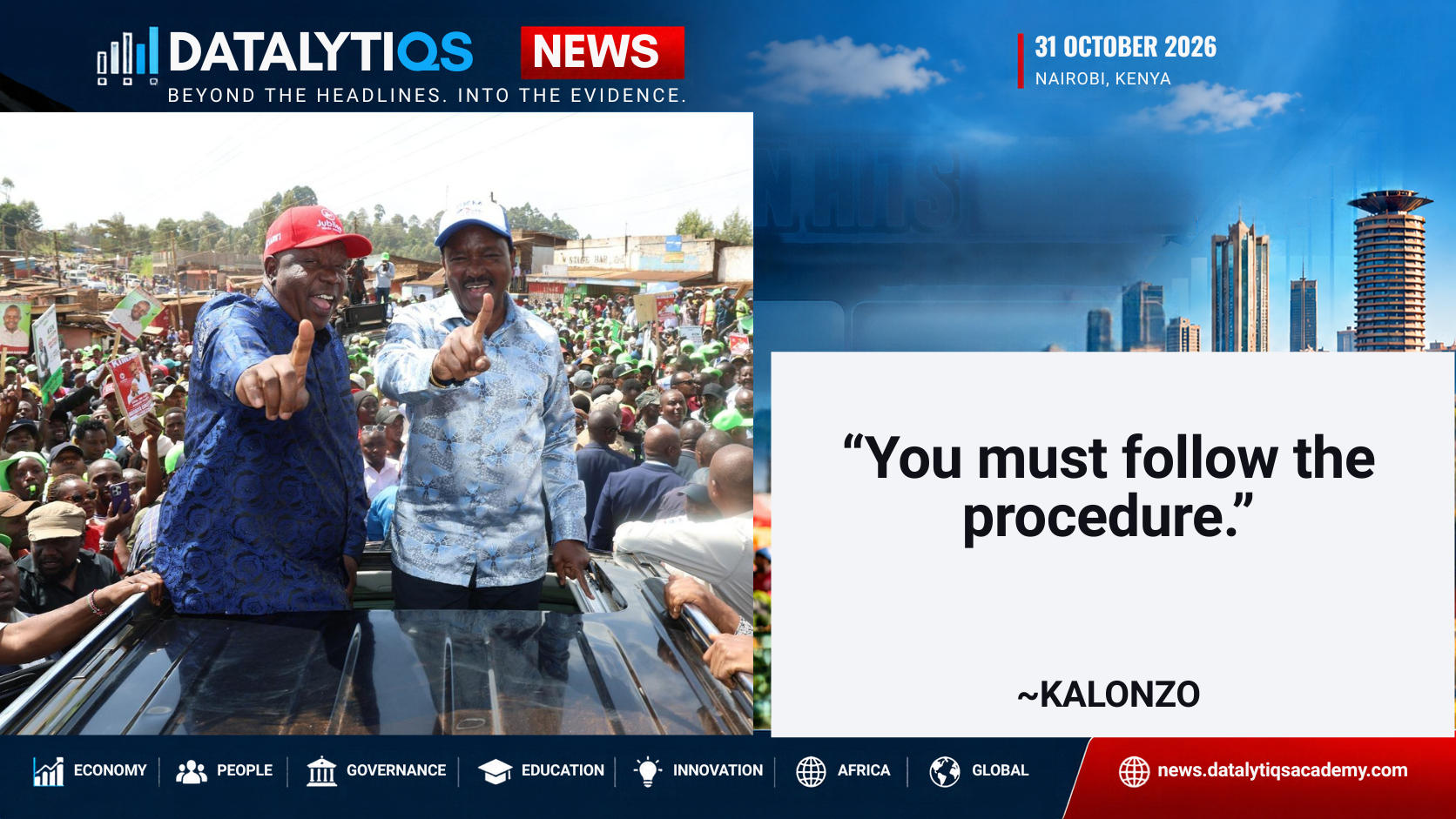
“You must follow the procedure.”
His remarks prompted sections of the audience to chant in support of Sifuna, repeatedly interrupting his speech.
Sifuna intervened and urged supporters to respect Kalonzo and allow him to finish speaking. Kalonzo subsequently affirmed that he would support Sifuna if the opposition eventually selected him as its common candidate.
The incident illustrates a distinction that could become central to opposition coalition negotiations:
A party’s preferred presidential candidate is not automatically the candidate of a wider political alliance.
What Happened at the Linda Mwananchi Launch?
The disagreement began when Eugene Wamalwa appeared to endorse Sifuna’s presidential ambitions.
Kalonzo responded by distinguishing Sifuna’s position as a party leader from the formal process required to establish his presidential candidature.
He referred to the November 13 National Delegates Convention as the next relevant institutional step.
Sections of the audience responded with chants supporting Sifuna.
The interruptions became sufficiently persistent that Kalonzo questioned whether he should continue speaking.
Sifuna then appealed directly to supporters, reminding them that the visiting leaders deserved respect and that political cooperation required dialogue.
Kalonzo resumed his address.
The sequence matters because the disruption and the leadership response are separate observable events.
The heckling demonstrates that some attendees strongly favoured Sifuna’s candidacy.
Sifuna’s intervention demonstrates that he publicly sought to restore order.
Neither event establishes that a coalition nomination had been completed.
The November 13 Convention: What Can It Decide?
According to Daily Nation, Sifuna announced plans for the Linda Mwananchi Movement to convene a National Delegates Convention on November 13, 2026, to formalise his presidential ambitions.
The movement also unveiled a proposed leadership structure and announced plans to establish offices across Kenya’s 47 counties.
The convention could provide an institutional basis for decisions within Linda Mwananchi, subject to its registered constitution and applicable nomination rules.
However, two separate questions must be considered.
The first is whether the movement formally authorises Sifuna to pursue the presidency under its banner.
The second is whether other opposition parties agree to adopt him as their common presidential candidate.
These are not necessarily the same decision.
A Linda Mwananchi endorsement would not automatically bind Wiper, DCP or DAP-Kenya.
Those parties would need to authorise their participation through the applicable institutional processes and any agreed coalition framework.
Kalonzo’s Existing Presidential Mandate
Kalonzo reminded the gathering that he had received a mandate to pursue the presidency at a Wiper delegates’ conference held on October 10, 2025.
His statement was intended to establish that he also possessed an existing party-level basis for his presidential ambitions.
However, a mandate issued by Wiper does not automatically make Kalonzo the candidate of a wider opposition alliance.
The same principle applies to any nomination granted to Sifuna by Linda Mwananchi.
Where multiple parties have nominated presidential aspirants, a common coalition candidate requires a further mechanism for reconciling those mandates.
The relevant issue is therefore not which leader announced their candidacy first.
It is whether the participating parties have agreed on a process that can produce an authorised and accepted collective decision.
Three Separate Stages of Presidential Candidate Selection
A credible opposition nomination process should distinguish three institutional stages.
| Stage | Decision required | Relevant authority |
|---|---|---|
| Party-level nomination | Select or endorse a party’s presidential aspirant | Authorised party organ under its constitution |
| Coalition-level selection | Determine whether participating parties will support a common candidate | Parties acting through an approved coalition framework |
| Statutory nomination | Submit the presidential candidate and running mate in compliance with election law | Candidate, nominating political organisation and IEBC |
These stages may interact, but one should not be confused with another.
A rally endorsement cannot replace a party resolution.
A party resolution cannot automatically replace a coalition agreement.
And a coalition agreement does not remove the need to comply with constitutional and electoral nomination requirements.
What Does Kenyan Law Require?
Article 137 of the Constitution establishes the qualifications for election as President.
Article 138 governs the presidential election, including the threshold for election.
Article 148 provides for the nomination of a Deputy President as the presidential candidate’s running mate.
The Political Parties Act governs political party organisation and coalition agreements.
A formal coalition arrangement must comply with the relevant statutory requirements and the internal rules of participating parties.
However, the law does not require every opposition party to adopt a single presidential candidate.
That is a political choice.
If parties decide to cooperate electorally, the method of selecting their candidate must be consistent with their lawful institutional arrangements.
The legal framework therefore establishes boundaries, while the participating parties must negotiate the political details.
What Selection Mechanism Could the Opposition Adopt?
Several approaches are possible, although no final mechanism has been established in the reporting reviewed.
One option would be a negotiated consensus in which authorised party representatives agree on a candidate and obtain the necessary institutional approvals.
Another would involve a joint nomination process conducted under an agreed coalition framework.
A third would use a structured consultation process incorporating party delegates, regional representation and documented decision-making rules.
The participating parties could also choose to retain separate presidential candidates.
Each approach would have different consequences for party autonomy, internal nominations and campaign coordination.
Whatever mechanism is adopted, it would need to establish who participates, how decisions are reached and how disagreements are resolved.
A public commitment to support a common candidate is not sufficient to answer those procedural questions.
Gachagua Downplays the Disruption
Former Deputy President Rigathi Gachagua subsequently described the incident as political excitement rather than a threat to opposition cooperation.
He said he did not consider the disruption a serious obstacle to the parties’ shared objectives.
Gachagua also reiterated that he was willing to support Sifuna or Kalonzo if either emerged as the agreed opposition presidential candidate.
His remarks should be understood as a statement of conditional political cooperation.
They do not establish that DCP has formally endorsed either aspirant.
Nor do they confirm that the opposition has completed its nomination process.
Gachagua’s position may help explain his interpretation of the incident, but it does not eliminate the need for clear coalition rules.
Sifuna’s Intervention and the Question of Political Tolerance
Sifuna’s intervention is relevant to evaluating the conduct of the gathering.
He asked supporters to listen to Kalonzo and reminded them that the opposition leaders had attended as invited guests.
His response acknowledged the need for mutual respect during political consultations.
Nevertheless, the incident exposed a practical challenge for any coalition involving leaders with competing presidential ambitions.
Supporters may develop strong preferences before formal nominations are completed.
Those preferences can create pressure on political leaders during negotiations.
The responsibility of organisers is to maintain an environment in which competing views can be expressed without intimidation or sustained disruption.
Disagreement is legitimate.
Preventing an invited speaker from communicating their position raises a different concern.
The documented intervention should be considered alongside the disruption rather than treating either event as the entire story.
Wiper’s Reaction Shows Why the Dispute Matters
The controversy continued after the event.
According to Daily Nation, Wiper spokesperson Ndegwa Njiru strongly criticised the treatment of Kalonzo and subsequently challenged remarks attributed to DCP Deputy Leader Cleophas Malala concerning Sifuna’s candidacy.
Makueni Senator Dan Maanzo also described the incident as a breach of respect while indicating that the disagreement could be addressed internally.
These reactions demonstrate that the incident generated disagreement beyond the audience itself.
However, statements by individual party officials must be distinguished from formal resolutions adopted by their parties.
The relevant institutional question is whether the participating parties continue negotiations under mutually accepted procedures.
A public dispute does not automatically terminate political cooperation, but it can expose procedural questions that require resolution.
The Coalition Agreement Remains the Missing Document
The opposition leaders have publicly discussed supporting a single presidential candidate.
However, the reporting reviewed does not establish a final coalition agreement specifying how that candidate will be selected.
A workable agreement would need to clarify several matters:
- Which political parties are participating, and which organs have authorised their participation?
- Who is eligible to seek the common presidential nomination?
- Will the candidate be selected through consensus, a delegate vote or another agreed procedure?
- How will the presidential running mate be chosen?
- What dispute-resolution process will apply if negotiations fail?
- Will participating parties remain free to contest parliamentary, gubernatorial and county assembly positions independently?
These are institutional questions, not matters that can be settled through crowd chants.
They also determine whether political promises of unity can be translated into enforceable commitments.
The November 13 Test
The proposed Linda Mwananchi convention on November 13 is the next clearly identified milestone.
However, its significance should be interpreted precisely.
A decision by Linda Mwananchi to nominate Sifuna would establish the movement’s position, provided the relevant rules are followed.
It would not, without further agreement, determine the presidential candidate of every participating opposition party.
A separate coalition-level decision may still be required.
The important evidence will therefore include the convention’s official resolutions, any subsequent party approvals and the publication of a formal interparty agreement.
DatalytIQs Political Intelligence Assessment
The October 30 incident raises five substantive issues.
1. Nomination authority: Kalonzo’s warning concerned the distinction between an aspirant’s political popularity and the institutional authority required for nomination.
2. Competing mandates: Kalonzo’s Wiper mandate and Sifuna’s proposed Linda Mwananchi nomination are party-level processes that require reconciliation if a common candidate is pursued.
3. Coalition governance: No verified final agreement has established how the participating parties will select a single presidential candidate.
4. Political tolerance: The disruption was documented, as was Sifuna’s intervention. Responsibility should be assessed through observable conduct rather than assumptions about the intentions of every attendee.
5. Conditional cooperation: Kalonzo and Gachagua have expressed willingness to support another agreed candidate, but those statements do not themselves constitute formal endorsements.
Conclusion: A Presidential Ticket Requires More Than Popular Acclamation
Kalonzo’s warning at the Linda Mwananchi launch concerned an unresolved institutional question.
Sifuna’s supporters demonstrated enthusiasm for his presidential ambitions, but their chants could not confer a coalition nomination.
Sifuna’s intervention helped restore the proceedings, while Gachagua’s subsequent remarks sought to minimise the political significance of the disruption.
The underlying issue remains.
The opposition can agree publicly on the need for a common presidential candidate while still disagreeing over who selects that candidate, how the decision is authorised and whether every participating party will accept the outcome.
The November 13 convention may clarify Linda Mwananchi’s position. A binding common candidature would require further evidence of agreement among the participating parties.
DatalytIQs News — Beyond the Headlines. Into the Evidence.
Sources and references
- Constitution of Kenya, 2010 — Articles 137, 138 and 148.
- Political Parties Act, 2011 — Coalition agreements and political party governance.
Editorial verification: The interruption, Sifuna’s intervention, Kalonzo’s procedural objection, the proposed November 13 convention and Gachagua’s subsequent response are corroborated by contemporary reporting. The possible candidate-selection mechanisms are analytical scenarios, not confirmed coalition arrangements.