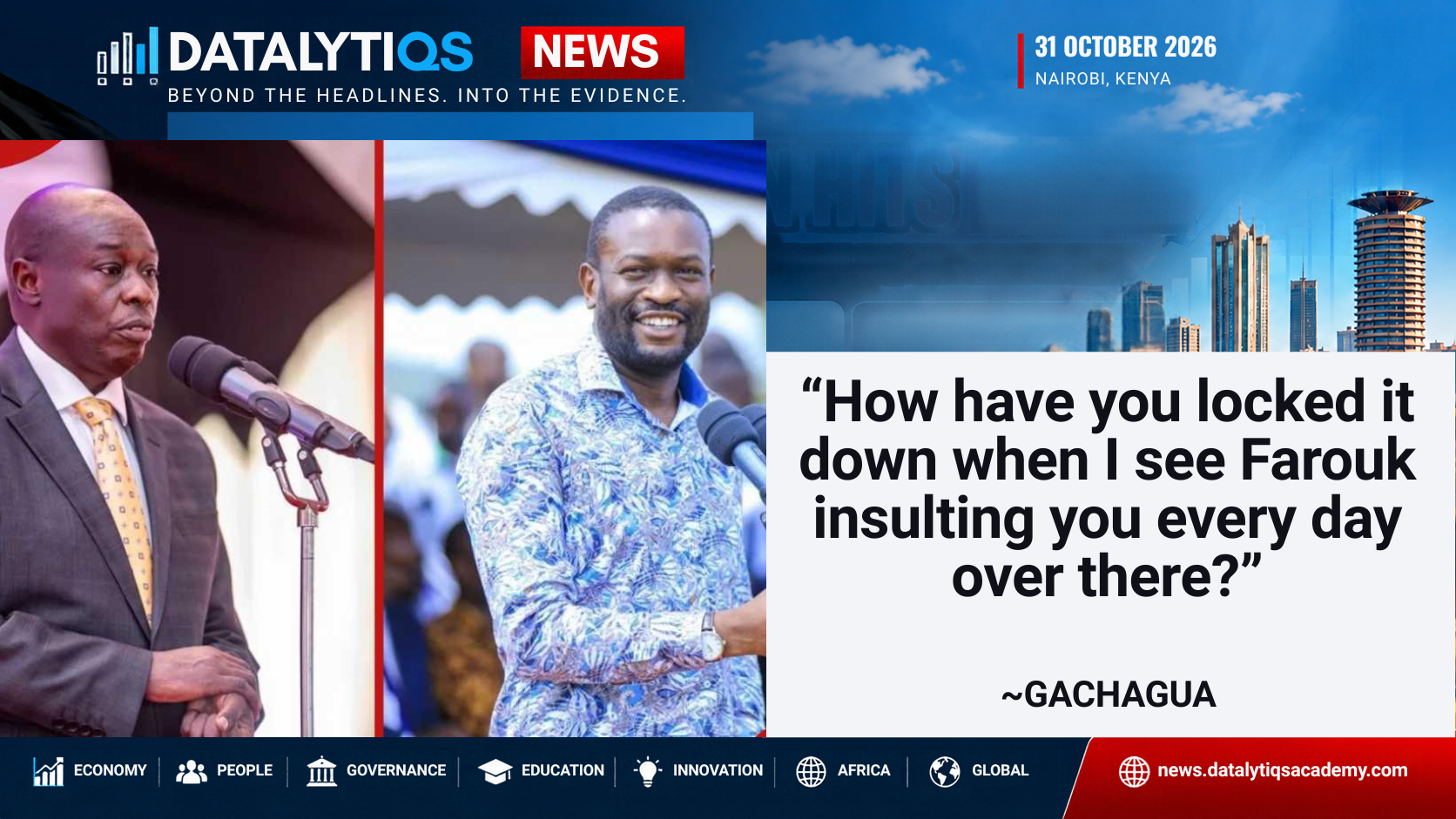
Former Deputy President Rigathi Gachagua has challenged Nairobi Senator Edwin Sifuna to demonstrate his political influence in Western Kenya, questioning why prominent regional figures continue to criticise him. Gachagua also claims that opposition leaders command substantial proportions of previously established party support. But these figures remain unverified, raising fundamental questions about how regional political influence should be measured ahead of Kenya’s 2027 General Election.
NAIROBI, KENYA | 31 October 2026
Former Deputy President Rigathi Gachagua has challenged Nairobi Senator Edwin Sifuna to demonstrate the political support he claims to command in Western Kenya.
Speaking at the Linda Mwananchi Movement’s launch on Friday, October 30, Gachagua questioned why influential political figures in the region continued to criticise Sifuna despite his assertions of growing support.
“But I asked him, how have you locked it down when I see Farouk insulting you every day over there?”
The remarks referred to Farouk Kibet, an aide to President William Ruto, whose public criticism of Sifuna has featured in the emerging political contest over Western Kenya.
Gachagua also addressed criticism from Central Organisation of Trade Unions Secretary-General Francis Atwoli, questioned the political record of Prime Cabinet Secretary Musalia Mudavadi and National Assembly Speaker Moses Wetang’ula, and made allegations concerning historical political agreements.
He further declared that he would support another opposition presidential candidate, including Sifuna or Wiper leader Kalonzo Musyoka, if the participating parties agreed on a common candidate.
However, his remarks contain several different categories of claims that require separate examination.
Public criticism by regional leaders is observable political activity. Claims of regional electoral control require substantially different evidence.
What Gachagua Wants Sifuna to Demonstrate
According to Capital FM, Gachagua described a conversation in which he asked Sifuna whether he was prepared for a presidential campaign and whether he had consolidated political support in Western Kenya.
Gachagua said Sifuna answered affirmatively.
The former Deputy President then questioned why regional leaders, particularly Farouk Kibet, continued to criticise him without encountering stronger political resistance from his supporters.
The argument reflects Gachagua’s emphasis on the importance of regional political organisation.
However, criticism from an influential individual does not establish the absence of public support for the person being criticised.
Political leaders can retain substantial support while facing vocal opposition from other leaders within the same region.
Likewise, an absence of public confrontation does not necessarily demonstrate weak organisation.
A political support base can be assessed through membership, campaign infrastructure, participation, fundraising, endorsements and voting behaviour.
The intensity of public exchanges between politicians is only one observable feature of political competition.
Western Kenya Is Not a Single Political Constituency
Gachagua’s remarks treat Western Kenya as an important area of political mobilisation.
However, the region contains distinct counties, constituencies and political networks.
Kakamega, Bungoma, Busia and Vihiga have different electoral histories and patterns of party competition.
Political activity associated with Trans Nzoia and other neighbouring areas may also feature in broader discussions of Western Kenya’s political landscape.
Consequently, a claim that a politician has secured Western Kenya requires geographic precision.
Does the claim concern registered party members?
Support among particular communities?
Endorsements from elected leaders?
Organisational presence across constituencies?
Or measured voting intentions?
These indicators are not interchangeable.
A politician may have an established network in one county without commanding equivalent support elsewhere.
Similarly, support for a presidential candidate may differ from preferences in gubernatorial, parliamentary and county assembly contests.
A credible regional assessment would therefore require county- and constituency-level evidence rather than a single regional percentage.
Farouk Kibet’s Criticism: What Does It Actually Establish?
Gachagua singled out Farouk Kibet as a prominent critic of Sifuna.
Kibet’s political proximity to President Ruto makes his statements relevant to the wider debate over the administration and its opponents.
However, his public criticism cannot be used as a statistical measure of Sifuna’s popularity.
The existence of a political disagreement establishes that competing positions are being expressed.
It does not establish how voters distribute their preferences between the individuals or political formations involved.
Nor does criticism from one political figure demonstrate that an entire region shares that position.
A meaningful assessment would require independent evidence of organisational activity and voter preferences.
The relevant question is therefore not whether Farouk criticises Sifuna, but whether Sifuna’s political organisation has identifiable structures and measurable support across the constituencies he seeks to mobilise.
Francis Atwoli and the Presidential Readiness Debate
Gachagua also responded to criticism associated with COTU Secretary-General Francis Atwoli.
Atwoli has questioned whether Sifuna possesses the political organisation necessary for a national presidential campaign.
His concerns, as reported by Capital FM, include the need for a sufficiently developed political network.
This introduces a distinction between constitutional eligibility and campaign organisation.
A politician may satisfy the constitutional qualifications for presidential nomination without having established a nationwide campaign structure.
Conversely, a substantial political network does not automatically guarantee electoral support.
Gachagua rejected arguments that Sifuna’s age should prevent him from seeking the presidency.
However, presidential eligibility is governed by Article 137 of the Constitution, which requires more than meeting the minimum voting age.
Candidates must satisfy the applicable citizenship, nomination and other constitutional requirements.
The relevant political question is therefore not simply whether Sifuna is eligible to contest.
It is what evidence exists concerning his party organisation, policy programme, fundraising, nominations and campaign activities.
Gachagua’s Allegation About Mudavadi’s ANC
Gachagua also alleged that Prime Cabinet Secretary Musalia Mudavadi’s Amani National Congress was transferred into President Ruto’s political camp through an arrangement involving Sh20 million.
He claimed personal involvement in the negotiations.
This is a serious allegation concerning a political transaction.
It should not be presented as an established fact without independent documentary evidence.
Verification would require identifying the legal nature of the alleged transaction, the parties involved, the relevant financial records and any official filings concerning the party’s dissolution or merger.
The publicly documented history of ANC’s integration into UDA-related political arrangements is distinct from Gachagua’s allegation about a specific payment.
A party’s merger, dissolution or deregistration can be examined through records maintained by the Office of the Registrar of Political Parties.
Such records would not necessarily prove or disprove every allegation about private negotiations.
The alleged Sh20 million payment therefore remains an attributed claim unless independently substantiated.
The 1,000-Kilometre Road Promise
Gachagua further accused Mudavadi and National Assembly Speaker Moses Wetang’ula of failing to deliver on a purported commitment to construct 1,000 kilometres of tarmac roads in Western Kenya.
He associated the promise with political arrangements made before or after the formation of the Kenya Kwanza administration.
The claim raises two separate questions.
First, was a commitment to construct 1,000 kilometres of roads formally documented?
Second, what infrastructure was actually delivered during the relevant period?
The first question requires the original agreement, manifesto, official speech or government commitment.
The second requires project-level evidence from the Kenya National Highways Authority, Kenya Rural Roads Authority, relevant ministries and budget implementation records.
Road expenditure should be distinguished from completed kilometres.
A project may receive funding without reaching completion.
Similarly, road rehabilitation should not automatically be counted as new tarmac construction.
A credible assessment would identify the specific roads, approved budgets, implementation dates, contractors and verified completion status.
Without these records, neither the full delivery nor the complete failure of the alleged commitment can be established.
Gachagua’s 80% and 70% Claims: Political Arithmetic Without Verified Polling
Among the most consequential statements were Gachagua’s claims that Sifuna had retained more than 80% of ODM supporters and that he himself had attracted 70% of President Ruto’s previous supporters.
These are claims made by Gachagua, not independently verified measurements of voter preferences. <Cite refs={[“turn602379search0″,”turn602379search4”]}/>
They also present a methodological problem.
The two percentages refer to different political populations, with no disclosed sample sizes, geographic coverage, fieldwork dates or measurement procedures.
They cannot legitimately be added together to calculate the strength of a proposed opposition alliance.
Political support is not automatically transferable between leaders. A voter who supported ODM in one election might not support every candidate endorsed by a former ODM official.
Likewise, a voter who supported Ruto in 2022 might make a different choice in 2027, but the direction of that choice cannot be established without appropriate evidence.
What would credible evidence look like?
| Political claim | Evidence required |
|---|---|
| Sifuna commands Western Kenya | Representative county-level surveys, party structures and documented mobilisation |
| Sifuna retained 80% of ODM supporters | Defined population, survey methodology, fieldwork dates and uncertainty estimates |
| Gachagua attracted 70% of Ruto’s supporters | Comparable survey evidence identifying previous and current political preferences |
| Regional leaders have lost support | Dated, representative polling or actual electoral results |
| A joint opposition can consolidate support | Formal agreements, coordinated organisation and subsequent voter-preference measurements |
Historical IEBC results can establish how voters behaved in previous elections. They cannot independently verify the percentages Gachagua asserted in October 2026.
Gachagua Offers to Support Kalonzo or Sifuna
Gachagua also said he remained interested in becoming President but would support another candidate if the opposition agreed on one.
He specifically identified Kalonzo Musyoka and Edwin Sifuna as possible candidates he would support.
If Sifuna were selected, Gachagua offered to participate directly in managing his presidential campaign.
The statement is significant because it distinguishes Gachagua’s personal presidential ambition from his declared willingness to accept a collective nomination decision. <Cite refs={[“turn602379search0″,”turn602379search8”]}/>
However, the offer remains conditional.
On October 28, Gachagua had clarified that his Democracy for the Citizens Party had not formally endorsed Sifuna. He distinguished Cleophas Malala’s personal support for the senator from an authorised party decision. <Cite ref=”turn602379search5″/>
That clarification remains important when interpreting his subsequent remarks.
A commitment to support an eventual candidate is not equivalent to an endorsement of a particular aspirant.
Neither does it establish that the participating parties have agreed on nomination procedures, campaign financing or coalition governance.
The Emerging Opposition’s Organisational Challenge
The political engagement between Gachagua, Sifuna and Kalonzo has produced visible consultations and joint appearances.
Gachagua met Sifuna at his Wamunyoro residence on October 20, while Kalonzo held separate discussions with him on October 26. <Cite refs={[“turn602379search6″,”turn602379search10”]}/>
Their participation in the October 30 Linda Mwananchi launch provided additional evidence of ongoing cooperation.
However, the event also exposed disagreements over presidential candidate selection.
Kalonzo was interrupted when he questioned the premature promotion of Sifuna’s presidential candidacy. <Cite ref=”turn602379search7″/>
These developments demonstrate why political cooperation must be assessed at several levels: personal relationships, party authorisation, nomination procedures, organisational resources and policy commitments.
A public declaration of unity does not resolve every institutional disagreement.
DatalytIQs Political Intelligence Assessment
Gachagua’s remarks present five distinct issues requiring evidence-based scrutiny.
Regional influence: Western Kenya cannot be treated as a single homogeneous voting bloc. Organisational activity and political preferences should be examined by county and constituency.
Public criticism: Statements by Farouk Kibet or Francis Atwoli demonstrate political disagreement, not the distribution of voter support.
Historical allegations: Claims concerning ANC’s alleged sale and promised road construction require documentary and financial verification.
Numerical support claims: The asserted 80% and 70% figures lack disclosed polling methodologies and cannot be treated as established estimates.
Coalition commitments: Gachagua’s willingness to support Sifuna or Kalonzo is conditional on a future collective decision, not proof of a concluded presidential nomination.
What Should Be Monitored Next?
The most informative developments would be the publication of formal opposition nomination procedures, verifiable records of party organisation across Western Kenya and independently conducted surveys with transparent methodologies.
Official records concerning ANC’s political restructuring and project-level documentation of the alleged road commitments would also help resolve the historical claims.
Finally, any formal endorsement should be distinguished from individual leaders’ statements of preference.
Conclusion: Political Influence Must Be Demonstrated, Not Merely Declared
Gachagua’s challenge places regional political organisation at the centre of the emerging opposition’s discussions.
His remarks also illustrate the limitations of political arithmetic based on unsupported percentages and assumptions about transferable voter loyalty.
The publicly documented meetings and campaign activity establish that opposition leaders are exploring cooperation. They do not establish the proportions of voters supporting each leader.
A political region is not secured by a declaration, a prominent endorsement or a percentage announced at a rally. Electoral influence must be assessed through verifiable organisation, credible public-opinion evidence and actual voting behaviour.
For Sifuna, Gachagua and their prospective partners, the substantive questions concern the institutions they establish, the procedures they agree upon and the evidence supporting their claims.
DatalytIQs News — Beyond the Headlines. Into the Evidence.
Sources and verification
Editorial verification note: The Capital FM report confirms Gachagua’s statements and attributes the allegations to him. It does not independently substantiate the alleged Sh20 million transaction, the 1,000-kilometre road commitment or the 80% and 70% political-support estimates. Those claims should remain explicitly attributed in any published version.