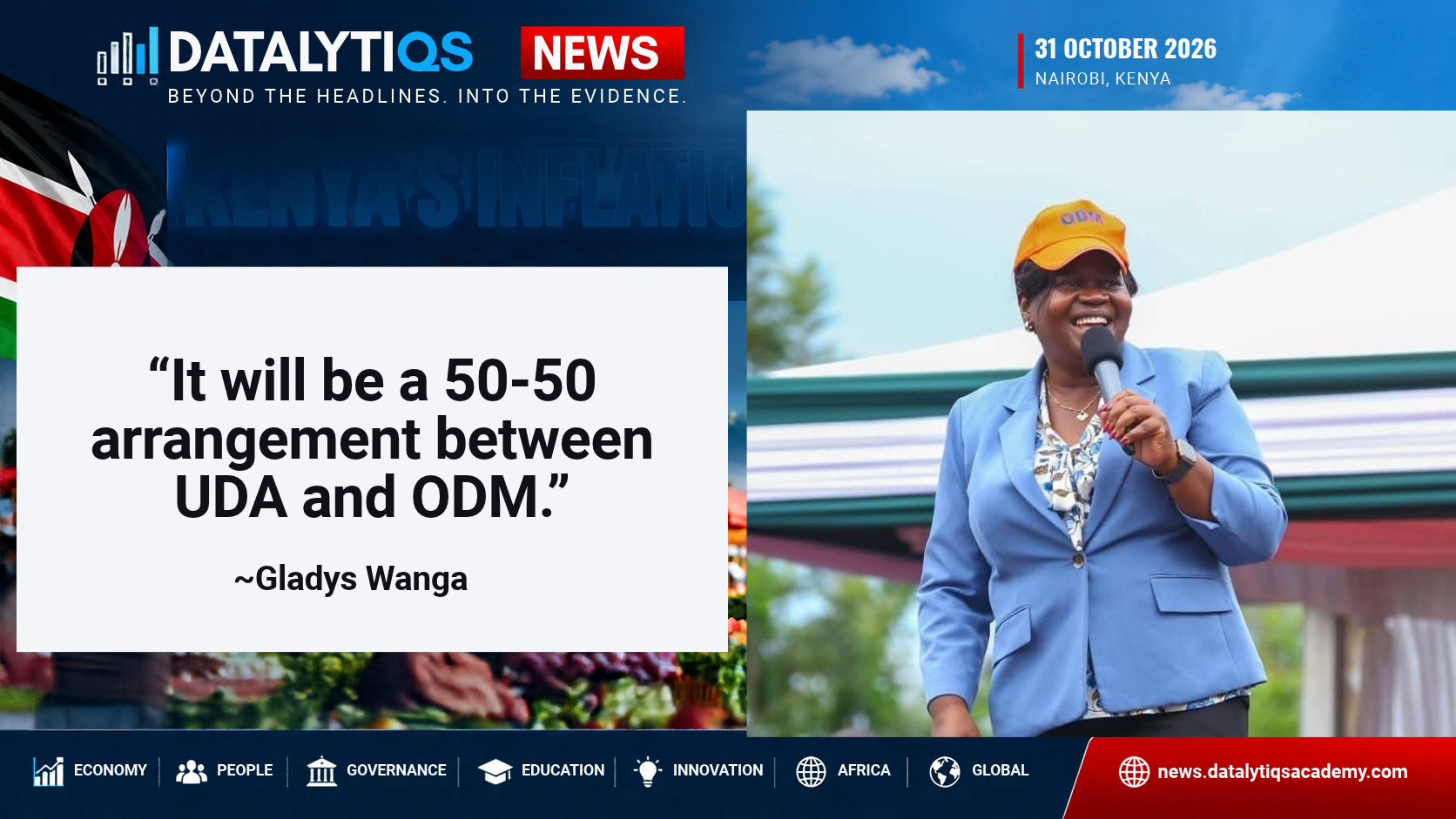
Homa Bay Governor and ODM Chairperson Gladys Wanga has proposed an equal division of government positions between ODM and President William Ruto’s UDA ahead of the 2027 General Election. Her formula would give UDA the presidency, ODM the running-mate position and both parties equal Cabinet representation. But who authorised the proposal, what happens to the current Deputy President, and how much of the proposed arrangement can legally be guaranteed?
NAIROBI, KENYA — 31 October 2026
Homa Bay Governor and Orange Democratic Movement (ODM) Chairperson Gladys Wanga has outlined an ambitious power-sharing proposal under which ODM and President William Ruto’s United Democratic Alliance (UDA) would divide positions in a future government equally.
Speaking to ODM delegates in Turkana during the party’s October grassroots mobilisation activities, Wanga said the proposed broad-based political arrangement should operate on a 50–50 basis.
Her remarks were reported by Daily Nation on October 24 and revisited by The Star on October 29 as disagreements intensified within ODM over the conditions for supporting President Ruto’s re-election.
Wanga’s position was explicit:
“It will be a 50-50 arrangement between UDA and ODM. If they field a presidential candidate, we shall have the running mate. If they take 10 slots in the Cabinet, we shall demand the same number.”
The proposal establishes a negotiating position for ODM: UDA would provide the presidential candidate, while ODM would seek the Deputy President’s position and equal representation in the Cabinet.
However, the arrangement has not been established as a concluded coalition agreement.
Nor does the available reporting demonstrate that UDA has formally accepted the proposed allocation.
The distinction is important because Wanga’s declaration raises constitutional, legal and institutional questions extending beyond the political negotiations themselves.
Wanga’s Proposal: An Equal Partnership, Not Unconditional Support
Wanga’s remarks indicate that ODM intends to negotiate a substantial role in any future government formed through cooperation with UDA.
Her position differs from proposals that ODM should support President Ruto without demanding specific written conditions.
Under the formula she outlined, the parties would negotiate an equal division of government positions, with ODM seeking the running-mate slot on the presidential ticket.
The proposal is linked to ODM’s wider efforts to strengthen its grassroots structures and retain elected positions in its traditional strongholds.
During the Turkana mobilisation, Wanga urged party delegates to concentrate on building local electoral structures and preparing candidates for county and parliamentary contests.
She argued that the number of elective seats secured by ODM would strengthen its position in future negotiations.
This introduces an important distinction between political ambition and institutional entitlement.
A party may seek a particular share of government positions, but the outcome of negotiations depends on the agreement reached by the participating parties and the constitutional processes governing the relevant offices.
The 50–50 formula is therefore a political demand rather than an automatic legal entitlement.
Who Authorised the 50–50 Formula?
Wanga occupies an influential position as ODM’s national chairperson.
Her statements consequently carry significant political weight.
However, the authority to negotiate and approve a coalition arrangement is not necessarily identical to the authority to announce a negotiating position.
Kenya’s Political Parties Act requires formal coalition agreements to comply with the participating parties’ internal rules and procedures.
The Third Schedule further requires such agreements to be sanctioned by the governing bodies of the parties involved.
They must be executed in writing by authorised national party officials and commissioned by a Commissioner for Oaths.
These requirements make institutional approval central to the formation of a formal coalition.
For Wanga’s proposal, several questions remain relevant.
Has ODM’s governing body formally adopted the 50–50 formula?
Was Wanga communicating an approved negotiating mandate or advocating a position for consideration?
Has the proposal been submitted to the technical committee negotiating with UDA?
Has UDA formally responded?
The reports reviewed establish that Wanga publicly advocated the formula and that other senior ODM leaders have supported equal power sharing.
They do not establish that the complete proposal has been ratified by both parties.
Other ODM Leaders Support Equal Power Sharing
Wanga’s proposal has received support from other prominent ODM officials.
National Assembly Minority Leader Junet Mohamed has publicly advocated an equal distribution of government positions between ODM and UDA.
Speaking at an ODM delegates’ meeting in Funyula, Busia County, on October 11, Junet argued that the parties should negotiate the distribution of responsibilities in any future administration.
ODM Secretary-General Catherine Omanyo has also been identified in reporting as supporting substantial power-sharing commitments.
Their statements demonstrate that the demand is not confined to Wanga.
However, several senior officials expressing similar positions does not automatically establish that a binding institutional resolution has been adopted.
The distinction between political consensus among leaders and formal party approval remains relevant.
For a proposed coalition agreement, the decisive records would include official resolutions, the negotiating mandate and the final agreement approved through the required procedures.
The Deputy Presidency: What Happens to Kithure Kindiki?
The most consequential aspect of Wanga’s proposal concerns the Deputy President’s position.
President Ruto’s current Deputy President is Kithure Kindiki.
Kindiki has publicly expressed confidence in his suitability to continue serving alongside Ruto.
The proposal that ODM should provide the running mate for the 2027 presidential election therefore introduces a potential conflict between different political expectations.
Wanga’s formula would require agreement on the composition of the future presidential ticket.
It would also have implications for UDA’s existing political relationships and the expectations of other leaders associated with the administration.
However, no formal decision replacing Kindiki as a future running mate has been established by the reporting cited here.
The issue remains a matter of political negotiation.
The President’s eventual running mate must be nominated in accordance with Kenya’s constitutional and electoral framework.
Until an authorised decision is made and the relevant electoral procedures are completed, proposals concerning the 2027 ticket should not be presented as confirmed appointments.
What the Constitution Says About the Running Mate
Article 148 of the Constitution governs the election and swearing-in of the Deputy President.
Under the constitutional framework, a presidential candidate nominates a person qualified for election as President to serve as Deputy President.
The nomination is made as part of the presidential electoral process.
The Deputy President is elected together with the President rather than through a separate popular vote.
This means that a coalition agreement may influence the political decision about who becomes a running mate.
However, it cannot override constitutional eligibility requirements or the prescribed electoral procedures.
A commitment that ODM will provide the running mate would therefore need to be implemented through a lawful presidential nomination.
The agreement itself would not independently appoint a Deputy President.
This distinction is particularly important where political negotiations involve offices whose appointment or election is expressly regulated by the Constitution.
Can ODM Legally Demand Half the Cabinet?
Wanga has also proposed that ODM receive an equal number of Cabinet positions.
Her example was straightforward: if UDA receives ten Cabinet positions, ODM should receive ten.
The proposal raises questions about how such an allocation would interact with the Constitution.
Article 152 provides for the composition of the Cabinet.
Cabinet Secretaries are nominated and appointed by the President with the approval of the National Assembly.
The Constitution also establishes limits on the number of Cabinet Secretaries.
Political parties may negotiate proposed allocations of Cabinet responsibilities.
However, the agreement cannot remove the President’s constitutional nomination role or the National Assembly’s approval function.
Nor can it exempt nominees from constitutional qualifications and applicable integrity requirements.
An equal allocation would therefore be a political undertaking to nominate or support a specified distribution of positions, subject to lawful appointment procedures.
It would not constitute an unconditional guarantee that every proposed nominee would assume office.
The Arithmetic Behind a 50–50 Cabinet
Wanga’s example of ten Cabinet positions for each party is politically understandable, but the exact distribution would require clarification.
Kenya’s Cabinet includes constitutionally designated offices alongside Cabinet Secretaries.
The President, Deputy President and Attorney-General occupy distinct constitutional positions.
A power-sharing agreement would therefore need to specify what is being divided.
Does the proposed 50–50 arrangement refer only to Cabinet Secretary positions?
Does it include the Deputy President?
Would it cover Principal Secretaries, ambassadors, state corporation appointments or other senior public offices?
How would positions be allocated if the total number were not evenly divisible?
Would the formula apply to appointments made throughout the government’s term or only to the initial Cabinet?
These are not merely mathematical questions.
They determine the actual scope of the political commitments.
A statement that parties will share government equally can produce competing interpretations unless the offices, allocation method and implementation procedures are clearly defined.
The Limits of Coalition Power Sharing
The proposed arrangement also raises questions about the relationship between political bargaining and constitutional governance.
Political parties can negotiate cooperation and agree on common policy priorities.
They may also establish internal mechanisms for recommending candidates for public office.
However, government positions are public offices governed by constitutional and statutory responsibilities.
Appointments must comply with applicable legal requirements.
A coalition agreement cannot lawfully exempt public officials from accountability or require them to disregard their constitutional duties.
Similarly, a promise to allocate public resources between political parties would need to be distinguished from the lawful allocation of government expenditure through the budget process.
This distinction matters because political power sharing concerns participation in government, while public administration must continue operating within the Constitution.
ODM’s Internal Debate: Written Guarantees or Political Goodwill?
Wanga’s proposal has emerged amid a broader disagreement over whether ODM should insist on a written agreement before supporting President Ruto.
Some politicians argue that the administration has already demonstrated goodwill through development projects and appointments.
Uriri MP Mark Nyamita has questioned the need to impose additional conditions on continued cooperation.
Nyando MP Jared Okello has similarly argued that written agreements can be breached and do not necessarily guarantee compliance.
Other ODM leaders have advocated a more formal approach.
Homa Bay Senator Moses Kajwang’ has called for risk management based on historical political experiences.
Migori Woman Representative Fatuma Mohammed has insisted that any arrangement should be documented and approved through party institutions.
Homa Bay Town MP Peter Opondo Kaluma has stated that technical negotiations between ODM and UDA are expected to produce a written agreement.
These positions demonstrate that the disagreement is not limited to whether the parties should cooperate.
It also concerns the conditions, procedures and safeguards governing that cooperation.
The Negotiating Committee’s Role
According to The Star‘s October 29 report, a joint broad-based committee involving representatives of ODM and UDA is undertaking technical negotiations.
The committee is co-chaired by Carey Orege for ODM and Emmanuel Nzai for UDA.
Kaluma has indicated that the discussions are progressing towards a written agreement.
The committee’s work is relevant to Wanga’s proposal because it provides a potential institutional mechanism through which power-sharing demands could be examined.
However, the publicly reported existence of negotiations does not establish that the 50–50 formula has been accepted.
The committee’s mandate, terms of reference and authority to recommend specific allocations would need to be verified.
Any draft agreement would also require the approvals prescribed by the parties’ governing documents and applicable law.
The distinction between negotiation, agreement in principle, ratification and legal registration should remain clear throughout the process.
What Must a Formal Coalition Agreement Contain?
Kenya’s Political Parties Act provides a framework for formal coalition agreements.
Section 10 permits political parties to form coalitions before or after elections and establishes requirements concerning the deposit of coalition agreements with the Registrar of Political Parties.
The Third Schedule identifies matters that such agreements must address.
These include the participating parties, the coalition’s objectives, governance structure, decision-making arrangements and procedures for sharing positions.
The agreement must also address coalition elections and nominations, dispute resolution, enforcement mechanisms, sanctions for breaches and procedures for dissolution.
For a proposed ODM–UDA arrangement, these requirements are especially relevant.
An agreement should identify the precise offices covered by the power-sharing formula.
It should specify how candidates and nominees would be selected.
It should establish which party institutions possess authority to approve decisions.
It should also provide procedures for resolving disputes where the parties disagree over implementation.
These provisions would not eliminate political risk.
They would provide a documented framework for interpreting the parties’ commitments.
Can a Written Agreement Guarantee Equal Power?
A written agreement can establish an obligation between political parties, subject to applicable law.
However, it cannot guarantee every future political outcome.
For example, an agreement concerning the running-mate position would depend on a lawful presidential nomination.
An agreement concerning Cabinet appointments would remain subject to constitutional appointment procedures.
A commitment to implement particular policies may require parliamentary approval, budgetary resources or action by other institutions.
The enforceability of an agreement also depends on the nature of the obligation and the dispute-resolution mechanisms available.
A coalition agreement may provide procedures for addressing breaches, but not every political expectation is necessarily enforceable through a court or tribunal.
The practical value of Wanga’s proposed formula would therefore depend on the specificity and legality of the commitments eventually adopted.
The Electoral Strength Argument
Wanga has linked ODM’s negotiating position to the party’s ability to secure elected seats in 2027.
During the Turkana mobilisation, she urged party officials to strengthen grassroots structures and prepare for county and parliamentary contests.
Her argument is that a substantial presence in elective institutions would strengthen ODM’s position in political negotiations.
This is a stated political strategy, not an established prediction of electoral results.
The number of parliamentary, gubernatorial and county assembly seats ODM ultimately secures will depend on the outcomes of the 2027 elections.
Historical party performance can provide context but cannot establish future results.
Similarly, political rally attendance and membership claims should not be treated as direct measures of electoral support without appropriate verification.
The party’s negotiating position can be assessed through its formal resolutions and documented proposals.
Its future electoral representation will be determined through the electoral process.
Does the Formula Address Policy or Only Positions?
One overlooked dimension of the debate concerns the distinction between sharing government positions and agreeing on public policy.
Wanga’s proposal focuses prominently on the presidency, Deputy Presidency and Cabinet representation.
However, a coalition agreement can also establish common policy objectives.
These may concern economic management, public finance, devolution, institutional reform and service delivery.
The parties would need to determine whether they intend to negotiate only the distribution of positions or also a detailed governing programme.
A power-sharing formula does not automatically establish agreement on fiscal priorities, legislative reforms or the allocation of public expenditure.
These matters require separate policy decisions and lawful implementation processes.
For citizens, the relevant accountability question is therefore broader than which party receives particular offices.
It includes what the participating parties intend to achieve through government and how progress will be measured.
DatalytIQs Political Intelligence Assessment
Wanga’s proposal raises six questions that warrant continued scrutiny.
First, institutional authorisation remains to be established. Wanga has publicly advocated the 50–50 formula, but the available reporting does not establish that both parties have formally ratified it.
Second, the Deputy President’s position is constitutionally regulated. A coalition agreement may influence the selection of a running mate but cannot independently appoint one.
Third, Cabinet allocations remain subject to lawful appointment procedures. Negotiated political quotas cannot override constitutional nomination and approval requirements.
Fourth, the proposed formula requires precise definition. The parties would need to identify which offices are included and how the allocation would operate.
Fifth, implementation mechanisms matter. A written agreement should establish responsibilities, decision-making procedures and mechanisms for resolving disputes.
Sixth, policy commitments should be distinguished from political appointments. Equal participation in government does not automatically establish agreement on development priorities or public-service outcomes.
These considerations provide a framework for examining the proposal without assuming that the negotiations will produce a particular result.
What Should Be Monitored Next?
The first development to monitor is whether ODM formally adopts the 50–50 formula through its authorised governing institutions.
The second is UDA’s official response.
Public statements by individual politicians should be distinguished from a formally approved party position.
The third is the negotiating committee’s report and any proposed coalition agreement.
The fourth is the treatment of the Deputy President’s position, including any formally announced decision concerning the future presidential ticket.
The fifth is the proposed Cabinet allocation and its consistency with constitutional appointment procedures.
The sixth is ratification and compliance with applicable coalition-registration requirements.
Finally, any adopted agreement should be examined for policy commitments, implementation responsibilities and dispute-resolution mechanisms.
Conclusion: Wanga Has Set Out a Demand, Not a Concluded Agreement
Gladys Wanga has articulated a clear political proposal for ODM’s future relationship with President William Ruto’s UDA.
Her formula would give UDA the presidential position, ODM the running-mate slot and both parties equal representation in the Cabinet.
The proposal has attracted attention because it would affect the composition of a future presidential ticket and the distribution of senior government responsibilities.
However, the available reporting does not establish that UDA has accepted the formula or that the parties have concluded a binding coalition agreement.
The next decisive evidence will come from formal party decisions, the negotiating committee’s recommendations and any agreement approved through the required procedures.
A 50–50 formula may define what ODM is demanding. Only a lawful, approved and clearly drafted agreement can establish what the parties have actually committed to deliver.
For the public, the essential questions remain who authorised the proposal, which commitments can legally be implemented and how any resulting agreement would be held accountable.
DatalytIQs News — Beyond the Headlines. Into the Evidence.
Sources and References
- The Star — Oburu’s ODM split over written Ruto pact ahead of 2027, 29 October 2026. Reports Wanga’s proposed 50–50 arrangement and the wider disagreement over written coalition commitments.
- Daily Nation — All seats except president up for grabs: ODM sells 50–50 deal with UDA to supporters, 24 October 2026. Reports Wanga’s statements during ODM’s Turkana mobilisation.
- Daily Nation — Written pact or goodwill? Fresh split in ODM over Ruto 2027 deal, 29 October 2026.
- The Star — Omollo questions ODM push for written pact with Ruto ahead of 2027 polls, 26 October 2026.
- Kenya Law — Constitution of Kenya. Articles 148 and 152 govern the Deputy Presidency and Cabinet.
- Kenya Law — Political Parties Act. Section 10 and the Third Schedule establish the statutory framework for coalition agreements.
- Office of the Registrar of Political Parties. Official information concerning political party governance and coalition arrangements.