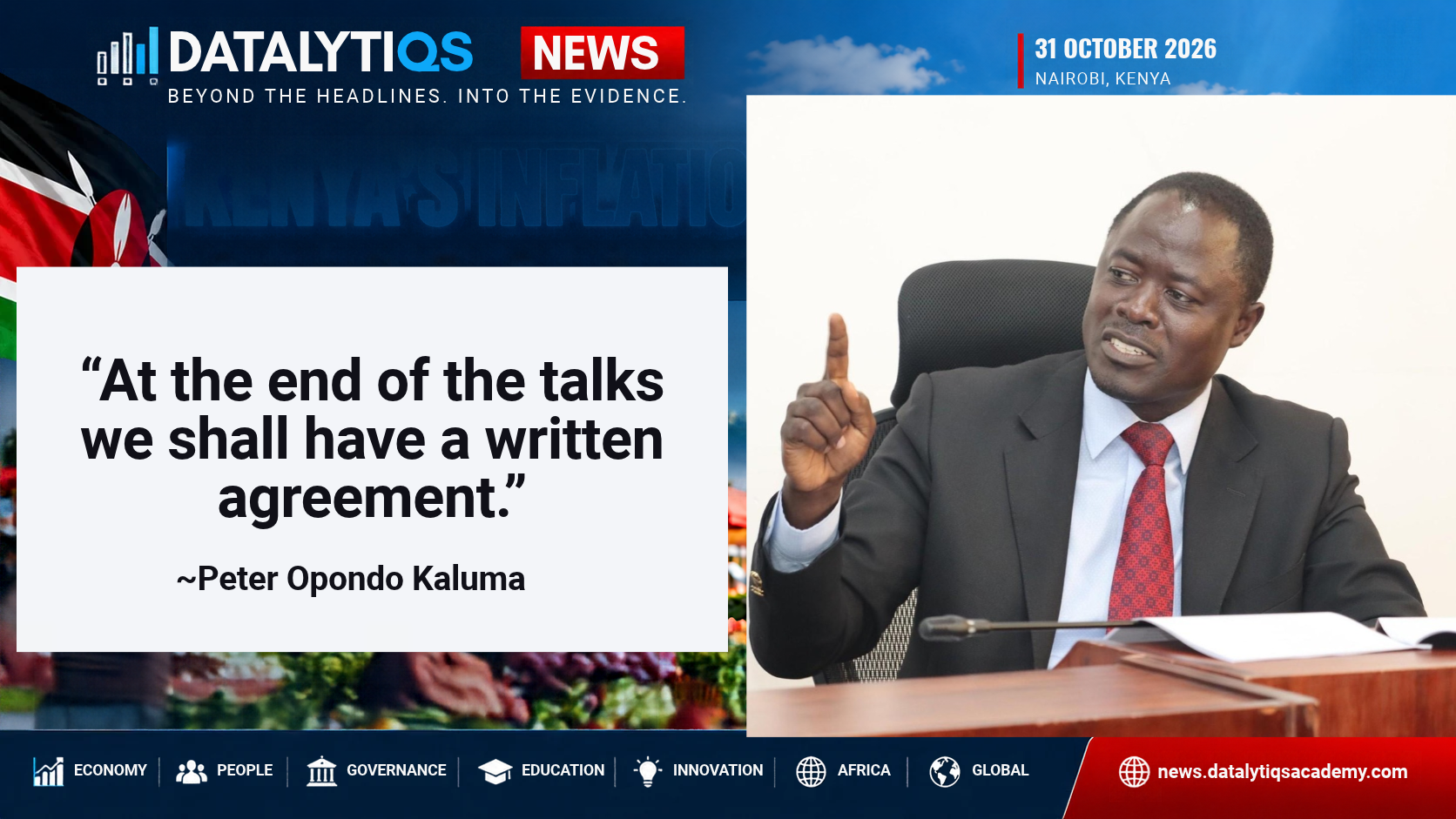
Homa Bay Town MP Peter Opondo Kaluma says negotiations between ODM and President William Ruto’s UDA are progressing towards a formal political agreement. But with senior ODM leaders divided over power sharing, political goodwill and constitutional guarantees, the critical question is what the proposed document will contain—and who will have the authority to approve it.
NAIROBI, KENYA — 31 October 2026
Homa Bay Town Member of Parliament Peter Opondo Kaluma has declared that ongoing negotiations between the Orange Democratic Movement (ODM) and President William Ruto’s United Democratic Alliance (UDA) are expected to culminate in a written agreement defining their future political cooperation.
Kaluma’s remarks, reported by The Star on October 29, come amid disagreements within ODM over whether the party should formally negotiate guarantees before committing its political support to President Ruto ahead of the 2027 General Election.
“We have set a negotiating committee, talks are progressing well between ODM and UDA, at the end of the talks we shall have a written agreement.”
The statement offers an important indication of the direction in which Kaluma expects the negotiations to proceed.
However, it does not establish that the parties have already agreed on the substantive terms, approved a final document or concluded a legally recognised coalition arrangement.
That distinction is central to understanding the unfolding political negotiations.
At stake are questions concerning power sharing, party autonomy, constitutional appointments, the implementation of existing political commitments and the accountability mechanisms that would govern any future partnership.
Kaluma Confirms Technical Negotiations
According to The Star, the negotiations are being undertaken through a joint broad-based committee involving representatives of ODM and UDA.
The committee is co-chaired by Carey Orege, representing ODM, and Emmanuel Nzai, representing UDA.
The newspaper reported that the committee had briefed representatives of the two parties on the progress of its work.
Kaluma said the resulting agreement would guide the parties’ relationship after the 2027 election.
In a separate report published by Daily Nation on October 29, he urged ODM members to allow the negotiating process to proceed before drawing conclusions about the proposed partnership.
His position is that the technical discussions should produce a document setting out the parties’ agreed commitments.
The immediate significance of his statement lies in the distinction between negotiations and ratification.
Technical teams may develop proposals, reconcile competing demands and recommend terms.
However, their work does not automatically constitute final approval by the political parties they represent.
The authority of the negotiating committee, its terms of reference and the procedures required to approve its recommendations are therefore essential elements of the process.
Why ODM Leaders Are Divided
The proposed written agreement has generated competing positions within ODM.
Some leaders argue that the party should secure formal commitments before supporting President Ruto’s re-election campaign.
Others maintain that the President has already demonstrated sufficient goodwill through government appointments, development projects and political cooperation.
Uriri MP Mark Nyamita has questioned the need to impose a written agreement as a precondition for continued cooperation.
He has cited government projects and appointments as evidence of goodwill towards regions traditionally associated with ODM.
Nyando MP Jared Okello has also questioned whether written political agreements necessarily provide reliable guarantees.
He has referred to previous political arrangements involving former Presidents Daniel arap Moi and Mwai Kibaki, arguing that written commitments can still become subjects of disagreement or non-compliance.
The opposing position has been articulated by politicians including Homa Bay Senator Moses Kajwang’, Alego Usonga MP Sam Atandi and Migori Woman Representative Fatuma Mohammed.
They argue that ODM should establish clear terms before making political commitments affecting its future.
Kajwang’ has called for risk management, citing the experience of earlier political partnerships.
Atandi has warned that entering negotiations without clearly documented commitments could create disagreements over the distribution of positions.
Fatuma Mohammed has similarly argued that ODM should pursue a formal arrangement rather than rely exclusively on informal political understandings.
These positions reflect different approaches to managing political uncertainty.
Neither the existence of a written agreement nor reliance on political goodwill can, by itself, guarantee future compliance.
The Proposed 50–50 Power-Sharing Arrangement
One of the most prominent issues in the negotiations is the proposed distribution of political positions.
Homa Bay Governor and ODM chairperson Gladys Wanga has publicly advocated a 50–50 power-sharing formula between ODM and UDA.
Under the proposal she described, UDA would provide the presidential candidate while ODM would receive the running-mate position.
She also proposed equal representation in Cabinet appointments.
Other senior ODM politicians have expressed support for substantial power-sharing guarantees.
However, these demands remain political proposals unless formally accepted by the negotiating parties.
The public reporting reviewed does not establish that UDA has agreed to the proposed formula.
It also does not establish that the parties have settled the distribution of all senior government positions.
The distinction matters because political demands are often presented during negotiations before a common position has been reached.
A final agreement would need to identify which proposals have been accepted, which remain unresolved and which are subject to constitutional requirements.
The Constitutional Limits of Power-Sharing Promises
Any agreement concerning senior government positions must operate within Kenya’s constitutional framework.
The Deputy President is elected together with the President under the procedures established by the Constitution.
A political party may negotiate the selection of a presidential running mate, but the resulting ticket must comply with electoral law.
Cabinet appointments are also governed by constitutional procedures.
The President nominates Cabinet Secretaries, whose appointment is subject to approval by the National Assembly.
A coalition agreement cannot remove these constitutional requirements.
Consequently, a promise to allocate a particular Cabinet position should not be presented as an unconditional legal guarantee of appointment.
The agreement would need to distinguish between political undertakings and decisions requiring approval by constitutionally established institutions.
This distinction is particularly relevant because the current Deputy President, Kithure Kindiki, has publicly expressed interest in retaining his position on a future presidential ticket.
The proposed ODM–UDA formula therefore raises questions that extend beyond the bilateral negotiations.
It could affect existing political relationships and the expectations of other political actors associated with the administration.
Oburu Oginga Asserts ODM’s Negotiating Authority
The debate has also drawn an intervention from ODM party leader Oburu Oginga.
In a statement dated October 29, Oburu warned individuals outside ODM against attempting to dictate the terms of the party’s negotiations with UDA.
He maintained that ODM possesses established institutions and experienced leadership capable of conducting negotiations in the party’s interests.
Oburu also emphasised that full implementation of the 10-point agenda agreed between President Ruto and Raila Odinga in March 2025 remains central to ODM’s engagement with UDA.
His statement is important because it reinforces the distinction between public political commentary and the formal authority of party institutions.
It should not automatically be interpreted as a definitive rejection of a written agreement.
Oburu’s central objection concerned external pressure over how the negotiations should be conducted and whether particular outcomes should be prescribed.
The party’s final position will depend on its formal decisions and the outcome of the negotiations.
What Is the Negotiating Committee Authorised to Do?
Kaluma’s statement places attention on the mandate of the joint technical committee.
Several questions require clarification.
Was the committee formally appointed by the governing institutions of both parties?
What issues fall within its terms of reference?
Can it negotiate the allocation of political positions, or is its mandate limited to preparing recommendations?
Does it have authority to propose binding commitments on policy, governance and electoral cooperation?
What procedures must be followed before its recommendations become official party decisions?
These questions are important because the existence of a negotiating committee does not establish that its recommendations are automatically binding.
A technical committee may prepare a draft agreement, but the participating parties must still satisfy their own constitutional and statutory requirements.
According to reporting by Citizen Digital, ODM’s Central Management Committee resolved in January 2026 to initiate structured pre-election coalition discussions, with a resulting framework expected to undergo ratification by the party’s National Delegates Convention.
The precise approval requirements applicable to any final agreement should be verified against ODM’s current constitution, official resolutions and applicable law.
Equivalent authorisation and approval requirements on the UDA side also warrant examination.
Ratification: The Difference Between Negotiation and Party Approval
Ratification is one of the most consequential stages of any formal political arrangement.
Negotiators may reach a common understanding, but party institutions must determine whether to adopt it.
For ODM, the process should establish whether the proposed agreement has been reviewed and approved by the organs authorised under its constitution.
The same principle applies to UDA.
Formal approval provides evidence that the agreement reflects an institutional decision rather than the personal position of individual politicians.
It can also clarify the responsibilities of party officials and the procedures for implementing agreed commitments.
Where ratification is required, the public should distinguish between a draft negotiated by representatives and an agreement approved by the parties.
A document announced before completion of the required procedures should not automatically be described as a concluded coalition agreement.
The Political Parties Act and Coalition Agreements
Kenya’s Political Parties Act provides a legal framework for political party coalitions.
The Office of the Registrar of Political Parties administers relevant statutory procedures concerning political parties and coalition arrangements.
A proposed ODM–UDA agreement would need to be assessed according to its actual legal form.
Political cooperation can take different forms, including informal collaboration, a formal coalition or another arrangement recognised under applicable law.
Not every political understanding automatically constitutes a registered coalition agreement.
Where parties intend to establish a formal coalition, the agreement must satisfy the relevant legal requirements.
Its provisions may address governance structures, decision-making procedures, dispute resolution and other matters required by law.
The exact registration and filing obligations depend on the nature of the arrangement and the applicable statutory provisions.
A written document may therefore have political significance without necessarily having the same legal status as a duly registered coalition agreement.
That distinction should be established before the public is told that a binding political partnership has been concluded.
What Should the Written Agreement Contain?
Kaluma’s assurance raises a more substantive question than whether the document will be signed.
What commitments will it contain?
A meaningful agreement should clearly establish the scope and duration of the proposed cooperation.
It should identify the responsibilities of the participating parties and the procedures for making joint decisions.
Where political positions are discussed, the agreement should distinguish negotiated expectations from appointments governed by constitutional procedures.
Where policy commitments are made, the parties should identify measurable actions and responsible institutions.
The agreement should also address the treatment of disagreements.
For example, what happens if one party alleges that the other has failed to honour a commitment?
Who has authority to interpret disputed provisions?
What internal process must be followed before the parties seek external dispute resolution?
Can the agreement be amended, and under what circumstances may either party withdraw?
These provisions would not eliminate political disagreements.
They would, however, establish a documented framework for managing them.
The 10-Point Agenda Remains a Separate Accountability Question
The negotiations are taking place against the background of the 10-point agenda agreed between President Ruto and Raila Odinga in March 2025.
The agenda addressed issues including governance, economic concerns, devolution and institutional reforms.
ODM leaders have continued to refer to its implementation as an important component of the political relationship.
Oburu has described its full implementation as non-negotiable.
This creates an important distinction between two sets of commitments.
The first concerns the implementation of an existing political understanding.
The second concerns possible future electoral and governing arrangements.
A new agreement should not be treated as evidence that earlier commitments have been fulfilled.
Implementation of the 10-point agenda should be evaluated through documented government actions, legislative measures, budgetary decisions and verifiable outcomes.
Where commitments remain outstanding, the parties should identify the relevant implementation responsibilities and timelines.
The Development Argument: Goodwill Versus Measurable Delivery
Politicians opposing additional conditions have cited government development projects as evidence of President Ruto’s goodwill.
Roads, markets, electricity connections and other public investments have featured prominently in these arguments.
However, development expenditure and political cooperation should be assessed separately.
Public projects are implemented through government institutions and funded through legally authorised processes.
Their performance should be evaluated through approved budgets, procurement records, expenditure, physical completion and actual public benefits.
A political coalition agreement, by contrast, defines commitments between participating political organisations.
The existence of a development project does not automatically establish that a future political agreement will be honoured.
Likewise, a signed agreement does not guarantee that public projects will be completed.
Both require transparent implementation and independent scrutiny.
DatalytIQs Political Intelligence Assessment
Kaluma’s statement provides a clear basis for monitoring the negotiations through institutional evidence rather than political declarations alone.
First, the existence of technical talks is now publicly acknowledged. The reported committee structure identifies individuals associated with the negotiating process, although its complete mandate requires documentary confirmation.
Second, a written agreement remains an anticipated outcome. Kaluma has expressed confidence that the talks will produce one, but the final terms and approval status have not been established.
Third, power-sharing proposals remain subject to negotiation. The 50–50 formula advanced by ODM leaders should not be confused with an accepted arrangement.
Fourth, ratification is essential to institutional legitimacy. The parties’ governing organs must exercise the authority assigned to them under their constitutions and applicable law.
Fifth, implementation mechanisms will determine how commitments are assessed. Clear responsibilities, measurable obligations and dispute-resolution procedures would provide a basis for evaluating compliance.
These issues establish a framework for public accountability without assuming that the negotiations will necessarily succeed or fail.
What Should Be Monitored Next?
The first development to monitor is the negotiating committee’s formal report.
That document would help establish which issues have been discussed, which proposals have been accepted and which remain unresolved.
The second is the publication of any proposed agreement.
Its provisions should be examined for legal status, political commitments, implementation responsibilities and dispute-resolution procedures.
The third is formal approval by the relevant party institutions.
Public resolutions, official minutes or other authenticated records would help establish whether the parties have adopted the proposed arrangement.
The fourth is compliance with applicable coalition-registration requirements.
Finally, any agreement should be evaluated against subsequent actions rather than treated as fulfilled merely because it has been signed.
Conclusion: Kaluma Has Promised a Document—The Terms Will Matter More
Peter Opondo Kaluma has publicly stated that ODM and UDA’s ongoing negotiations are expected to produce a written agreement governing their future relationship.
His remarks clarify the outcome he anticipates from the technical discussions.
They do not establish that the parties have concluded negotiations or agreed on every substantive issue.
The debate within ODM demonstrates that important questions remain concerning political goodwill, power sharing, institutional authority and the implementation of commitments.
For the public, the critical evidence will emerge from the committee’s recommendations, the text of any agreement, formal party approvals and subsequent implementation.
A political handshake signals cooperation. A written agreement records commitments. But accountability begins when those commitments can be independently verified.
As ODM and UDA continue their negotiations ahead of 2027, the central question is not merely whether they will sign a document, but whether its provisions will be lawful, transparent and capable of meaningful scrutiny.
DatalytIQs News — Beyond the Headlines. Into the Evidence.
Sources and References
- The Star — Oburu’s ODM split over written Ruto pact ahead of 2027, 29 October 2026.
- Daily Nation — Written pact or goodwill? Fresh split in ODM over Ruto 2027 deal, 29 October 2026.
- The Star — Oburu fires warning at outsiders meddling in ODM–UDA talks, 29 October 2026.
- Citizen Digital — Oburu shuts down calls for written ODM–UDA agreement, 30 October 2026.
- Office of the Registrar of Political Parties — Political party and coalition registration framework.
- Kenya Law — Constitution of Kenya, Political Parties Act and relevant electoral legislation.